Martine Bedin
Martine Bedin, The Joy of Bold Living
Artist Spotlight · The Collection Editorial
There is a moment in the history of design when the rules simply broke open, and color, humor, and irreverence came rushing in. That moment has a name: Memphis. And among the constellation of designers who gathered around Ettore Sottsass in Milan in the early 1980s, Martine Bedin shone with a particular brightness. Her work was not merely decorative rebellion.
Martine Bedin
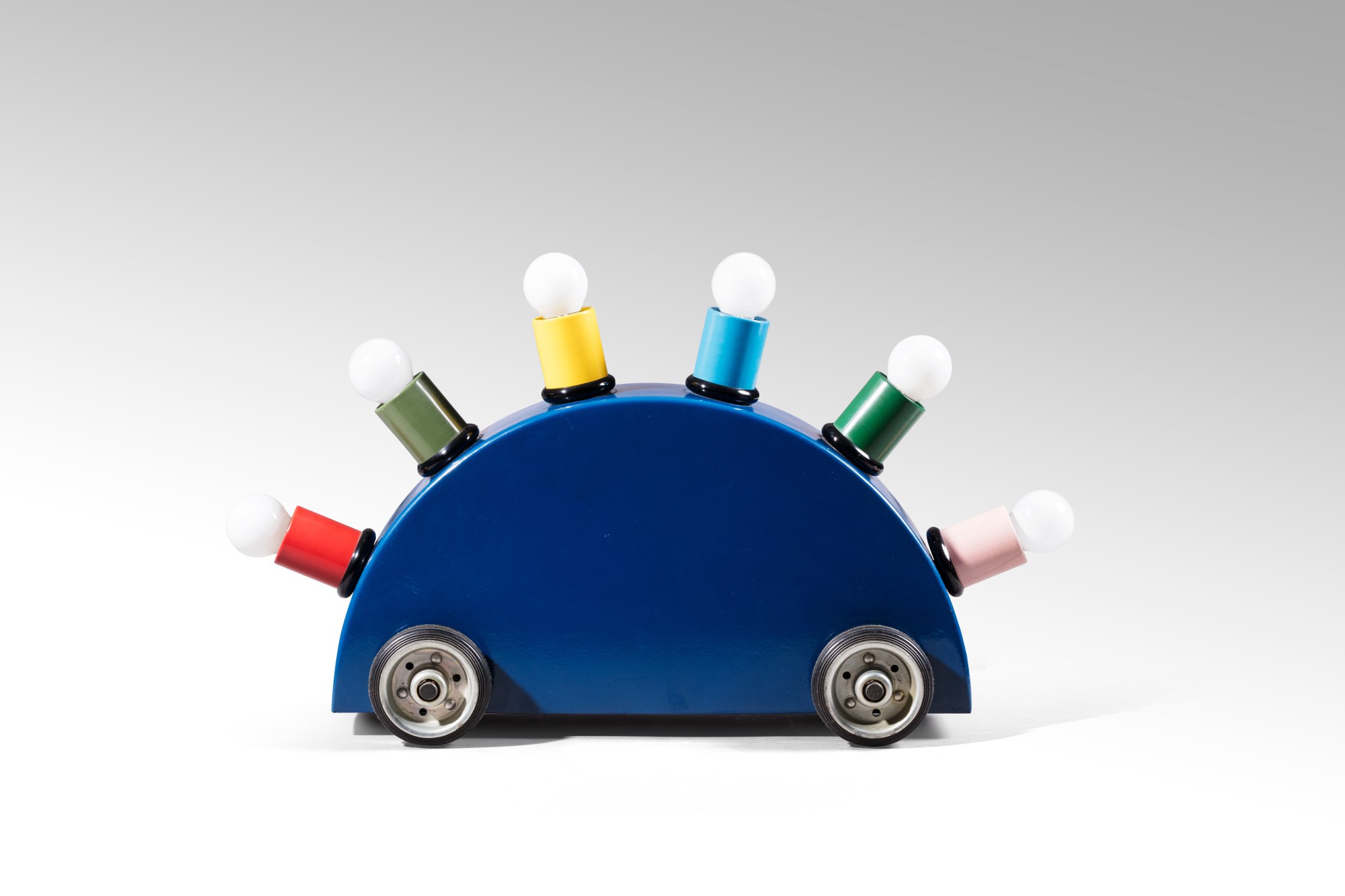
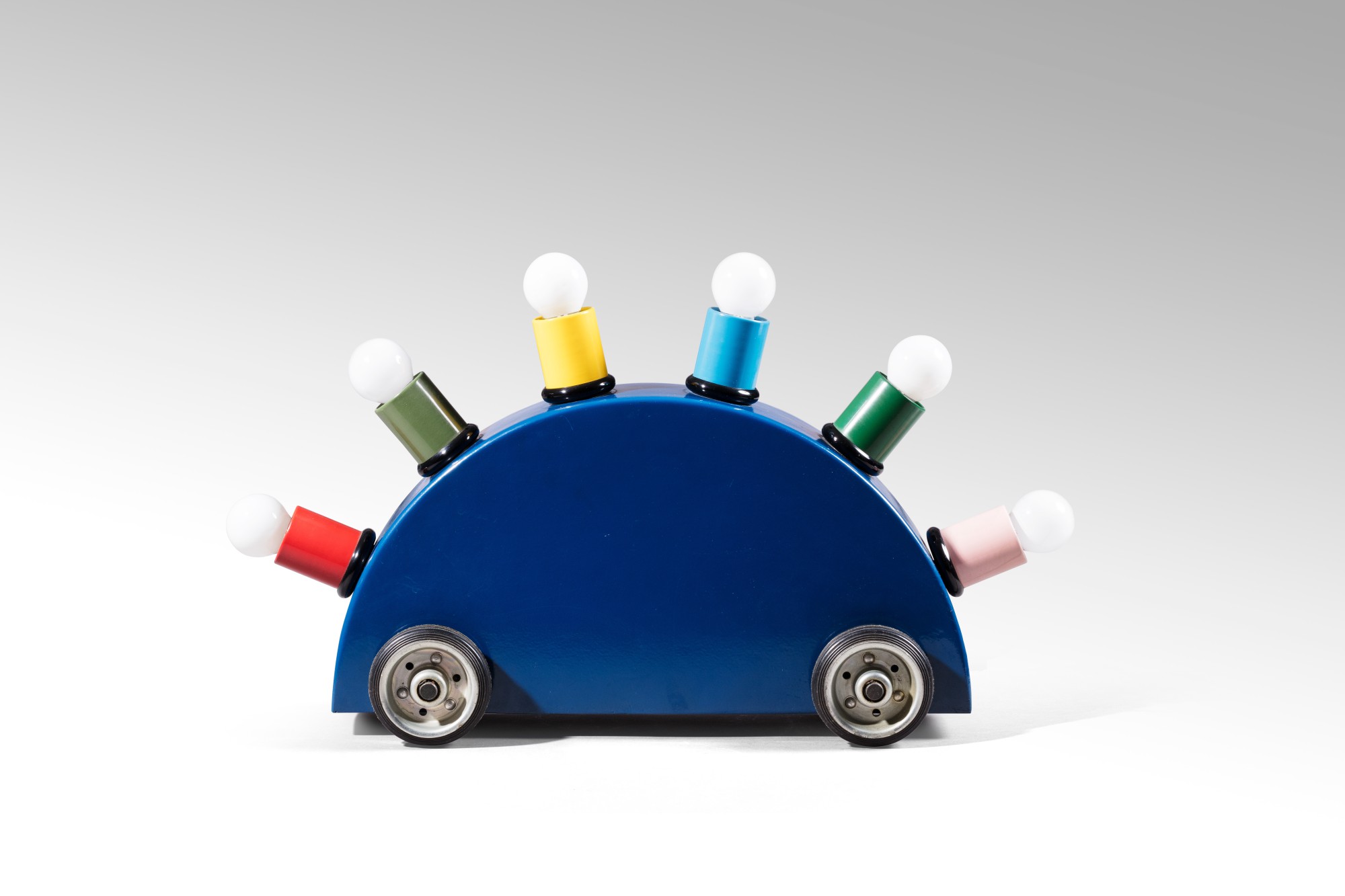
Super lamp, designed in 1981
It was a fully formed argument for the idea that designed objects could be joyful, strange, and profoundly human all at once. Decades on, museums from the Vitra Design Museum in Weil am Rhein to the Centre Georges Pompidou in Paris have revisited this period with renewed seriousness, and Bedin's contributions stand as some of its most enduring. Bedin was born in Bordeaux, France, in 1957, which makes her one of the few French voices at the heart of what became an Italian phenomenon. She studied architecture in Paris before moving to Florence, where she enrolled at the Scuola Superiore di Disegno and later worked alongside Superstudio, the radical Italian collective that had already rewritten the grammar of spatial thinking in the late 1960s and early 1970s.
Florence in that period was electric with architectural theory, and Bedin absorbed its intellectual rigor while quietly developing an instinct for the playful that would define her mature work. She then spent formative time in Japan, a country whose layering of the traditional and the ultra modern left visible traces in her sensibility. Her path to Memphis began in the late 1970s when she came into Ettore Sottsass's orbit in Milan. Sottsass, the visionary Olivetti designer turned design philosopher, was assembling a group of young architects and designers who were frustrated with the austerity of late modernism.
In December 1980, at Sottsass's apartment, the founding meeting of what would become the Memphis Group took place. Bedin was among those present at the beginning. When the group made its astonishing debut at the Salone del Mobile in September 1981, the international press reacted with a mixture of bewilderment and delight. Here were objects that used plastic laminate like a luxury material, that stacked geometric forms with cartoon confidence, and that treated domestic space as a stage for personality.
Bedin was fully fluent in this language from the start. The work that crystallized her vision most perfectly is the Super lamp, designed in 1981. The Super is a low wheeled trolley lamp whose form suggests a small locomotive or a cheerful vehicle from an illustrated children's book. Six colored bulbs ring a central body mounted on rubber wheels, giving the object an unmistakable sense of readiness, as if it might simply roll away on its own errand.
The Super is both fully functional and almost defiantly absurd. It refuses the pretense that a lamp must justify its existence through sobriety. The use of wheels, an element that belongs to transport rather than to interior objects, gives the piece an almost philosophical dimension: why should domestic objects be fixed in place? Why should they not suggest movement, possibility, departure?
Collectors who own a Super often describe it as the piece in their home that generates the most conversation, and that quality of social activation is itself a marker of great design. Beyond the Super, Bedin contributed furniture and objects to several Memphis collections through the early and middle years of the 1980s, and she continued to work independently as both a designer and an architect after the group's formal activities wound down. Her practice has always maintained the Memphis conviction that the boundary between architecture and object design is permeable, and her interior projects carry the same chromatic confidence as her furniture. She has taught and lectured across Europe, and her theoretical contributions to postmodern design thinking deserve wider recognition than they have sometimes received in histories that focus on Sottsass and a small circle of male colleagues.
For collectors, Bedin's work represents one of the most compelling entry points into the Memphis canon. Original Memphis pieces from the 1981 debut collection have appeared at major auction houses including Christie's and Sotheby's over the past decade, and prices for landmark objects have risen steadily as institutions and private collectors have come to understand how genuinely rare and historically significant these works are. The Super lamp, in particular, is among the most recognizable objects from the entire Memphis project, and examples in good condition with documented provenance command serious attention. Collectors drawn to postmodern design often find that Bedin's work sits beautifully alongside pieces by Michele De Lucchi, George Sowden, and Nathalie Du Pasquier, all fellow Memphis contributors whose profiles have grown considerably in the contemporary market.
Within the broader arc of art and design history, Bedin belongs to a generation of practitioners who understood that postmodernism was not simply irony or pastiche but could be a genuine and warm blooded humanism. Her work speaks across to figures like Alessandro Mendini, whose Proust Chair proposed that ornament was a form of memory, and to the radical French designers of the same period who were questioning the inherited certainties of the Bauhaus tradition. She is a designer who treats the people who live with her objects as co conspirators in a kind of ongoing celebration of the material world. That generosity of spirit is legible in everything she has made.
Today, as the museum world and the collecting community continue to excavate the full complexity of the 1980s, Bedin's place in that story looks more significant with each passing year. The reductive reading of Memphis as a fashionable blip has given way to a much richer understanding of the group as a genuine cultural rupture, one that created space for later generations of designers to take risks, embrace contradiction, and refuse the tyranny of good taste. Martine Bedin was present at the creation of that rupture. Her Super lamp, those wheels, those colored bulbs, that irresistible suggestion of motion, remains one of the clearest symbols of a moment when design remembered that it could make people smile.