Martin Puryear
Martin Puryear, Shaping Wonder From Wood
Artist Spotlight · The Collection Editorial
“I want the work to be able to stand on its own, to communicate without my having to explain it.”
Martin Puryear, interview with Neal Benezra, 2007
When the Museum of Modern Art mounted its landmark retrospective of Martin Puryear's work in 2007, bringing together four decades of sculpture, drawings, and prints under one roof, it confirmed what a devoted community of collectors and curators had long understood: here was one of the most singular artistic voices America had produced. The exhibition traveled to the Modern Art Museum of Fort Worth and the San Francisco Museum of Modern Art, drawing audiences who came in quiet and left changed. The experience of moving through Puryear's world, of encountering forms that feel at once ancient and entirely of the present, is among the genuinely transformative encounters contemporary art can offer. Puryear was born in Washington, D.
Martin Puryear
Martin Puryear
C., in 1941, the eldest of seven children in a family that valued both intellectual rigor and handcraft. His father was a postal worker and amateur woodworker, and from him Puryear absorbed an early reverence for material, for the weight and grain and possibility of wood. He studied at the Catholic University of America, where he earned a Bachelor of Arts in 1963, and then made a decision that would fundamentally alter the course of his practice: he joined the Peace Corps and spent two years in Sierra Leone, teaching biology and English while apprenticing himself to local craftspeople who worked in traditional West African building and carving techniques.
That experience, of learning to make things slowly, with attention and without ego, never left him. From Sierra Leone, Puryear traveled to Stockholm, where he studied printmaking at the Swedish Royal Academy of Arts from 1966 to 1968. The influence of Scandinavian design sensibility, its commitment to economy of form and honesty of material, became another current running beneath his sculpture. He then returned to the United States to complete a Master of Fine Arts at Yale University in 1971, where he encountered the rigorous intellectual atmosphere of postminimalism while holding fast to the handmade and the poetic.
Martin Puryear
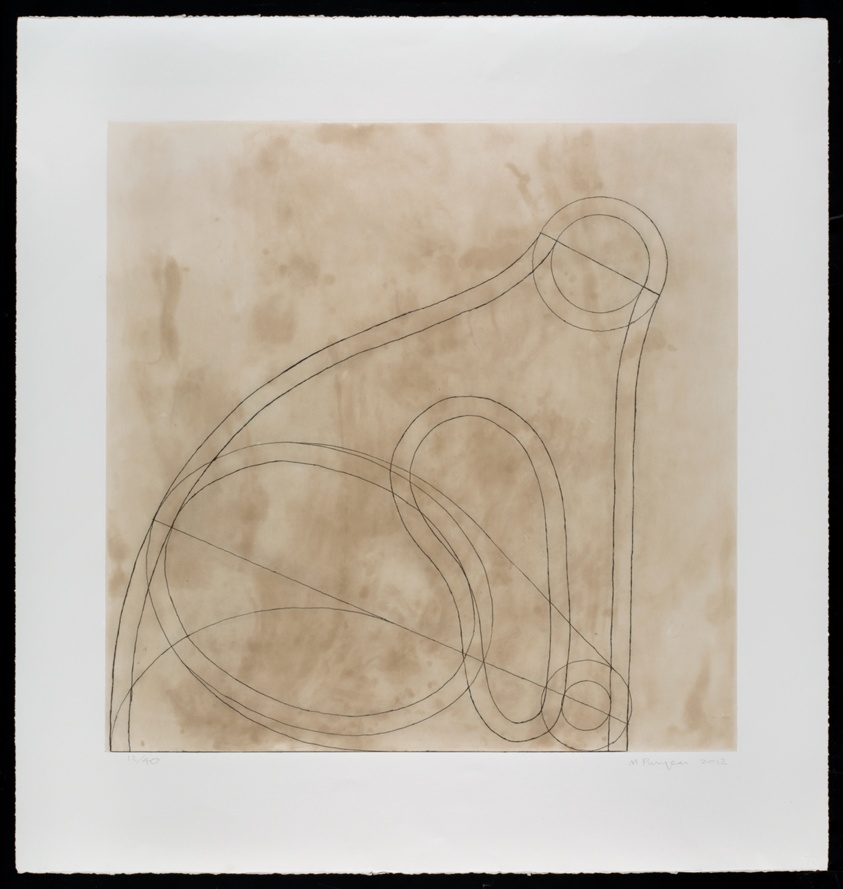
Untitled VI, 2012
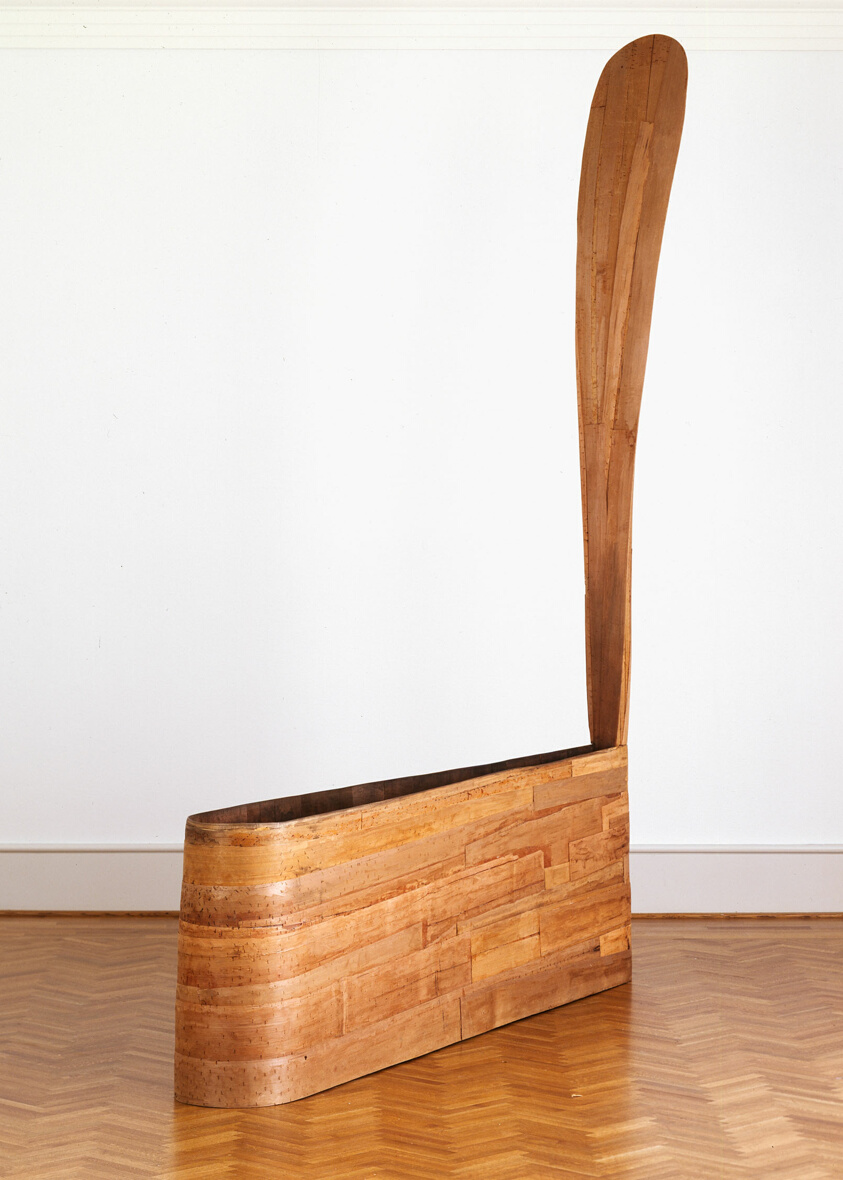
The tension between those two poles, the conceptual and the visceral, the abstract and the deeply human, became the generative engine of everything that followed. Puryear's mature work resists easy categorization, which is precisely part of its power. His large wooden sculptures breathe. They suggest bodies, vessels, traps, shelters, and tools without ever fully committing to any one identity.
“I am interested in the notion of craft as a way of knowing the world, of understanding through making.”
Martin Puryear, MoMA retrospective catalogue, 2007
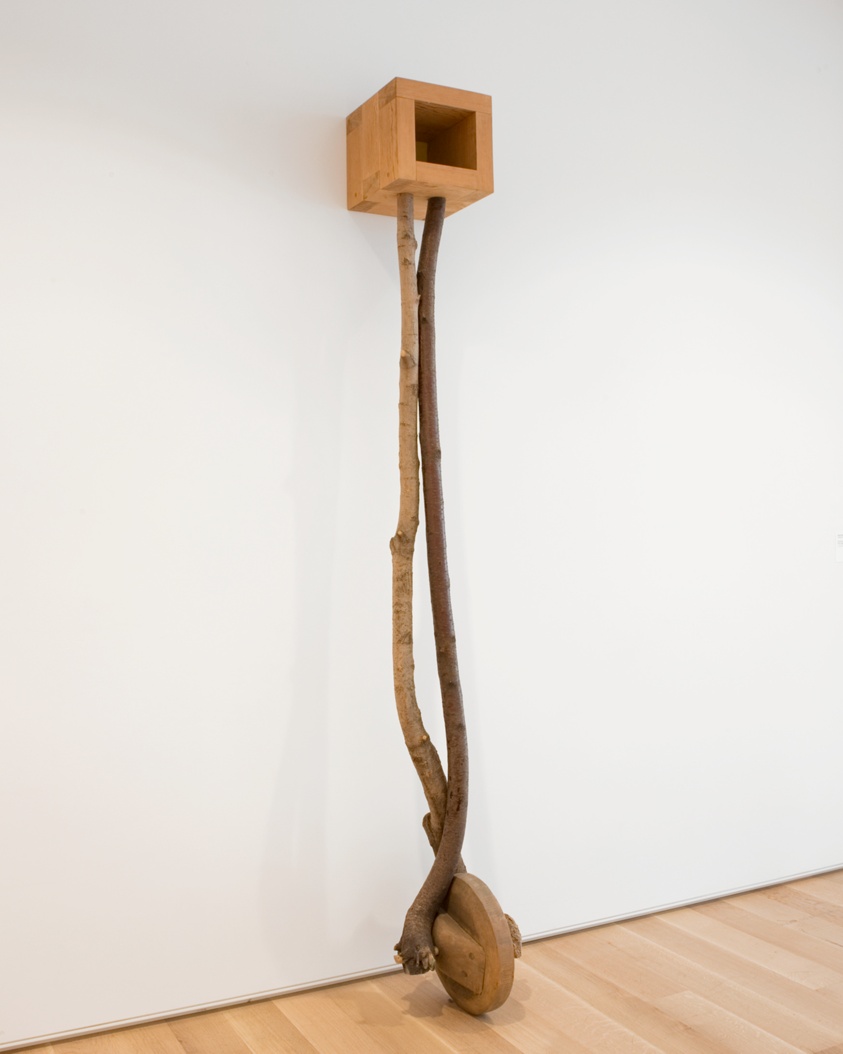
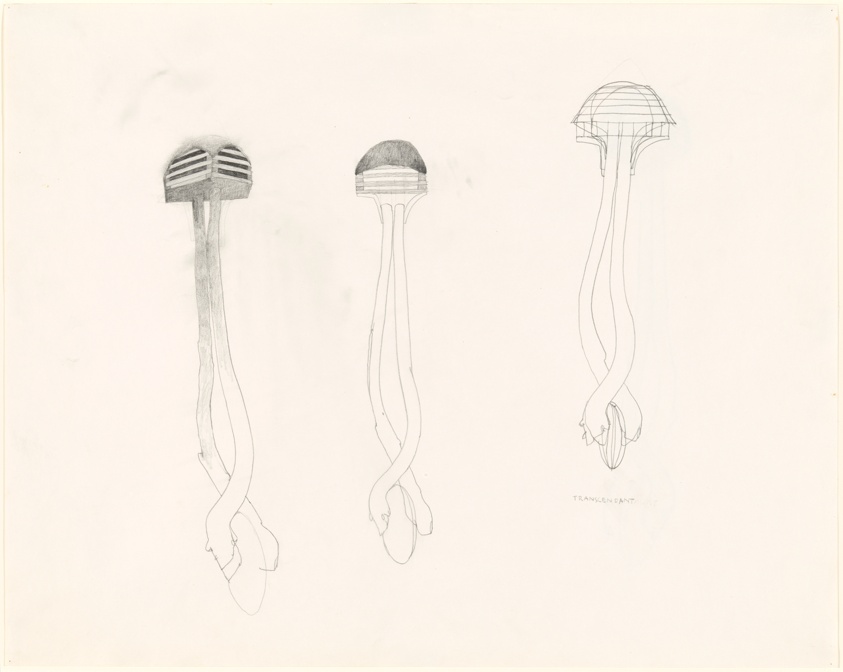
Sanctuary, made in 1982 from pine, maple, and cherry, is among his most beloved early works. A curved, enclosed form that reads simultaneously as a nest, a dwelling, and a cage, it distills everything essential about his method: the patient joinery, the dialogue between inside and outside, the way a simple shape can carry enormous psychological freight. The drawing for Sanctuary, made in graphite in 1977 and held in The Collection as Untitled, Drawing for Sanctuary, reveals how long Puryear lived with an idea before committing it to three dimensions, and how fully formed his vision was even on paper. Lever No.
Martin Puryear
Sanctuary, 1982
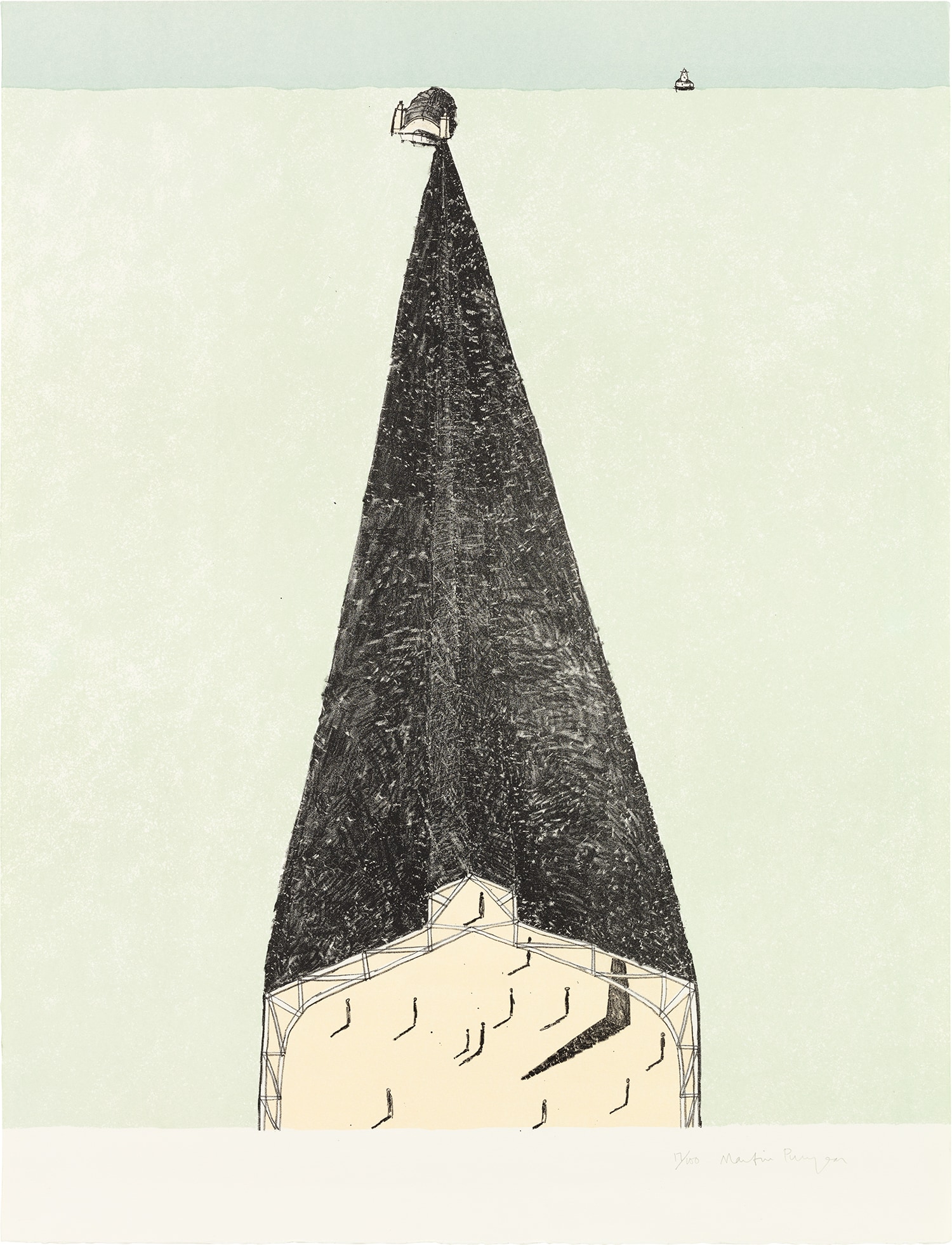
1, made in 1988 from red cedar, cypress, poplar, and ash, extends this vocabulary into something more architectural and assertive. A long, tapering form that rests against the wall and extends across the floor, it plays with weight, balance, and the implied force of a simple machine. The work was included in the Carnegie International in 1988, where it announced Puryear as a major figure in international contemporary sculpture. Black Cart from 2008, rendered as a color aquatint and etching, and the various intaglio works including Shoulders and the Untitled series demonstrate that his printmaking practice is not secondary to his sculpture but a full parallel inquiry, exploring many of the same biomorphic and structural concerns through the specific resistances and pleasures of the etching plate and the lithography stone.
For collectors, Puryear represents something increasingly rare: an artist whose work holds together across every medium and scale, from intimate works on paper to monumental outdoor installations. His prints, particularly the chine collé etchings and drypoints produced with skill and care, offer an accessible entry point into a practice that at its largest scale commands significant institutional resources. Works like Untitled VI from 2012 and Shoulders (State 2) from 2005 reward close looking, their delicate surfaces carrying the same quality of attention that defines his sculpture. At auction, Puryear's works on paper and sculpture have maintained steady collector interest, with institutions including the Art Institute of Chicago, the Hirshhorn Museum, and the National Gallery of Art holding significant examples.
Martin Puryear
Untitled, Drawing for Sanctuary (recto and verso), 1977
Private collectors who follow the work of artists such as Ursula von Rydingsvard, Richard Serra, and Louise Bourgeois, whose practices share something of Puryear's commitment to material and formal investigation, often find his work a natural and deeply satisfying complement. Puryear belongs to a lineage that connects Constantin Brancusi's distillation of form to the American craft tradition, and his work exists in productive conversation with artists like Isamu Noguchi, who similarly moved between cultures and materials to arrive at a universal formal language. Yet Puryear is entirely himself. His biography, shaped by Africa, Scandinavia, Yale, and decades of studio solitude in upstate New York, produced a practice that reflects no single tradition and honors all of them.
In 2019, the United States selected Puryear to represent the country at the Venice Biennale, where his installation, a vast and compelling meditation on freedom and constraint, received wide critical acclaim and brought renewed international attention to a body of work that had always deserved it. What endures about Martin Puryear is the quality of his thinking made physical. To own a work by Puryear is to live with evidence that patience and care and genuine curiosity about the world can produce objects of lasting beauty. His sculptures and prints do not explain themselves or demand particular knowledge.
They simply ask to be present with, and they give back more with each encounter. For collectors who value depth over spectacle and resonance over novelty, there is no more rewarding American artist working today.
Explore books about Martin Puryear
Martin Puryear
Rosalind E. Krauss
Martin Puryear: A Retrospective
Paul Stephanie
Martin Puryear: Wood
Margo Machida
Martin Puryear: Multiple Dimensions
Catherine Morris
Martin Puryear: Heaven
Okwui Enwezor