Martin Lewis
Martin Lewis and the Glittering Night
Artist Spotlight · The Collection Editorial
There is a particular quality of light that belongs to New York City after rain, when the pavement becomes a mirror and the city seems to double itself in reflection. No artist understood this phenomenon more intimately than Martin Lewis, the Australian born printmaker whose etchings and drypoints of metropolitan life in the 1920s and 1930s remain among the most quietly ravishing images ever made of urban America. Interest in Lewis has grown steadily in recent decades, with institutions including the Whitney Museum of American Art and the Smithsonian American Art Museum holding significant works by his hand, and the art market consistently rewarding collectors who recognised his genius early. His prints appear regularly at major auction houses, where strong results confirm what connoisseurs have long understood: Lewis produced a body of work of extraordinary and enduring power.
Martin Lewis
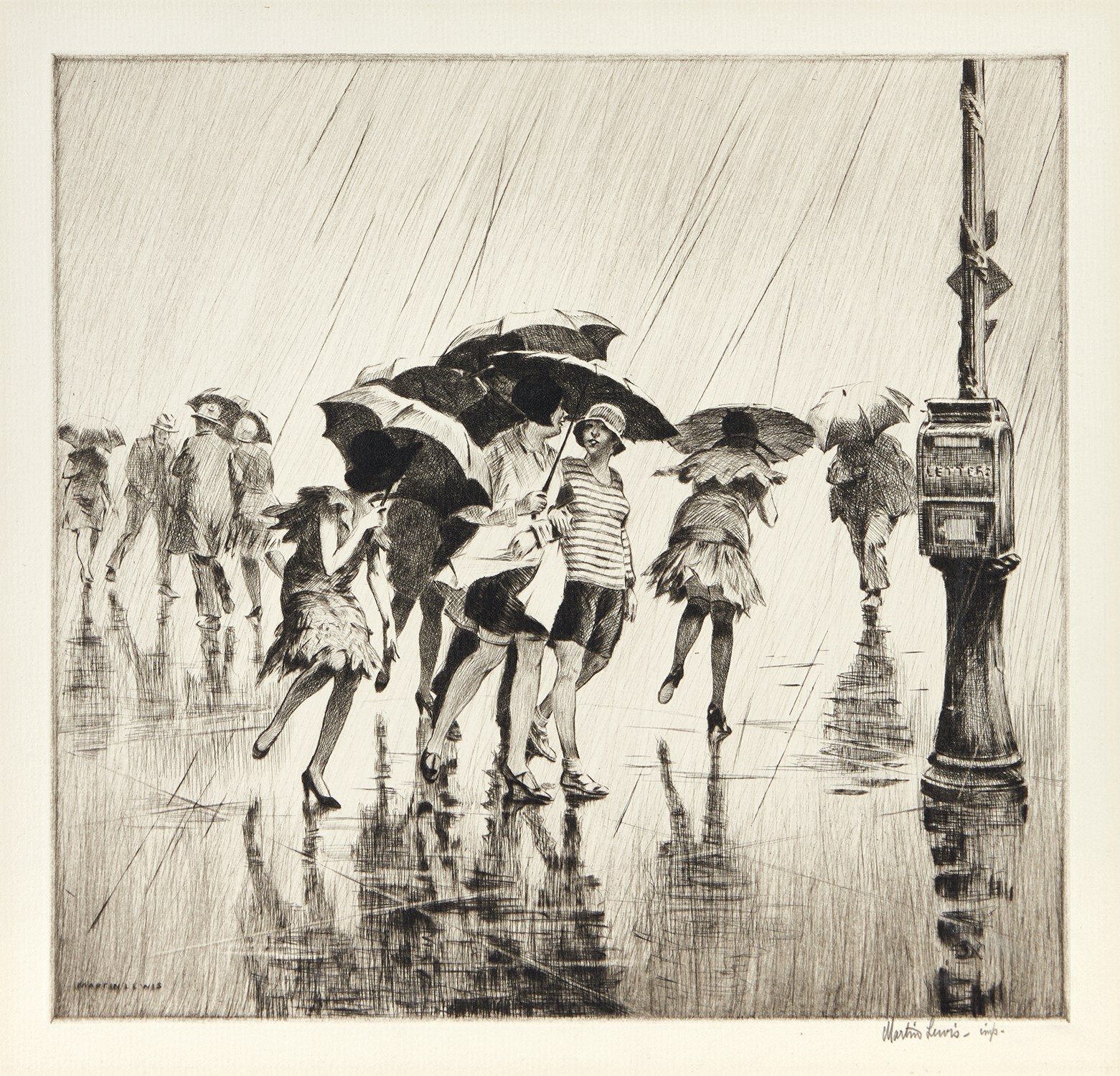
Wet Saturday (M. 81)
Martin Lewis was born in Castlemaine, Victoria, Australia in 1881, a gold rush town whose particular mixture of transience and ambition may have shaped his lifelong fascination with people caught in the act of passing through. He left Australia as a young man and spent formative years travelling through Asia and eventually arriving in the United States, where he settled permanently in New York City. The city seized him completely. Its crowds, its theatres of light and shadow, its anonymous choreography of strangers became the subject he would spend a lifetime exploring with a printmaker's needle and an observer's patient eye.
Lewis came to printmaking through commercial work, spending years as an illustrator and developing the technical discipline that would serve him throughout his career. It was a rigorous foundation, one that taught him economy of line and the value of contrast. By the early 1920s he had committed himself fully to fine art printmaking, working in etching and drypoint with a virtuosity that set him apart from contemporaries. Drypoint, a technique in which the artist scratches directly into the metal plate with a sharp instrument, rewards only the most confident hand, as lines cannot easily be corrected.
Martin Lewis
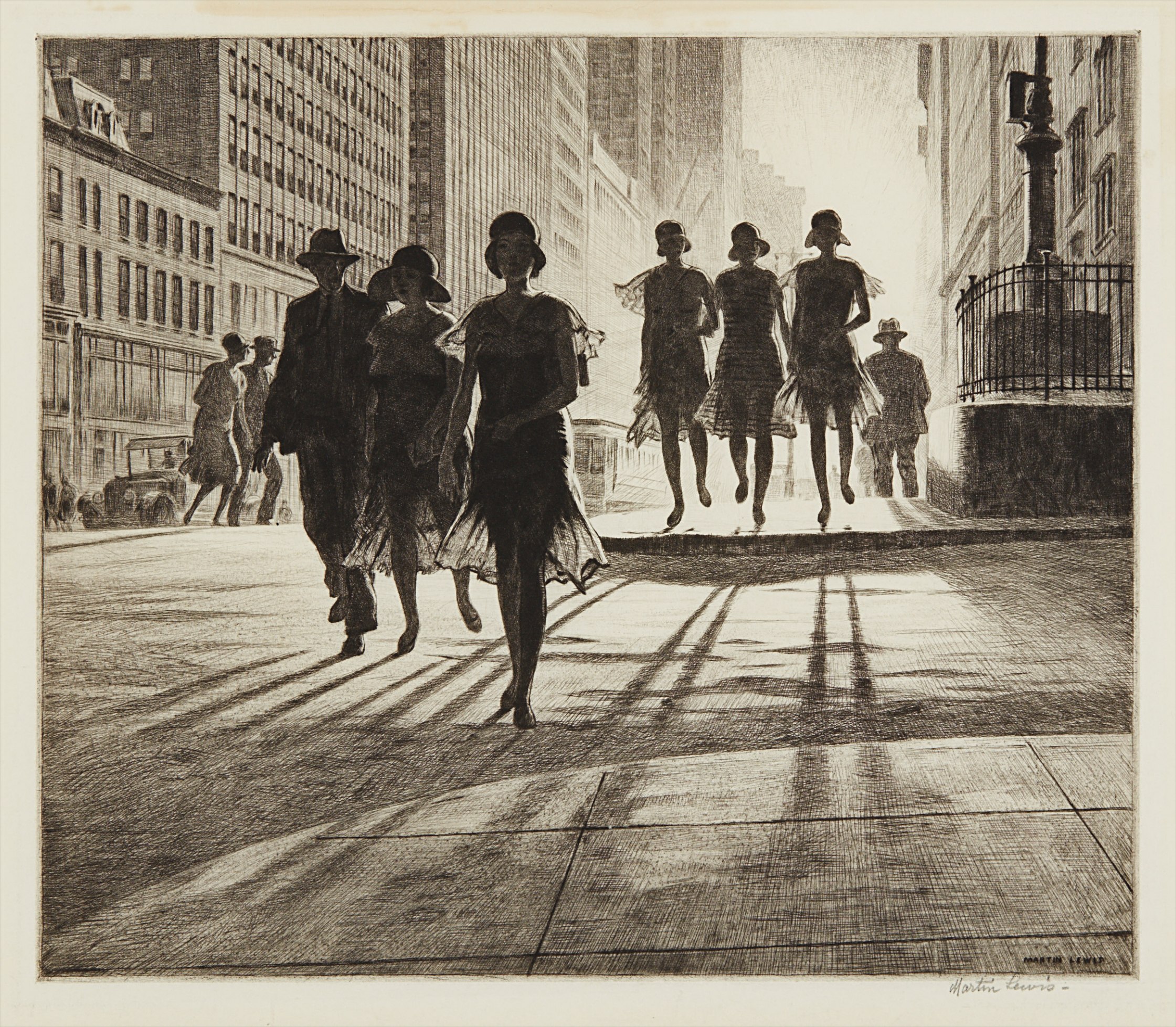
Shadow Dance
Lewis used it to conjure textures of extraordinary richness, the burr of the drypoint line holding ink in ways that gave his shadows a velvety depth unlike anything achievable through etching alone. The friendship between Lewis and Edward Hopper is one of the great creative relationships in American art history, and it deserves to be understood in its full complexity. Lewis was the more technically accomplished printmaker of the two, and he is widely credited with teaching Hopper the fundamentals of etching. The two men were close during the 1920s, and scholars have noted the visual dialogue between their respective bodies of work, both drawn to solitude, to the drama of light against darkness, to figures absorbed in private worlds within the shared space of the modern city.
To see Lewis clearly is to see one of the animating spirits behind an entire tradition of American urban realism. Among Lewis's most celebrated works, Shadow Dance of 1930 stands as a defining achievement. The print depicts two figures on a fire escape, their shadows thrown across the brick facade of a building in patterns of extraordinary geometric complexity. It is an image of the city as theatre, of architecture transformed by light into something almost abstract, while remaining fiercely grounded in observed reality.
Martin Lewis
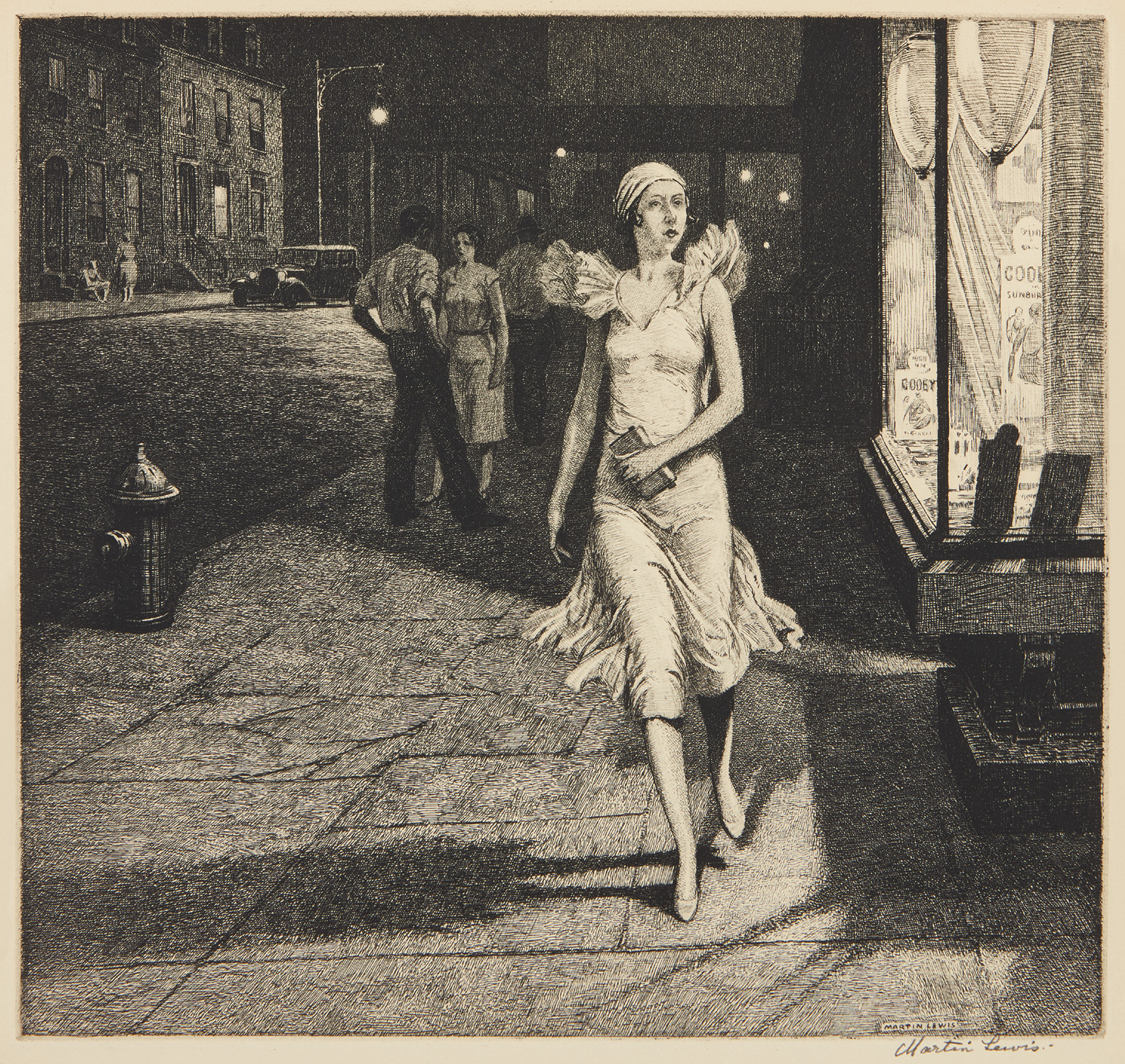
Night in New York
Wet Saturday, one of the finest prints of his career, captures a rain slicked street with figures moving through it, each surface alive with reflection. The title is perfect in its plainness, and the image delivers everything that title promises and then far more. Night in New York and Chance Meeting share this quality of the captured instant, the sense that Lewis positioned himself at some precise corner of time and place and waited for life to arrange itself into meaning. For collectors, Lewis presents a compelling combination of historical significance and visual pleasure.
His prints were produced in relatively small editions and exist in a range of states, meaning that serious collectors can engage with the technical evolution of individual images across different printings. The quality of impression matters enormously with Lewis, as the drypoint burr wears with each printing, and early impressions carry a richness of tone that later ones cannot replicate. Works on laid paper, as with Wet Saturday, offer one kind of surface quality, while those on wove paper present the image differently, and experienced collectors learn to appreciate these distinctions as part of what makes print collecting such an intimate and intellectually rewarding pursuit. Prices for Lewis have risen meaningfully over the past two decades as his reputation has been reassessed and his influence on American art history has been more fully acknowledged.
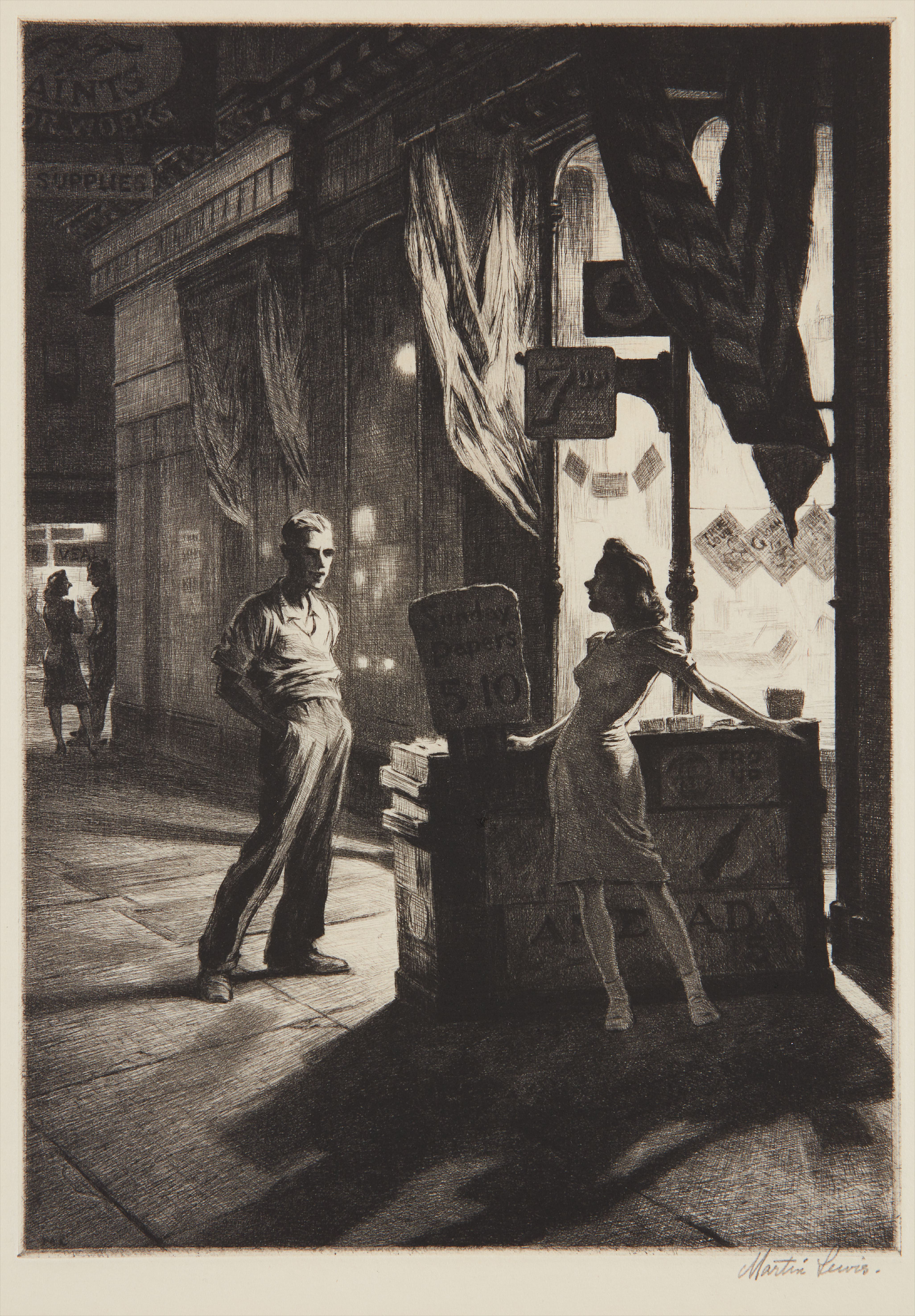
Martin Lewis
Chance Meeting
In terms of context and companionship within art history, Lewis occupies a fascinating position between several traditions. He shares with the American Scene painters a commitment to the vernacular beauty of everyday urban life, and his work belongs alongside that of John Sloan and the Ashcan School in its democratic attention to ordinary people and ordinary moments. At the same time, his handling of nocturnal light connects him to a broader international tradition of urban romanticism that includes Whistler, whose influence on American printmaking was pervasive and whose own atmospheric etchings Lewis clearly absorbed. The Regionalist movement claimed Lewis in part, though his New York was never merely local in its appeal.
It was and remains universal, a vision of city life that speaks to anyone who has ever walked through a lit street at night and felt both solitary and strangely alive. Martin Lewis died in New York in 1962, having spent the last decades of his life in relative obscurity, a fate that has since been corrected by sustained critical attention and the enthusiasm of collectors and curators who recognised what had been overlooked. His rehabilitation is one of the more satisfying stories in the history of American art, a reminder that the market and the museum do not always move together, and that patient appreciation sometimes precedes official recognition by many years. Today, to own a Lewis print is to hold a precise and luminous fragment of a city and an era, made by a man who loved both with a depth that only the best artists are capable of feeling.
His work rewards every encounter, giving back more with each return visit, which is finally the only test of art that matters.
Explore books about Martin Lewis