Mark Tobey
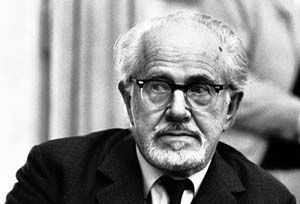
Mark Tobey: Light, Motion, and Infinite Space
Artist Spotlight · The Collection Editorial
“I am trying to paint the fourth dimension, time and space together.”
Mark Tobey
In the winter of 2023, the Fondation Beyeler in Basel staged a sweeping survey of postwar American abstraction that placed Mark Tobey in exactly the company he deserves, alongside peers who reshaped the visual language of the twentieth century. Tobey's shimmering webs of calligraphic mark making stopped visitors in their tracks, a reminder that this quietly revolutionary artist from the American Midwest anticipated many of the ideas that would define Abstract Expressionism and beyond. For those who know his work intimately, the response is always the same: wonder, followed by a deep desire to look longer. His paintings do not give themselves up quickly, and that is precisely their power.
Mark Tobey
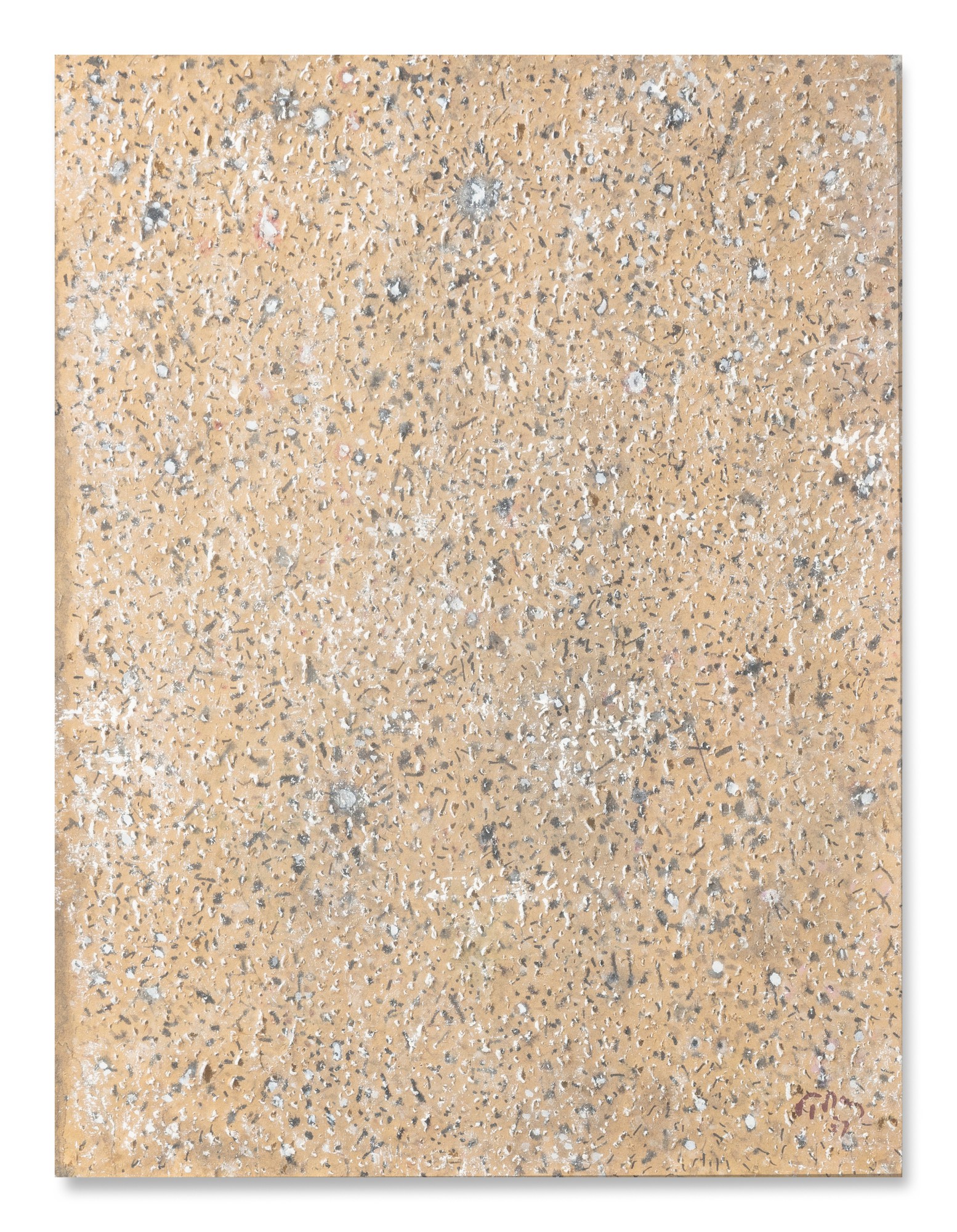
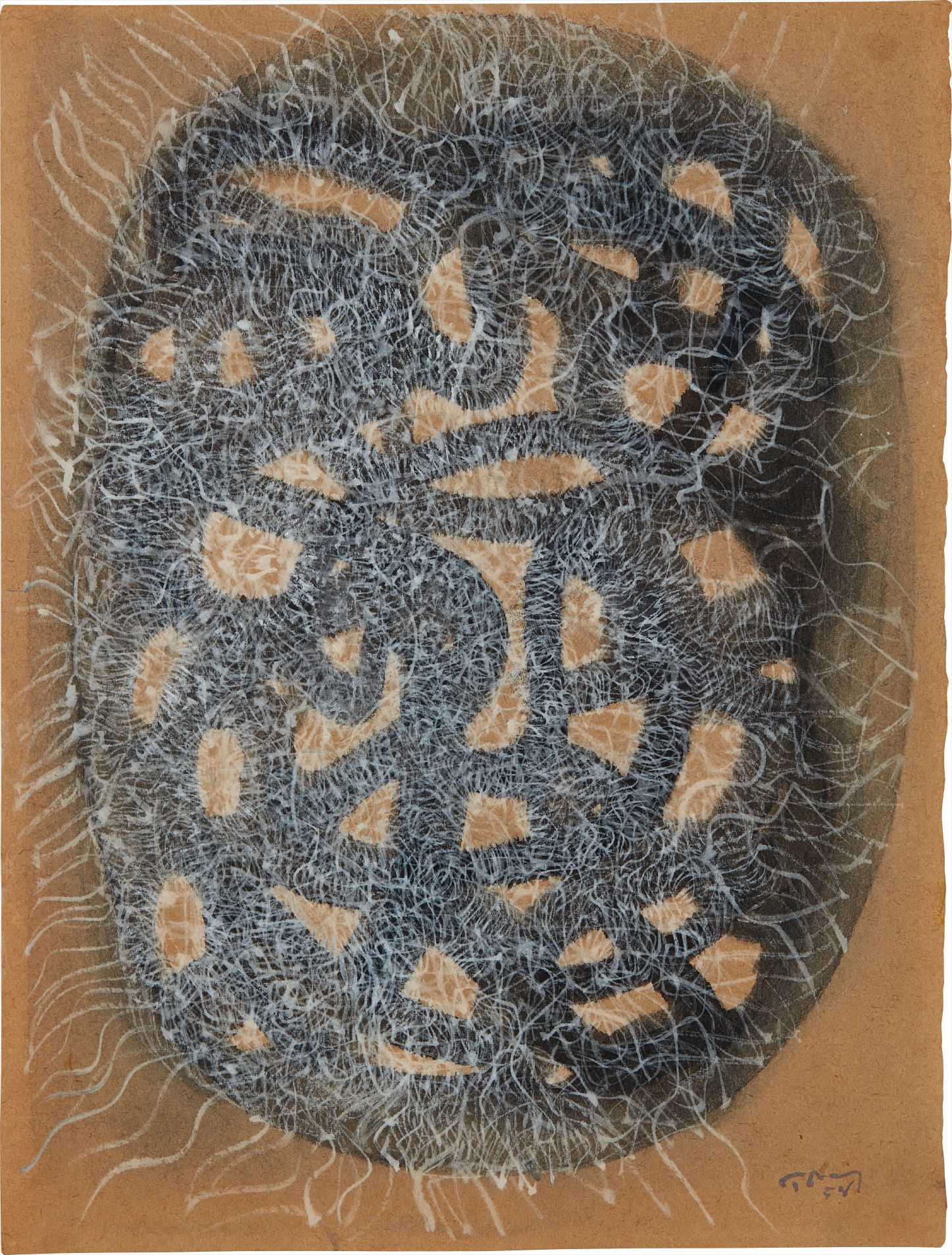
Sans Titre, 1957
Mark Tobey was born in 1890 in Centerville, Wisconsin, and grew up in a country that was still finding its cultural footing. He showed an early aptitude for drawing and moved to Chicago and then New York as a young man, supporting himself as a fashion illustrator while absorbing everything the early modernist world had to offer. It was a practical education in line, form, and the economy of visual communication, and traces of that training would surface throughout his career in the elegance and precision of his mark making. His conversion to the Bahai faith in 1918 proved transformative, introducing him to a philosophy of unity across cultures and spiritual traditions that would animate every canvas he produced for the rest of his life.
The great turning point in Tobey's artistic development came through his friendship with the Chinese artist Teng Baiye, who introduced him to Chinese brush calligraphy in the 1920s. Tobey spent time studying this tradition with genuine seriousness, and the encounter fundamentally altered his understanding of what a mark could mean and do. A residency at Dartington Hall in Devon, England, in the 1930s deepened his engagement with Eastern philosophy and aesthetics, and a journey to China and Japan in 1934 allowed him to study Zen brush painting firsthand. Out of this extraordinary synthesis of Western modernism, Bahai spirituality, and East Asian calligraphic tradition, Tobey developed what he would come to call white writing, a technique of layering luminous, interlocking strokes of white paint across a darker ground to create a field of vibrant, pulsating energy.
Mark Tobey
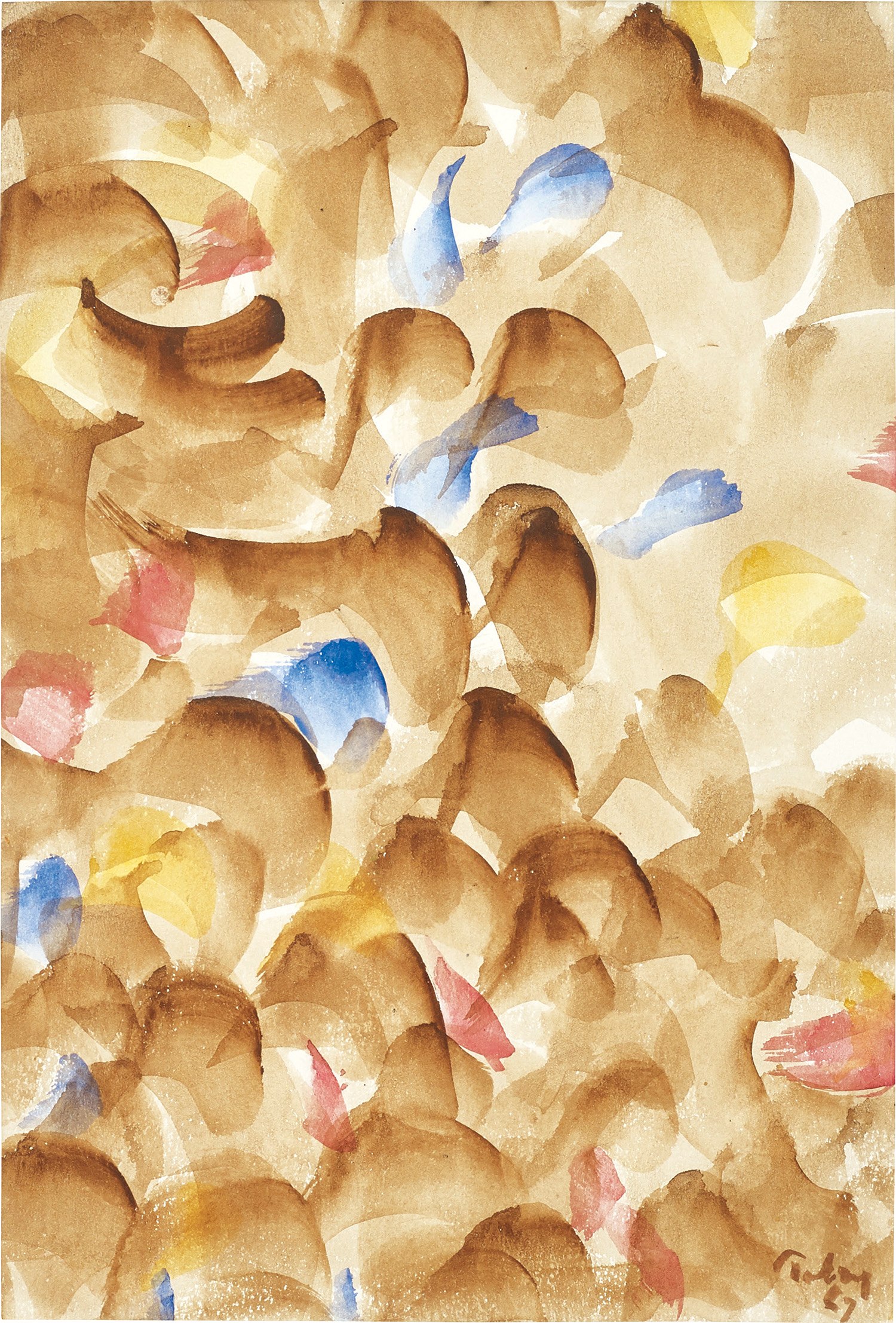
Composition with Blue and Red, 1967
The white writing works stand as some of the most original paintings produced in America during the mid twentieth century. "White Writing" from 1959, a gouache on buff paper held among the works on The Collection, exemplifies what made this approach so radical: the surface becomes a field of simultaneous events, thousands of small decisions accumulating into something that feels both ancient and entirely of the moment. There is no hierarchy of foreground and background in the conventional sense, no single focal point demanding the eye's attention. Instead the gaze is invited to travel, to find rhythms and resonances, to experience something closer to meditation than to traditional picture reading.
“The eye should not be led by the nose, but left free to explore.”
Mark Tobey
Works such as "Between Black and White" from 1970 and "Silver Rain" from 1964 extend this sensibility across different materials, demonstrating how consistently Tobey could generate that quality of luminous, restless energy across decades of practice. Tobey's willingness to work across gouache, tempera, watercolour, and printmaking speaks to an artist who was genuinely curious rather than doctrinaire. "Sans Titre" from 1957, executed in gouache and watercolour on perforated paper mounted on golden cardboard, shows an almost playful inventiveness in the choice of support, the perforations becoming part of the visual rhythm of the surface. "Emboy" from 1954 and "Paris" from 1959 reveal how sensitively Tobey responded to place and atmosphere, carrying his signature mark making language into new emotional registers without ever abandoning its essential character.
Mark Tobey
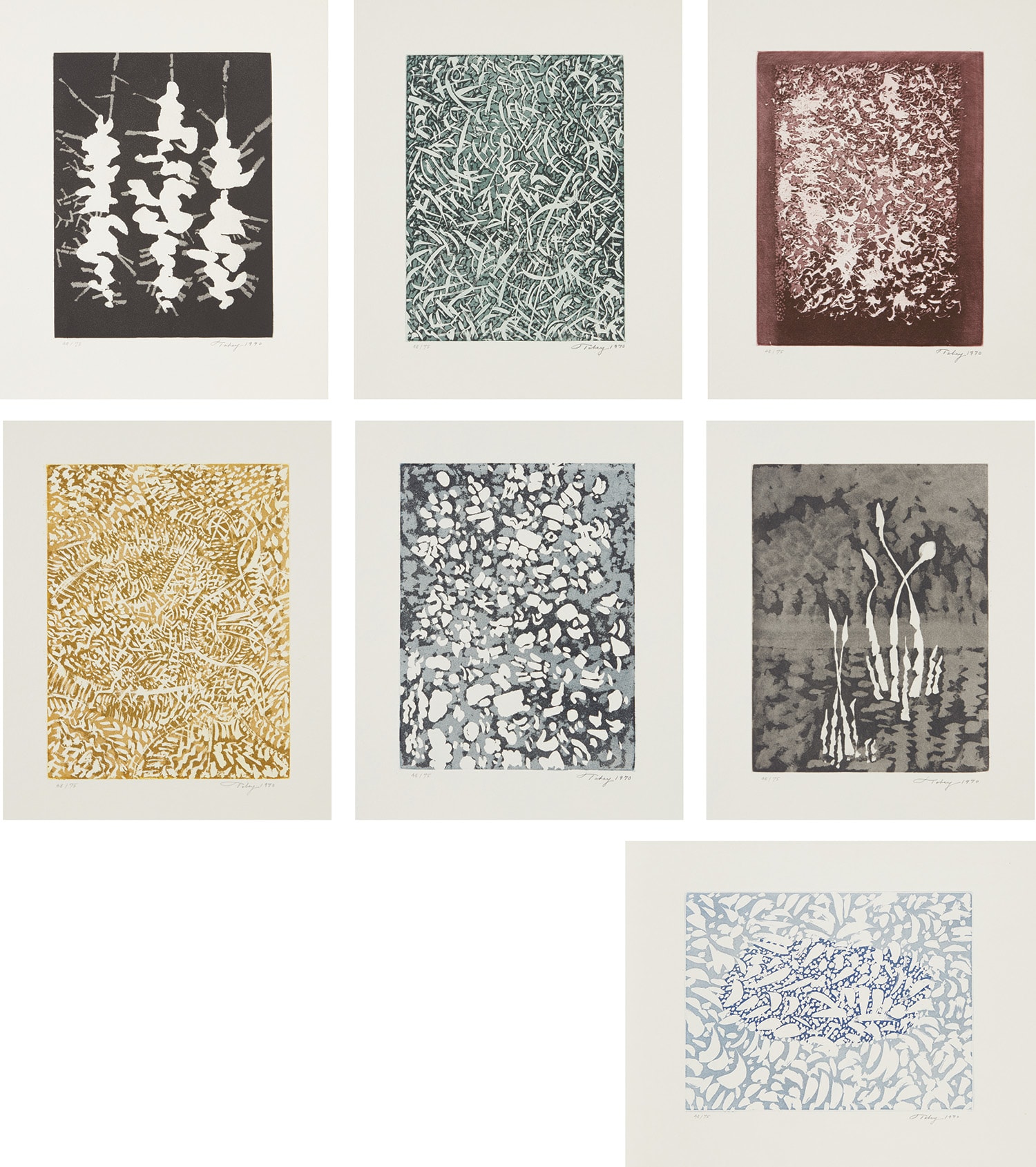
Transitions
His prints, including the lithograph and etchings gathered under the title "Renaissance of a Flower, Paean, and Of Time and Age," demonstrate that his ideas translated beautifully into the reproductive medium, with those works on Arches and Rives BFK papers carrying the same delicate luminosity as his unique works on paper. In terms of art historical context, Tobey occupies a singular and sometimes underappreciated position. He was working through ideas about allover composition and the dissolution of the centered image at roughly the same moment as Jackson Pollock, and the two men arrived at their respective solutions independently, from very different starting points. Where Pollock's drip paintings carry the weight of physical drama and gestural force, Tobey's white writing achieves something more introspective, a quieter and in some ways more demanding experience of sustained attention.
His closest intellectual companions include Morris Graves, his fellow Pacific Northwest visionary and fellow student of Eastern thought, and the German American abstractionist Adolf Gottlieb, whose interest in symbolic and archetypal imagery shares some of Tobey's spiritual ambition. Tobey was awarded the grand prize for painting at the 1958 Venice Biennale, a recognition that placed him among the most significant artists of his generation on the international stage. For collectors, Tobey's works offer something genuinely rare: a coherent and deeply personal vision that rewards sustained living with in a way that more immediately dramatic work sometimes does not. His gouaches and works on paper are particularly prized both for their accessibility relative to the larger canvas works and for the directness with which they reveal his hand and thinking.
Mark Tobey
Emboy, 1954
The market has recognized this with steady interest at auction, and works from the 1950s and 1960s, his most celebrated period, consistently attract serious collectors of postwar abstraction. Condition and provenance matter enormously with works on paper, and buyers are well advised to seek pieces with clean exhibition histories and good light stability in their storage. The diversity of his output, from intimate sketches to large scale gouaches to printed editions, means that there are genuine entry points at a range of collecting levels. Tobey spent his later years in Basel, Switzerland, a telling choice for an artist whose entire practice had been built on the idea that East and West were not opposites but two expressions of the same underlying human impulse toward meaning and beauty.
He died there in 1976, leaving behind a body of work that feels increasingly prescient as our understanding of global modernism continues to expand beyond its traditional Euro American boundaries. At a moment when the art world is actively reconsidering which voices and which traditions shaped the twentieth century, Tobey's lifelong synthesis of cultures looks not like a curiosity but like a model, proof that the most original art often grows precisely from the most generous and open engagement with the world beyond one's own origin.
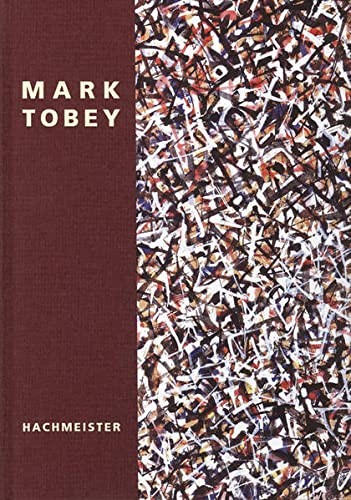
Explore books about Mark Tobey
Mark Tobey
William C. Seitz
Mark Tobey: A Retrospective
Eliza E. Rathbone
Mark Tobey: Calligraphy and Meditations
Vivian Barnhill
Mark Tobey: An American Master
Jeffrey Wechsler
Mark Tobey: The World of a Northwest Artist
Alden Mason
Mark Tobey: Angel of Light
Ann P. Schroeder