Mark Handforth

Mark Handforth Makes the City Sing
Artist Spotlight · The Collection Editorial
When the Fondazione Prada invited Mark Handforth to present work in Milan, the art world was reminded of something it periodically needs reminding of: that sculpture can be genuinely, generously alive. Handforth's towering street lamps bent at impossible angles, his neon signs glowing with a warmth borrowed from diners and highways, filled institutional space with the restless, democratic energy of the street. It was a moment that crystallized what this British born artist, long based in Miami, has been doing for three decades, which is transforming the overlooked furniture of modern life into something that stops you in your tracks. Mark Handforth was born in 1969 in Bristol, England, and came of age in a Britain still metabolizing punk, post punk, and the visual promiscuity of a culture in flux.

Mark Handforth
This work is unique and is accompanied by a certificate of authenticity.
He studied at the Ruskin School of Art in Oxford before completing his education at the Slade School of Fine Art in London, two institutions with very different temperaments that between them gave Handforth a grounding in both traditional discipline and conceptual ambition. He arrived in Miami in the early 1990s, drawn by the city's particular quality of light, its sun bleached surfaces, its sense of existing slightly outside the mainstream art world circuits centered on New York and Los Angeles. That decision would prove formative, giving his practice a distinctly coastal, warm weather sensibility that feels both American and entirely his own. Miami in the 1990s was not yet the art fair capital it would become, and working there required a certain self sufficiency.
Handforth developed early on a practice rooted in the physical encounter with objects, with weight, with the tactile reality of materials. His early works from the mid 1990s, including pieces like English Rose from 1996, show an artist already comfortable with sculpture as a form of cultural quotation. The work draws on the loaded iconography of Britishness while sitting squarely within a lineage that connects American minimalism to pop art's appetite for the vernacular. This dual inheritance, the cool geometry of Donald Judd and Carl Andre meeting the irreverent materialism of Claes Oldenburg, would shape everything that followed.

Mark Handforth
Moonshadow, 2005
Over the course of the late 1990s and into the 2000s, Handforth's practice expanded in scale and ambition. Moonshadow, created in 2005, is among his most resonant works, a piece that plays Handforth's characteristic game of seduction through the familiar. The title carries a gentle lyrical weight, evoking both the Cat Stevens song and something older, the romantic tradition of moonlit landscapes, while the sculpture itself grounds that lyricism in material fact. This is the essential Handforth maneuver: he lets poetry and irony coexist without forcing a resolution between them.
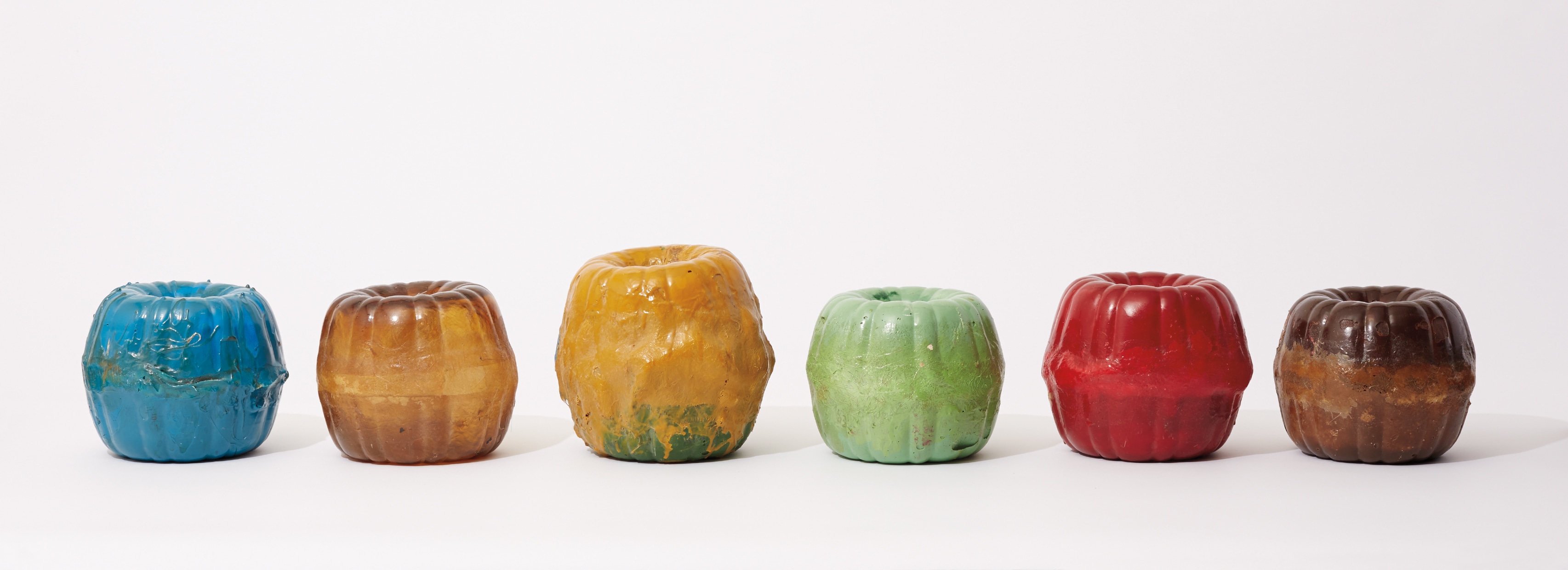
The viewer is allowed to feel the warmth of the reference without being told exactly what to think. His use of fluorescent neon is similarly poised, neon being a material with deep roots in both the sign painter's trade and in art history, from Dan Flavin's cool fluorescent tubes to Bruce Nauman's charged linguistic neon works. Handforth takes neon somewhere more intimate, more street level, closer to the glow of a late night bar than a white cube gallery. The early work Pony Barrel from 1994, cast in polyester, fiberglass, and resin across six parts, reveals how long Handforth has been thinking about fragmentation, seriality, and the comedy latent in everyday forms.
Mark Handforth
Pony Barrel, 1994
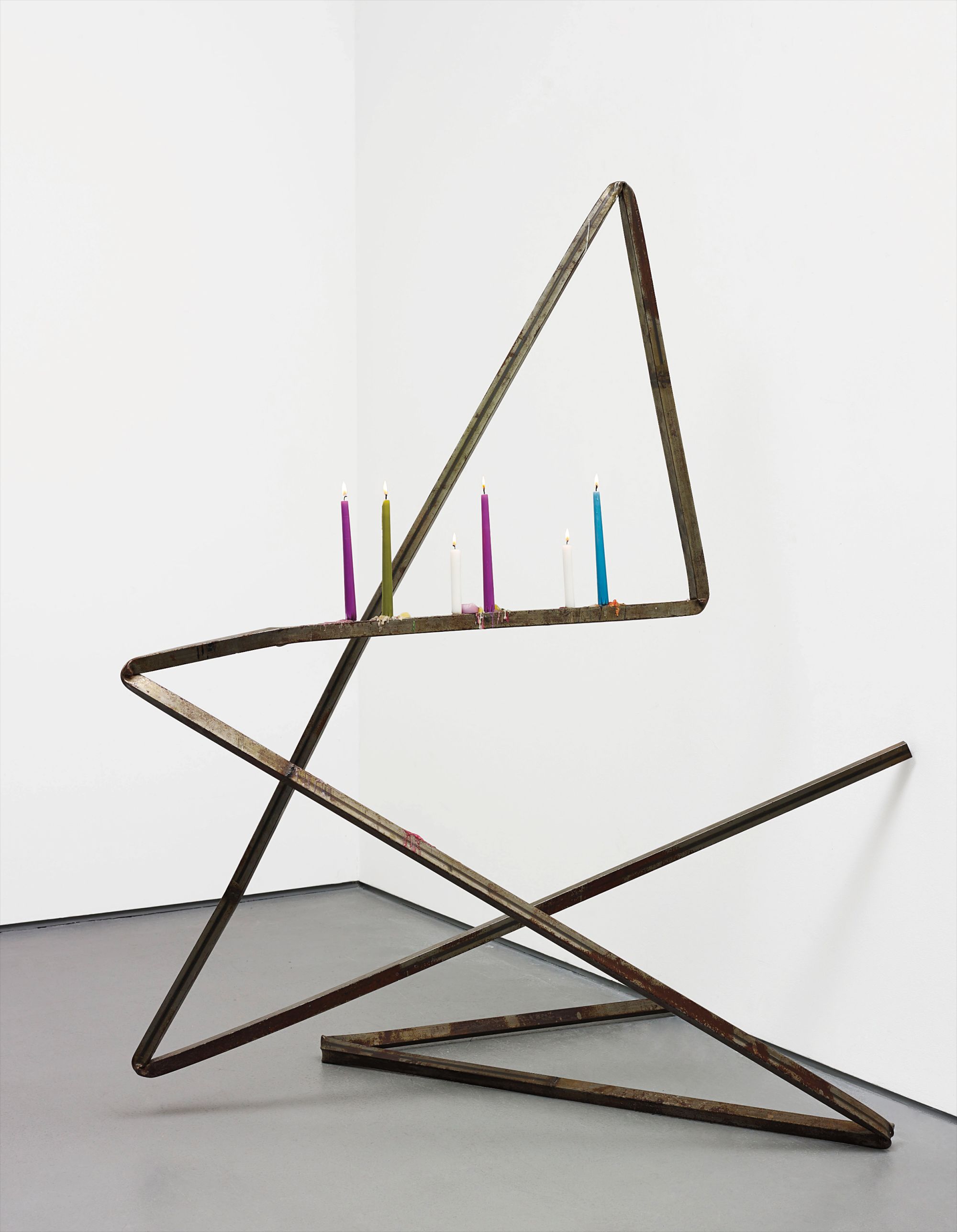
The use of industrial casting materials speaks to a deliberate choice: these are not precious substances but working materials, the stuff of manufacture and construction, elevated by context and intention rather than by inherent luxury. This democratic approach to materials runs consistently through his career and connects him to a broader tradition of artists who insist that sculpture should earn its meanings through form and placement rather than through the prestige of the medium. His incorporation of steel and coloured wax candles in certain works adds another dimension, bringing in the domestic, the ceremonial, and the fragile alongside the industrial and the durable. For collectors, Handforth's work occupies a genuinely attractive position in the contemporary sculpture landscape.
His pieces have been acquired by serious private collections and have appeared in significant institutional contexts, including exhibitions at galleries such as Gavin Brown's Enterprise in New York and Galerie Eva Presenhuber in Zurich, two spaces known for their rigorous and forward looking programs. The works reward sustained attention and tend to transform the spaces they inhabit, which is a quality that distinguishes genuinely great sculpture from the merely decorative. Collectors drawn to artists who operate at the intersection of minimalism, pop sensibility, and public art will find in Handforth a figure who synthesizes those influences with genuine originality. The unique works, each accompanied by a certificate of authenticity, carry particular significance given the artist's sustained critical reputation and the relatively intimate scale of his output.
Mark Handforth
steel and coloured wax candles
Handforth's closest relatives in the art historical conversation include Urs Fischer, whose own engagement with domestic and industrial materials shares something of Handforth's wit, and Franz West, whose commitment to sculpture as an open, even comedic proposition resonates with Handforth's practice. One might also think of Tom Friedman's transformation of mundane materials into unexpected sculptural events, or the legacy of John Chamberlain's insistence that beauty could be found in the discarded and the bent. What distinguishes Handforth is his specific relationship to urban space, to the grammar of the city as it presents itself in Miami and in the broader American landscape he has absorbed over thirty years of working there. Handforth's significance today lies precisely in his refusal to separate art from the world it comes from.
At a moment when contemporary sculpture can sometimes feel hermetically theoretical, his work remains stubbornly, joyfully connected to the textures of lived experience, to the way a street lamp looks at dusk, to the lure of a neon sign in the rain, to the odd beauty of a bicycle leaning against a wall. He reminds us that the city is already full of sculpture if you know how to look, and that the artist's task is sometimes simply to show us what was always there, transfigured by attention and love. That is a rare and lasting gift.