Mark Dion
Mark Dion: Nature's Most Devoted Renegade Curator
Artist Spotlight · The Collection Editorial
“The history of collecting nature is the history of power over nature, and that is something we need to examine very carefully.”
Mark Dion, interview with Cabinet Magazine
In the spring of 1999, volunteers lined the muddy banks of the Thames in London, sifting through centuries of sediment with the focused intensity of archaeologists on a career defining dig. They were not archaeologists, however. They were participants in one of the most celebrated art projects of the decade, working under the direction of Mark Dion, an American artist who had persuaded the Tate Gallery to let him excavate the riverbank in front of its new Bankside home. The resulting installation, Tate Thames Dig, presented the recovered fragments clay pipes, animal bones, pottery shards, and Victorian glass arranged in meticulous wooden cabinets that mimicked the taxonomic display systems of the great natural history institutions.
Mark Dion
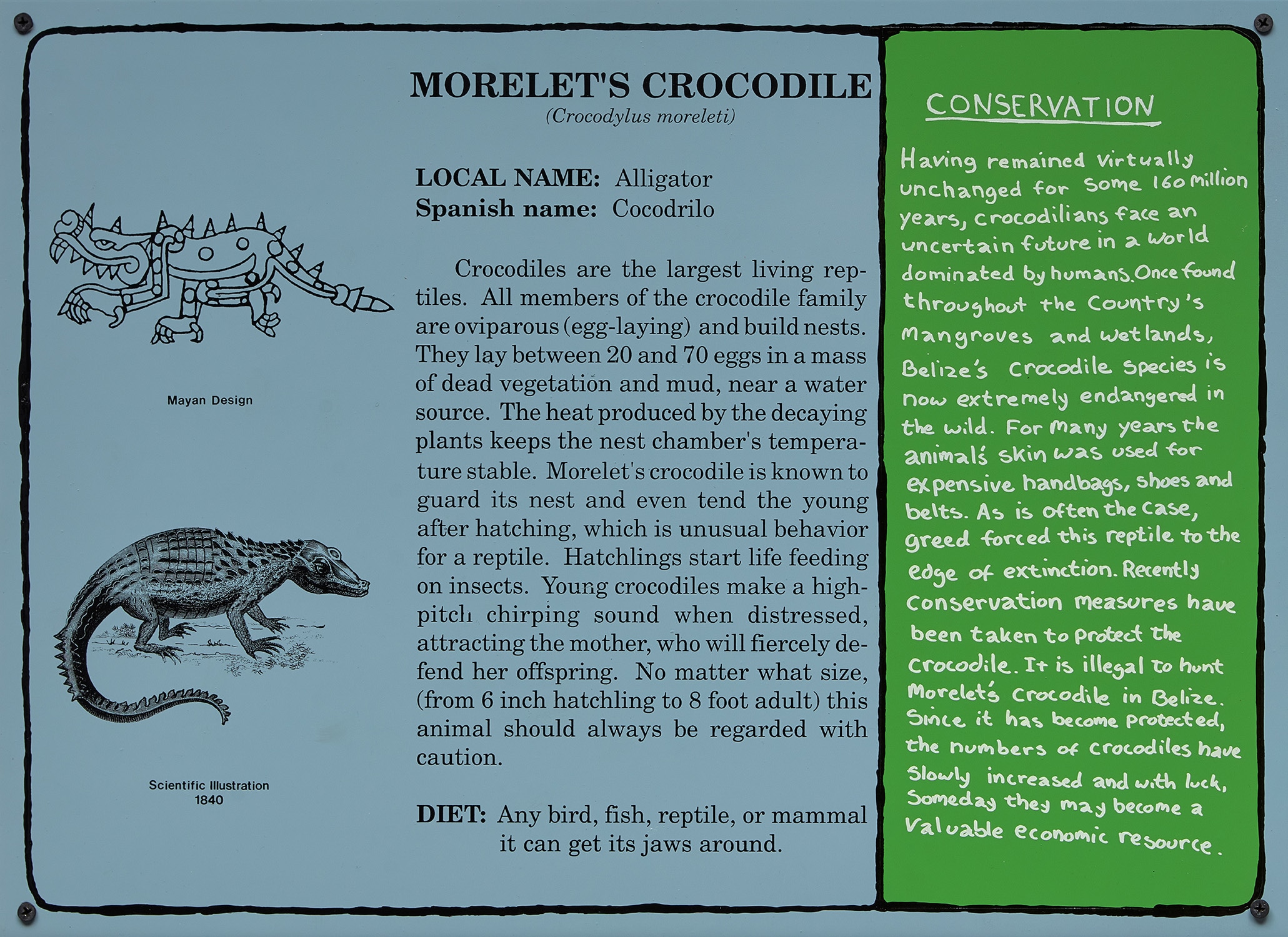
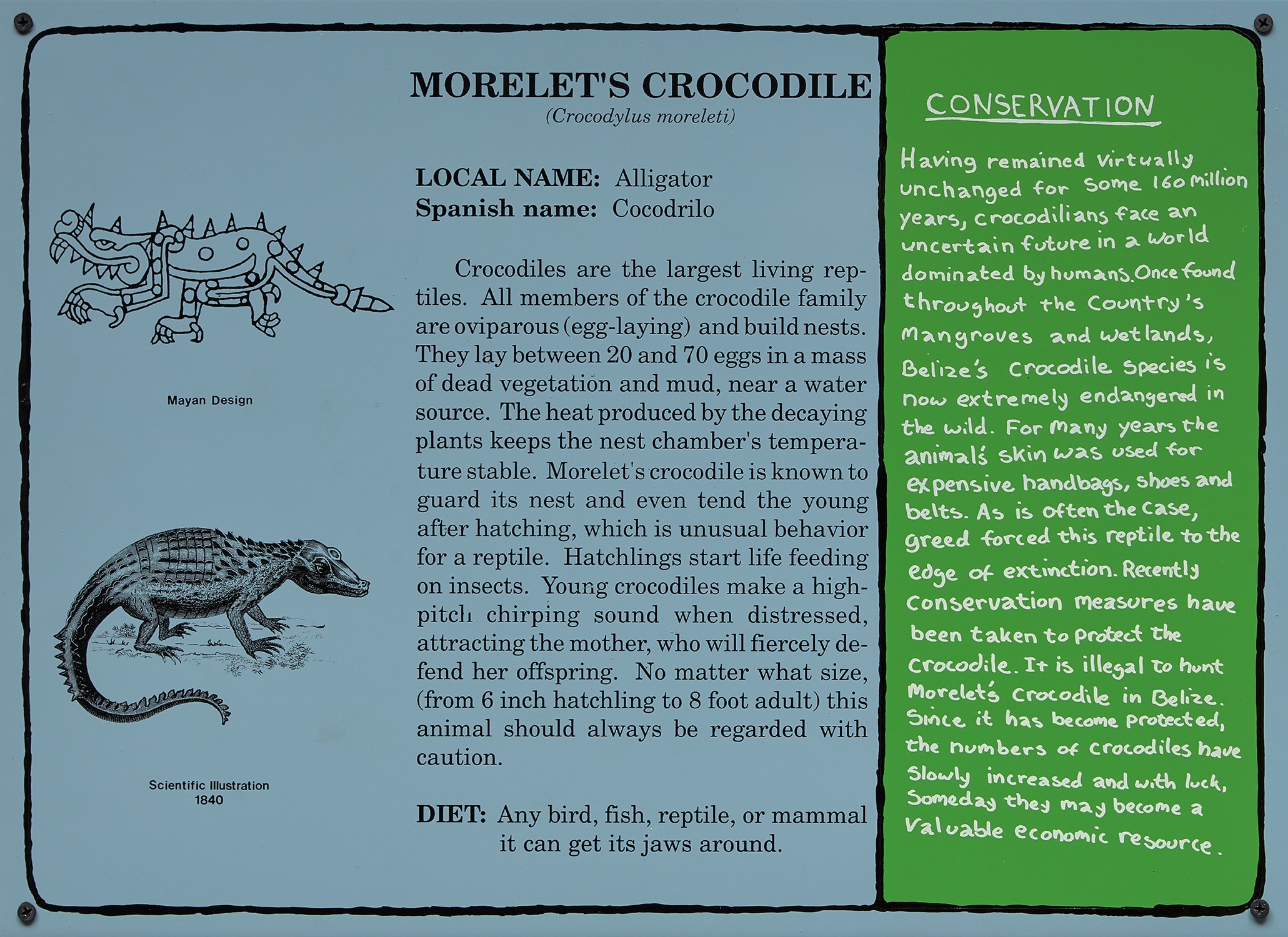
Morelet's Crocodile Project for the Belize Zoo
It was witty, rigorous, and quietly radical, and it announced Dion to the broadest possible audience as one of the most original thinkers working in contemporary art. Mark Dion was born in New Bedford, Massachusetts, in 1961, a port city with deep roots in maritime industry and a particular relationship with the natural world through its history of whaling. That background, with its entanglement of commerce, ecology, and the human drive to catalogue and exploit nature, seems almost too perfectly formative in retrospect. Dion studied at the School of Visual Arts in New York before completing his education at the University of Hartford, where he encountered ideas that would prove foundational: the history of science, the philosophy of classification, and the political dimensions of how Western culture has organized its understanding of the natural world.
He also spent formative time in New York during the 1980s, absorbing the theoretical energy of that moment and connecting with a generation of artists who were questioning the authority of institutions. Dion came of age artistically in dialogue with the critical theory and institutional critique that defined so much of the most ambitious art practice of the late 1980s and early 1990s. Artists like Andrea Fraser, Fred Wilson, and Hans Haacke were interrogating museums and their inherited assumptions, and Dion found his own distinctive angle of attack through natural history. Where Wilson famously recontextualized objects within art and history museums to expose racial narratives, Dion turned his attention to the cabinet of curiosities, the expedition, the field station, and the biological survey.
Mark Dion
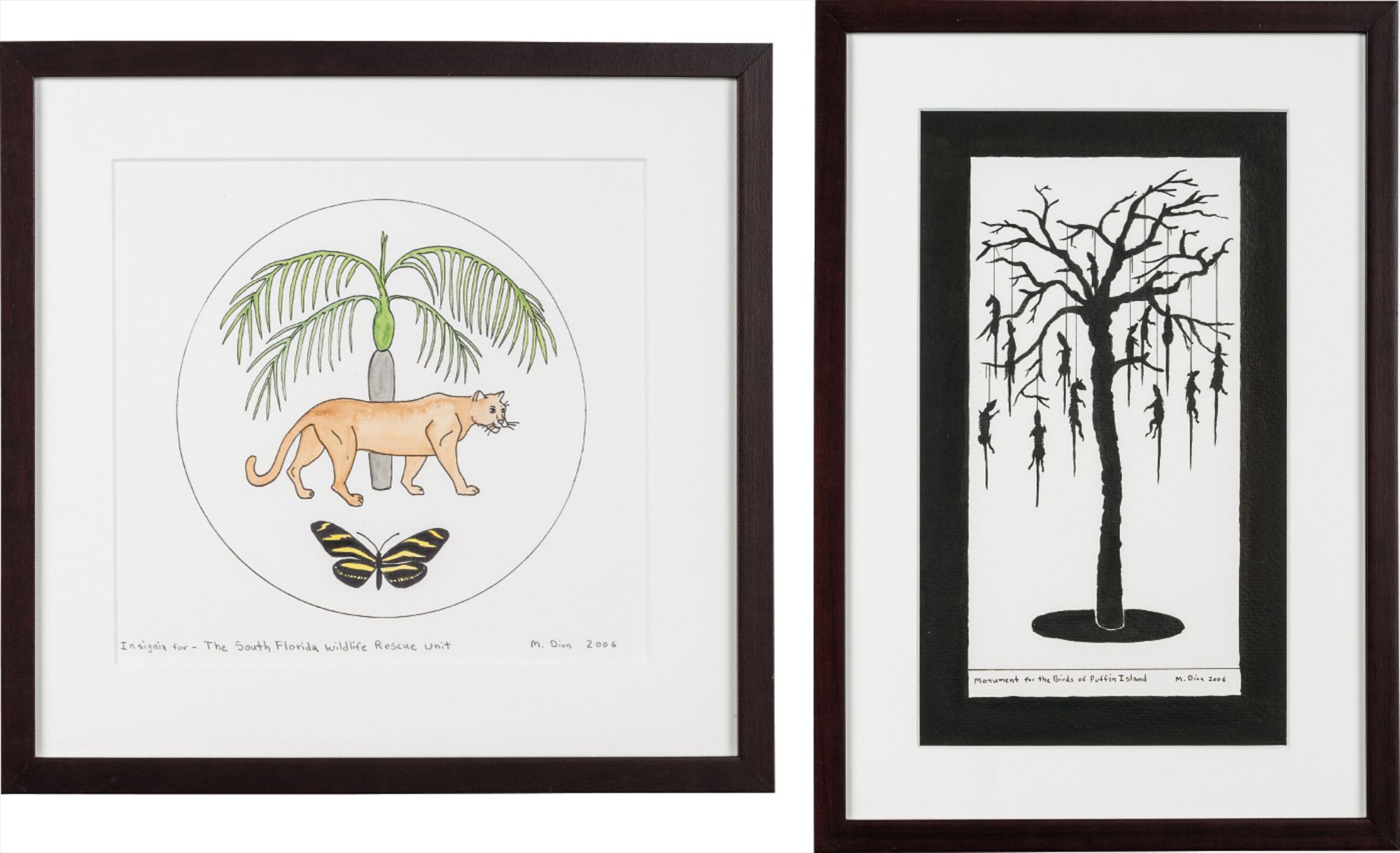
Two works: (i) Insignia for the South Florida Wildlife Rescue Unit, (ii) Monument for the Birds of Puffin Island, 2006
He asked, with great wit and genuine intellectual seriousness, whose knowledge systems these were and what ideologies they carried. The result was a practice that felt at once playful and philosophically dense, approachable in its theatricality and demanding in its implications. The signature vocabulary of Dion's practice includes the elaborate recreation of historical display systems: the Wunderkammer, the laboratory, the naturalist's field station, the storage room of a great museum. These environments are immaculately constructed, filled with objects that have been genuinely collected, sorted, and arranged according to logics the artist has devised or borrowed from history.
His participatory excavation projects bring communities into the work of collection and classification, democratizing a process that has historically been the exclusive preserve of credentialed experts. The Tate Thames Dig remains the most famous of these, but Dion has carried out similar projects across Europe and the Americas, each time using the act of digging as a way to think about what a culture values enough to preserve and what it allows to be buried and forgotten. Among the works available through The Collection, several reveal the range and richness of Dion's intelligence. The Morelet's Crocodile Project for the Belize Zoo takes the form of a screenprinted aluminum sign, a format borrowed from conservation and wildlife management bureaucracies, and uses it to raise questions about the intersection of scientific authority, tourism, and the performance of environmental concern.
Mark Dion
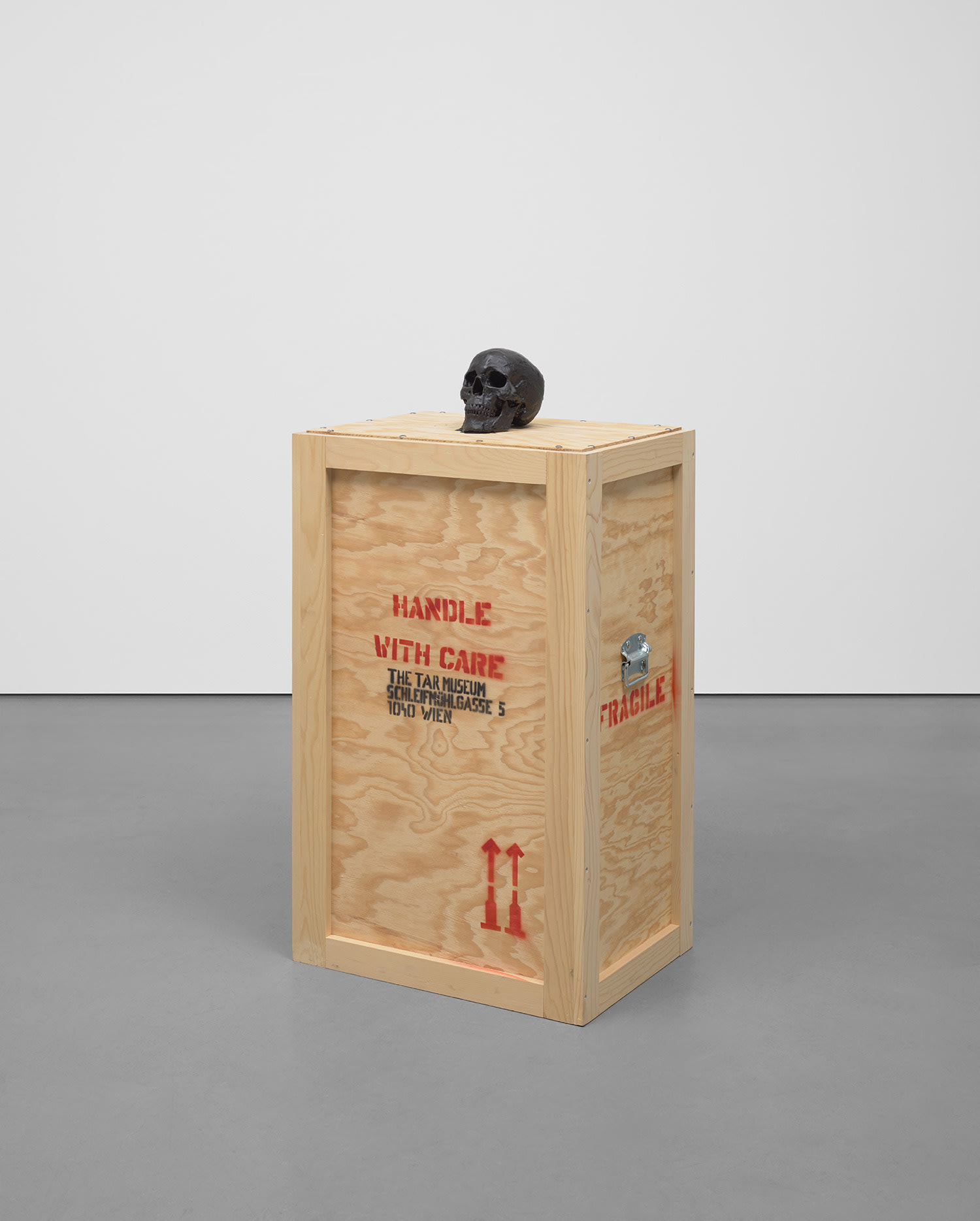
The Tar Museum - Skull, 2006
The work is characteristic of Dion's ability to inhabit institutional visual languages so convincingly that the critique emerges from within the form itself rather than being imposed upon it from outside. Similarly, The Tar Museum: Skull from 2006 presents a plastic cast of a skull housed in a wooden shipping crate coated in tar, invoking both the fossilized specimens of the La Brea Tar Pits and the strange afterlives of natural history objects as they travel through systems of collection, transport, and display. It is an object of considerable formal beauty that earns its place in any serious collection. From a collecting perspective, Dion's work occupies a particularly compelling position.
He works across a range of media and scales, from large immersive installations that have been acquired by major institutions to intimate works on paper, signs, and sculptural objects that translate beautifully into private collections. His watercolors and drawings, including works like the Insignia for the South Florida Wildlife Rescue Unit, display a delicacy and humor that complements the conceptual weight of the larger projects. Collectors who have built holdings around institutional critique, ecological art, or the history and philosophy of science will find Dion's work in productive conversation with artists such as Robert Smithson, whose thinking about entropy and the non site shares philosophical territory with Dion's investigations, and Joseph Beuys, whose shamanic relationship with the natural world Dion both inherits and gently interrogates. The market for Dion's work has remained steady and thoughtful, driven by institutions and private collectors who value intellectual substance alongside aesthetic pleasure.
The question of why Mark Dion matters with such urgency today is not difficult to answer. At a moment when the natural world is under unprecedented pressure, when the great natural history collections are being asked to account for their colonial histories, and when the authority of scientific expertise is itself a subject of intense public debate, Dion's practice addresses the central anxieties of the cultural moment with a lightness of touch that makes the medicine go down beautifully. He does not moralize or lecture. He builds extraordinary environments and invites us to inhabit them, to notice what we take for granted about how knowledge is organized and authorized, and to laugh a little at the solemn rituals through which Western culture has convinced itself it understands the natural world.
That combination of deep seriousness and genuine pleasure is rare, and it is what makes Dion's work a gift to any collection fortunate enough to hold it.
Explore books about Mark Dion
Mark Dion: Archaeology
Mark Dion, Germano Celant
Mark Dion: Trophies of the Hunt
Mark Dion
Mark Dion: Misadventures with Natural History
Mark Dion, Lawrence Rinder
Fishing for Answers
Mark Dion, Alex Irwin
Mark Dion: Oceanomania
Mark Dion, Robert Storr