Mark Bennett
Blueprint for a Life Well Imagined
Artist Spotlight · The Collection Editorial
There is a particular kind of American longing that lives not in memory but in the blue glow of a television screen. It is the longing for spaces that were never real but felt, somehow, more familiar than our own living rooms. Mark Bennett has spent decades giving that longing a precise and extraordinary form, translating the phantom architecture of fictional homes into meticulous, drafting table perfect floor plans that read like the most poignant documents in contemporary art. His work has found an enduring place in museum collections and in the imaginations of collectors who grew up understanding the Brady house as a kind of second home, and it continues to resonate with growing urgency as questions about media, myth, and domestic life sit at the very center of cultural conversation.
Mark Bennett
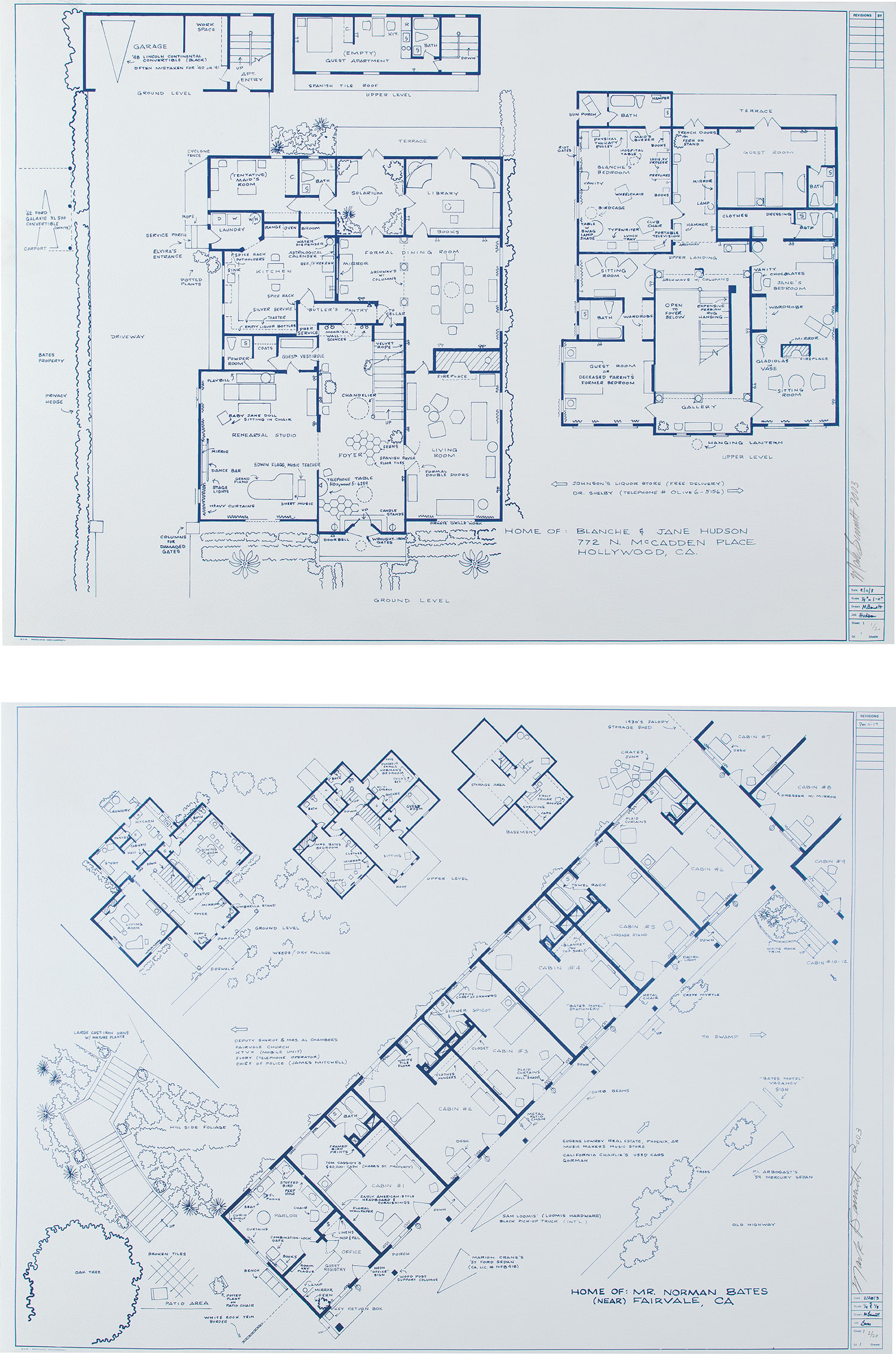
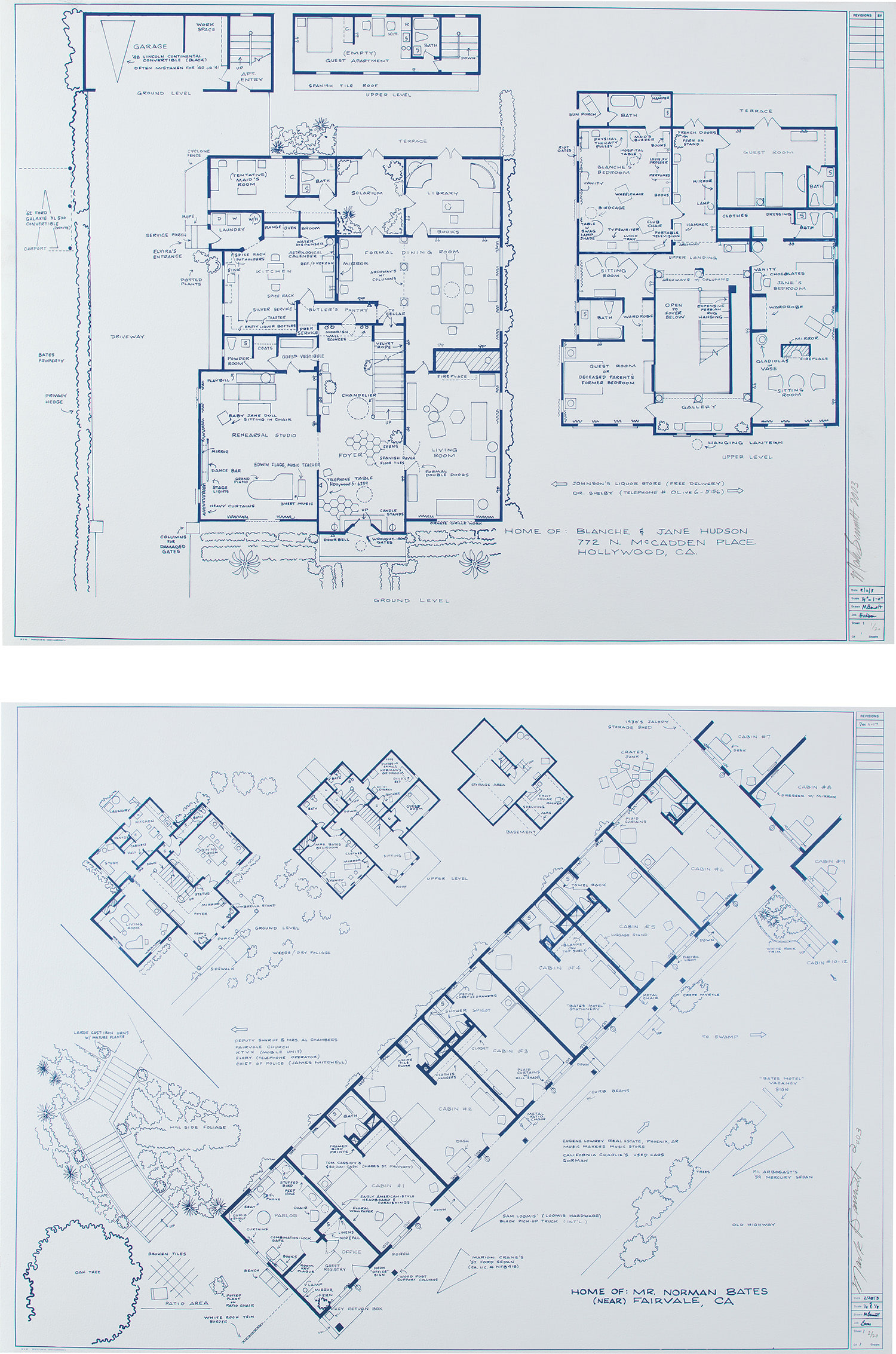
Home of Blanche and Jane Hudson (What Ever Happened to Baby Jane); and Home of Norman Bates (Psycho)
Bennett was born in 1956, and came of age in an America where television had completed its conquest of the living room. The postwar suburban dream was being projected nightly into millions of households, and the homes depicted on screen, those split levels and bungalows and ranch houses, became as legible as real neighborhoods. For a child growing up in that landscape, the television home was not a backdrop but a character in its own right. Bennett absorbed this world with a particular kind of attention, one that would eventually reveal itself as something closer to architectural curiosity than passive viewership.
He would spend years developing the technical and conceptual vocabulary to articulate what so many others had simply accepted as scenery. His practice emerged from a genuinely original idea: to treat fictional domestic spaces with the same rigor and seriousness that an architect would bring to a real commission. Working in graphite and ink on vellum, and later producing pigment prints, Bennett renders his floor plans in the style of official architectural drawings, complete with room labels, dimensions, and the calm authority of a professional document. The medium is essential.
![Mark Bennett — Home of Mike and Carol Brady [The Brady Brunch], from TV Sets and the Suburban Dream](https://rtwaymdozgnhgluydsys.supabase.co/storage/v1/object/public/artwork-images/auction-lots/NY030218-172018-lot1774380086381.jpg)
Mark Bennett
Home of Mike and Carol Brady [The Brady Brunch], from TV Sets and the Suburban Dream
Vellum carries its own history as the surface of blueprints and technical drawings, and Bennett's choice of it transforms a nostalgic exercise into something that feels both institutional and intimate. The work looks like evidence. It looks like something you might find in a county records office, which is precisely where its power lives. The body of work that established Bennett's reputation draws on an extraordinary range of American television history.
His floor plan for the home of Mike and Carol Brady, rendered in graphite and ink on vellum, is among the most celebrated works in his practice, and rightly so. It is a document that any viewer who watched The Brady Bunch as a child will immediately recognize as authoritative, even though no such document could ever have existed. Bennett constructs these plans from careful observation of on screen evidence, cross referencing scenes and sight lines to determine the spatial logic of rooms that set designers never needed to make fully coherent. The result is both a feat of intellectual archaeology and a profoundly moving act of devotion to the culture that shaped a generation.
Mark Bennett
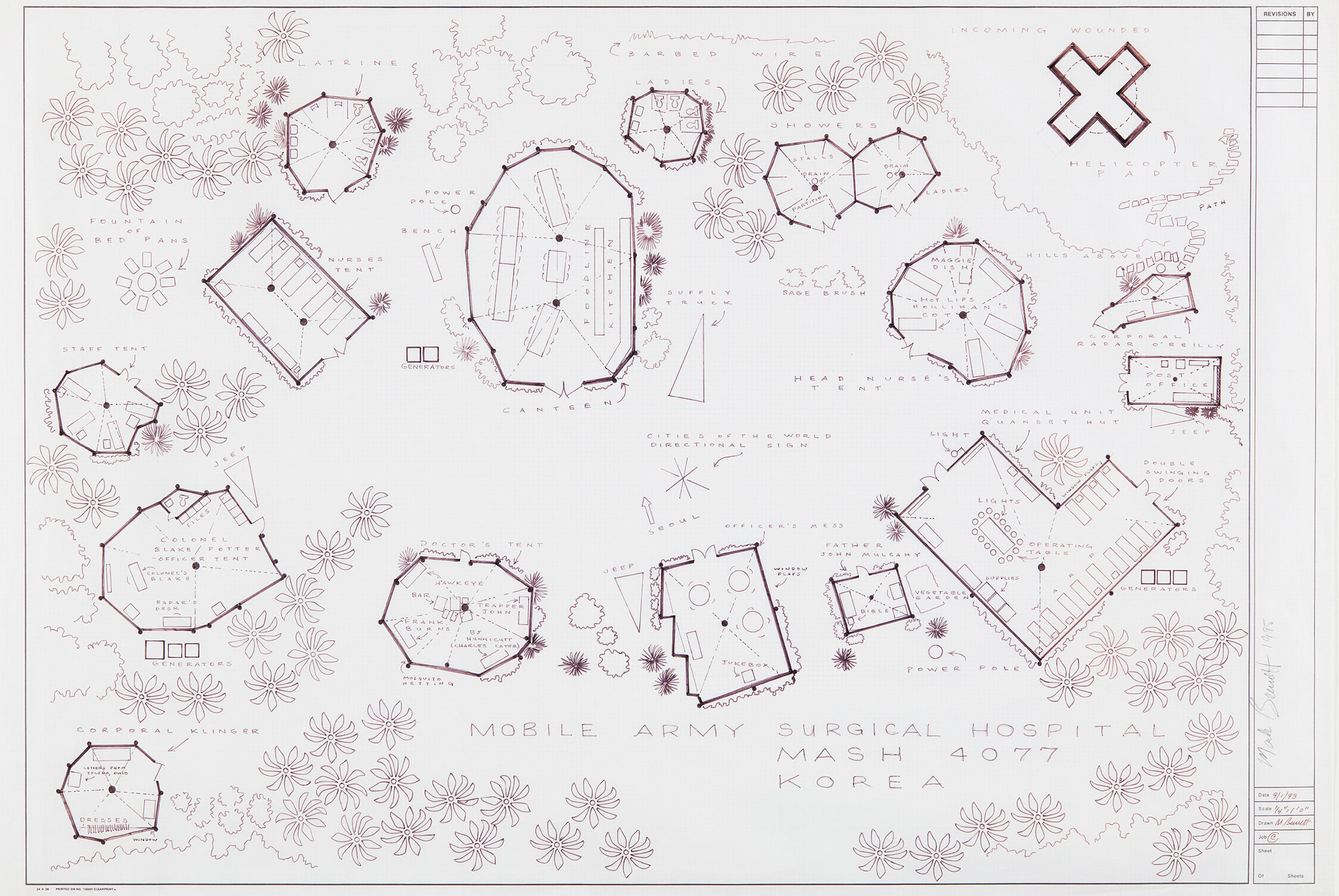
M*a*s*h
His rendering of the M*A*S*H camp, also executed in graphite and ink on vellum, extends this practice into more complex terrain, mapping a community of temporary structures in a war zone that became, for millions of viewers, one of the most emotionally significant homes on American television. Among the most striking works in Bennett's practice are his floor plans for spaces drawn not from domestic sitcoms but from the darker corners of American cinema. His pigment prints depicting the home of Blanche and Jane Hudson from What Ever Happened to Baby Jane and the home of Norman Bates from Psycho represent a brilliant and unsettling extension of the core idea. By applying the same cool, bureaucratic draftsmanship to these haunted fictional spaces, Bennett does something genuinely mischievous and philosophically rich.
The Bates house rendered as a real estate document, with its rooms laid out as neutrally as any suburban floor plan, transforms a site of horror into something almost domestic. The gap between the visual language of the blueprint and the cultural memory of what occurred in those rooms generates a tension that is difficult to shake. These works reveal that Bennett's project is not simply nostalgic. It is, at its deepest level, an inquiry into how spaces acquire meaning through narrative, and how that meaning can be destabilized by a simple change of representational register.
For collectors, Bennett's work occupies a genuinely rare position in the market. It sits at the intersection of conceptual art, pop cultural scholarship, and fine draftsmanship in a way that few practices manage. The works appeal to collectors who respond to ideas as much as to aesthetics, but they also reward sustained looking in the way that only technically accomplished work can. The vellum drawings in particular have a delicate, luminous quality that no reproduction fully captures.
Bennett's works have been held by serious private collections and have appeared in institutional contexts including the Museum of Contemporary Art in Los Angeles, which has been an important site for understanding his practice within the broader landscape of California conceptualism and pop art. Collectors drawn to artists such as Ed Ruscha, whose practice similarly transforms vernacular American visual culture into something rigorous and strange, or to the work of Jenny Holzer, whose institutional visual language carries its own conceptual charge, will find in Bennett a practice of comparable seriousness and wit. Bennett's place in art history becomes clearer with each passing year, as the cultural forces his work engages grow only more relevant. In an era of streaming platforms and algorithmically curated content, when the fictional domestic spaces of television have multiplied beyond any individual's capacity to track them, his original gesture of attention and care feels almost radical.
He insisted, at a moment when pop culture was still frequently dismissed as unserious subject matter, that these imaginary homes deserved the full apparatus of architectural documentation. That insistence has been vindicated not only by critical reception but by the depth of feeling his work provokes in anyone who encounters it. To stand before a Bennett floor plan is to understand something true about how we live, how we are shaped by images of living, and how the spaces we never actually inhabited can feel, against all reason, like home.