Marino Marini
Marino Marini: The Rider Rides Forever
Artist Spotlight · The Collection Editorial
“I do not want to represent a hero. I want to represent man as a witness of catastrophe.”
Marino Marini
There is a moment, standing before a Marino Marini bronze, when the weight of the twentieth century becomes entirely legible. The horse strains forward, the rider's arms thrown wide or falling back, and the whole composition trembles between triumph and catastrophe. It is a feeling that never grows old. When the Museo del Novecento in Milan mounted a landmark survey of Marini's work in recent years, critics and collectors alike were reminded that this singular Italian master speaks to our present moment with a directness and emotional power that few of his contemporaries can match.
Marino Marini
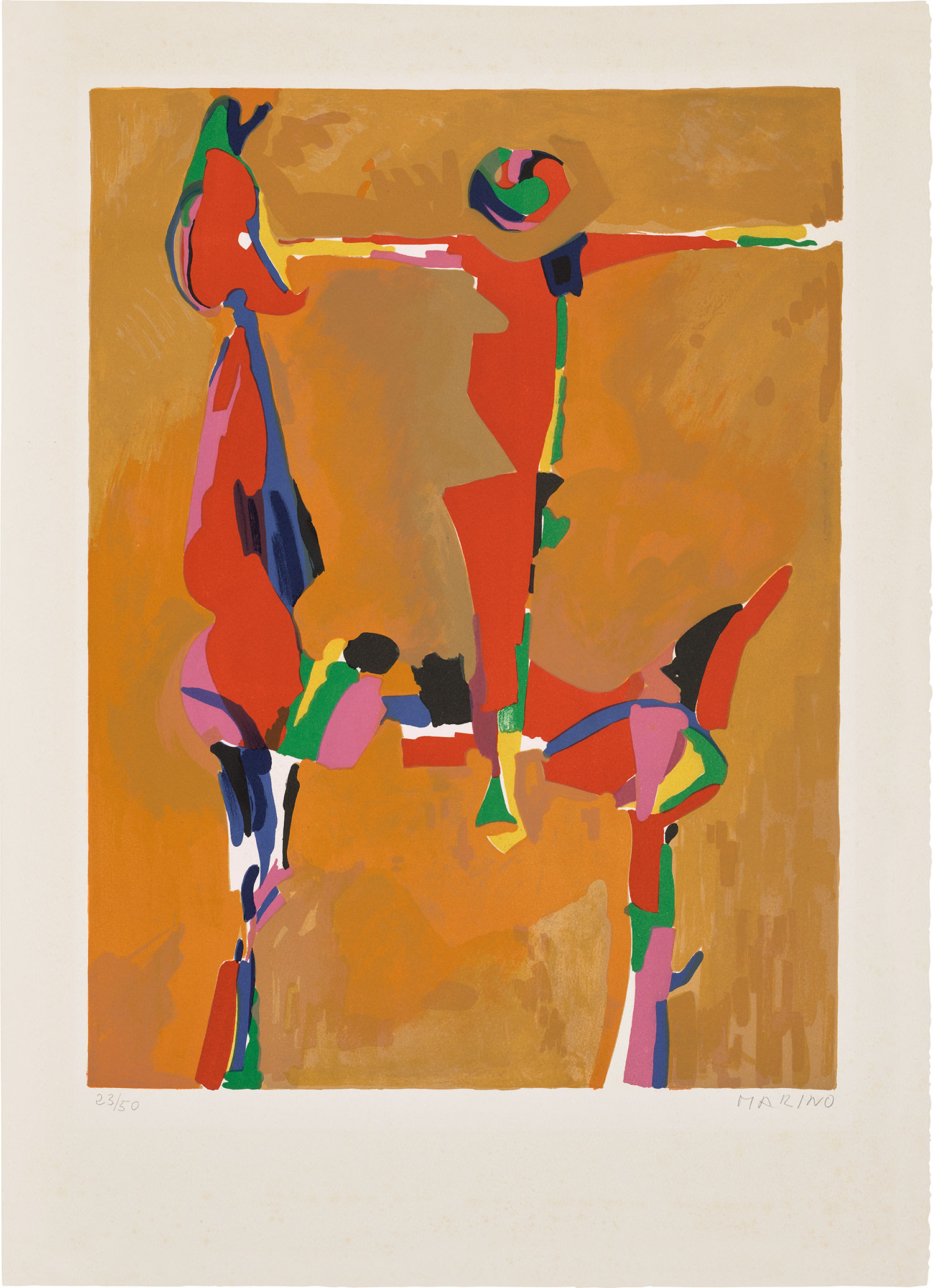
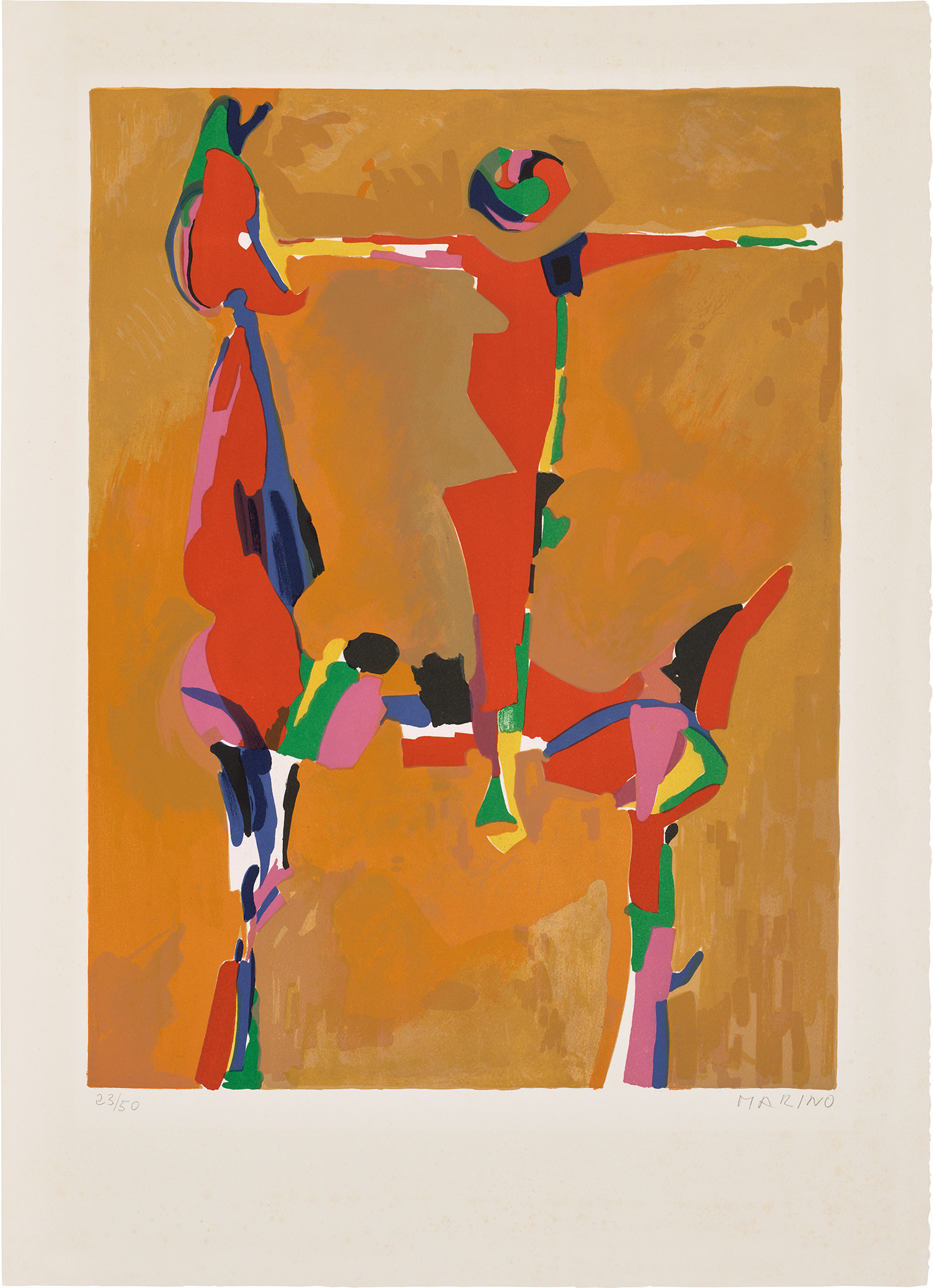
Idea del Cavaliere (Idea of the Knight) (G. L103)
His figures do not pose. They endure. Marino Marini was born in 1901 in Pistoia, a Tuscan city with deep roots in medieval sculpture and craft. He studied at the Accademia di Belle Arti in Florence, immersing himself in the rich visual culture of central Italy, where Etruscan bronzes and archaic votive figures lined the shelves of regional museums.
This early exposure to pre Roman art was not merely academic. It planted in Marini a lifelong fascination with the elemental, with figures stripped of narrative refinement and reduced to their most essential and expressive forms. He absorbed the lessons of ancient Etruria the way a musician absorbs folk music, not as a curiosity but as a living inheritance. Through the 1920s and 1930s Marini worked across sculpture, painting, and printmaking, establishing himself as a figure of serious ambition in Italian modernism.
Marino Marini
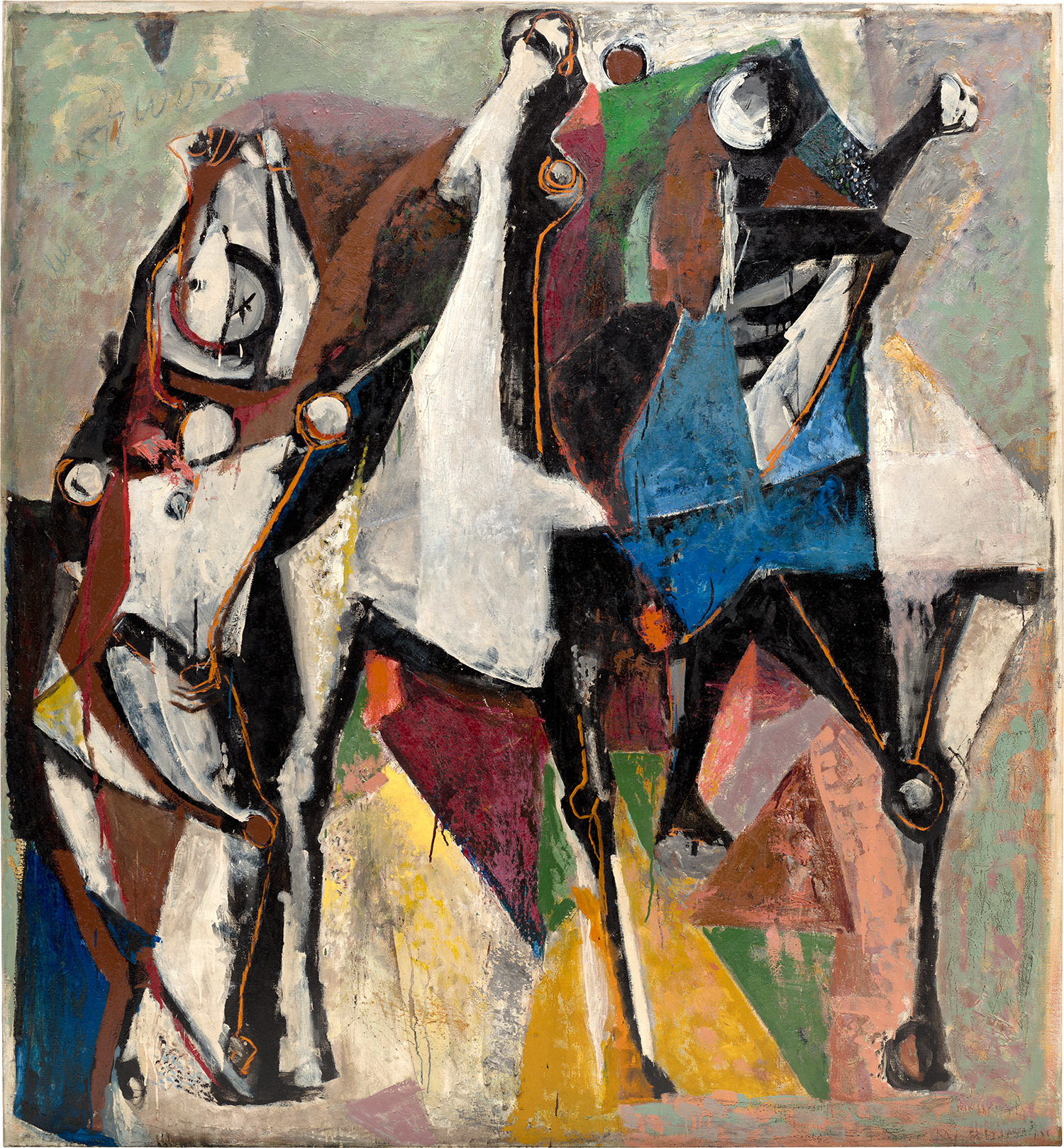
Il Cavaliere Azzurro (The Blue Rider), 1952
He taught at the Scuola d'Arte di Villa Reale in Monza beginning in 1929, and later at the Accademia di Brera in Milan, where his influence on younger generations would prove lasting. His early sculptural work engaged with portraiture and the female nude, and pieces such as Le tre Grazie from 1943 demonstrate his remarkable ability to synthesize classical composure with a tactile, almost archaic roughness of surface. He was never a mere imitator of the antique. He was in genuine conversation with it.
The equestrian series, which Marini began developing in earnest in the late 1930s and which would consume and define his practice for decades, is among the most sustained and emotionally coherent bodies of work produced by any European sculptor of the twentieth century. The horse and rider, one of Western art's oldest subjects, became for Marini a vehicle for exploring the deteriorating relationship between human will and natural force. As the decades progressed and the trauma of the Second World War receded into a complicated postwar modernity, his riders grew less confident and more precarious. Arms that once gestured with authority began to fall away from the body.
Marino Marini
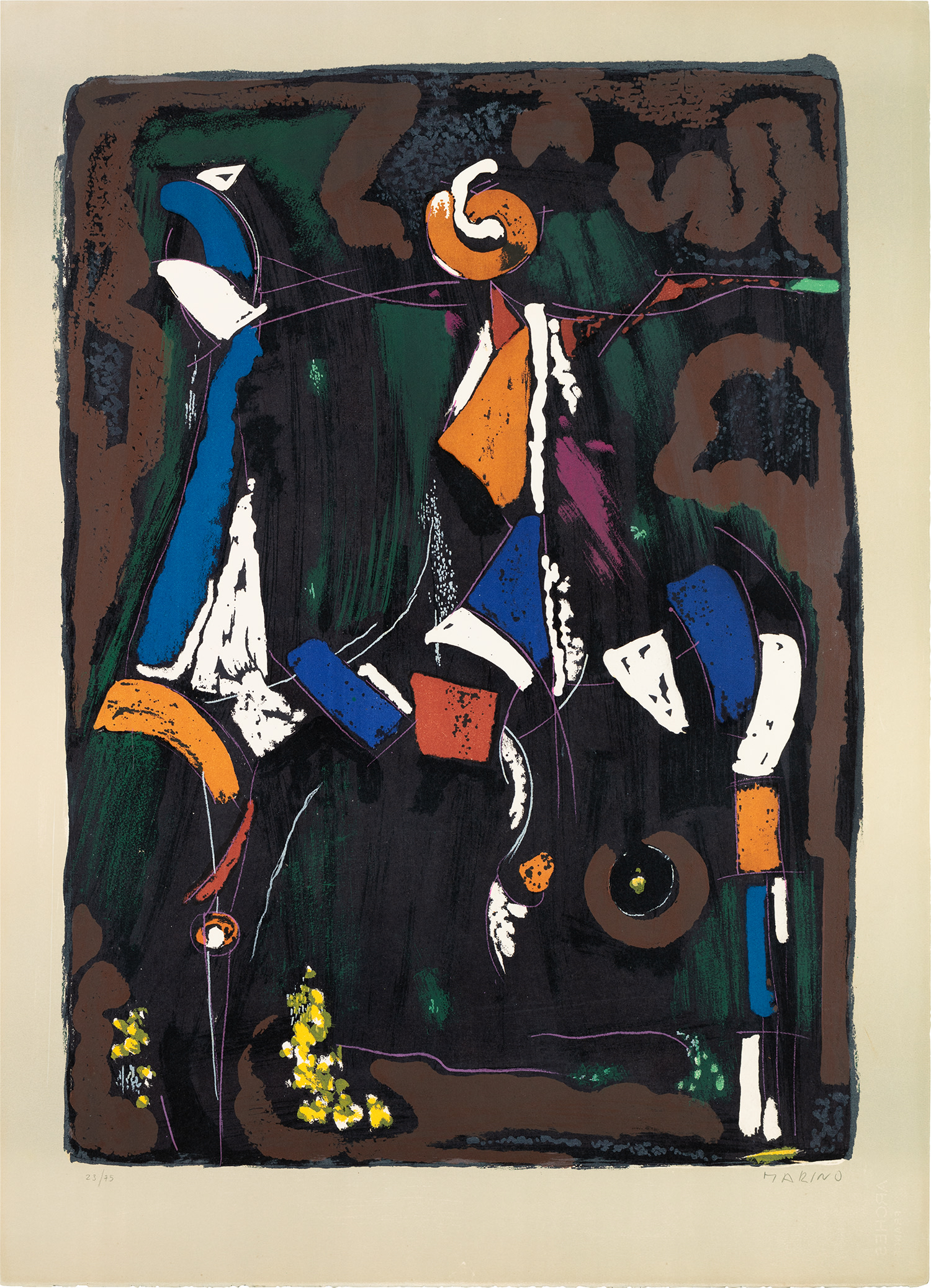
Bunter Reiter II (Multi-Colored Rider II) (G. 123)
Horses that once suggested forward motion became rigid, arrested, almost geological. The evolution was deliberate and deeply felt. Il Cavaliere Azzurro of 1952, rendered in oil on canvas with characteristic boldness of color and form, captures this tension at a particularly charged moment in the series, the figure inseparable from the animal yet profoundly isolated upon it. As a printmaker Marini brought the same formal intelligence and emotional intensity to the lithograph and the etching plate that he brought to bronze and plaster.
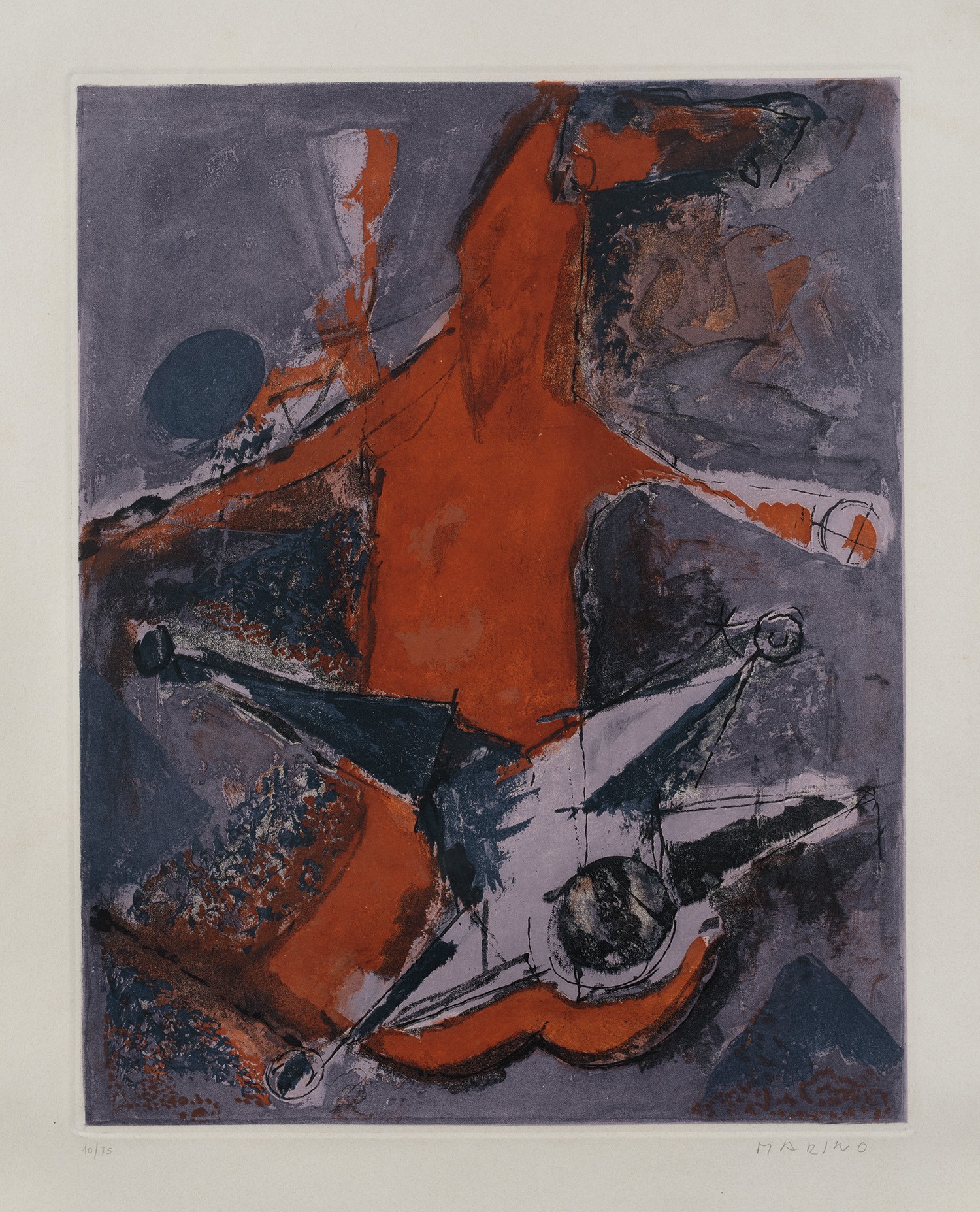
Works such as Idea del Cavaliere and the extraordinary Miracolo demonstrate his mastery of color aquatint, his willingness to let the processes of printmaking introduce a quality of accident and texture that reinforced rather than diminished the expressive charge of his imagery. The complete Shakespeare series, Marino from Shakespeare II, stands as one of his most ambitious graphic achievements, a sequence of etchings with aquatint and drypoint in which literary imagination and personal mythology intertwine with remarkable fluency. These prints are not reproductions of sculptural ideas. They are fully realized works in their own right, pursued with the same rigor and vision.
Marino Marini
Miracolo (Miracle) (G. A210)
For collectors, the appeal of Marini is multidimensional and genuinely durable. His bronzes have long attracted serious institutional and private attention, with major examples held in the collections of the Tate in London, the Museum of Modern Art in New York, and the Kunsthaus Zürich. At auction his works have consistently performed at the upper tier of the postwar Italian market, with significant bronzes achieving prices in the millions and important prints and works on paper drawing competitive bidding from collections across Europe, the United States, and Asia. The diversity of his output means that entry points exist across a wide range of budgets and collecting orientations.
A small bronze such as Piccolo nudo from 1945, with its dark brown patina and quietly contemplative presence, offers an intimacy that the monumental equestrian works deliberately refuse. Works on paper, including the Giocoliere ink drawings and the richly colored lithographs, allow collectors to engage with the full range of his visual intelligence at a scale suited to domestic interiors as well as dedicated print collections. Marini occupies a distinctive position within the broader constellation of twentieth century European sculpture. He shares with Alberto Giacometti an obsession with the human figure under existential pressure, though where Giacometti attenuates and isolates, Marini consolidates and confronts.
His work invites comparison with the Italian contemporaries Lucio Fontana and Emilio Greco, as well as with international figures such as Henry Moore and Fritz Wotruba, all of whom engaged with the archaic and the primitive as sources of renewal rather than nostalgia. Among German Expressionists and the figurative traditions of postwar Europe, Marini stands apart for his combination of formal authority and psychological depth, his refusal of either pure abstraction or sentimental representation. The legacy of Marino Marini is secured not only by the institutions that bear his name, most notably the Museo Marino Marini in Florence and the dedicated museum spaces in Pistoia and Milan, but by the ongoing vitality of his imagery in the broader culture. The rider who cannot hold on, who cannot quite fall, who exists in permanent suspension between mastery and surrender, feels more contemporary with each passing year.
In an era defined by its sense of precariousness, its negotiation between human agency and forces beyond individual control, Marini's great equestrian figures ask the questions that matter most. They do so without words, without rhetoric, with nothing but bronze and balance and an almost unbearable grace.
Explore books about Marino Marini
Marino Marini: Catalogo Generale
Umbro Apollonio

Marino Marini: Sculptor
Henry Moore
Marino Marini: The Horse and the Rider
Michel Brenson
The Sculpture of Marino Marini
Herbert Read
Marino Marini: Drawings
Eduard Trier
Marino Marini: Catalogue of the Donated Works
Museo Marino Marini