María Berrío
María Berrío Weaves Worlds From Fragile Beauty
Artist Spotlight · The Collection Editorial
“I want to create a world where I can be both here and there, in a kind of in-between space.”
María Berrío, Victoria Miro
In 2023, María Berrío unveiled "Apachetas," a monumental collage on linen that stopped visitors in their tracks and confirmed what her most devoted collectors have long understood: she is among the most emotionally and technically ambitious artists working today. The work takes its name from the Andean tradition of stone cairns built as offerings to the earth, stacked with intention and care at crossroads and mountain passes. It is a fitting metaphor for everything Berrío does, layering fragment upon fragment, story upon story, until something sacred and entirely new emerges from the accumulation. Berrío was born in Bogotá, Colombia, in 1982, and the texture of that city, its lush contradictions, its political tensions, and its deep vein of magical realist culture, runs through every work she has ever made.
María Berrío
Apachetas, 2023
She studied art history at the Universidad de los Andes, where she developed a rigorous understanding of image making across cultures and centuries. That academic grounding gave her something many artists lack: a confident sense of where her work sits in the longer conversation of art history, even as she pushes that conversation into entirely new territory. Her move to New York proved decisive. She completed her MFA at the School of Visual Arts in 2007 and began building the practice that would define her.
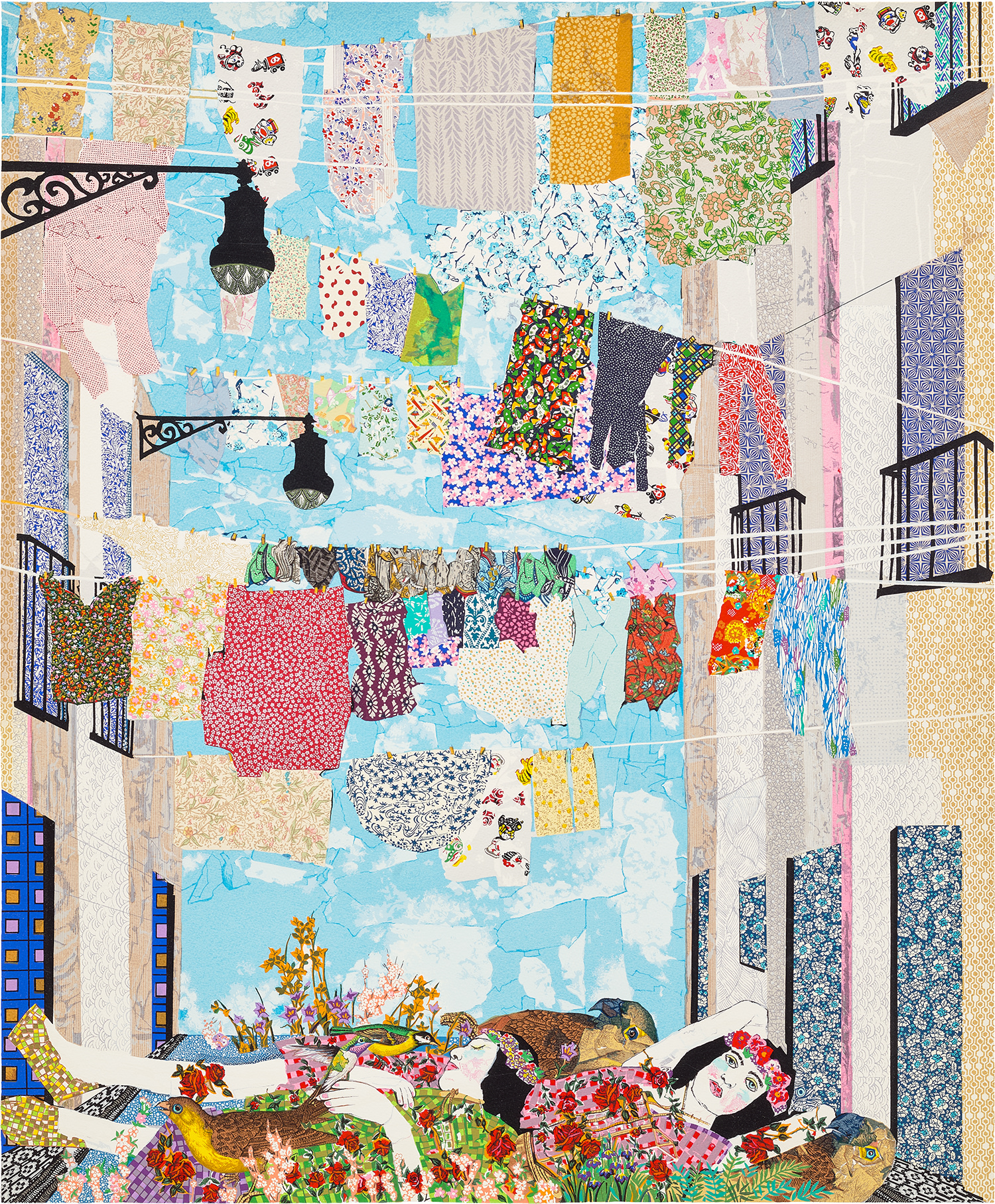
The city itself became a subject, not as skyline or spectacle but as a stage for the lives of women navigating distance, memory, and belonging. New York offered her proximity to the Japanese paper suppliers whose delicate tissue would become her primary material, and it placed her within a community of artists grappling with diaspora, identity, and what it means to make beauty while holding grief. Berrío's technique is unlike anything else in contemporary art. She begins with Japanese washi and tissue papers, painting them by hand with watercolor before tearing them into hundreds of small fragments.
María Berrío
Knitting the Wind, 2016
These fragments are then layered and adhered with meticulous care onto canvas or linen, building up surfaces that seem to glow from within, as though lit by some interior source. The process is slow, contemplative, almost devotional. Figures emerge from this accumulation in the way that meaning emerges from lived experience: gradually, and with great effort. The dreamlike quality of the resulting images is not an accident or an affectation.
It is the direct result of a material logic, where every layer carries the ghost of what came before. The works from the early 2010s established her reputation with force. "La Cena," from 2012, gathers figures around a table in a scene that recalls both Renaissance painting and the communal rituals of Latin American family life. "The Riders II," also from 2012, places women on horseback in a landscape that belongs to no single geography, at once tropical and mythic.
María Berrío
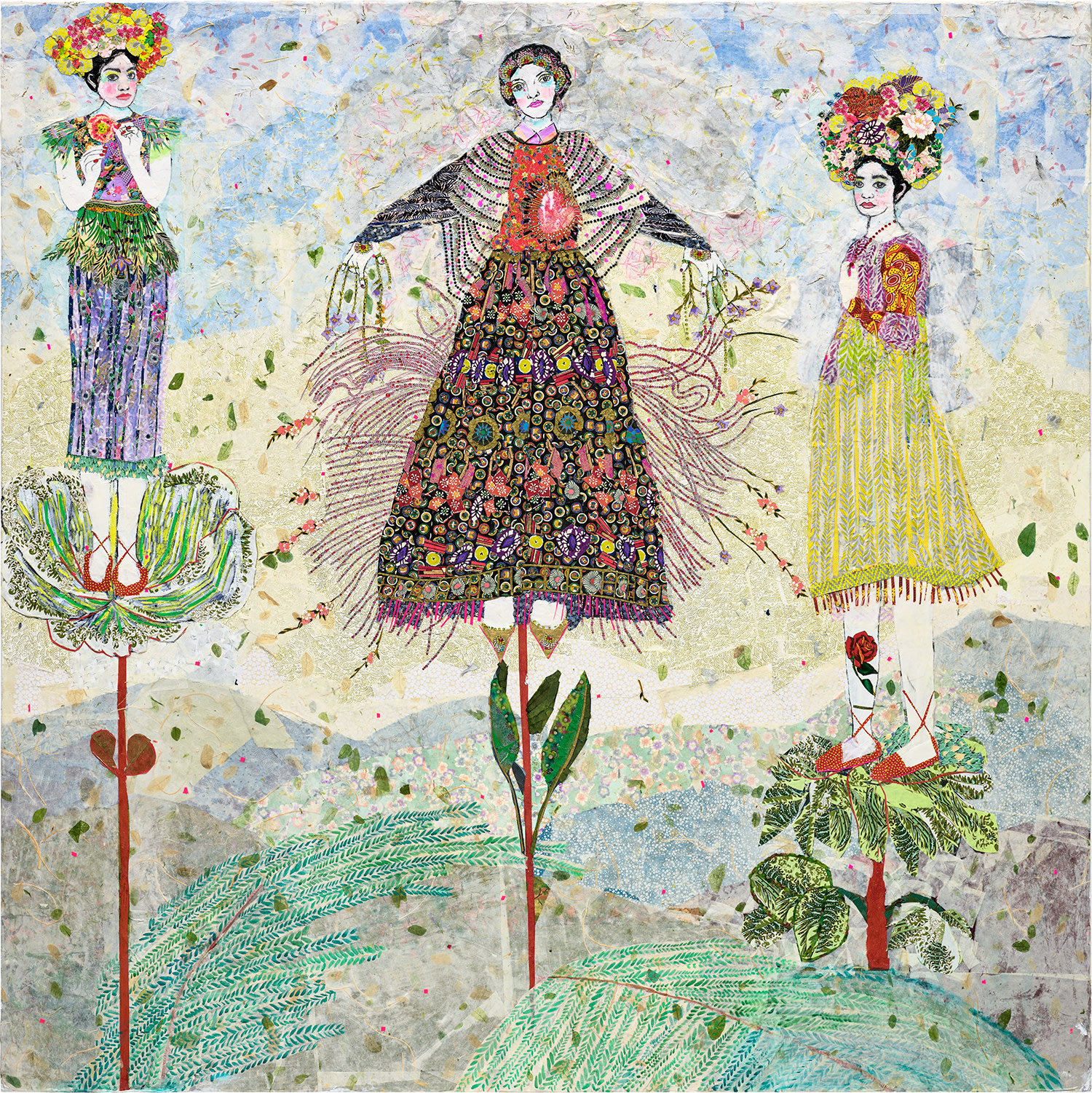
He Loves Me, He Loves Me Not, 2015
"Burrow of the Yellow" from 2013 and "Flor" from the same year extended this language into something more intimate and searching. These works drew the attention of Victoria Miro Gallery in London, which began representing Berrío and helped introduce her to a broad international audience. Her work also found a home with Anton Kern Gallery in New York, cementing her position within the serious gallery ecosystem on both sides of the Atlantic. By the mid 2010s, Berrío's ambitions had grown larger in every sense.
"He Loves Me, He Loves Me Not" from 2015 and the untitled works from the same year, incorporating rhinestones alongside watercolor and Japanese paper, showed her willingness to introduce unexpected elements of adornment and vulnerability. The rhinestones do something subtle and powerful: they catch light in the way that tears do, or sequins on a dress worn to a party one needs to survive. "Knitting the Wind" arrived as a silkscreen in 2016, translating her imagery into the language of printmaking and expanding the reach of her visual world. Works like "Our Children on the Battlefield" and "The Lovers 3" demonstrate her sustained engagement with the experiences of communities displaced by conflict, environmental precarity, and economic migration.
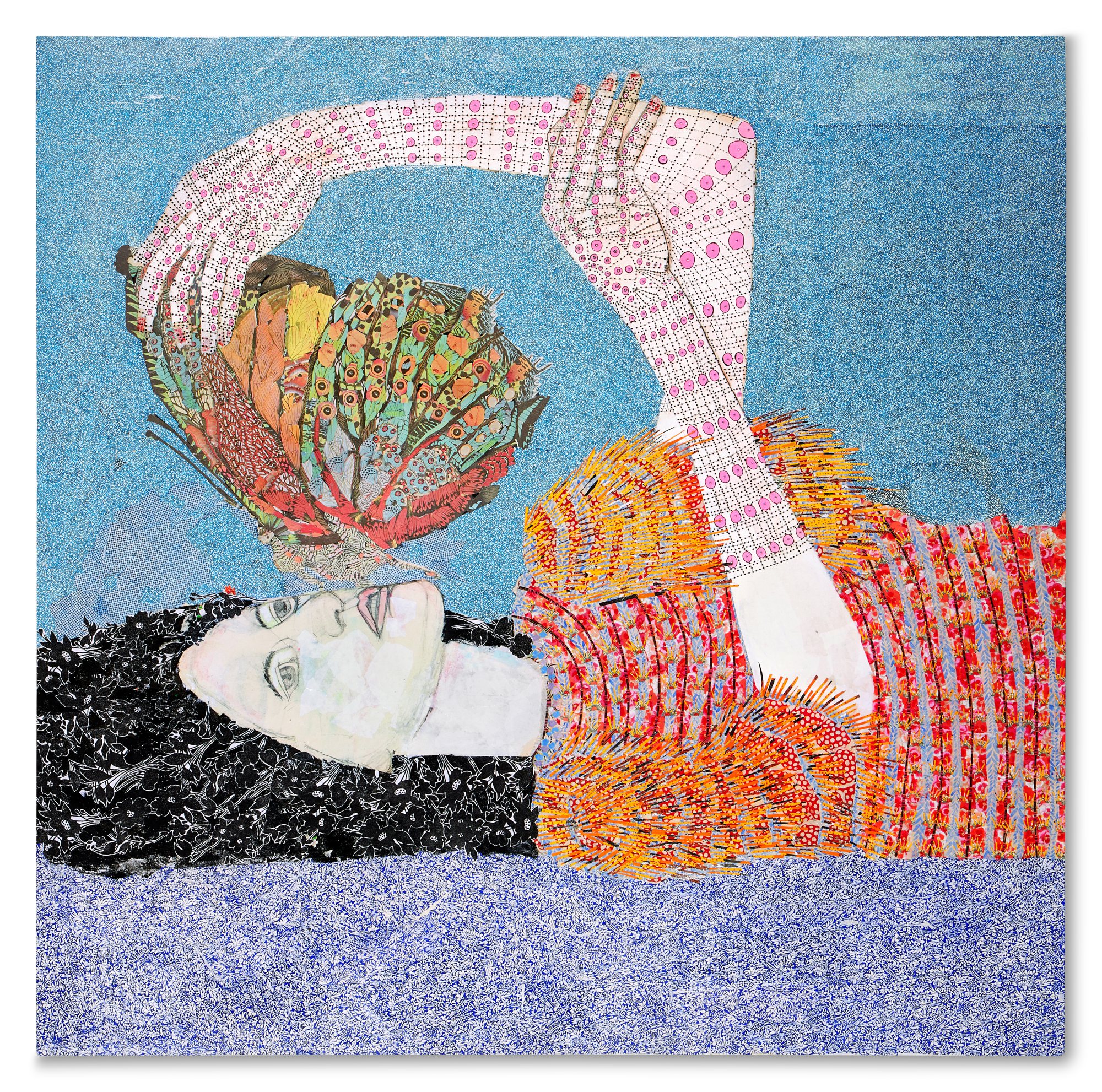
María Berrío
The Lovers 3 戀人 3
These are not protest works in any simple sense. They are elegies and celebrations at once, honoring the resilience of people who carry whole worlds inside them as they move across borders. For collectors, the appeal of Berrío's work operates on multiple registers simultaneously. There is the immediate visual pleasure of these surfaces, which reward close looking in a way that few contemporary works do.
The closer you stand, the more the individual fragments reveal themselves, and the more the sheer labor of construction becomes apparent. Then there is the emotional depth, the sense that these images are holding something real about the human condition. Collectors who have lived through migration, or who care deeply about questions of belonging and cultural memory, often describe encountering a Berrío for the first time as a recognition. Her works from the early period, particularly the 2012 and 2013 canvases, have attracted significant collector interest, and her more recent large scale works on linen represent an evolution that serious collections should track closely.
In the context of art history, Berrío belongs to a lineage of artists who have used the female figure and domestic or natural materials to speak about power, survival, and tenderness. Her work enters into dialogue with Romare Bearden, who also used collage to build layered cultural narratives, and with Kara Walker, whose silhouettes engage myth and violence with equal compositional precision. Her lush surfaces and her interest in women's spiritual lives connect her to artists like Cecily Brown and Lisa Yuskavage while remaining entirely distinct in method and vision. The Japanese paper technique places her in conversation with textile traditions and with the legacy of Arte Povera, where humble materials carry the weight of profound meaning.
What María Berrío offers the culture right now, at this particular moment of mass displacement and collective grief and urgent questions about who gets to belong where, is both timely and timeless. She makes works that are beautiful enough to bear witness to painful truths, and truthful enough to justify the beauty. Her practice is a form of commitment: to the people she depicts, to the materials she has mastered over two decades, and to the belief that art can hold what ordinary language cannot. To collect Berrío is to participate in that commitment, and to bring into one's home images that will continue to open and deepen with every year that passes.