Marcel Broodthaers
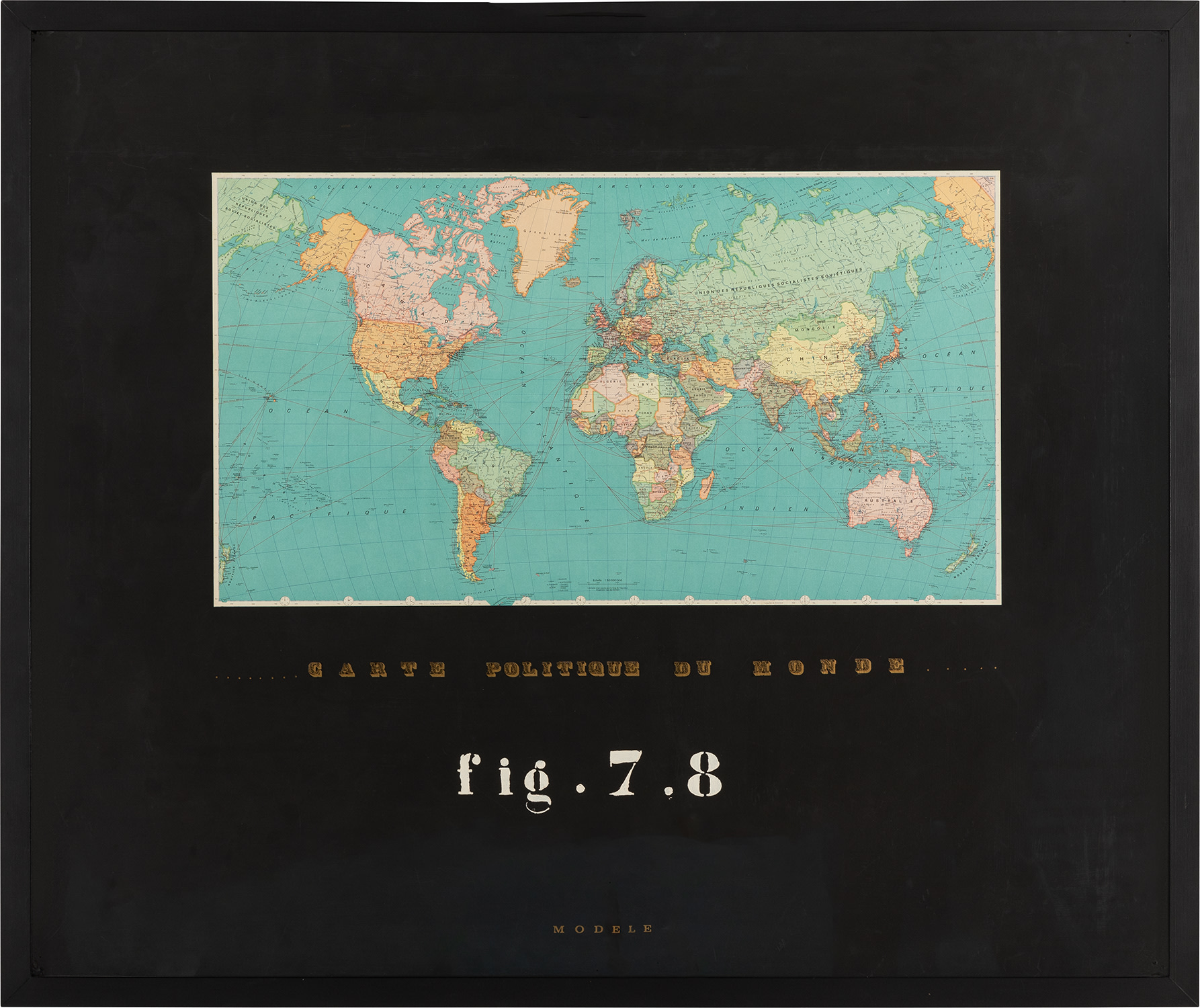
Marcel Broodthaers, Poetry Made Magnificently Visible
Artist Spotlight · The Collection Editorial
“I too wondered whether I could not sell something and succeed in life. For quite some time I had been good at nothing.”
Statement on Pense Bête, 1963
In the spring of 1968, a modest but electrifying announcement reached the European art world: Marcel Broodthaers had founded a museum. Not a real museum, exactly, but the Musée d'Art Moderne, Département des Aigles, an institution invented wholesale by the artist himself, complete with official correspondence, departmental sections, and exhibition catalogues. The gesture was absurd, rigorous, and wildly funny all at once. It was also, in retrospect, one of the most prescient acts of institutional critique the twentieth century produced, a move that artists and curators are still reckoning with today.
Marcel Broodthaers
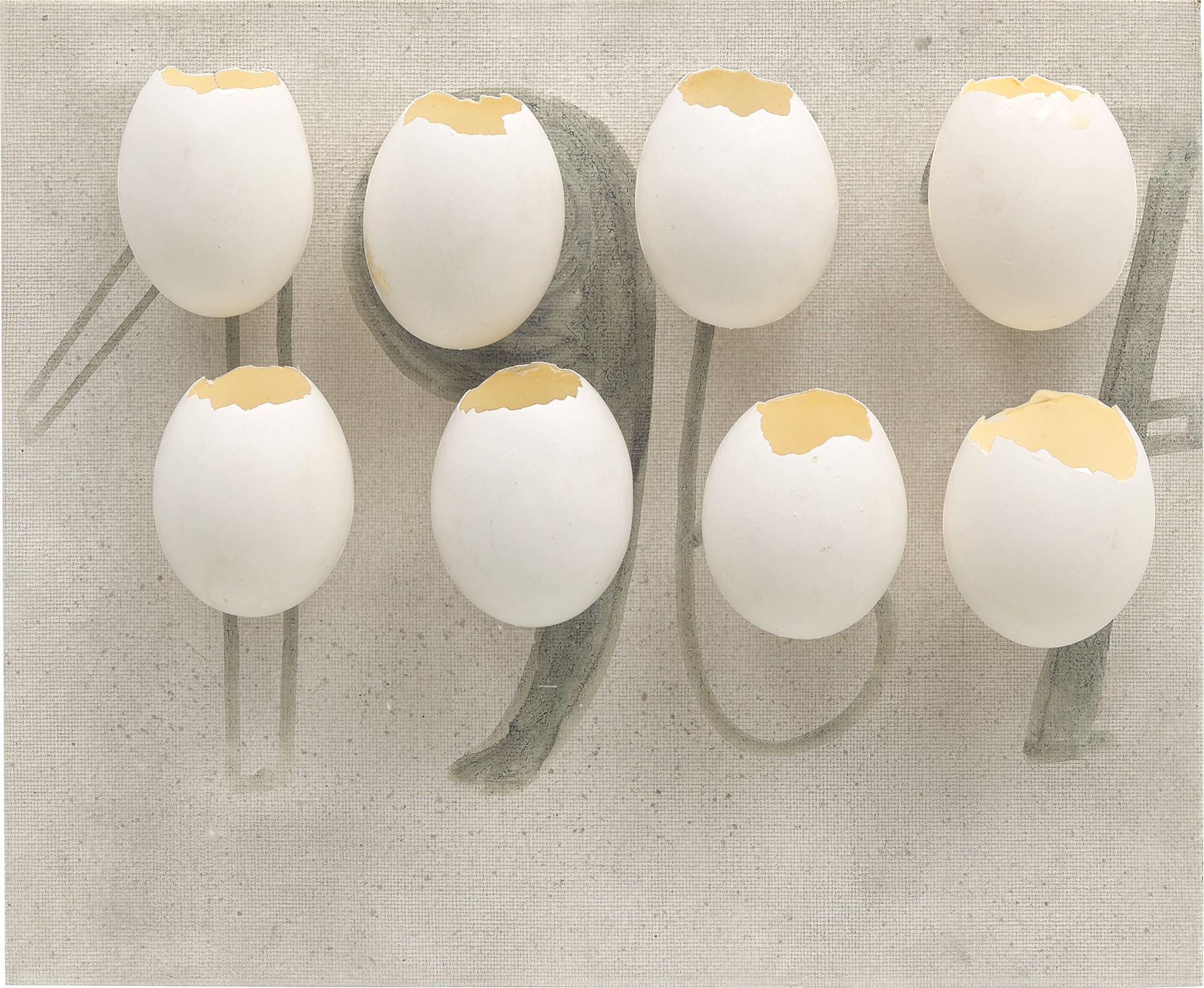
Bonne Année 1967, 1966
Broodthaers came to visual art late, which only deepened the clarity of his vision. Born in Saint Gilles, Brussels, in 1924, he spent his early adult life as a poet, bookseller, and occasional journalist, moving through the literary and surrealist circles that defined postwar Belgian cultural life. He admired René Magritte deeply, and the elder artist's shadow falls across much of his work, not as imitation but as affectionate and subversive dialogue. Broodthaers was also shaped by his friendship with the poet Hugo Claus and by his close reading of Stéphane Mallarmé, whose idea of the book as a total aesthetic object became a touchstone for everything that followed.
The rupture into visual art came in 1963, when Broodthaers was nearly forty years old. Frustrated by his inability to sell his poetry, he famously filled fifty unsold copies of his collection Pense Bête with plaster and exhibited them as sculpture. The act was both despairing and liberating, a farewell to one life and an inauguration of another. From that moment forward, his practice moved with remarkable confidence through sculpture, film, photography, printed matter, and installation, always circling back to questions about the language we use to assign meaning and value to objects and images.
Marcel Broodthaers
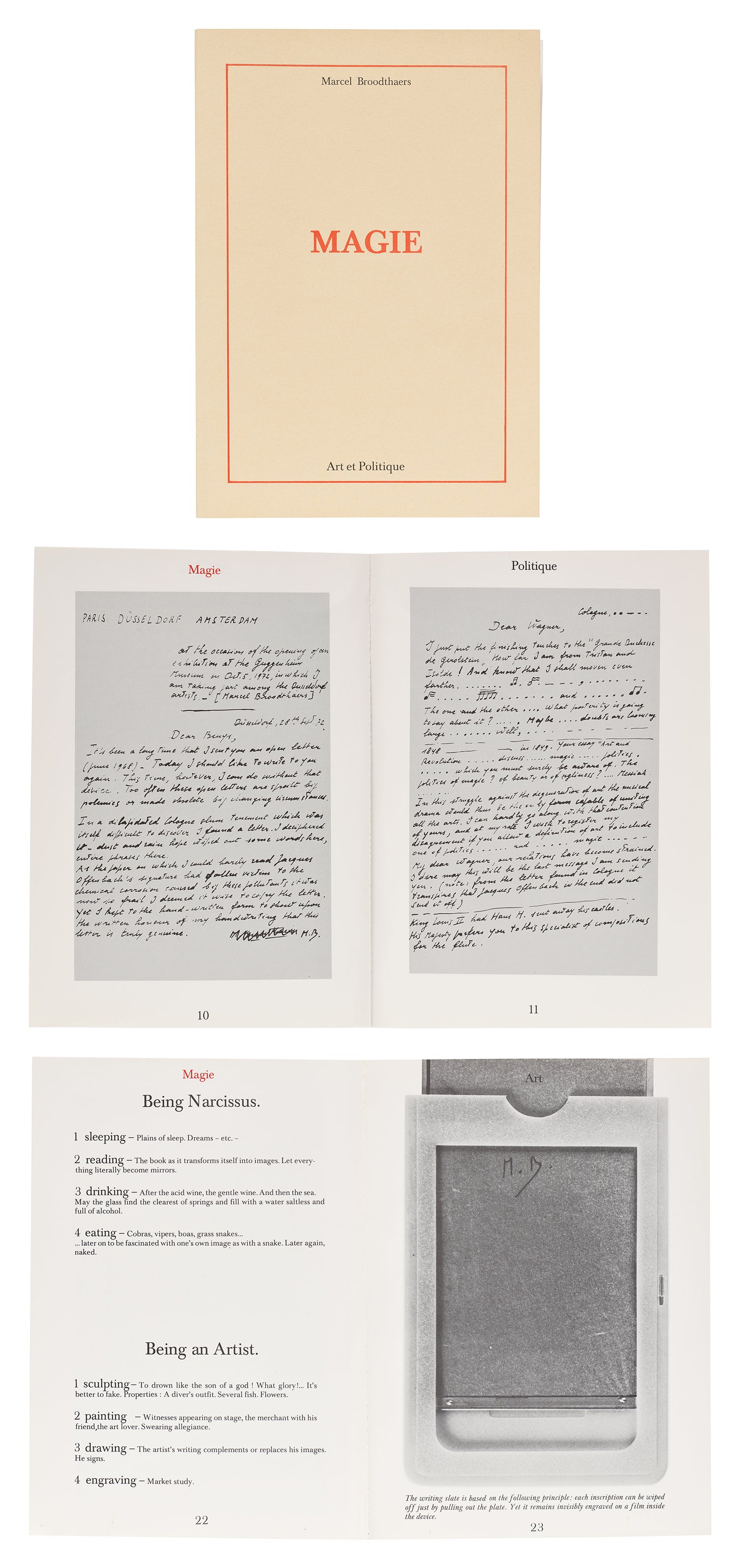
Magie. Art et politique (Magic. Art and Politics) (V. 37)
Eggshells became one of his most recognisable materials. Works such as Bonne Année 1967, created in 1966 and rendered in eggshells and ink on linen, distill his sensibility perfectly. The egg, fragile and biological, pressed into service as a decorative and conceptual unit, is both absurdly humble and surprisingly monumental. Broodthaers returned to mussels and eggshells repeatedly throughout the 1960s, and these works now read as a kind of signature, immediately identifiable and endlessly rich in their associations with food, labour, the domestic, and the Flemish painterly tradition he was simultaneously honouring and dismantling.
“The function of art is perhaps to transform the spectator into a subject rather than an object.”
Marcel Broodthaers
His engagement with language was equally central. The publication Magie. Art et politique, issued in an edition of 400 by Multiplicata in Paris, exemplifies his belief that the printed object could function as both artwork and polemic. Signed with his characteristic red ink initials, it is an object that refuses to settle into a single category, neither pamphlet nor artist book nor manifesto, but all three at once.
![Marcel Broodthaers — Citron - Citroen (Réclame pour la Mer du Nord) [Lemon - Citroen (Advertisement for the North Sea)]](https://rtwaymdozgnhgluydsys.supabase.co/storage/v1/object/public/artwork-images/auction-lots/UK030219-122019-lot1774409065126.jpg)
Marcel Broodthaers
Citron - Citroen (Réclame pour la Mer du Nord) [Lemon - Citroen (Advertisement for the North Sea)]
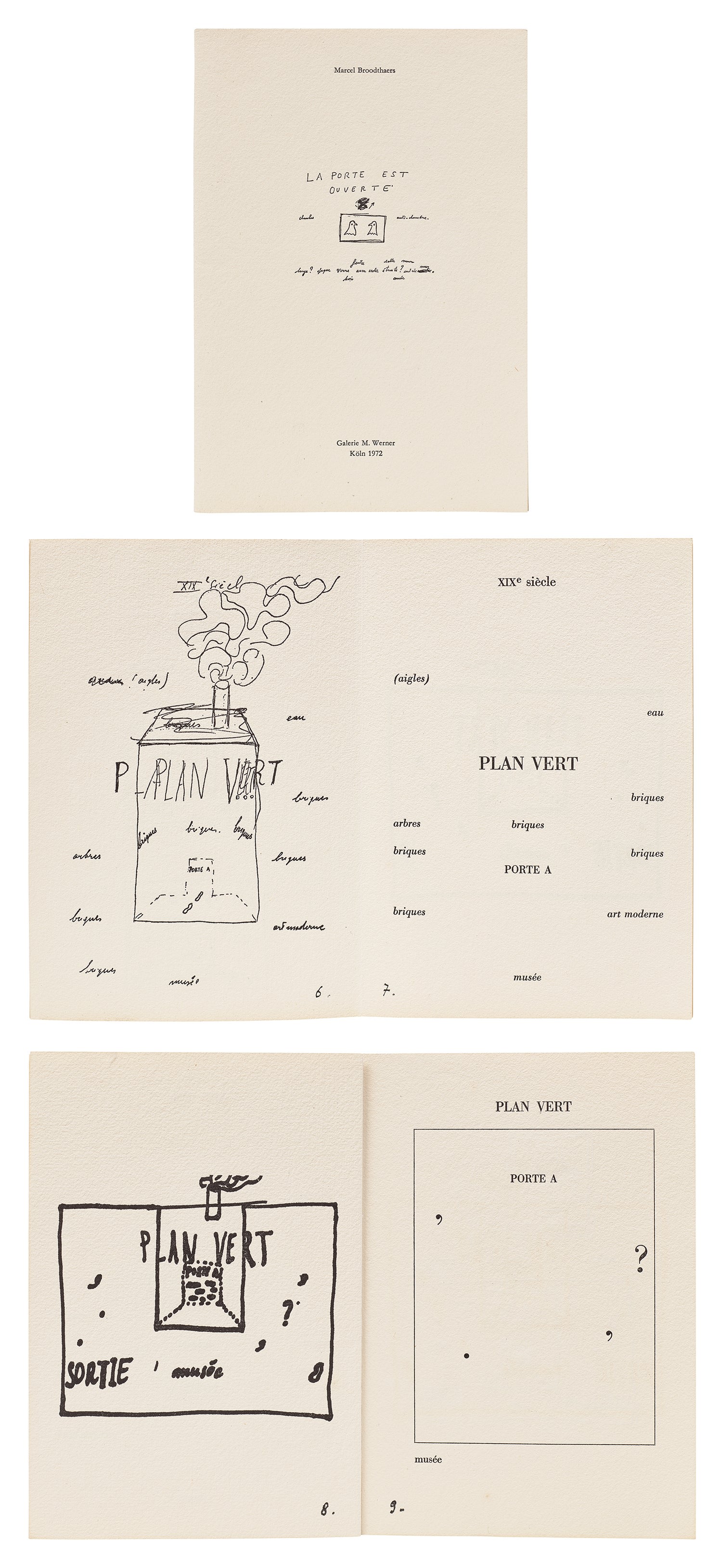
Similarly, works published through Galerie Michael Werner in Cologne and Edition Staeck in Heidelberg reveal how seriously Broodthaers took the multiple as a democratic and subversive form, a way of distributing ideas through the market while simultaneously questioning what the market does to ideas. The Musée d'Art Moderne, Département des Aigles, which he sustained in various forms from 1968 until 1972, remains the keystone of his legacy. Beginning in his Brussels apartment and eventually travelling to Düsseldorf and documenta 5 in Kassel in 1972, the project used the apparatus of institutional authority, the labels, the display cases, the departmental logic, to expose how museums construct knowledge and confer legitimacy. His film work from this period, including his meditations on Magritte and on the nature of the image itself, extends the same inquiry into moving pictures.
Works such as Écran fig. 1, fig. 2, fig. O, fig.
Marcel Broodthaers
PLAN VERT. La porte est ouverte (GREEN PLAN. The Door is Open) (V. 36)
A, in oil on canvas and wood, fold painting and text into each other until the border between image and caption dissolves entirely. For collectors, Broodthaers presents an unusually rich field. His practice spans photography, painting, multiples, unique sculpture, and printed matter, meaning that entry into his work is possible across a range of budgets and sensibilities. The gelatin silver print Simplon Pass from 1964 offers an intimate window into his photographic eye, while the enamel on vacuum formed plastic Rue René Magritte Straat from 1968, with its directional sign format and its homage to his great predecessor, demonstrates how elegantly he could transform a readymade language into something unmistakably his own.
Offset lithographs such as Citron, Citroen, which plays on the French word for lemon and the Belgian car brand's name, show his delight in linguistic slippage and his gift for making conceptual jokes that are also visually gorgeous. Broodthaers sits in natural conversation with artists including Joseph Beuys, with whom he appeared at documenta 5, and with the broader Conceptualist generation of the late 1960s that included Lawrence Weiner, Hans Haacke, and Daniel Buren. But his specifically Belgian formation, his roots in Surrealism, and his literary sensibility set him apart from the more austere Anglo American strands of Conceptual art. He is closer in spirit to Fluxus at its most poetic, or to the tradition of the artist as writer and intellectual that runs through Magritte, Francis Picabia, and on to later figures such as Mike Kelley and Rosemarie Trockel, both of whom owe him a considerable debt.
Broodthaers died in Cologne in January 1976, at just fifty one, leaving a body of work that felt, even then, like it contained more ideas than most artists generate in twice the time. In the decades since, his reputation has only grown. Major retrospectives at the Museum of Modern Art in New York in 2016 brought his work to new generations of viewers and confirmed what European institutions had long understood: that he was not a footnote to Conceptualism but one of its most original and necessary voices. His insistence that art must think, that it must take pleasure seriously, and that the systems we use to contain and valorise culture are always available for scrutiny and reinvention, feels urgently relevant in a moment when those systems are under pressure as never before.
To collect Broodthaers is to invest in a sensibility that keeps rewarding attention, a practice built not on spectacle but on the quiet, persistent intelligence of someone who looked at the world and could not stop asking what it was trying to say.
Explore books about Marcel Broodthaers
Marcel Broodthaers
A. James Speyer

Marcel Broodthaers: Collected Writings
Edited by Gloria Moure

Marcel Broodthaers
Benjamin H. D. Buchloh
Broodthaers: Writings, Interviews, Photographs
Edited by Rainer Michael Mason
Marcel Broodthaers: An Annotated Bibliography
Anne Rorimer and Ruth Kaufmann
Marcel Broodthaers: The Museum After Duchamp
Martha Buskirk
Marcel Broodthaers: Les Musées d'Art Modernes
Edited by Gloria Moure