Marc Chagall
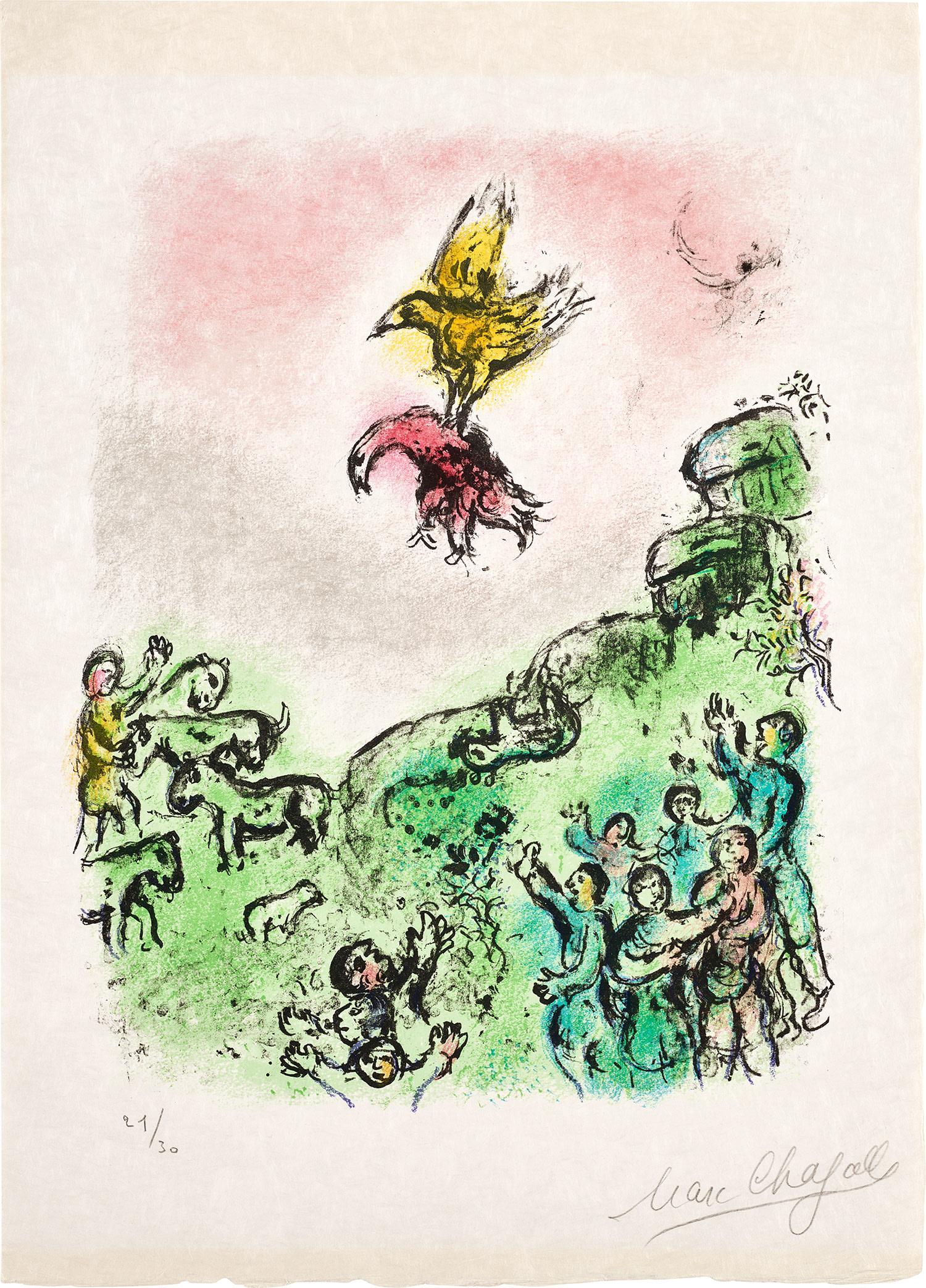
Marc Chagall: Dreams Rendered in Eternal Color
Artist Spotlight · The Collection Editorial
“Only love interests me, and I am only in contact with things that revolve around love.”
Marc Chagall
There are artists who document the world and artists who reimagine it entirely. Marc Chagall belongs decisively to the second category. When the Centre Pompidou mounted a landmark retrospective of his work in recent years, the queues stretched through the Marais on cold mornings, proof that nearly four decades after his death, the spell he cast remains wholly unbroken. His canvases and prints feel less like objects and more like permissions, invitations to accept the floating lovers, luminous animals, and celestial violinists of dream logic as a perfectly valid account of human experience.
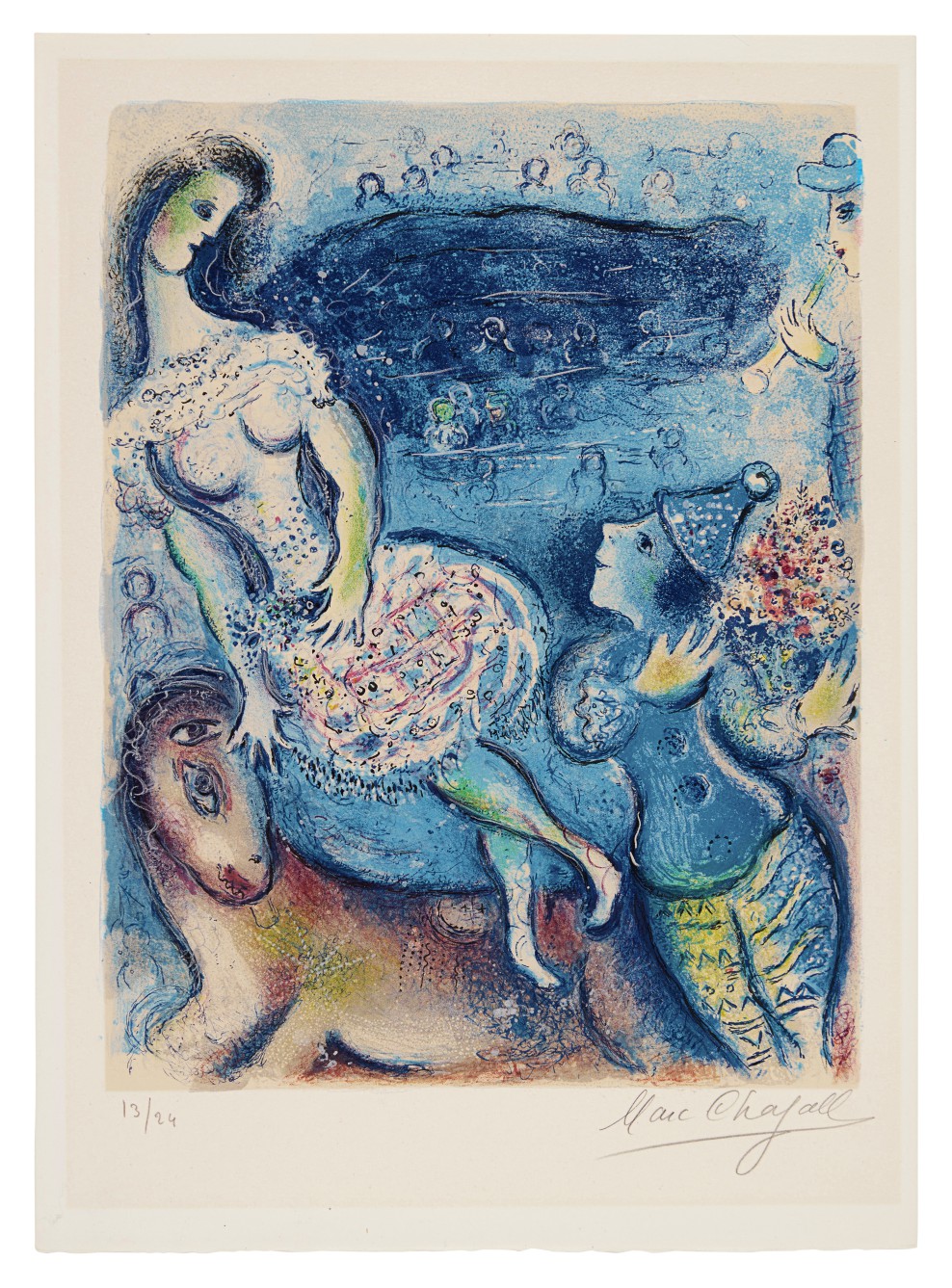
Marc Chagall
The Circus: One Plate (Mourlot 511)
Chagall was born in 1887 in Vitebsk, a provincial city in what is now Belarus, then part of the Russian Empire. He came from a devout Hasidic Jewish family, the eldest of nine children, and the textures of that world, the synagogue, the market, the snow covered rooftops, the prayers murmured at dusk, would never leave his work even as he traveled to Paris, New York, and the sun drenched south of France. His mother Feiga Ita was a woman of formidable will who arranged for her son to study under the local painter Yehuda Pen. The young Chagall was already composing images that felt borrowed from somewhere between waking life and reverie, a quality that no teacher fully explained and no movement entirely claimed.
In 1910, Chagall arrived in Paris and entered the cultural ferment of La Ruche, the celebrated artists residence in Montparnasse where Fernand Léger, Amedeo Modigliani, and Chaim Soutine were also finding their footing. He absorbed the lessons of Cubism and absorbed the electricity of Fauvism without surrendering to either. Where Cubism fractured form in the service of analytical rigor, Chagall fractured it in the service of emotion and memory. He met the dealer and champion Herwarth Walden, who gave him his first solo exhibition in Berlin in 1914, and returned to Vitebsk shortly afterward, only to be stranded there by the outbreak of the First World War.
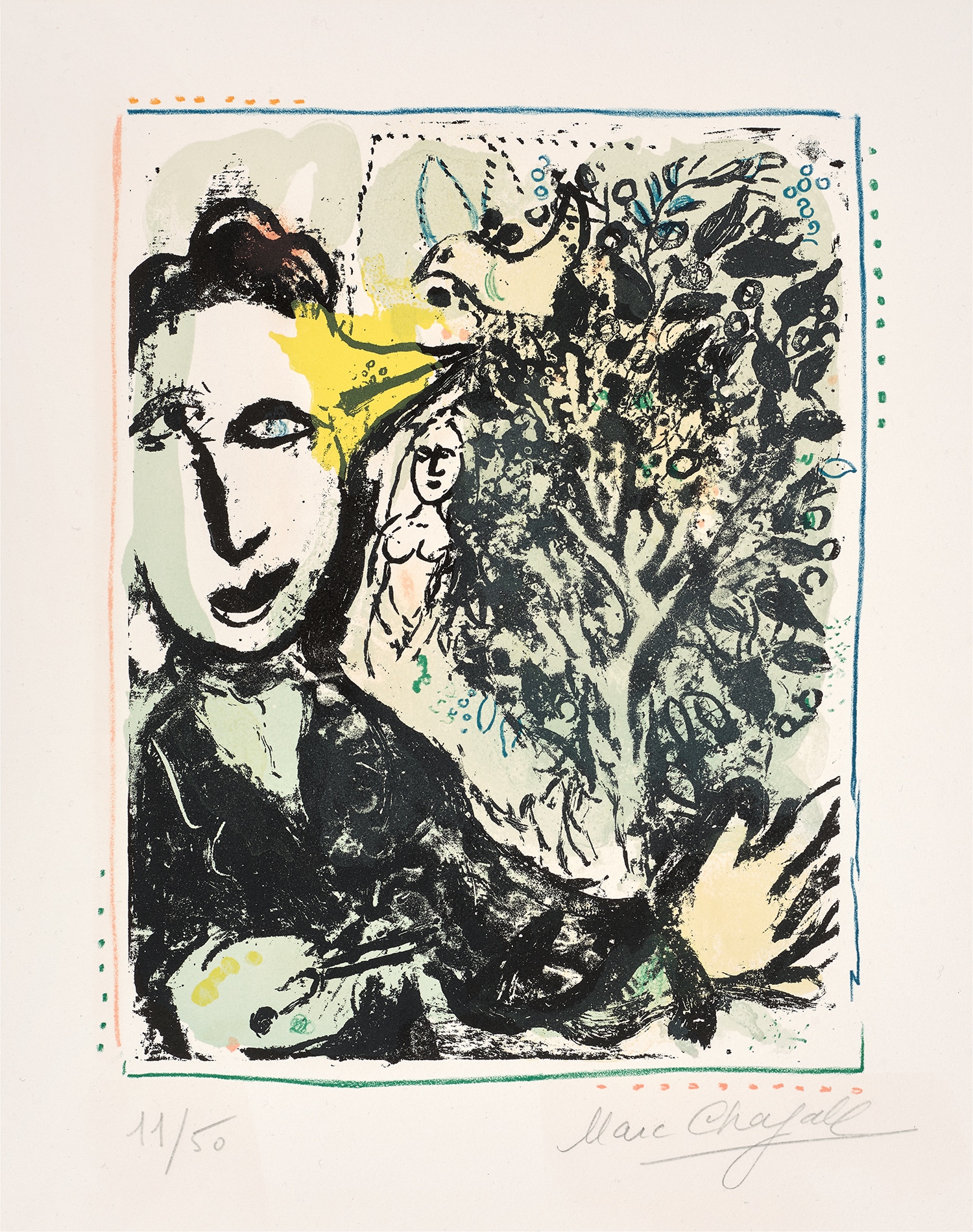
Marc Chagall
L’oiseau-peintre (The Painter Bird) (M. 473)
He married his great love Bella Rosenfeld in 1915, and she would become the recurring luminous presence in his paintings, literally airborne, suspended in the rose and cobalt heavens above their village. After a complicated period in revolutionary Russia, where he briefly served as commissar of arts in Vitebsk and founded an art school, Chagall returned to Western Europe in 1923. His friendship with the visionary dealer and publisher Ambroise Vollard proved transformative. Vollard commissioned a suite of etchings illustrating the Bible, a project that occupied Chagall for years and deepened his engagement with printmaking as a primary medium of spiritual expression.
“In our life there is a single color, as on an artist's palette, which provides the meaning of life and art. It is the color of love.”
Marc Chagall
He also produced etchings for Gogol's Dead Souls during this period, work of extraordinary delicacy and wit. These were not illustrations in any diminished sense. They were fully inhabited worlds pressed onto paper. The prints that collectors prize most fervently today bear witness to the full arc of Chagall's emotional and technical range.
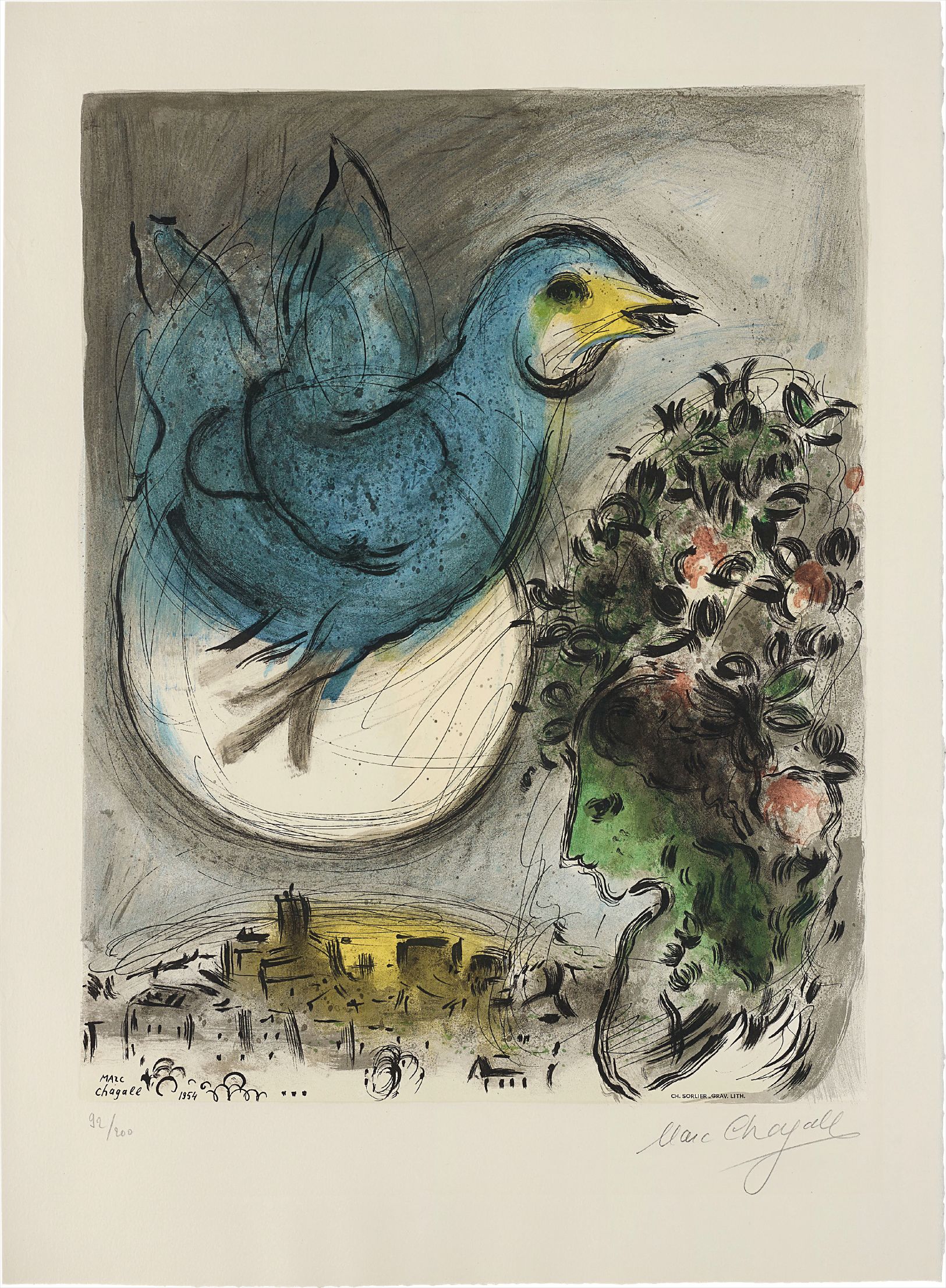
Marc Chagall
L'Oiseau bleu (The Blue Bird) by Charles Sorlier
His work on the Daphnis et Chloé suite, produced in collaboration with the master printer Charles Sorlier and published by Tériade in 1961, represents perhaps the most ravishing color lithography of the twentieth century. The sheets glow with Mediterranean light, the figures of the young lovers dissolving into landscapes of improbable tenderness. Prints from this suite, including the celebrated L'hiver and Daphnis et Chloé au bord de la fontaine, appear regularly at the most serious print sales and command sustained collector attention. His Cirque series is equally beloved, capturing the acrobats and clowns who fascinated him throughout his life as emblems of fragility and transcendence.
“Great art picks up where nature ends.”
Marc Chagall
Works such as The Circus: One Plate and Le cirque plate 34 demonstrate his mastery of color separation and the particular warmth he drew from Arches paper, a collaboration with material that feels almost biological in its intimacy. From a collecting standpoint, Chagall's prints occupy a remarkable position in the market. They are among the most accessible entry points into a body of work whose paintings regularly achieve seven and eight figure results at Christie's and Sotheby's. The lithographs carry genuine museum quality and can be examined with the same rigorous eye one brings to the paintings.
Marc Chagall
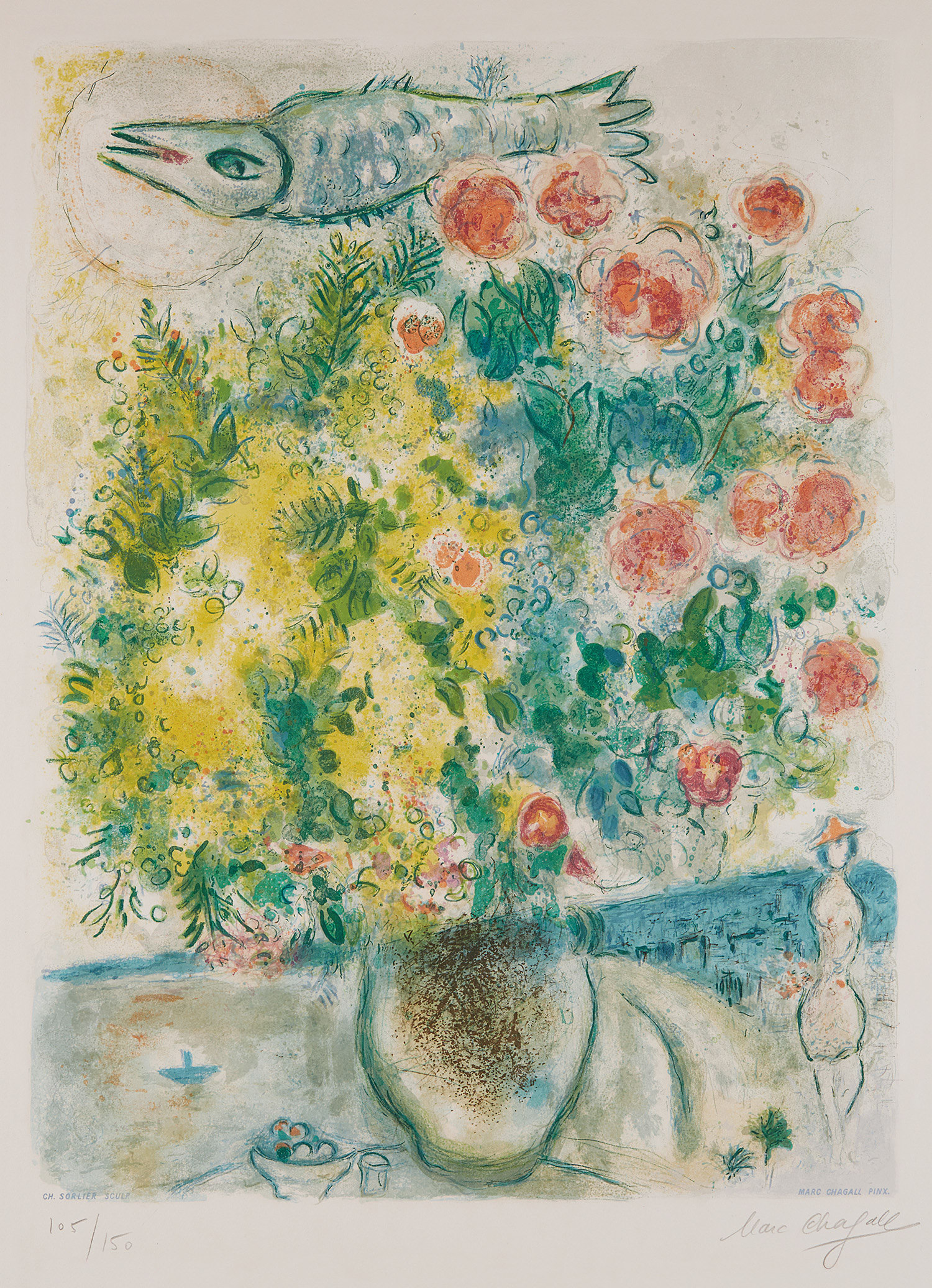
Roses et mimosas, from Nice et la Côte d'Azur (Roses and Mimosas, from Nice and the French Riviera), by Charles Sorlier
Works printed on Arches paper with full margins, catalogued within the authoritative Mourlot and Sorlier references, are the standard of quality collectors pursue. The participation of Charles Sorlier, who worked with Chagall closely and brought enormous skill to the translation of his painterly vision into lithographic form, is a particular mark of distinction. Prints bearing that collaboration carry both technical excellence and historical significance. Collectors entering the market now benefit from a deep and well documented secondary literature that makes authentication and condition assessment relatively straightforward compared to less thoroughly catalogued artists.
Chagall's place in art history is singular precisely because he resists the clean categories that make art historical narration tidy. He is claimed by Surrealism, with André Breton acknowledging the dreamlike logic of his imagery, yet he always denied the designation, insisting his imagery arose from lived experience rather than the unconscious as a theoretical program. He is linked to the School of Paris alongside Modigliani, Soutine, and Jules Pascin, artists who brought Eastern European Jewish sensibility into the French avant garde. He is a giant of Jewish art and simultaneously a universalist whose stained glass windows for the cathedrals of Reims and Metz and the synagogue at the Hadassah Medical Center in Jerusalem speak to a vision of human longing that crosses every tradition.
His late works, including the monumental tempera and pastel piece La Rencontre from 1980, created when he was in his nineties, confirm that his imaginative energy never dimmed. To collect Chagall is to participate in something larger than the art market. It is to align oneself with a vision that refused the twentieth century's most brutal pressures, its wars, its genocides, its ideological fanaticisms, and answered them with color, with love, with the image of a fiddler balanced impossibly on a rooftop above a world that might at any moment disappear. That stubbornness, that insistence on beauty as a serious response to catastrophe, is what makes him not merely historically important but urgently alive.
His work does not hang on walls so much as inhabit rooms, changing the emotional weather of wherever it is placed. For collectors who want art that asks something meaningful of the viewer and gives something essential in return, Chagall remains one of the great permanent answers.
Explore books about Marc Chagall
Marc Chagall: 1887-1985
Jean Leymarie
Marc Chagall: A Retrospective
Susan Compton
Chagall: An Autobiography
Marc Chagall
Marc Chagall: His Life, His Work
Franz Meyer
Marc Chagall: My Life
Marc Chagall

Chagall and the Bible
Jean Leymarie
Marc Chagall: Paintings 1910-1914
Benjamin Harshav
Chagall
Jackie Wullschlager