Marc Chagall after.
Marc Chagall: Love, Light, and Wonder
Artist Spotlight · The Collection Editorial
“In our life there is a single color, as on an artist's palette, which provides the meaning of life and art. It is the color of love.”
Marc Chagall
In the spring of 2023, the Musée National Marc Chagall in Nice welcomed record visitor numbers for its seasonal reinstallation, reminding a new generation why this artist remains one of the most emotionally immediate voices in modern art. That same year, major lithographs by Chagall continued to perform with remarkable consistency at auction houses across London and Paris, with collectors drawn not only to the rarity of his finest prints but to something harder to quantify: a feeling of warmth that radiates from every carefully layered colour. Few artists in the twentieth century managed to build a body of work so recognisably personal, so suffused with tenderness, and yet so formally inventive. Chagall belongs to no single movement and to all of them at once.
Marc Chagall after.
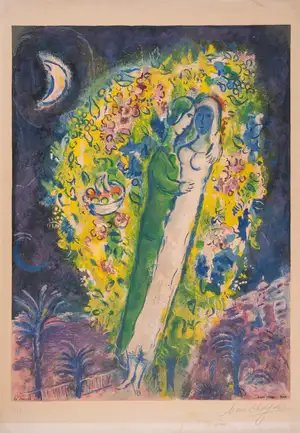
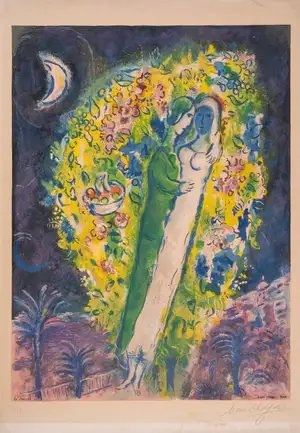
Couple dans les Mimosas, from Nice et la Côte d'Azur (Sorlier 32)
Mark Zakharovich Chagall was born on 7 July 1887 in Vitebsk, a city in what is now Belarus, into a modest Hasidic Jewish family. He was the eldest of nine children, and the world of his childhood was one of ritual, community, and the particular colour of provincial Russian life at the turn of the century. These early years never left him. The fiddlers on rooftops, the floating figures, the goats and candlesticks and village synagogues that populate his canvases and prints are not invented fantasies but memory made luminous.
When he left for Saint Petersburg in 1906 to study painting, and then for Paris in 1910, he carried Vitebsk with him like a second skin. In Paris, Chagall settled in La Ruche, the legendary artists' colony in Montparnasse, where he became part of a remarkable constellation of talent that included Fernand Léger, Amedeo Modigliani, and Guillaume Apollinaire. He absorbed Cubism and Fauvism with an alert eye but refused to be consumed by either. His breakthrough canvases from this period, including I and the Village from 1911, now housed at the Museum of Modern Art in New York, show a painter synthesising multiple influences into something entirely his own: fractured planes of colour animated by myth, folklore, and an almost mystical sense of longing.
Marc Chagall after.
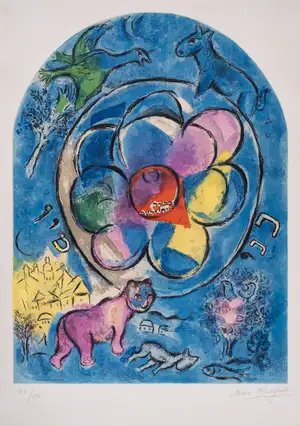
The Tribe of Benjamin, from Twelve Maquettes of Stained Glass Windows for Jerusalem
He returned to Russia in 1914, intending a brief visit, and was caught there by the outbreak of the First World War. He married his great love Bella Rosenfeld in 1915, and she became one of the enduring presences in his art, appearing again and again as a floating, luminous figure beside him. The years that followed took Chagall through extraordinary upheaval. He served as commissar for arts in Vitebsk after the Russian Revolution, founded an art school there, and briefly taught alongside Kasimir Malevich before artistic and political tensions drove him out.
“Only love interests me, and I am only in contact with things that revolve around love.”
Marc Chagall
He emigrated to Berlin in 1922 and then returned permanently to Paris in 1923, where his friendship with the dealer Ambroise Vollard led to one of the great collaborations in print history. The two worked together on illustrated editions of Gogol and the Bible, commissioning etchings from Chagall that demonstrated his mastery of the medium. These biblical etchings, produced between 1931 and 1939, are among the most sought after works in his graphic output and remain benchmarks for collectors serious about his printmaking legacy. It is in his lithographic work, however, that many collectors find the most accessible and consistently rewarding entry into Chagall's world.
Marc Chagall after.
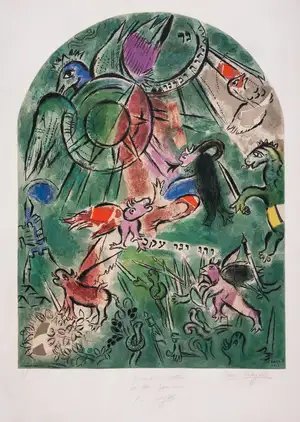
The Tribe of Gad, from Twelve Maquettes of Stained Glass Windows for Jerusalem
His partnership with the master printer Fernand Mourlot, which began in the late 1940s and extended through the following decades, produced some of the most celebrated colour lithographs of the twentieth century. Works such as Couple dans les Mimosas, from the Nice et la Côte d'Azur series of 1968, exemplify everything that makes his prints so compelling: the saturated Mediterranean palette, the signature motifs of intertwined figures and flowering branches, and the sense that each sheet has been touched by an almost ceremonial care. Printed on Arches paper by Mourlot in Paris and signed in pencil by the artist, these lithographs carry the full weight of his vision in a format that was designed, from the outset, to reach collectors directly. The Jerusalem Windows series, produced in 1964 also through Mourlot, occupies an especially significant place in his output.
“Great art picks up where nature ends.”
Marc Chagall
The Twelve Maquettes of Stained Glass Windows for Jerusalem were created in connection with the actual windows Chagall designed for the synagogue at the Hadassah Hebrew University Medical Centre, and the prints documenting the Tribes of Benjamin, Gad, Simeon, and their companions represent a marriage of spiritual purpose and graphic brilliance that is genuinely rare in the history of modern printmaking. For collectors approaching Chagall today, the market rewards knowledge and patience in equal measure. Signed and numbered impressions from documented editions printed by Mourlot command the strongest premiums, particularly when they come with clear provenance and are presented in good condition with full margins intact. Estimates for significant colour lithographs regularly fall in the range of several thousand to fifteen thousand pounds at the major London salesrooms, though exceptional works or those with notable exhibition histories can exceed these figures comfortably.
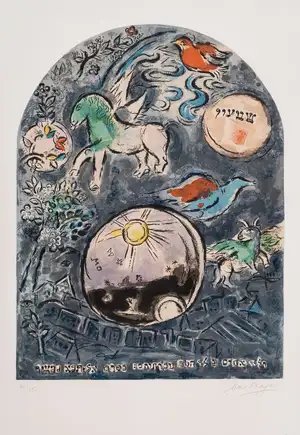
Marc Chagall after.
The Tribe of Simeon, from Twelve Maquettes of Stained Glass Windows for Jerusalem
The appeal crosses geographical markets: Chagall is collected with equal enthusiasm in Europe, North America, and increasingly across Asia and the Middle East, which speaks to the universality of his themes. Love, faith, memory, and the persistence of beauty are not concerns confined to any single culture. In the broader context of twentieth century art, Chagall sits in fascinating company. His closest affinities are with artists who similarly refused the purely intellectual demands of abstraction in favour of emotionally saturated imagery: Raoul Dufy shares his Mediterranean palette and lyrical lightness, Henri Matisse his decorative boldness and spiritual ambition in the stained glass medium, and Pablo Picasso, his near contemporary in Paris, provides the most instructive contrast, pursuing a radically different path through Cubism and transformation where Chagall chose fidelity to feeling.
Collectors drawn to Chagall often find themselves equally engaged by Miró's dreamlike symbolism or the tender intimacy of Renoir's late work. Chagall died on 28 March 1985 in Saint Paul de Vence, France, at the age of 97, having outlived almost every artist of his generation and witnessed the full arc of modern art. His legacy rests not on theoretical innovation but on something rarer: the ability to make the viewer feel welcomed into a world where love is the governing force. The windows at Hadassah, the ceiling of the Paris Opéra, the murals at the Metropolitan Opera in New York, and above all the prints and canvases in collections around the world continue to do what great art always does.
They make the present moment larger.
Explore books about Marc Chagall after.
Marc Chagall
Franz Meyer
Marc Chagall: My Life
Marc Chagall
Chagall: A Biography
Jackie Wullschlager
Marc Chagall 1887-1985
Jean Leymarie
Chagall: Love and Exile
David McNeil
The Lithographs of Marc Chagall
Fernand Mourlot
Marc Chagall: Catalogue Raisonné
Jean Leymarie and others
Chagall: The Russian Years
Susan Compton