Manolo Millares
Manolo Millares: A Force Beautifully Unleashed
Artist Spotlight · The Collection Editorial
There is a moment, standing before a Manolo Millares canvas at the Museo Reina Sofía in Madrid, when the work seems to breathe. The burlap tears, the black paint pools, the knotted threads reach outward like something alive and urgent. It is not a comfortable sensation, but it is an unforgettable one, and it explains precisely why Millares has never truly left the conversation since his death in 1972. His canvases hold a charge that decades cannot discharge, and institutions across Europe and the Americas have quietly been reasserting his place among the essential voices of twentieth century abstraction.
Manolo Millares
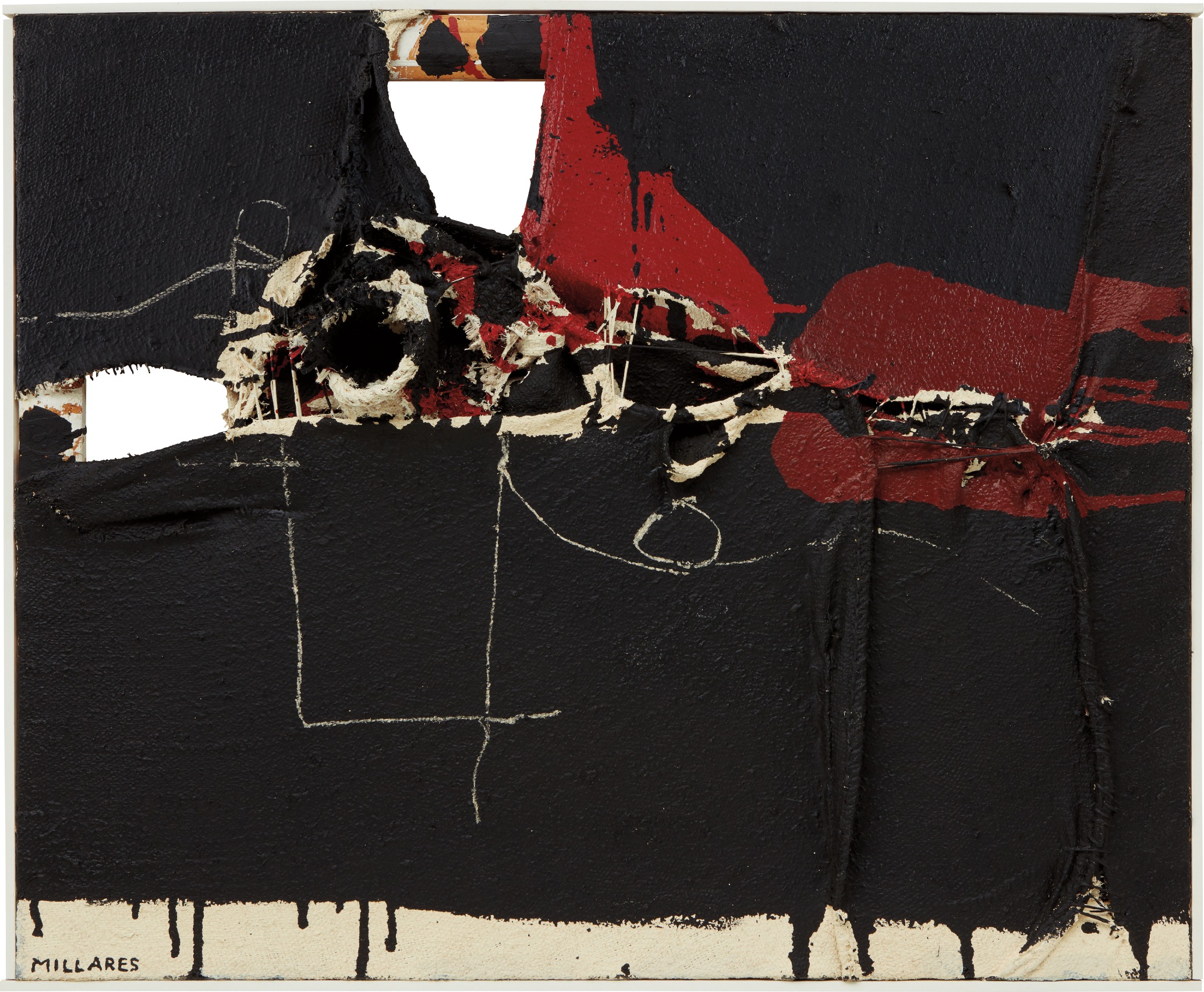
Cuadro 128, 1960
Manolo Millares was born in Las Palmas de Gran Canaria in 1926, and the Canary Islands shaped him in ways that would echo through every work he ever made. Growing up on an archipelago at the edge of the Atlantic, geographically removed from the Spanish mainland and its cultural centers, Millares developed an early independence of spirit and an acute awareness of isolation. He came of age during the long aftermath of the Spanish Civil War, in a country whose official culture was locked in the grip of Francoist conservatism. That experience of constraint, of grief held just below the surface of daily life, became the wellspring from which his art would eventually pour forth.
He began as a painter and draughtsman with an interest in primitivism and the pre Hispanic art of the Canaries, influences that gave his early work an archaeological quality, a sense of reaching backward into buried time. By the late 1940s and early 1950s, Millares was already exhibiting and building a reputation within the Spanish avant garde, but the decisive turn came in 1957 when he became one of the founding members of the El Paso group in Madrid. El Paso brought together some of the most radical artistic minds in Spain at that moment, including Antonio Saura and Rafael Canogar, and collectively they championed a form of gestural abstraction that placed Spanish painting in dialogue with Art Informel movements flourishing across Europe and in New York. For Millares, El Paso was not simply an association but a liberation.
Manolo Millares
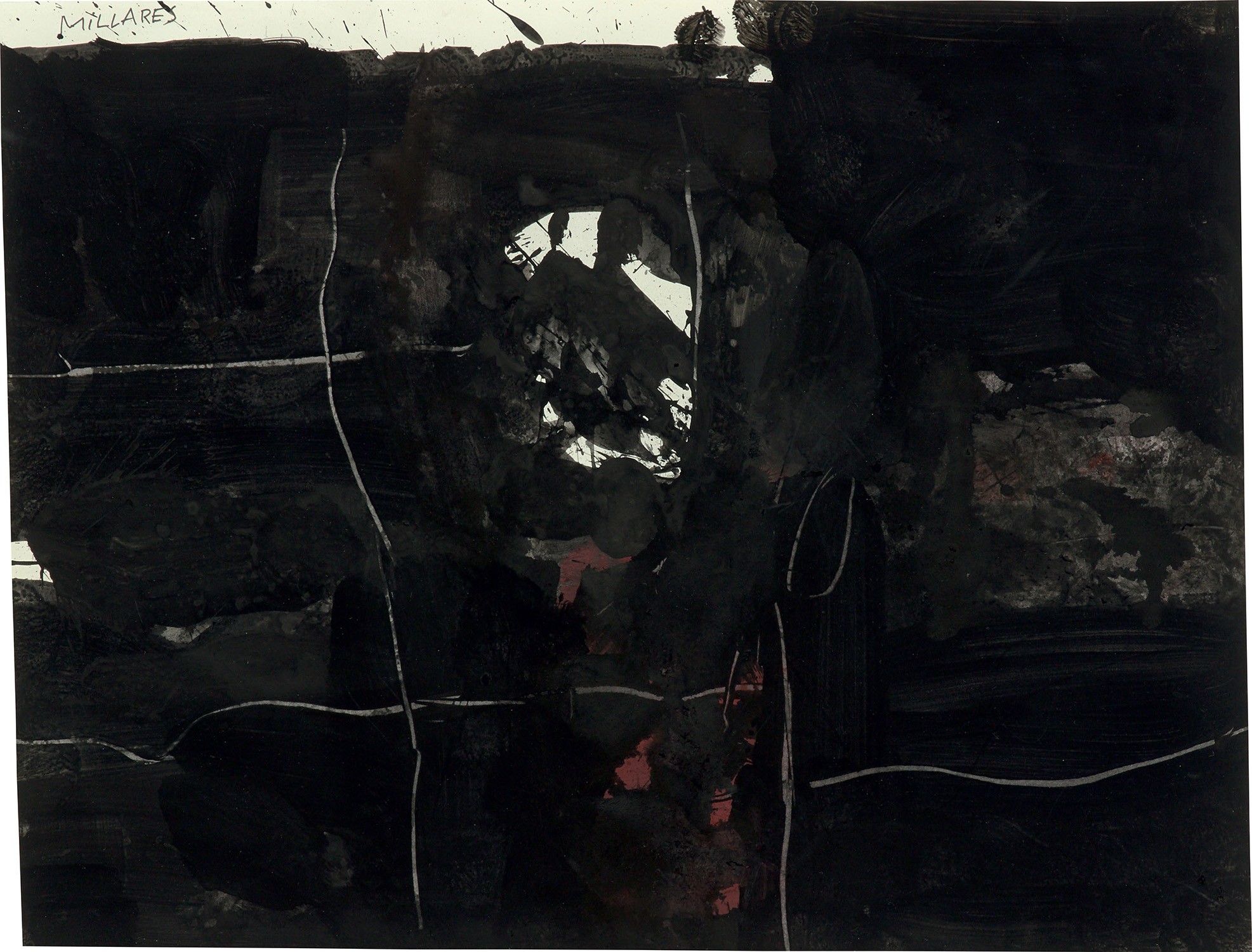
Composition, 1961
Here was a community of artists willing to refuse the decorative and the comfortable, willing to make work that bore witness to something real and difficult about the human condition. The breakthrough that defined his legacy was his embrace of arpillera, the rough sacking cloth used in everyday Spanish life. Beginning in the late 1950s, Millares began tearing, stitching, burning, and painting burlap directly, creating works of startling physical presence. The material carried its own memory, its own social weight, and Millares exploited this with extraordinary intelligence.
He combined the burlap with oil paint, often in stark blacks, whites, and reds, creating compositions that felt simultaneously ancient and absolutely contemporary. Works such as Cuadro 93 and Cuadro 128, both from 1960, stand as landmarks of this period. In them, the torn and sutured surface becomes a kind of skin, wounded and stitched, expressive of trauma without ever descending into mere illustration. Cuadro 196 from 1962 extends this vocabulary with even greater material confidence, the composition opening outward with a generosity that only an artist fully at ease with his own language can achieve.
Manolo Millares
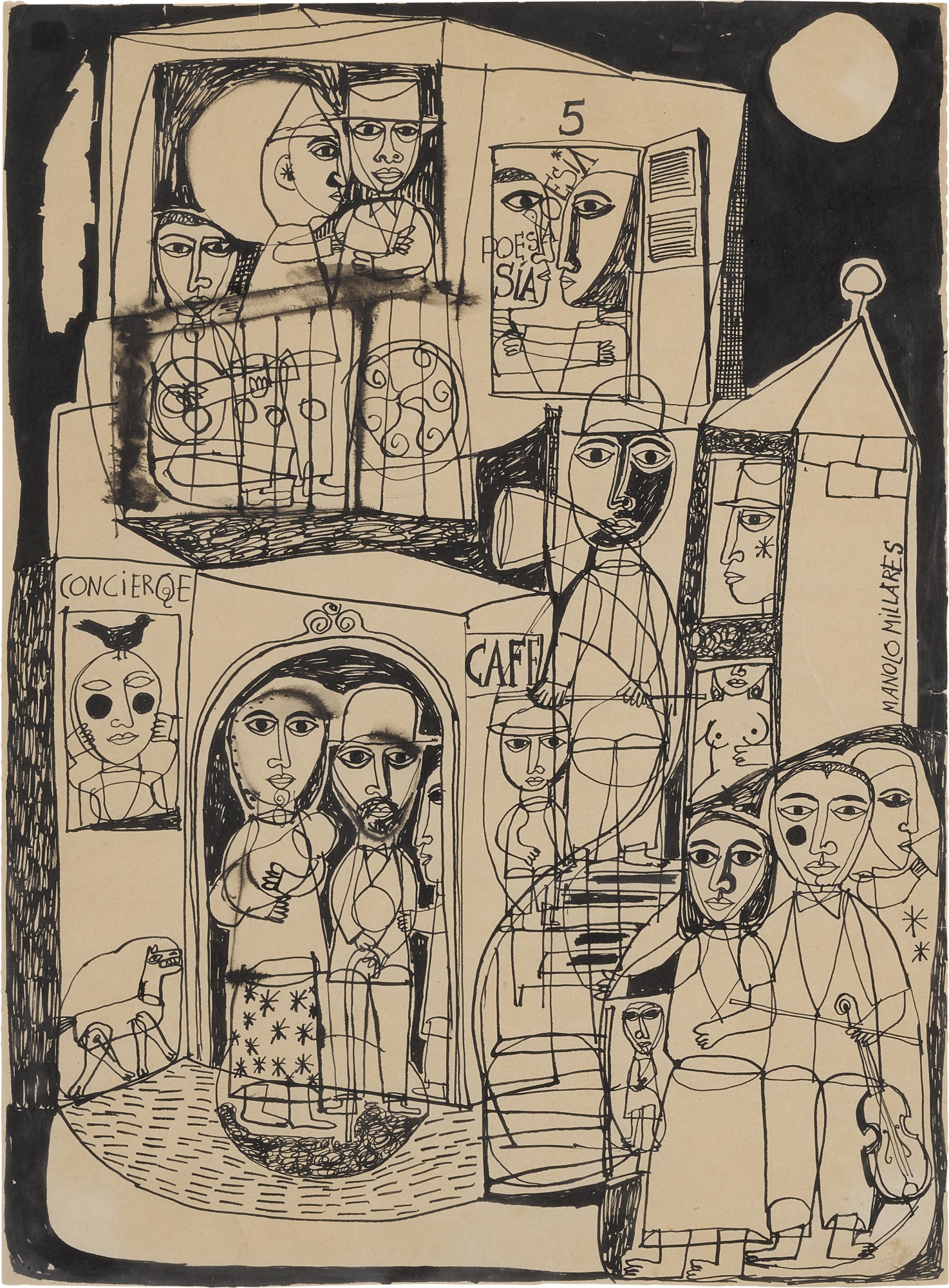
Figures en arquitectura
The series known as the Homúnculos occupied much of Millares throughout the 1960s and into the early 1970s. The homúnculo, a diminutive human figure evoked rather than depicted, became his central protagonist, a bundled form suggesting both vulnerability and endurance. These figures wrapped in burlap and smeared with paint spoke of bodies in extremis, of humanity compressed and pressured but persisting. The series earned Millares a growing international audience and placed him at the center of debates about what painting could do in an era scarred by war and political repression.
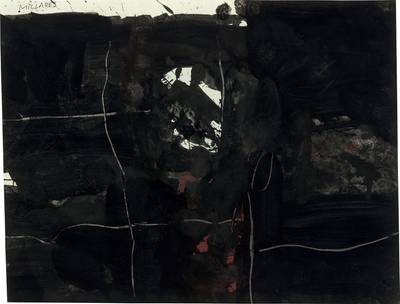
His works on paper from this period, including the delicate yet forceful brush and ink compositions, reveal another dimension of his practice, one more intimate in scale but no less searching in intent. For collectors, works by Millares represent something genuinely rare: a body of work that is both historically significant and viscerally alive. His canvases have been held in serious private collections across Spain, Germany, France, and the United States for decades, and they appear periodically at major auction houses and in the most distinguished gallery presentations of postwar European abstraction. The burlap works in particular reward sustained attention, as the layers of material and paint reveal new relationships depending on the light and the viewer's proximity.
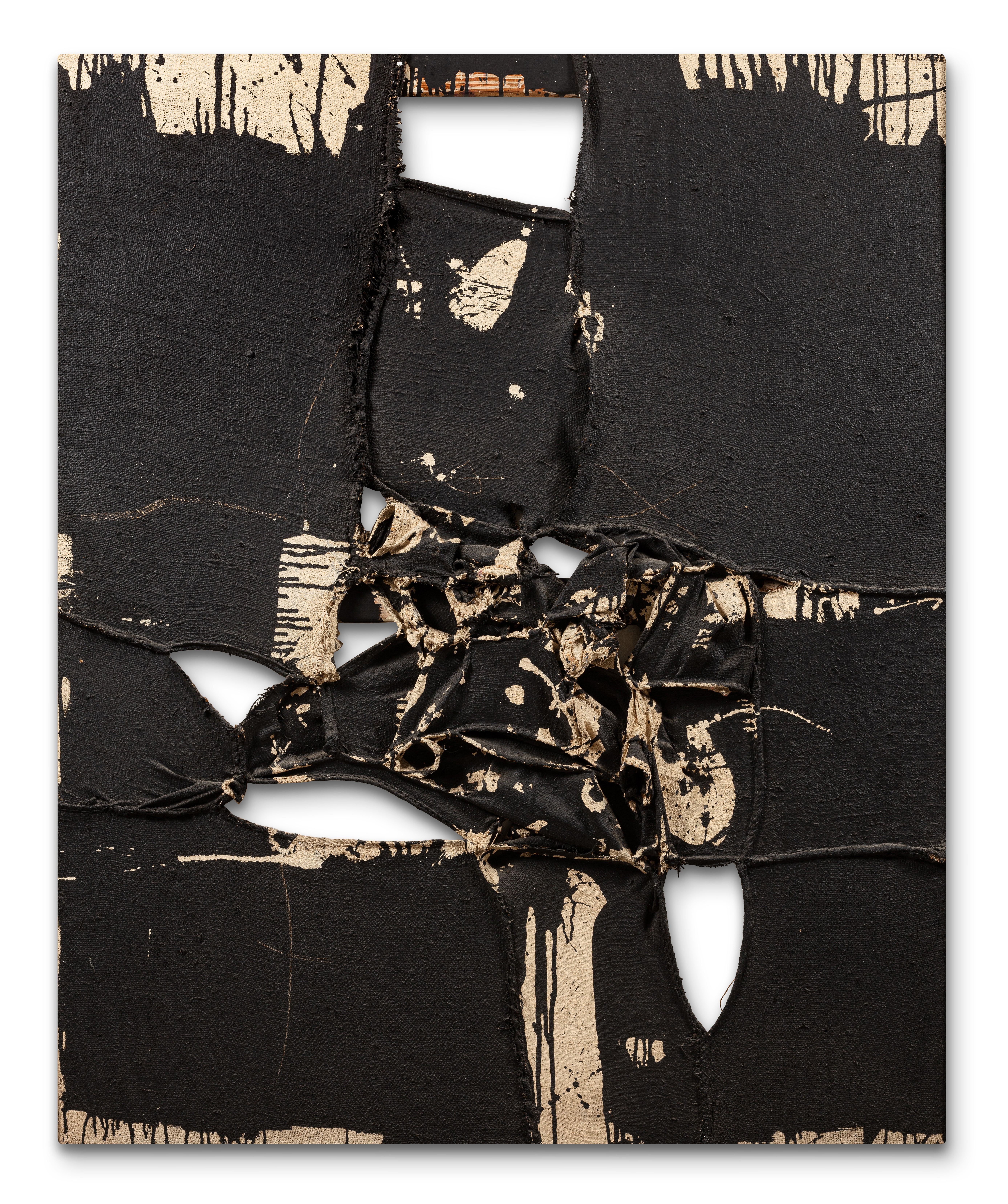
Manolo Millares
Cuadro 93, 1960
When approaching a Millares work, collectors and advisors often note that condition assessment requires an understanding of his intentional use of fragility, the tears and tensions are intrinsic to the work and should be understood as such rather than as damage. Works on paper offer a more accessible entry point and demonstrate the same searching quality found in the large canvases. Millares belongs to a constellation of artists who defined the most ambitious painting of the postwar European moment. His dialogue with Antoni Tàpies, who similarly turned to raw materials and surface as a language of witness, is instructive, and both artists share a common inheritance from Jean Dubuffet's embrace of unconventional matter.
Within Spain, his relationship to the wider El Paso group places him in a specific historical argument about national identity and artistic freedom. Internationally, his work resonates with the American Abstract Expressionists, particularly Franz Kline and Robert Motherwell, without being derivative of them. Millares arrived at his solutions through his own cultural circumstances, and that originality is precisely what makes him irreplaceable. Manolo Millares died in Madrid in 1972, just forty five years old, at the height of his powers.
The brevity of his career makes what he achieved all the more remarkable. The Reina Sofía holds a significant body of his work and has long recognized him as one of the foundational figures of Spanish modernism. International museums and private collections have ensured that his reach extends far beyond the Iberian Peninsula. For those encountering his work for the first time, the experience tends to be immediate and lasting.
These are paintings that do not ask for patience so much as openness, a willingness to meet the work on its own terms and find in its torn surfaces and battered forms something deeply, insistently human.
Explore books about Manolo Millares