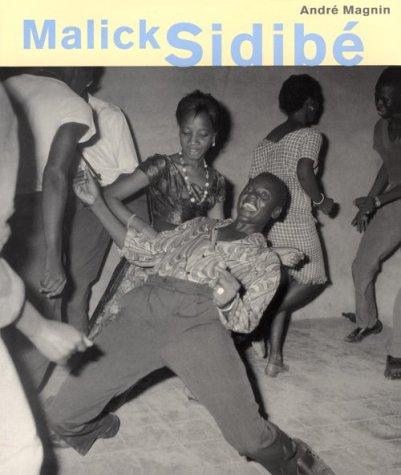
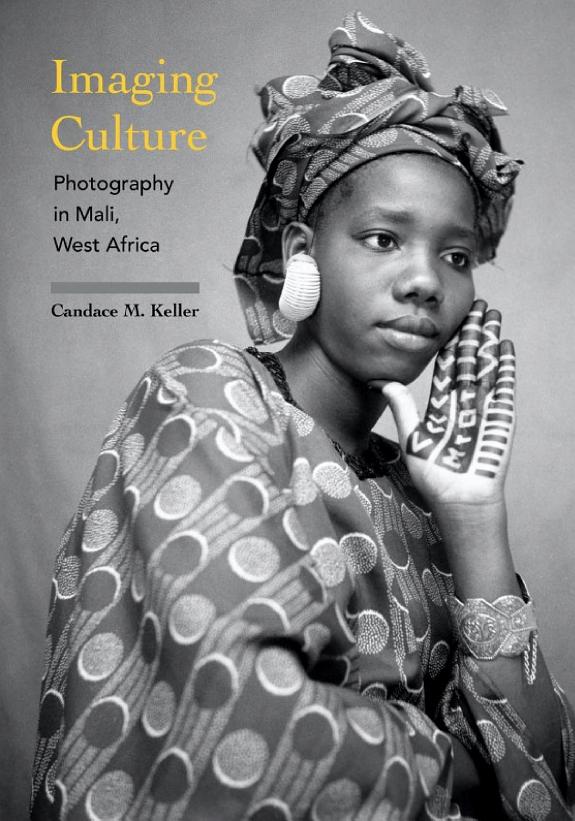
Malick Sidibé
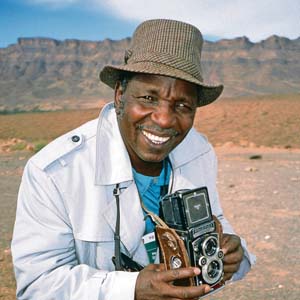
Malick Sidibé: Joy Preserved in Silver
Artist Spotlight · The Collection Editorial
“I wanted to show that Africans were happy, that they were living, that they had a real life.”
Malick Sidibé, Interview with The Guardian
There is a photograph that stops you cold. Two young men lean against a motorcycle, their shirts open, their smiles enormous, radiating the particular confidence of people who know they are alive and intend to make the most of it. The image was made in Bamako, Mali, sometime in the 1960s, and it belongs to a body of work that has come to define not only a city and an era but an entirely new understanding of what portraiture can do. Malick Sidibé, the man behind the camera, spent decades documenting the youth culture of post independence Mali with such tenderness, precision, and genuine delight that his photographs now rank among the most important documents of twentieth century African life ever made.
Malick Sidibé
Les Deux Amis avec Moto
Sidibé was born in 1936 in Soloba, a small village in what was then the French Sudan. He came from a Fulani family and showed early aptitude for drawing, which led to a scholarship at the École des Artisans Soudanais in Bamako, where he trained in jewelry and decorative arts before pivoting entirely toward photography. His tutelage under the French photographer Gérard Guillat, known as Gégé la Pellicule, at the studio Photo Service introduced him to the technical and commercial realities of the medium. By 1962, two years after Mali declared independence from France, Sidibé had opened his own studio, Studio Malick, in the Bagadadji neighborhood of Bamako.
The timing was not incidental. Independence had released something electric in Malian society, and Sidibé was perfectly positioned to capture it. The 1960s and 1970s represent the heart of his practice. Bamako's youth were dancing to rock and roll, twist, and James Brown at outdoor parties called bals poussière, literally dust dances, held on the edges of the city where the red laterite earth turned to powder underfoot.
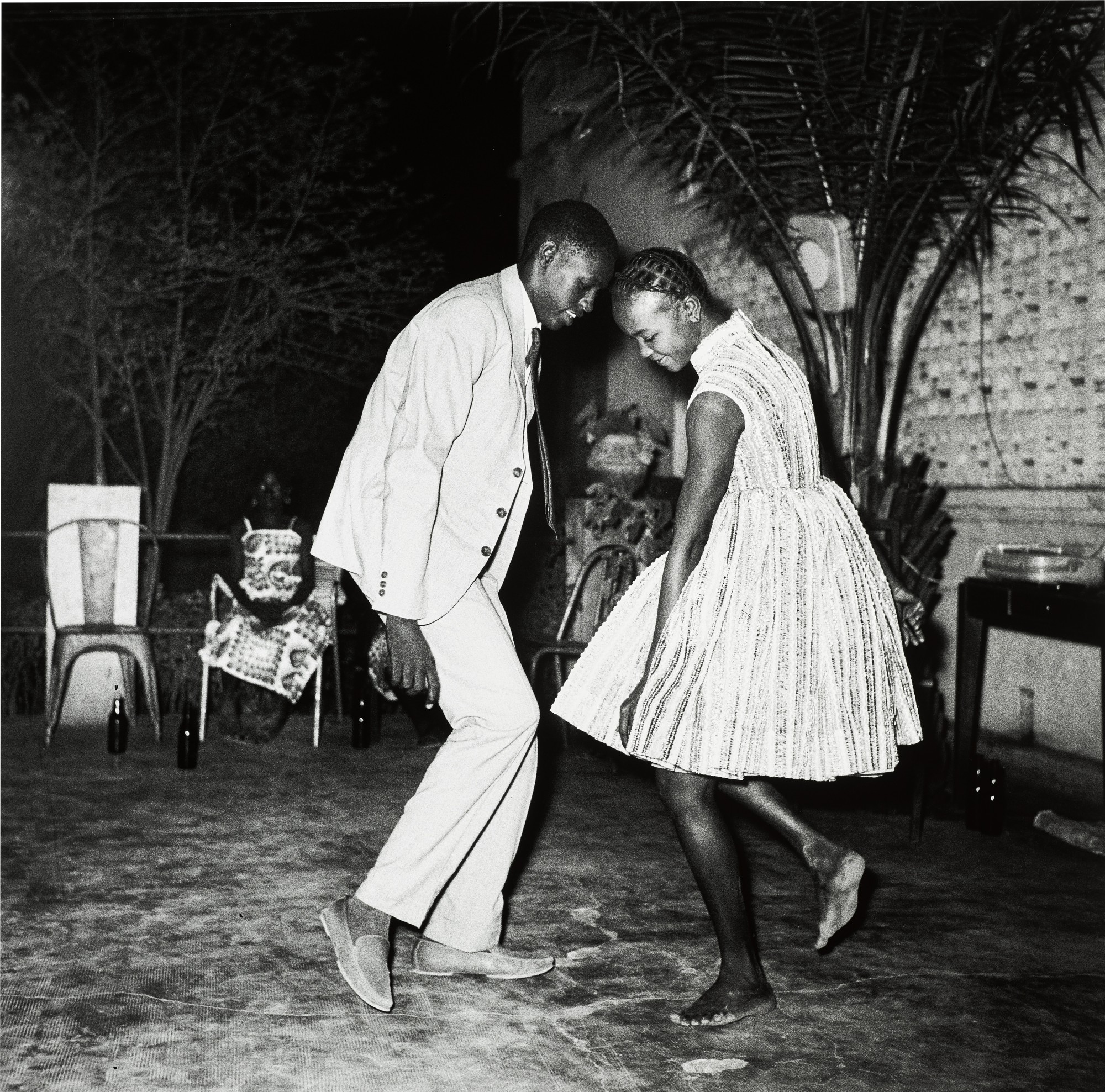
Malick Sidibé
Nuit de Noël (Happy Club)
Sidibé would arrive at these events with his camera and flashbulbs, shooting roll after roll, then return the next day to hang contact prints outside his studio so revelers could find themselves and order copies. This was photography as social infrastructure, as community memory, as a form of love. His subjects posed with motorcycles, with transistor radios, in matching outfits with their best friends, always aware of the camera and yet never stiffened by it. Sidibé had a gift for making people feel that being seen by him was itself a form of celebration.
“When I photographed people, I gave them the possibility to see themselves as beautiful.”
Malick Sidibé
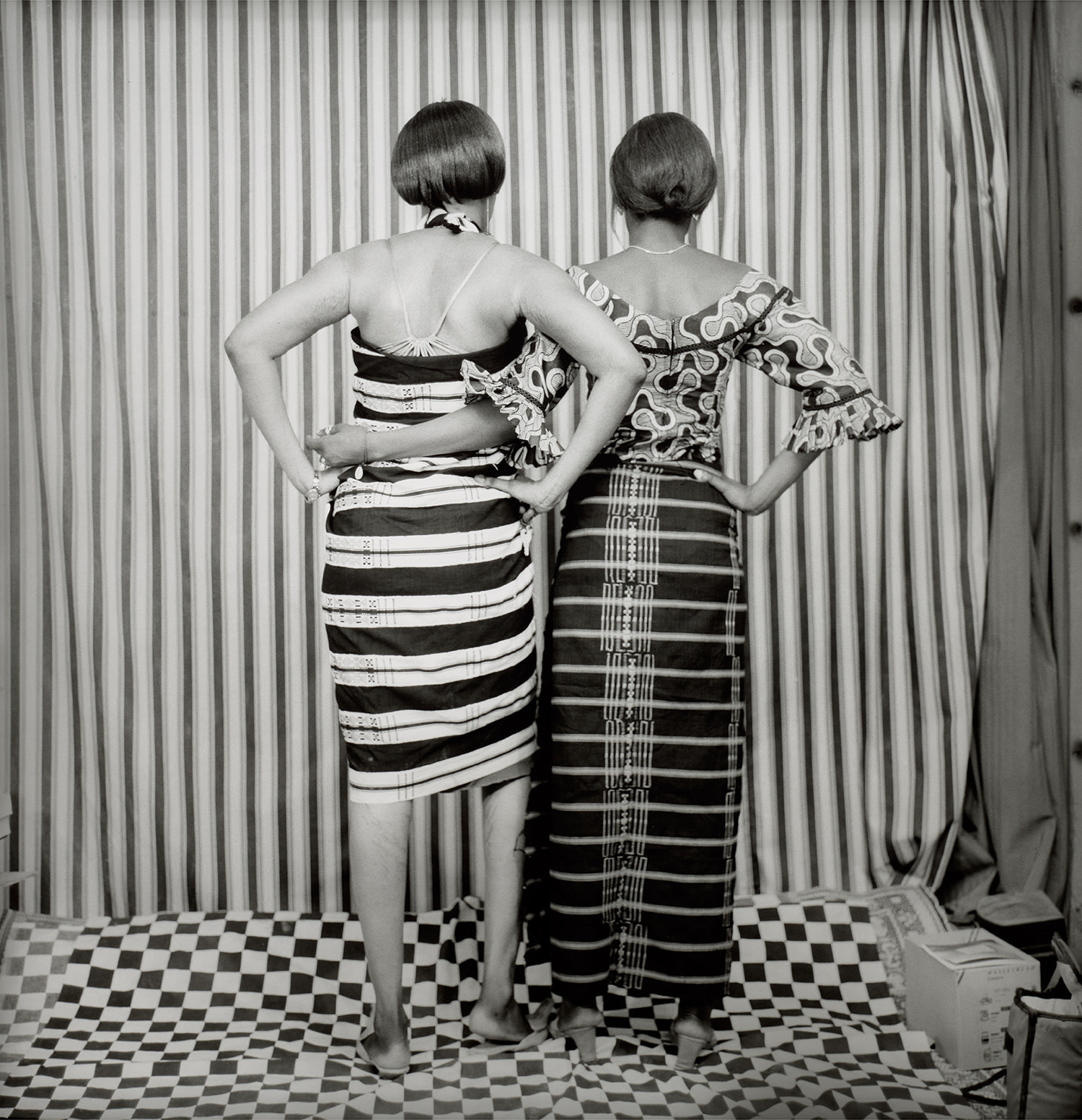
His signature works from this period include the now iconic Nuit de Noël series, documenting Christmas Eve parties at clubs like the Happy Club, where the Bamako youth shed the formalities of day and gave themselves over entirely to music and movement. Works such as Nuit de Noël (Happy Club), printed in various editions from 2001 onward, capture rooms full of dancers in states of pure transport. His portraits of pairs and trios, works like Les Deux Amis avec Moto and Les Trois Amis avec Moto, function almost as a typology of friendship, each one a small monument to the bonds that define youth. The gelatin silver print was his medium of choice throughout his career, and the warm tonal range of silver gelatin, with its capacity for both deep blacks and luminous highlights, suited perfectly the nighttime environments he favored.
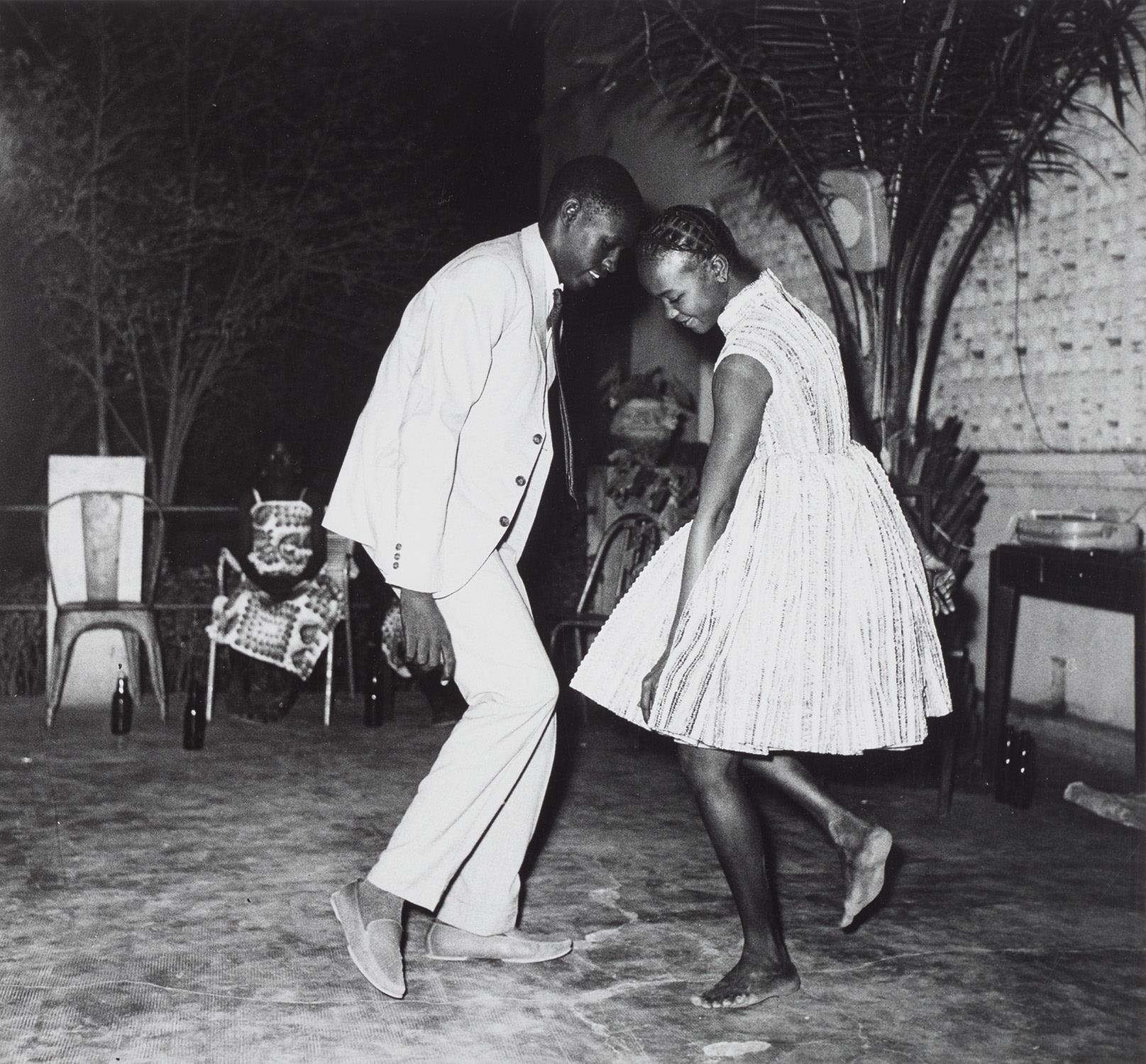
Malick Sidibé
Nuit de Nöel (Happy-Club)
His later printed editions, many produced from the 1990s onward as international interest in his work accelerated, allow collectors today to live with these images at a scale that honors their grandeur. The international art world came to Sidibé relatively late but with remarkable force. His inclusion in the 1996 exhibition In/sight: African Photographers, 1940 to the Present at the Guggenheim Museum in New York introduced his work to a global collecting audience. From that moment his reputation grew steadily.
In 2007, he became the first African photographer and the first person from Africa to receive the Golden Lion for Lifetime Achievement at the Venice Biennale, an honor that placed him unambiguously in the company of the great figures of contemporary art. The Foundation Cartier pour l'art contemporain in Paris gave him a major retrospective that same year, and his work entered the permanent collections of institutions including the Museum of Modern Art in New York, the Art Institute of Chicago, and the Smithsonian Institution. Auction houses including Christie's and Phillips have seen strong results for his prints, with gelatin silver prints from his classic Bamako period regularly achieving prices well into five figures. Collectors are drawn to the specificity of his prints: whether a vintage print made close to the time of shooting or a later authorized edition, each work carries an authenticity of vision that cannot be manufactured or approximated.
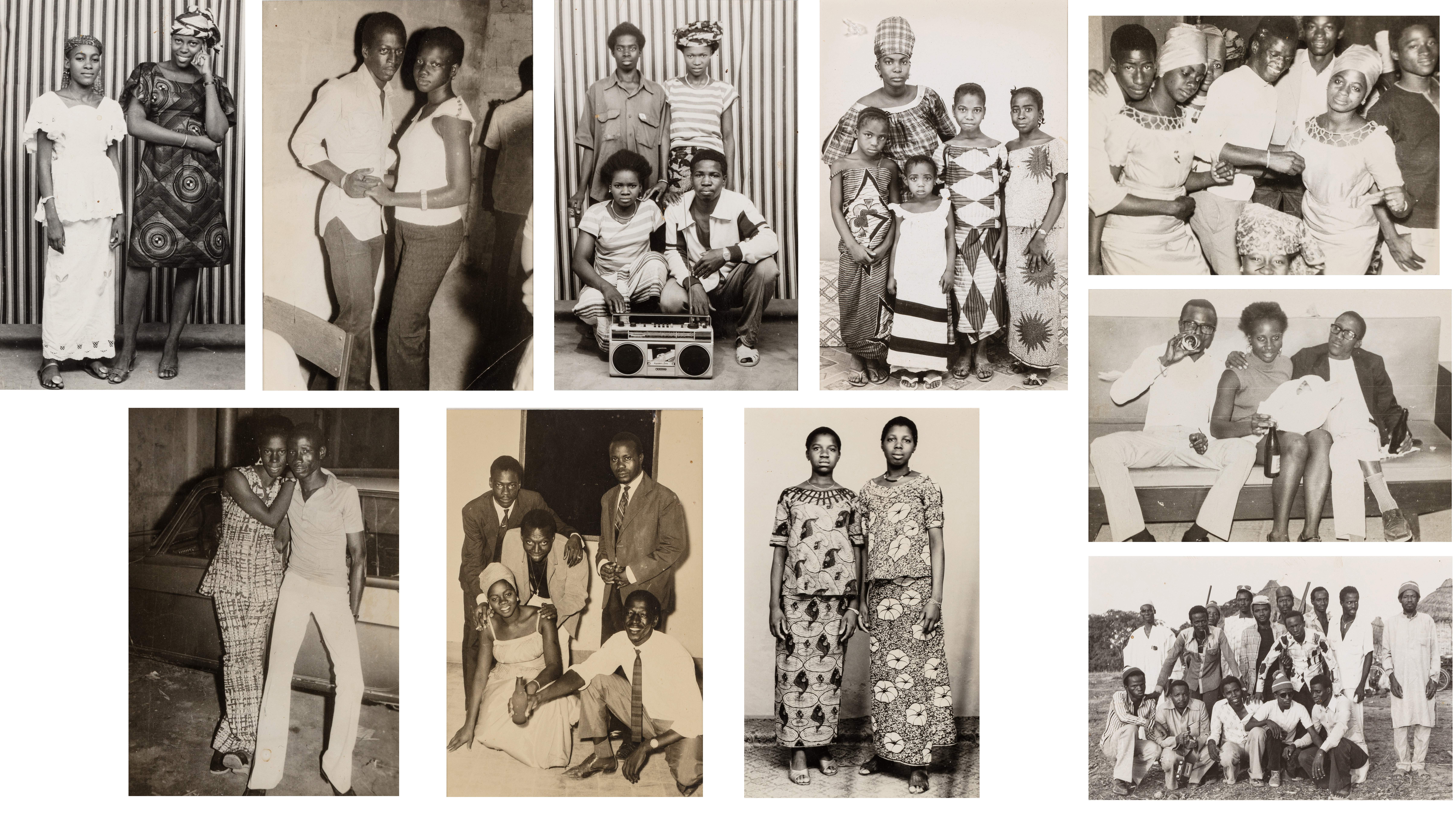
Malick Sidibé
Untitled (Ten Works)
In the context of art history, Sidibé belongs to a lineage of photographers who understood that the studio and the street together constitute a complete world. His relationship to his great Malian contemporary Seydou Keïta is often discussed, and rightly so. Keïta, working in Bamako from the 1940s onward, brought a formal grandeur to studio portraiture that influenced an entire generation. Sidibé took that tradition into the night, into the party, into the spontaneous and the unposed.
Together they form a remarkable diptych of Malian self representation. Beyond West Africa, Sidibé's work invites comparison with that of figures like Weegee in New York or Brassaï in Paris, photographers who understood that nightlife was where a city's true character revealed itself. More recently, his influence can be felt in the work of younger African photographers including Samuel Fosso, whose autobiographical performativity owes something to the theatrical self possession that Sidibé's Bamako subjects displayed so naturally. Malick Sidibé died in Bamako in 2016, at the age of eighty, having spent his entire career in the city he had documented so lovingly.
He worked from his studio until near the end of his life, continuing to receive clients and visitors who came from around the world to sit in the chair across from him and talk about the photographs. His legacy is not only the archive he left behind, extraordinary as that archive is. It is the argument his work makes, quietly but with absolute conviction, that joy is a subject worthy of the most serious artistic attention, that the people of Bamako dancing on a warm night in 1963 were as deserving of careful, beautiful documentation as any subject in the history of art. Collecting Sidibé is an act of alignment with that argument, a way of insisting that exuberance and community and the pleasure of being young and alive are things worth preserving in silver.
Explore books about Malick Sidibé