MADSAKI
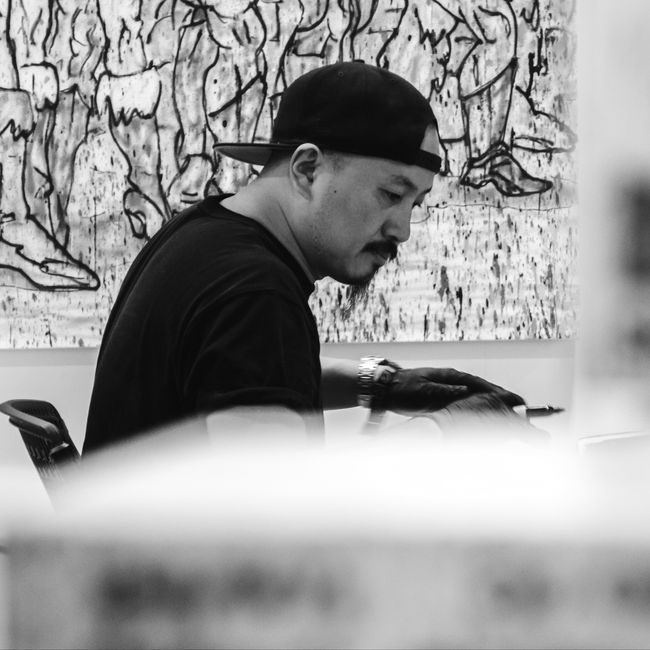
MADSAKI: The Rebel Who Rewrote Art History
Artist Spotlight · The Collection Editorial
In recent years, few artists working at the intersection of street culture and art history have generated as much genuine excitement as MADSAKI. His collaborations with Virgil Abloh during the Off White era brought his work to a global fashion audience, and his long association with Kaikai Kiki, the studio collective founded by Takashi Murakami, cemented his position as one of the most distinctive voices in contemporary Japanese art. Museum audiences and gallery visitors across Tokyo, New York, and beyond have taken notice, and the secondary market has followed with growing enthusiasm. MADSAKI is no longer a cult secret.
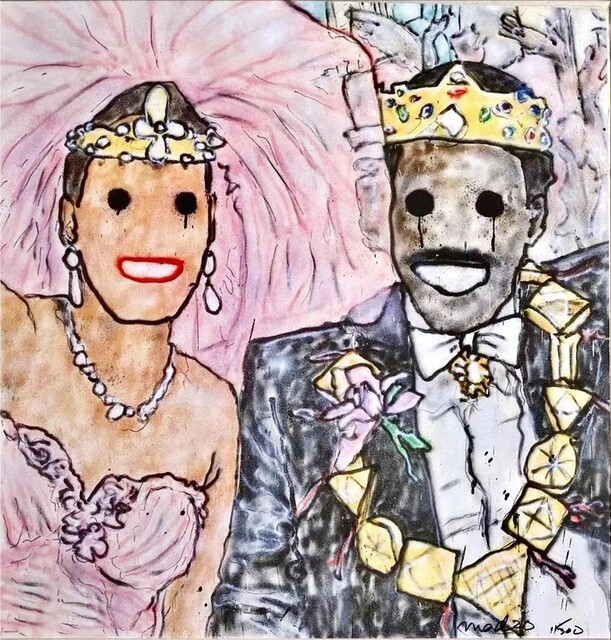
MADSAKI
Straight Outta Zamunda_P (Coming to America), 2020
He is, without question, one of the most compelling painters working today. Hiroyoshi Yamazaki, who goes by MADSAKI, was born in Osaka in 1974, and his early years were defined by cultural collision. When his family relocated to New Jersey during his childhood, he was dropped into the pulsating world of American street culture at precisely the moment when hip hop and graffiti were becoming the most vital artistic movements of their generation. The streets of New Jersey and New York became his first gallery, and the aerosol can his first medium.
He absorbed the energy of that world completely, developing a sensibility rooted in irreverence, humor, and an almost confrontational honesty about what art is and who it belongs to. His formative years in the United States gave MADSAKI something genuinely rare: a double cultural inheritance. He carries the aesthetic precision and conceptual rigor associated with Japanese contemporary art alongside an instinctive American street sensibility that prizes authenticity over polish. When he eventually returned to Japan and found his way into the orbit of Takashi Murakami and the Kaikai Kiki collective, those two worlds began to speak to each other in remarkable ways.
Murakami's own project of collapsing high and low culture provided the perfect intellectual environment for MADSAKI to push his practice into more ambitious territory. What MADSAKI does with a spray can and a canvas is genuinely difficult to categorize, and that difficulty is part of the point. He takes canonical works from art history, paintings by Pablo Picasso, Jean Michel Basquiat, Andy Warhol, and other giants, and repaints them in his own deliberately crude, distorted visual language. Faces dissolve.
Lines wobble. Colors collide without apology. The effect is not vandalism, though it carries the spirit of it. It is closer to critical love, a form of devotion that insists on stripping away the reverence that has calcified around these masterworks and returning them to something raw and alive.
His canvases feel as though the original paintings have been run through the filter of a lifetime spent staring at subway tags and album covers. Among his most celebrated works is the series of reinterpretations he developed through the Kaikai Kiki framework, which brought his spray painted appropriations to international art fairs and gallery presentations throughout the 2010s and into the 2020s. His print work, including pieces such as "Straight Outta Zamunda" from 2020, demonstrates his fluency with pop culture as a living language rather than a historical archive. That particular work draws on the iconography of the 1988 film Coming to America, filtering it through his graffiti rooted visual grammar in a way that is simultaneously nostalgic and urgently contemporary.
It speaks to a generation that grew up with both the Louvre and the video store as equally legitimate sources of imagery. From a collecting perspective, MADSAKI represents an exceptionally compelling proposition. He sits at the intersection of several major currents in the market right now: the sustained global appetite for street art and graffiti rooted practices, the increasingly serious institutional attention being paid to Japanese contemporary artists, and the broader critical reevaluation of appropriation art as a genuinely significant late twentieth and early twenty first century movement. Collectors who came to him through his association with Murakami or through the fashion world have often discovered that his work holds its own in serious art historical conversations.
Works on paper and prints provide an accessible entry point, while his larger canvases have drawn attention from serious private collections in Asia, Europe, and North America. The art historical context for MADSAKI's practice is rich and genuinely illuminating. His appropriation strategy connects him to a lineage that includes Sherrie Levine, Richard Prince, and of course Warhol himself, all artists who understood that copying is never neutral and that every act of reproduction is also an act of interpretation. His graffiti roots place him in conversation with Basquiat and Keith Haring, two figures whose work he has directly engaged with on canvas.
Within Japanese contemporary art, he occupies a space adjacent to Murakami and Yoshitomo Nara, artists who have similarly navigated the territory between commercial culture, pop iconography, and fine art with enormous intelligence and even greater commercial success. What makes MADSAKI matter in 2024 and beyond is something that no amount of market analysis can fully capture. He is genuinely funny, genuinely angry, and genuinely moved by art, and all three of those qualities are visible on the surface of his work simultaneously. At a moment when so much contemporary painting feels cautious or self consciously positioned, his canvases arrive with the energy of someone who has something to say and is not particularly interested in waiting for permission to say it.
That combination of irreverence and deep art historical literacy is rare, and collectors who spend time with his work tend to find that it rewards sustained attention in ways that more polished, well behaved painting simply cannot match. MADSAKI is the kind of artist that reminds you why you fell in love with contemporary art in the first place.
Explore books about MADSAKI