M.C. Escher
Escher: The Master Who Bent Reality
Artist Spotlight · The Collection Editorial
“Only those who attempt the absurd will achieve the impossible.”
M.C. Escher
There is a moment, standing before a large Escher lithograph in a hushed gallery, when the mind quietly surrenders. The staircases keep climbing. The water keeps falling upward. The birds dissolve into fish and back again.
M.C. Escher
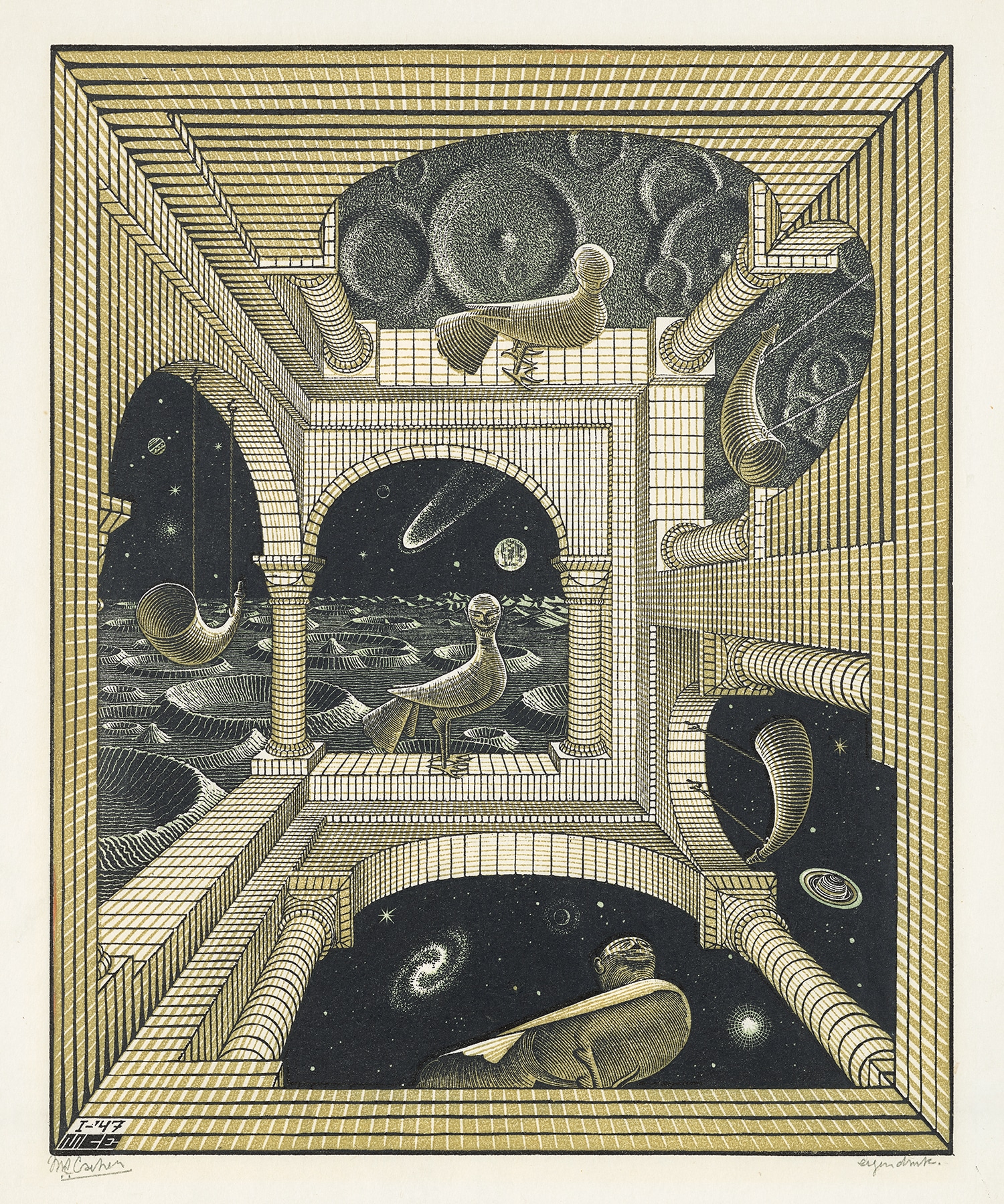
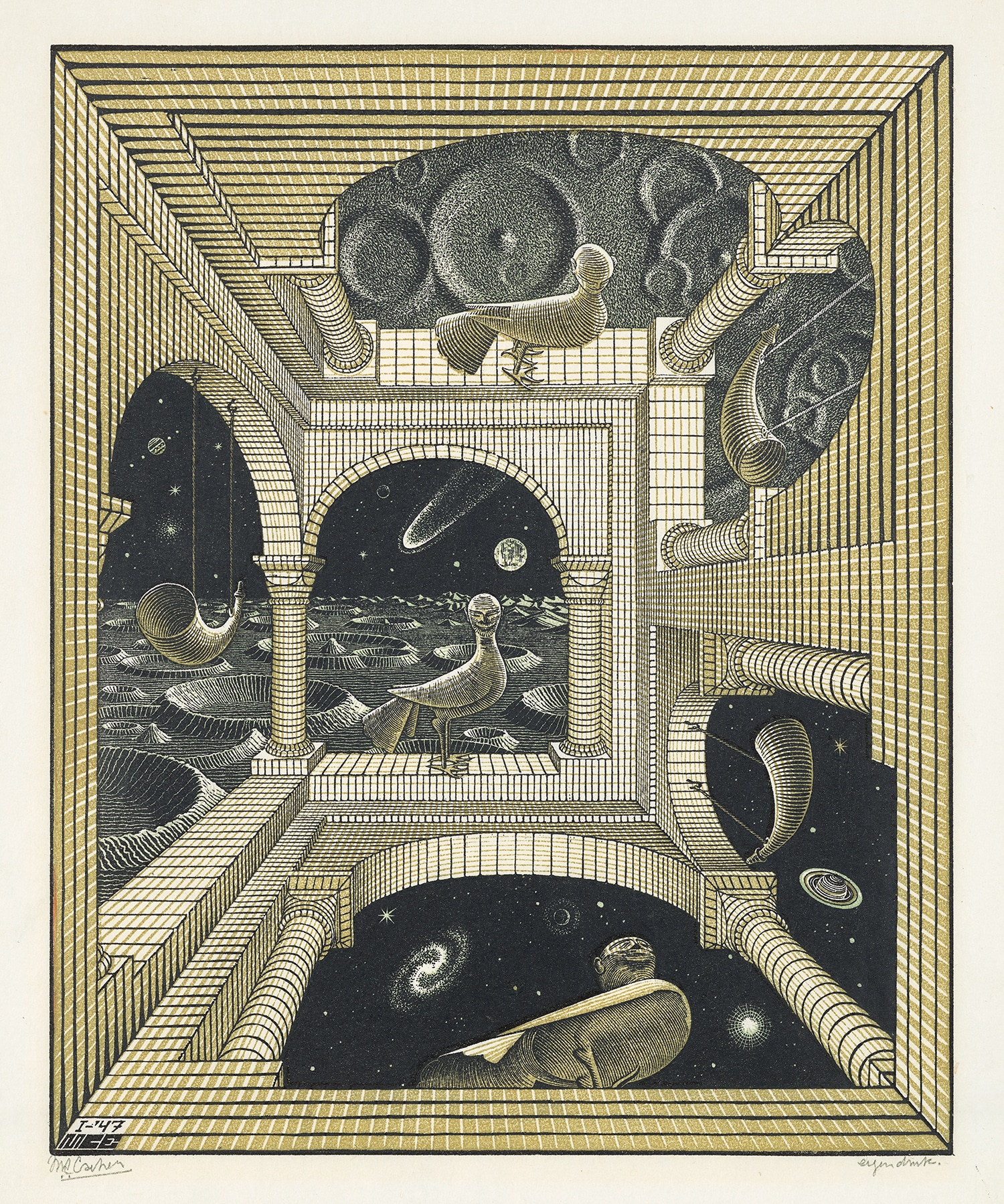
Other World (B. 348)
It happened most memorably for many visitors at the major retrospective held at the Gemeentemuseum Den Haag in The Hague, the institution that holds the world's largest collection of Escher works and has championed his legacy for decades. That experience of gentle cognitive vertigo, of being simultaneously delighted and destabilized, is the singular gift Maurits Cornelis Escher left to the world. Escher was born on June 17, 1898, in Leeuwarden, in the northern Dutch province of Friesland, the youngest of five sons of a civil engineer. His early years were marked by persistent ill health, and he was never considered a strong academic student.
Yet from childhood he showed an unusual sensitivity to pattern, texture, and the hidden geometries lurking inside everyday surfaces. He enrolled at the School for Architecture and Decorative Arts in Haarlem in 1919, intending to study architecture, but his instructor Samuel Jessurun de Mesquita quickly recognized that printmaking was the medium that truly unlocked Escher's gifts. De Mesquita became a formative mentor, and the shift from architectural draftsmanship to graphic art would prove one of the most consequential pivots in twentieth century printmaking. Throughout the 1920s Escher traveled extensively through Italy, settling for a time in Rome and making long journeys through the landscape of southern Italy and the island of Corsica.
M.C. Escher
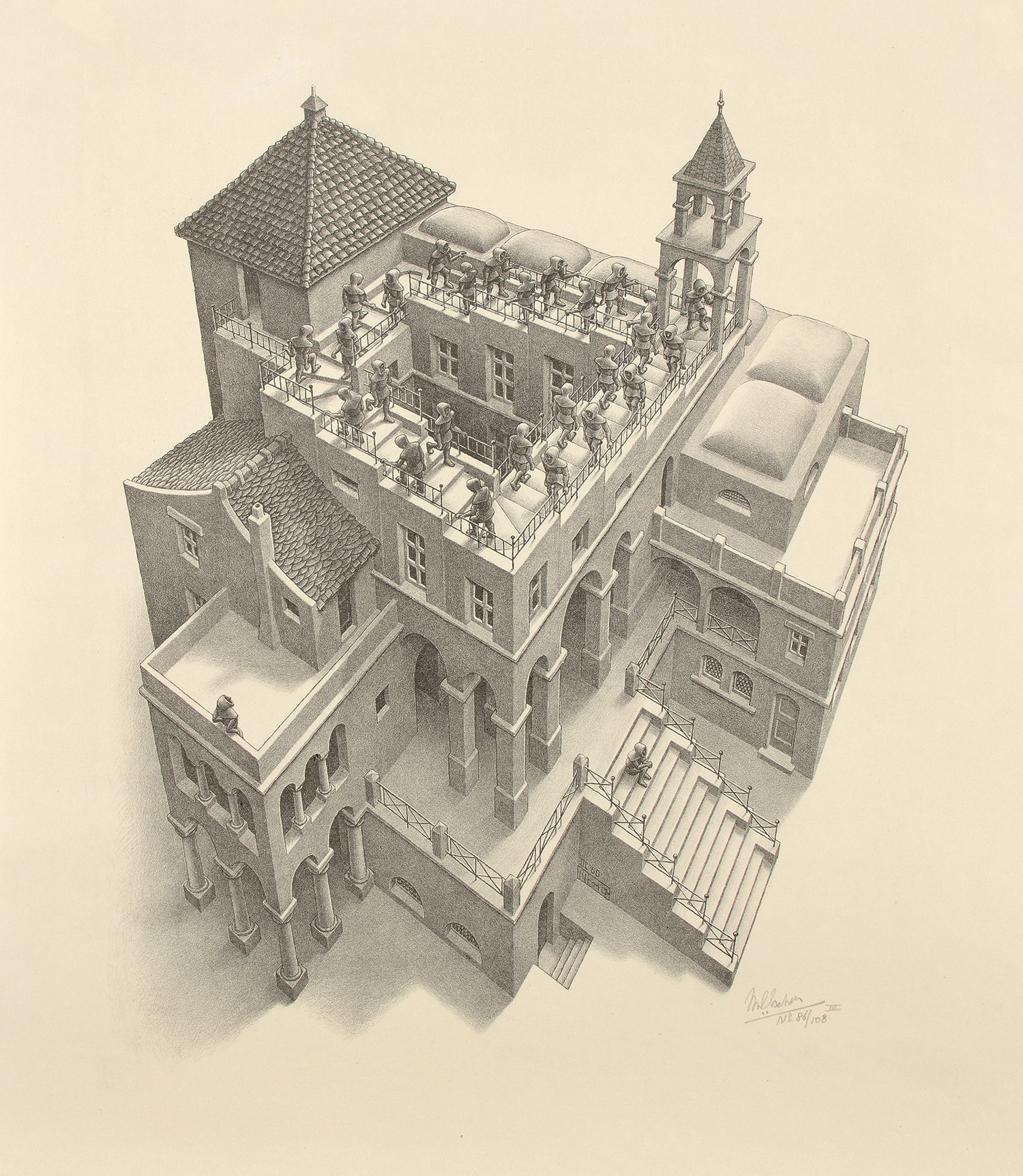
Ascending and Descending
These years produced luminous, naturalistic prints of towns and coastlines, including the lithograph Fiumara of Stilo in Calabria, a work of quiet documentary beauty that reveals the observational precision underpinning everything he would later create. A visit to the Alhambra palace in Granada in 1922, and a return visit in 1936 with his wife Jetta Umiker, proved transformative. The intricate Moorish tilework there, with its interlocking geometric forms covering every surface without gap or overlap, ignited something profound in Escher's imagination. From that point forward, the tessellation became his obsession and his instrument.
“We adore chaos because we love to produce order.”
M.C. Escher
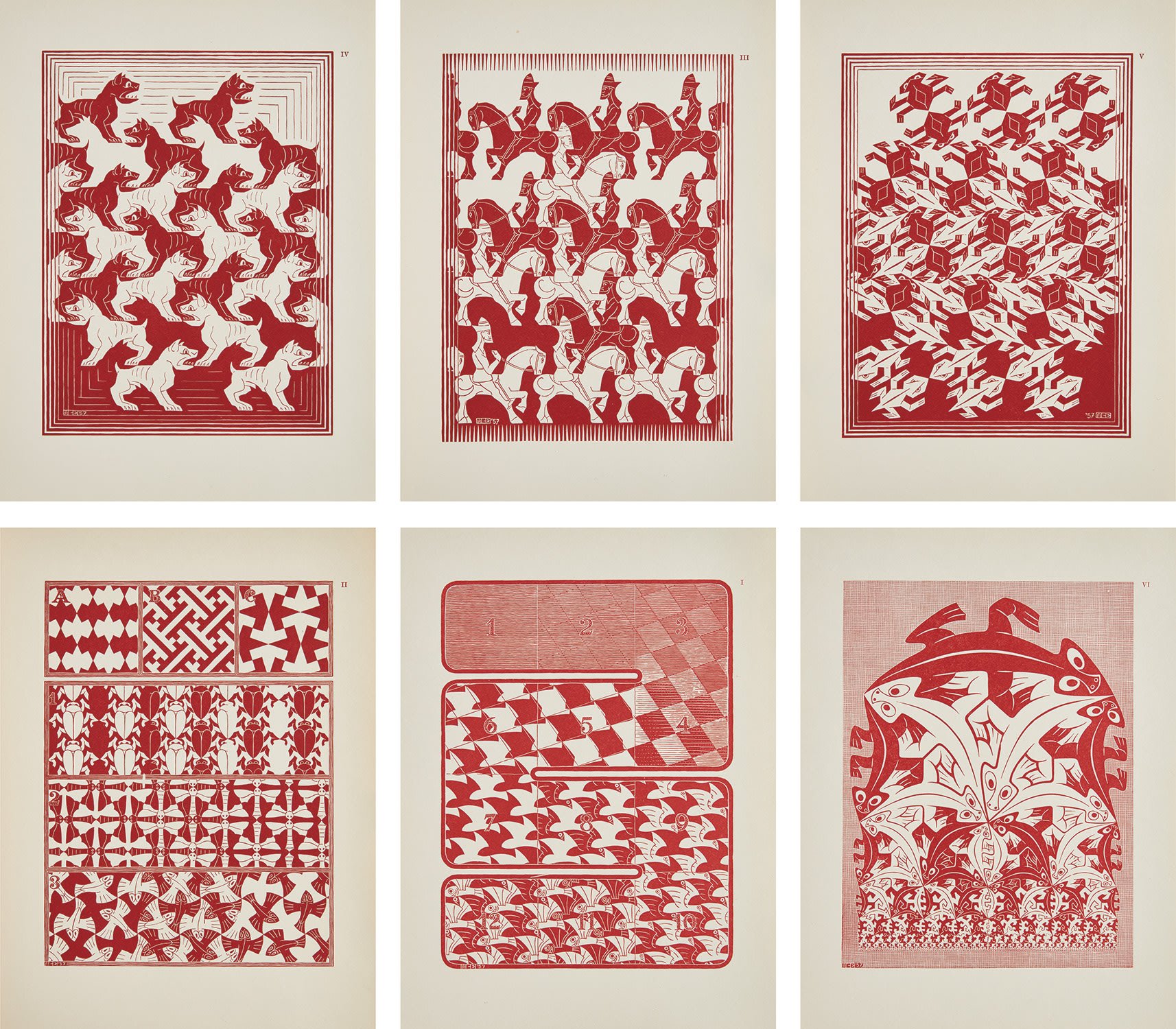
The late 1930s and 1940s marked Escher's great artistic breakthrough. After moving his family to Ukkel near Brussels and later to Baarn in the Netherlands, he began producing the works that would define his legacy entirely. He developed his theory of the regular division of the plane, documented meticulously in his sketchbooks and eventually published in his 1958 book Regelmatige Vlakverdeling, or Regular Division of the Plane. This was not merely an artist making pretty patterns.
M.C. Escher
Regelmatige Vlakverdeling (Regular Division of the Plane)
Escher was constructing a rigorous visual language for ideas that academic mathematicians had not yet fully articulated for popular audiences. Prints such as Encounter from 1944, in which figures of light and dark emerge from a tessellated flat surface and shake hands in three dimensional space, demonstrate how effortlessly Escher could make abstract mathematical principles feel warm and even philosophical. Among his most celebrated individual works, Ascending and Descending from 1960 remains perhaps the most intellectually audacious. The lithograph depicts robed figures marching perpetually upward or downward around a square circuit of stairs that paradoxically return to their starting point, a visual rendering of the impossible Penrose stairs developed by mathematician Roger Penrose and his father Lionel in 1958.
“My work is a game, a very serious game.”
M.C. Escher
Escher corresponded with both Roger Penrose and the mathematician H.S.M. Coxeter, exchanges that reveal the genuine intellectual reciprocity between his art and formal mathematics.
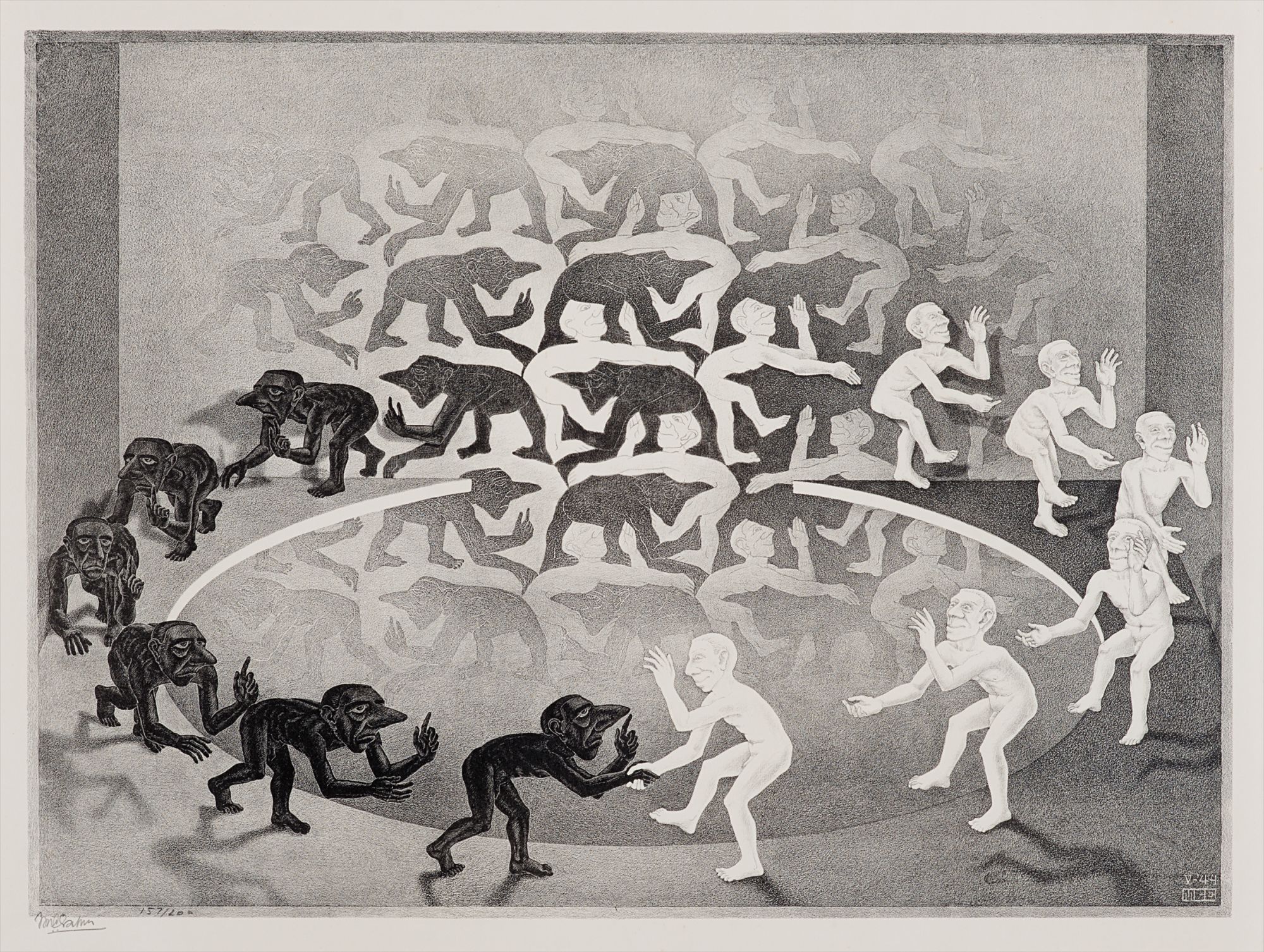
M.C. Escher
Encounter
Other World, produced as a wood engraving and woodcut in colors on thin Japan paper, is among the most otherworldly and spatially vertiginous objects in his entire catalog, a lunar archway through which three simultaneous vantage points open simultaneously: above, below, and straight ahead. The mezzotint Eye, annotated in the artist's own hand as eigen druk, meaning hand printed, presents the human iris as a convex mirror containing a skull, a small but devastating meditation on mortality and perception. From a collecting perspective, Escher occupies a fascinating and rewarding position in the market. His prints exist in clearly documented editions, and many carry his pencil annotations, edition numbers, and the coveted eigen druk notation indicating the artist pulled the impression himself.
These hand annotated impressions command considerable attention from serious collectors because they represent direct physical contact between the artist and the object. Works on thin Japan paper, such as the colored Other World, are particularly prized for their luminosity and the way the delicate substrate elevates the detail of woodcut lines. At auction, strong impressions of the major prints have consistently attracted bidders from across the art world and from the mathematics and design communities, reflecting the unusually broad cultural reach Escher commands. Collectors are advised to examine impression quality carefully, as the printed editions vary, and to prioritize works bearing pencil signatures and annotations in the lower margins.
To understand Escher's place in art history requires resisting the temptation to slot him neatly into any single movement. He was not a Surrealist, though Salvador Dali and René Magritte shared his appetite for the uncanny and the impossible. He was not an Abstract Expressionist, though his formal rigor rivals any practitioner of hard edge abstraction. He fits more comfortably in conversation with the decorative and geometric traditions of Art Nouveau and De Stijl, and his tessellation work anticipates the optical investigations of Victor Vasarely and Bridget Riley.
Yet Escher ultimately belongs to a category of one: a graphic artist who worked in the space between science and art before that space had a name, and who did so with woodblocks, lithographic stones, and his own two hands. Escher's legacy today is simultaneously everywhere and underappreciated in fine art circles. His imagery has permeated popular culture so thoroughly that the name Escher functions almost as a common adjective, used casually to describe any impossible staircase in a film or any looping architectural illusion in a video game. What this familiarity can obscure is the profound craft and intellectual seriousness of the original objects.
To hold a hand printed impression of Three Spheres I or Dragon, each signed in pencil and annotated eigen druk, is to encounter an artist of the highest technical discipline and the rarest imaginative ambition. Escher died on March 27, 1972, in the Dutch town of Hilversum, having spent his final years in a retirement community for artists. He left behind a body of work that continues to astonish mathematicians, enchant children, and reward the most discerning collectors with inexhaustible depth.
Explore books about M.C. Escher
M.C. Escher: The Graphic Work
M.C. Escher
M.C. Escher: His Life and Complete Graphic Work
F.H. Boolean, J.R. Kist, J.L. Locher, W.F. Wertheim
The Magic of M.C. Escher
J.L. Locher
M.C. Escher: Visions of Symmetry
Doris Schattschneider
The World of M.C. Escher
J.L. Locher
M.C. Escher: Journey to Infinity
Christoph Fishhoff
Escher: The Complete Prints
Chris Grossman
M.C. Escher: Architect of the Absolute
Friedrich Wachs