Lyonel Feininger
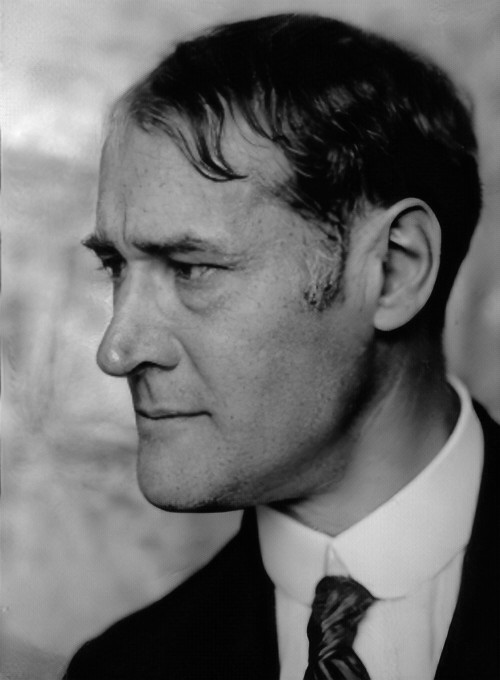
Lyonel Feininger: Light, Line, and Wonder
Artist Spotlight · The Collection Editorial
“All art is a vision penetrating the surfaces of things, not a reproduction of surfaces.”
Lyonel Feininger
There is a moment, standing before a Lyonel Feininger canvas, when the architecture seems to breathe. Spires fracture into planes of amber and violet. A street recedes not into distance but into something closer to music. The Museum of Modern Art in New York holds several of his finest oils, and the Busch Reisinger Museum at Harvard, which built its collection in part around the German American avant garde, treats Feininger as a cornerstone figure.
Lyonel Feininger
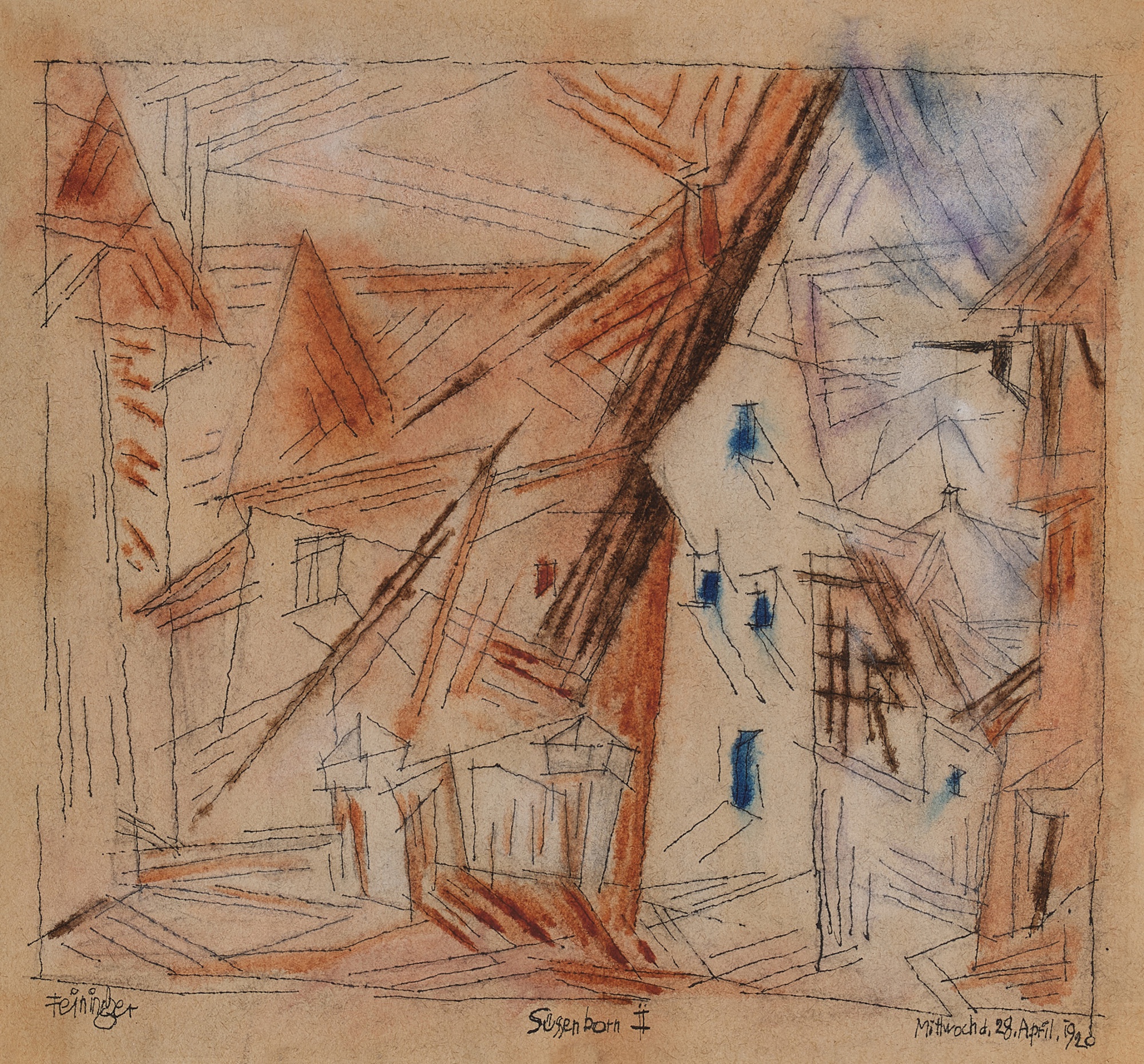
Süssenborn II
When major survey exhibitions of Bauhaus art travel internationally, as they have done with renewed frequency around the centenary of that institution in 2019, Feininger's work invariably commands a central room. He is not rediscovered so much as perpetually revealed, each new generation finding in his crystalline geometries something that feels both ancient and entirely alive. Lyonel Feininger was born in New York City in 1871 to a family of musicians. His father, Karl Feininger, was a violinist of some distinction, and his mother a singer and pianist.
Music was not merely background in the Feininger household; it was a structuring principle of life, a way of understanding how parts relate to a whole, how rhythm and interval create meaning. At sixteen, Feininger sailed to Germany to study music, but drawing and the visual world seized him instead. He enrolled at the Kunstgewerbeschule in Hamburg and later at the Académie Colarossi in Paris. Germany, and particularly Berlin, became his adoptive home for decades, and the tension between his American birth and his deeply European formation would charge his sensibility throughout his career.
Lyonel Feininger
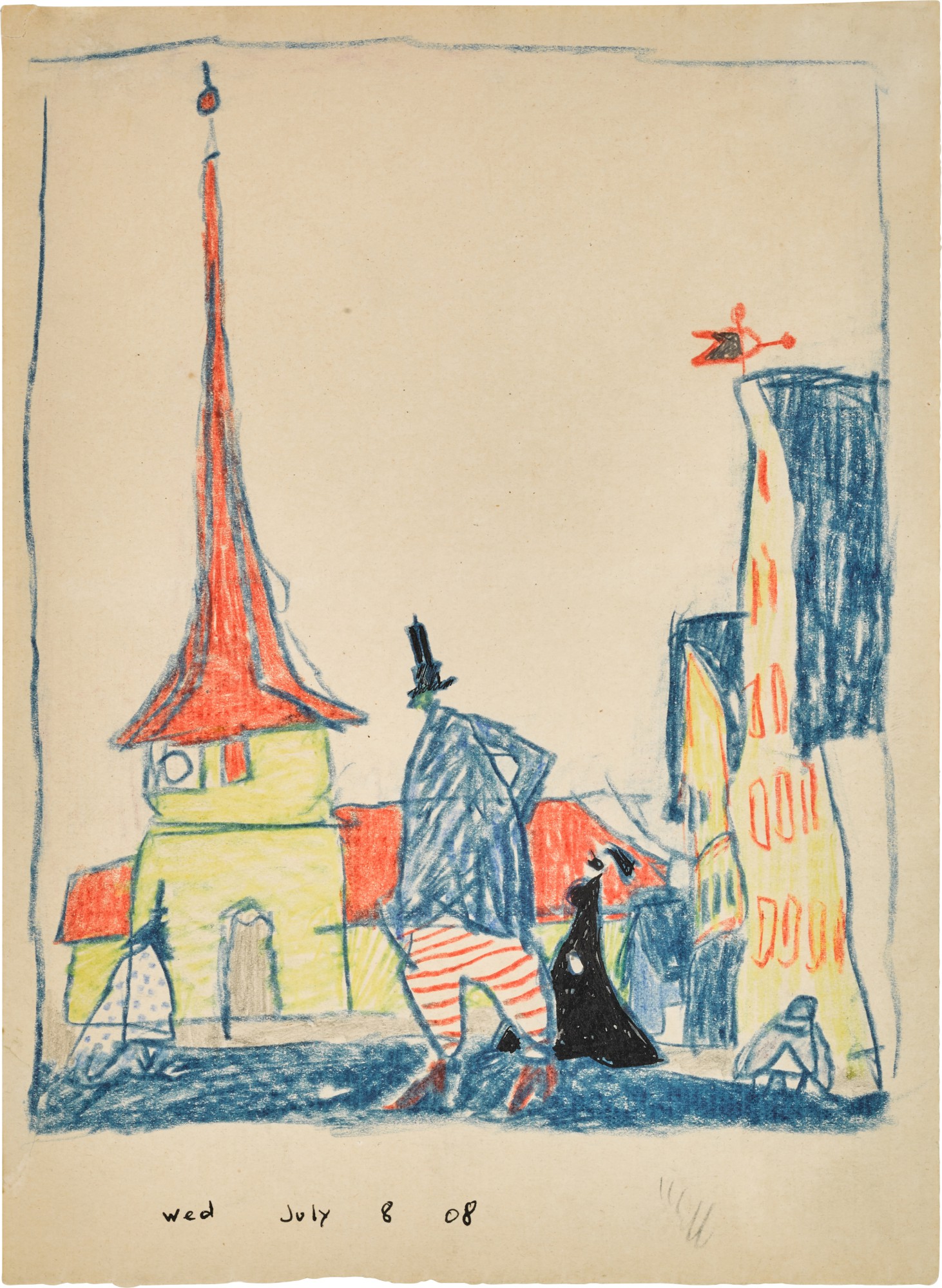
Masks, Gelmeroda
His earliest professional work was as a caricaturist and cartoonist, a fact that rewards careful attention. Through the 1890s and into the first decade of the twentieth century, Feininger contributed illustrations and comic strips to publications including Harper's Round Table, the Chicago Tribune, and various German periodicals. His 1906 comic strips for the Chicago Tribune, most notably The Kin der Kids and Wee Willie Winkie's World, demonstrated an already sophisticated command of sequential imagery, compressed perspective, and the expressive distortion of form. These were not apprentice works; they were vivid, inventive, and stylistically assured.
“My pictures are riddles to myself; I cannot always tell what they mean, only that they must be painted.”
Lyonel Feininger
The lessons of caricature, the economy of line, the emotional charge of exaggeration, never left his painting even as his style ascended toward abstraction. Feininger encountered Cubism during a visit to Paris in 1906 and it changed the direction of his painting decisively. He absorbed its lessons about fractured planes and multiple viewpoints but bent them toward a quality that was entirely his own: a luminous, almost transcendent stillness. Where Picasso and Braque used Cubist fragmentation to interrogate the object, Feininger used it to reach toward light itself.
Lyonel Feininger
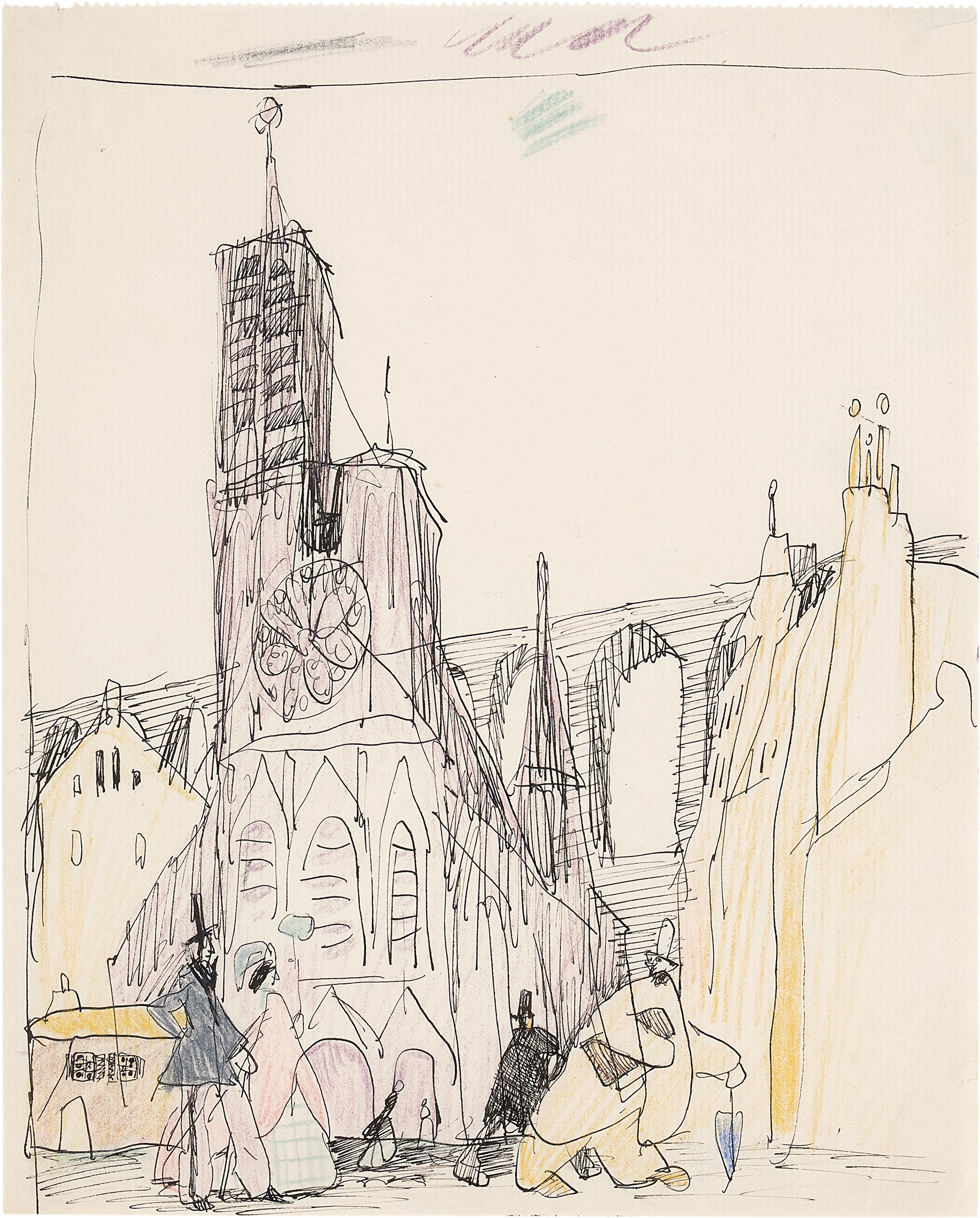
Street Scene, 1908
By the early 1910s he was exhibiting with the Blaue Reiter group and showing at the first German Autumn Salon in Berlin in 1913, where he appeared alongside Kandinsky, Chagall, and Delaunay. His paintings from this period, architectural vistas of Gothic churches, cobblestone streets, figures caught in the geometry of shadow, already possess the signature quality that would define his mature work: a sense that solid matter is on the verge of dissolving into pure radiance. In 1919, Walter Gropius invited Feininger to join the newly founded Staatliches Bauhaus in Weimar as its first Master. Feininger did not teach painting in the conventional sense; instead he presided over the printmaking workshop, and his engagement with the woodcut became one of the most fruitful chapters in his practice.
The iconic woodcut he created for the cover of the Bauhaus manifesto in 1919, depicting a Gothic cathedral pierced by rays of light, announced the school's ambitions with an image of nearly mystical clarity. His woodcuts, including works from the Meistermappe des Staatlichen Bauhauses and the Zwölf Holzschnitte series, carry the same architectural poetry as his paintings but with an added rawness, the grain of the wood pressing through, the contrast absolute. These prints are among the most sought after documents of the entire Bauhaus era. The village of Gelmeroda, a small community outside Weimar, became one of Feininger's most enduring subjects.
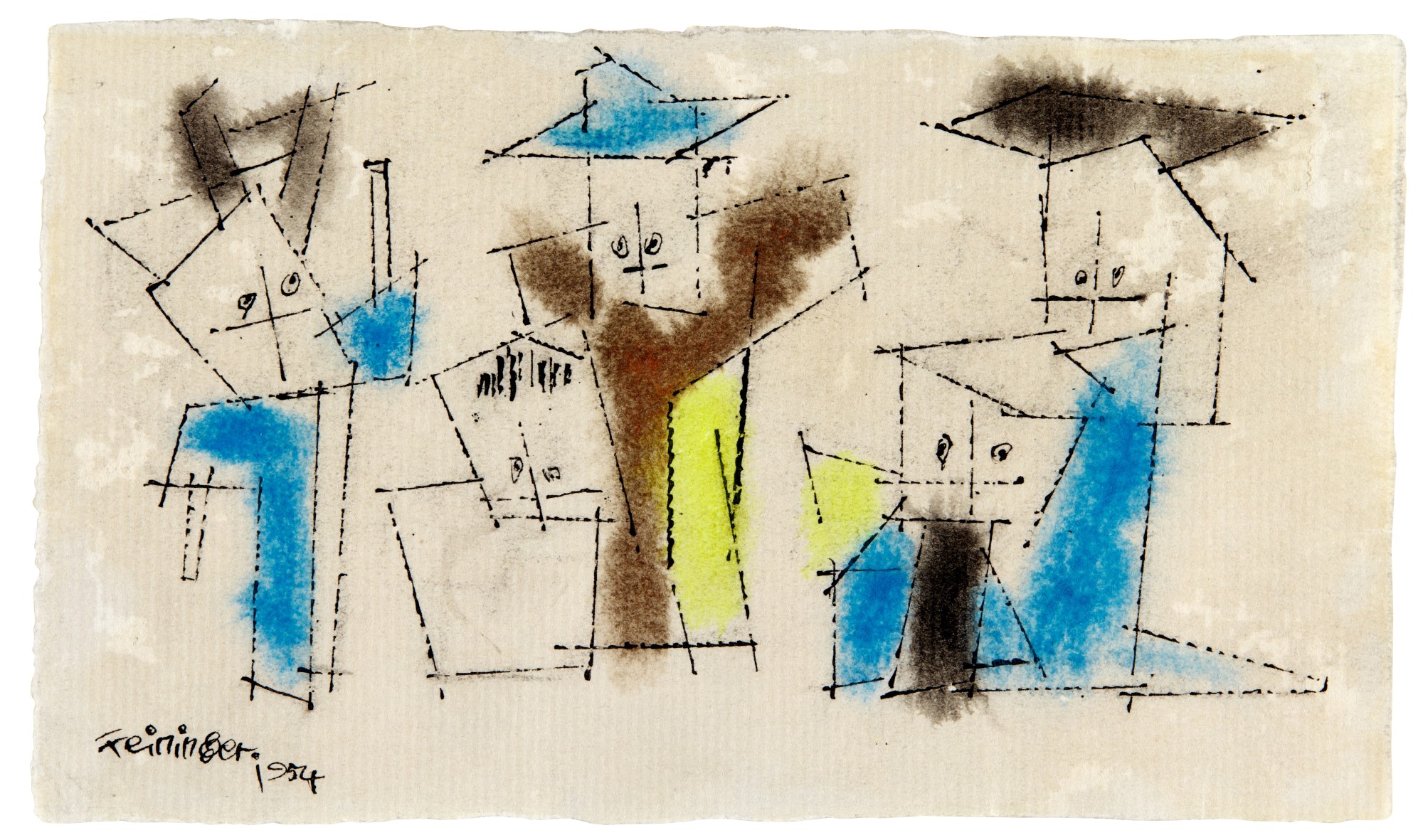
Lyonel Feininger
Five Figures, 1954
He painted its modest church more than forty times across several decades, and the series stands as one of the great sustained meditations on a single motif in modern art, comparable in its devotion to Monet's Rouen Cathedral studies or Cézanne's engagement with Mont Sainte Victoire. Each Gelmeroda canvas approaches the structure from a different angle of light and feeling, some austere and winter pale, others warm with amber dusk. The watercolors and drawings of the subject, including works such as Masks, Gelmeroda, reveal how deeply preparatory practice informed his vision, the hand working and reworking until form and light achieved their necessary equilibrium. Feininger's works on paper represent some of the most accessible and intimate entry points into his world, and they are the category in which collectors today find remarkable range and depth.
Works such as Paris (Chimney Pots at Night) in brush and ink and crayon demonstrate his ability to conjure an entire atmosphere from the simplest means. Süssenborn II and Ausfahrender Frachtdampfer III, a sailing and maritime subject in watercolor and pen and ink, show the breadth of his geographic and emotional imagination. His late work, including Five Figures from 1954, completed just two years before his death, suggests no diminishment of inventive energy. The line remained precise, the color radiant, the underlying feeling of wonder entirely intact.
For collectors, Feininger occupies an enviable position in the market: historically significant enough to anchor any serious collection of modern art, yet diverse enough in medium and scale that works across a range of price points regularly appear at auction and through specialist dealers. His prints, particularly the Bauhaus era woodcuts on Japanese paper, are prized for their historical importance as much as their visual beauty. Watercolors and drawings appear at Christie's, Sotheby's, and Bonhams with regularity, and strong examples have achieved significant results in recent years as institutional and private interest in the Bauhaus centenary continued to drive scholarly and market attention. When considering a Feininger work on paper, condition, provenance, and the clarity of the characteristic prismatic geometry are the primary considerations.
To place Feininger within art history is to see him as a bridge figure of unusual grace. He absorbed Cubism and Expressionism, was shaped by his Bauhaus colleagues including Paul Klee and Wassily Kandinsky, and yet produced a body of work unmistakably his own. His closest spiritual companion in temperament might be Klee, whose poetic, music inflected vision shares with Feininger a sense that art is ultimately a form of listening. American painters working in a Precisionist mode, including Charles Sheeler and Charles Demuth, offer another comparative lens, though Feininger's mysticism sets him apart from their cooler objectivity.
He is one of those rare artists who belong equally to multiple traditions and fully to none, which is precisely why his work continues to feel essential. Feininger returned permanently to the United States in 1937, driven from Germany by the rise of National Socialism and the designation of his work as degenerate. He settled in New York and found in Manhattan's vertical geometries a new set of subjects that suited his vision perfectly. The city's towers and bridges became, in his hands, cathedrals of a secular age, fractured by light, humming with the same mysterious energy as the Gelmeroda spires.
He died in New York in 1956 at the age of eighty four, leaving behind a body of work that spans caricature and cosmic abstraction, the intimate sketch and the monumental canvas. What endures is something that resists easy summary: a conviction, felt in every mark, that the visible world is charged with an inner luminosity that art exists to reveal.
Explore books about Lyonel Feininger
Lyonel Feininger: A Definitive Catalogue of His Graphic Work
Prasse, Leona E.
Lyonel Feininger
Hess, Hans
Lyonel Feininger: City at the Edge of the World
Whitford, Frank

Feininger: Paintings, Drawings, Prints
Selz, Peter
Lyonel Feininger: Aquarelle und Zeichnungen
Tubbe, Friedhelm

The Cubist Cosmos of Lyonel Feininger
Weinberg, Jonathan

Lyonel Feininger: American Modernist
Karshan, Donald H.