Lucas Van Leyden
Lucas Van Leyden: Renaissance Genius Reborn
Artist Spotlight · The Collection Editorial
Imagine standing in the print room of the Rijksmuseum in Amsterdam, leaning over a vitrine to study a small engraving no larger than a playing card. The lines are impossibly fine, the scene alive with movement and psychological depth, and the date inscribed in the plate reads 1508. The artist was barely a teenager. This is the world of Lucas van Leyden, one of the most astonishing prodigies that Northern European art has ever produced, and a figure whose influence on the history of printmaking and painting continues to reward close attention from scholars, curators, and collectors alike.
Lucas Van Leyden
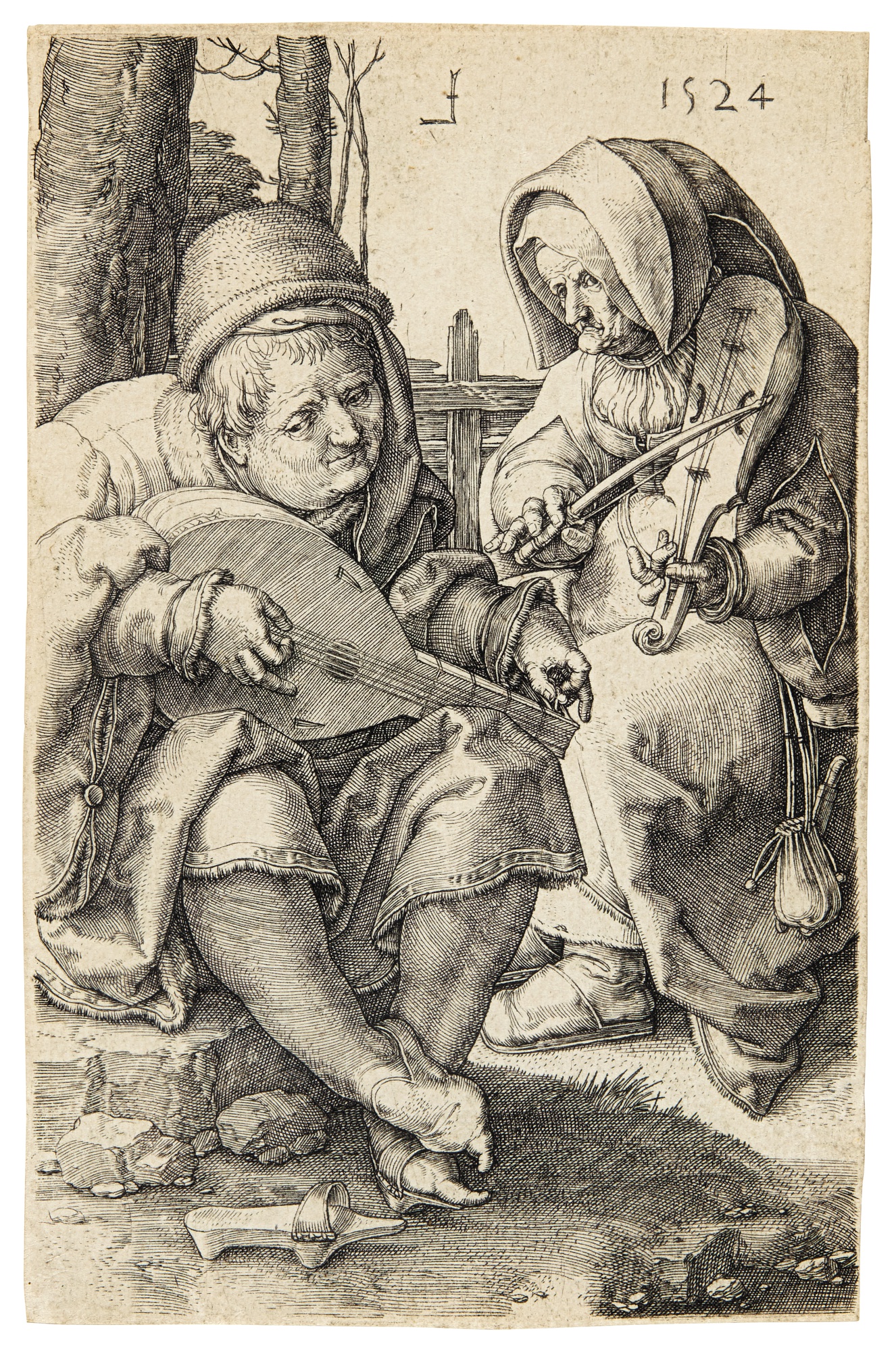
The Musicians (new Hollstein 155)
Lucas was born around 1494 in Leiden, in what is now the Netherlands, the son of a painter named Huigh Jacobsz. His early formation took place entirely within the rich guild culture of the Low Countries, where craft mastery was prized above all else and the exchange of ideas between painters, printmakers, and goldsmiths was constant and generative. Leiden in the early sixteenth century was a prosperous textile city with an active intellectual life, and Lucas absorbed its energies fully. He entered his father's workshop as a child and demonstrated gifts so extraordinary that contemporaries struggled to explain them through ordinary means.
The biographer Karel van Mander, writing in his celebrated Schilder boeck of 1604, preserved accounts of Lucas producing finished engravings as young as nine or ten years old, a claim that modern scholarship has largely accepted as consistent with the evidence of the surviving works. What set Lucas apart from his contemporaries was not merely his technical virtuosity, though that was staggering, but his restless curiosity about what images could do and say. His early engravings show an artist already grappling with questions of narrative, emotion, and spatial illusion that would preoccupy him throughout his career. He was acutely aware of Albrecht Dürer, the German master whose innovations in printmaking had electrified the whole of Northern Europe in the preceding decade, and Lucas engaged with Dürer's example both competitively and admiringly.
The two men are known to have met in Antwerp in 1521, an encounter that produced one of the more charming anecdotes in Renaissance art history: Dürer, by then the most celebrated artist north of the Alps, sat for a portrait drawing by Lucas and noted the younger man's elegance and refinement. The drawing itself, now in the Musée des Beaux Arts in Lille, survives as testimony to the mutual regard between two giants. Lucas's development as a painter unfolded alongside his activity as a printmaker, and the two practices informed each other in ways that were unusual for the period. His paintings, which include major altarpieces such as the Last Judgment triptych of around 1526 to 1527 now in the Stedelijk Museum De Lakenhal in Leiden, reveal an artist deeply engaged with the innovations of his Flemish and Italian contemporaries.
There is a quality of attention to ordinary human beings in Lucas's work, a willingness to depict peasants, musicians, and card players with the same seriousness usually reserved for sacred subjects, that feels genuinely modern even five centuries later. He was among the first Northern European artists to make genre scenes a serious pictorial enterprise, and his influence on later painters of everyday life, including those who would follow in the great Dutch Golden Age tradition, is difficult to overstate. Among the works that collectors and scholars return to most often is the engraving known as The Musicians, catalogued in the definitive Hollstein survey of Dutch and Flemish prints as number 155. This print is a characteristic demonstration of everything that makes Lucas so compelling: a group of figures gathered in easy sociability, rendered with extraordinary finesse in the placement of hands and faces, the whole composition suffused with a warmth and immediacy that feels less like illustration than observation.
The Musicians belongs to a strand of Lucas's work concerned with secular pleasure and communal life, subjects that were still somewhat novel in Northern European printmaking at the time he made them. For collectors, works like this represent not only the highest achievement in early sixteenth century graphic art but a genuine window into how people lived, gathered, and enjoyed themselves in the Low Countries during the Renaissance. In the market for early prints and drawings, Lucas van Leyden occupies a position of considerable prestige. His engravings appear at the major print sales at Christie's, Sotheby's, and Swann Galleries with some regularity, and fine impressions of his most celebrated plates, particularly those in early states with strong ink and clean margins, command prices that reflect both their rarity and their art historical importance.
Collectors who specialize in the Northern Renaissance or in the history of printmaking regard a Lucas van Leyden engraving as a foundational acquisition, the kind of work around which a serious collection of the period can be organized. The relative compactness of the objects, a practical consideration that should never be underestimated, makes them accessible to collectors who might not have the wall space or resources to pursue paintings of comparable significance. To understand Lucas fully it helps to situate him within a broader community of Northern Renaissance artists whose ambitions were similarly expansive. Dürer is the inevitable point of comparison, but Lucas also shares important affinities with Martin Schongauer, whose refined engraving technique prepared the ground for everything that followed, and with Jan Gossaert, known as Mabuse, with whom Lucas had documented contact and whose integration of Italian spatial ideas into a Netherlandish visual language runs parallel to Lucas's own experiments.
The Flemish painters of the preceding generation, particularly those working in the orbit of the Bruges and Ghent workshops, provided Lucas with a model of ambitious, technically refined painting that he absorbed and transformed. Looking forward, his influence on Pieter Bruegel the Elder in the treatment of crowd scenes and genre subjects is a matter of genuine art historical consensus. The legacy of Lucas van Leyden is ultimately the legacy of an artist who understood that seriousness and pleasure need not be in opposition. He made sacred art that was genuinely moving and secular art that was genuinely wise.
He practiced two demanding crafts simultaneously and excelled in both. He died young, probably in 1533, but left behind a body of work that shaped Northern European visual culture for generations. For collectors today, engaging with Lucas means joining a very long conversation about what pictures are for and what they can reveal about the human beings who make and view them. That conversation, five centuries on, shows no sign of reaching its conclusion.
Explore books about Lucas Van Leyden
Lucas Cranach and his Time
Christian Müller
The Complete Engravings and Woodcuts of Lucas Cranach
Hollstein
Lucas van Leyden: A Study of 16th Century Panel Paintings
Filedt Kok
Northern Renaissance Prints: Lucas van Leyden and Contemporaries
David Landau and Peter Parshall
The Engravings of Lucas van Leyden
William Stukeley