Lucas Samaras
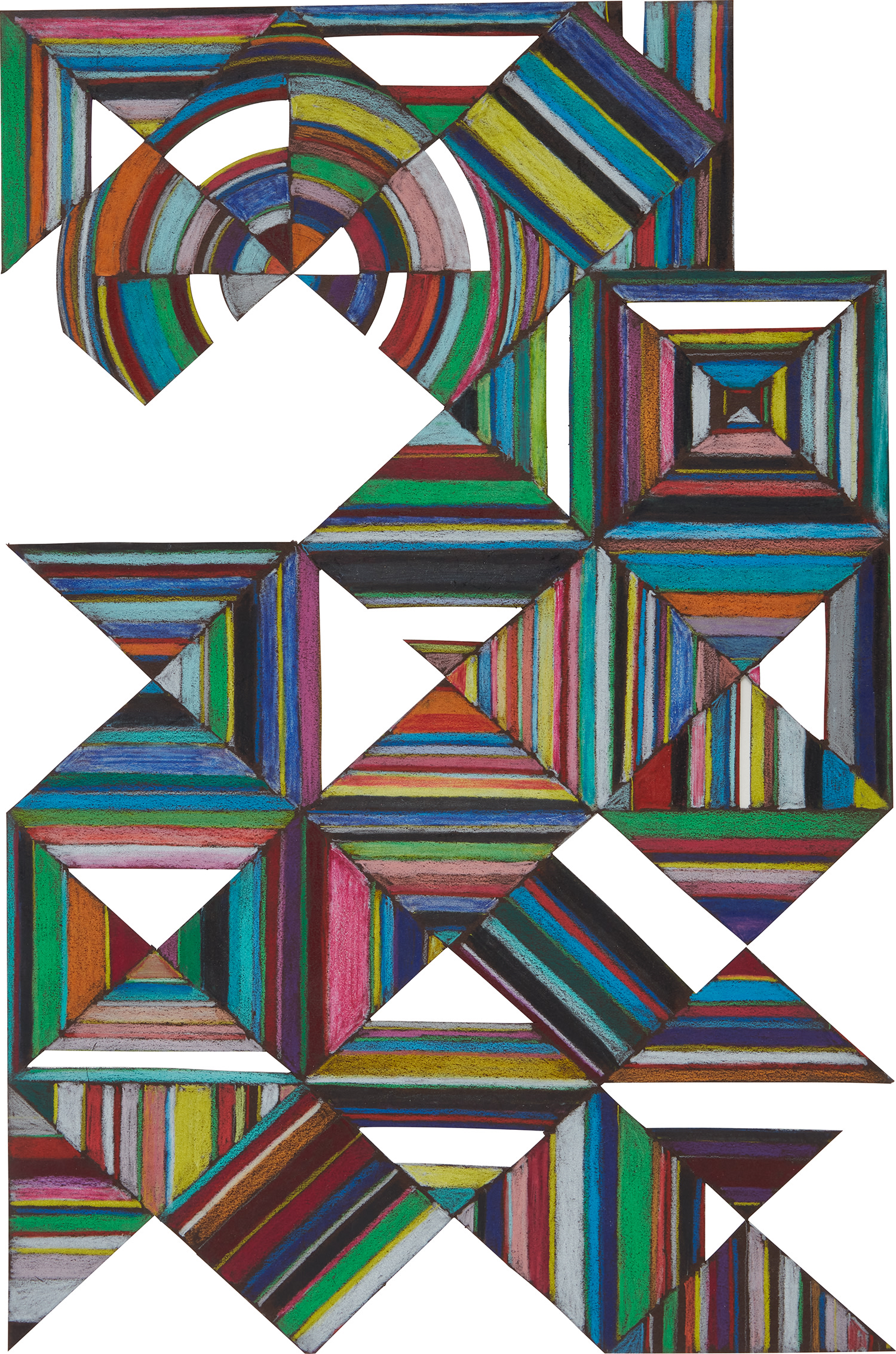
Lucas Samaras: Transformation Is His Greatest Art
Artist Spotlight · The Collection Editorial
“I am my own model. I am available, I am free, and I know myself.”
Lucas Samaras, interview circa 1970s
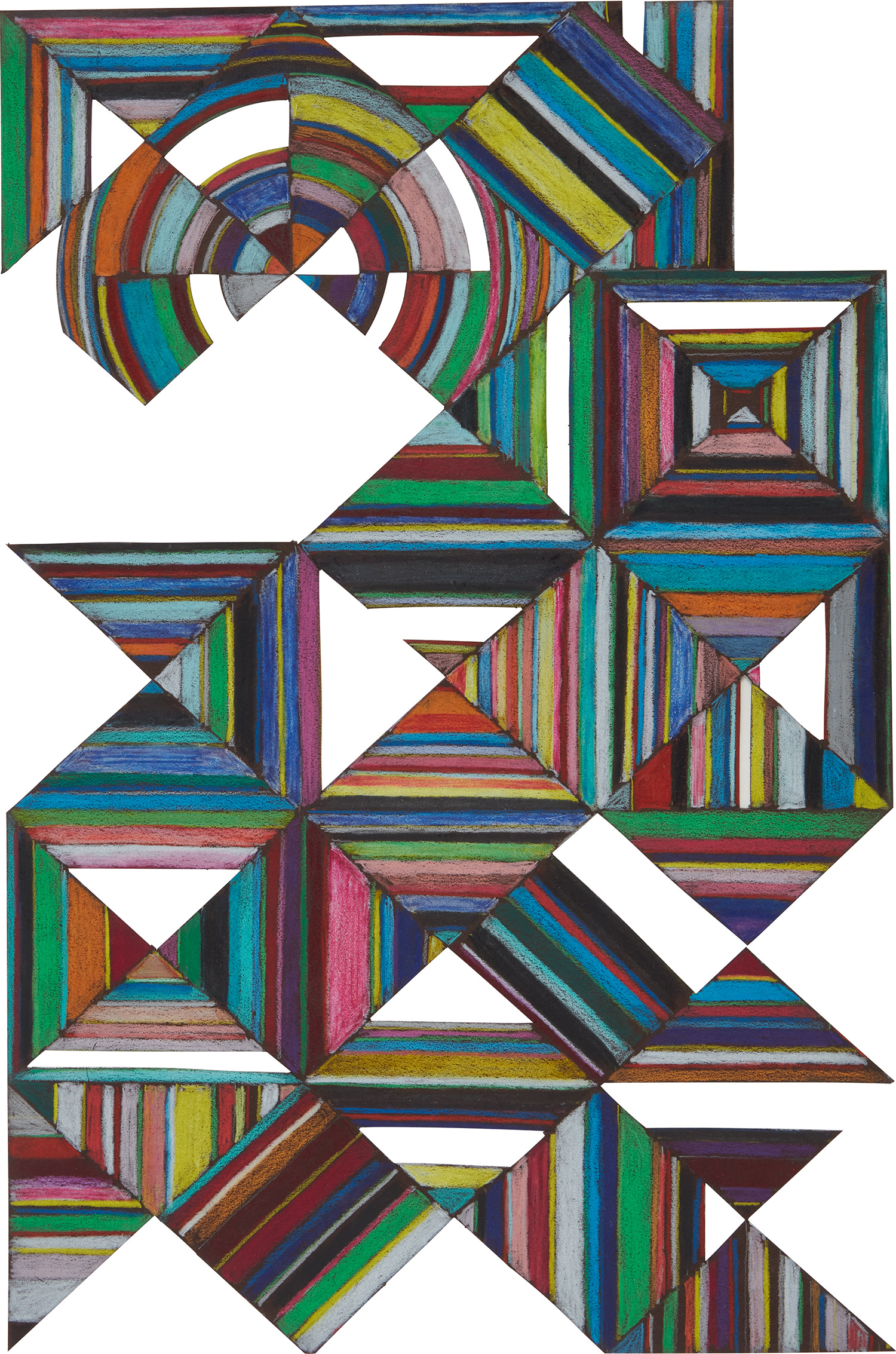
There are artists who observe the world, and then there are artists who consume it, reconstitute it, and hand it back to you shimmering and strange. Lucas Samaras belongs emphatically to the second category. The Whitney Museum of American Art, MoMA, and the Guggenheim have each built significant holdings of his work, a trinity of institutional affirmation that speaks to how thoroughly Samaras has shaped the conversation around identity, materiality, and the radical possibilities of self invention. For collectors and scholars returning to his practice now, the timing feels especially resonant: in an era saturated with digitally manipulated imagery and algorithmically constructed selfhood, Samaras achieved something wilder and more tactile decades before any of those tools existed.
Lucas Samaras
Lucas Samaras
Samaras was born in Kastoria, Greece in 1936, a town known for its fur trade and its Byzantine churches, and he carried the textures of that world with him. He emigrated to the United States as a teenager, settling in New Jersey, and went on to study at Rutgers University under the painter Allan Kaprow, one of the founding figures of the Happening movement. That environment, electric with experimentation and suspicious of conventional artistic hierarchies, proved formative. Samaras arrived in New York at exactly the moment when the boundaries between painting, sculpture, performance, and everyday life were being dismantled, and he threw himself into that dismantling with singular commitment.
In the early 1960s Samaras fell in with the downtown New York scene, participating in Happenings alongside Claes Oldenburg, Jim Dine, and Red Grooms. He showed at the Reuben Gallery, a crucial incubator for the American avant garde. But even in that company, his sensibility stood apart. Where many of his peers were drawn outward, toward public spectacle and consumer culture, Samaras turned inward, toward the bedroom, the body, and the disturbing beauty of ordinary objects transformed by obsessive attention.
Lucas Samaras
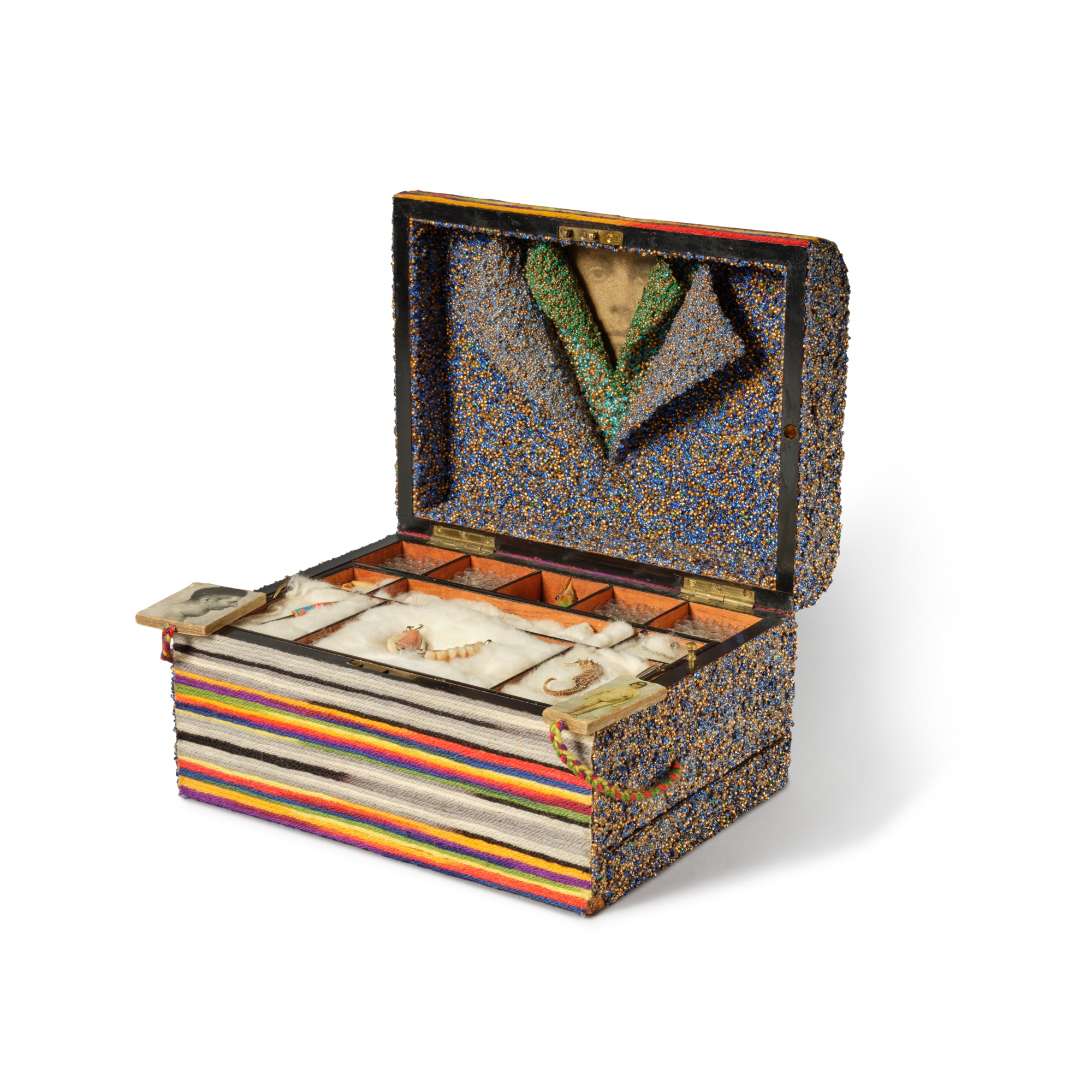
Box #62, 1967
His early room installations, most notably the recreation of his own bedroom at the Green Gallery in 1964, announced an artist for whom autobiography was not confessional but alchemical. The Box series, which Samaras developed through the 1960s, remains among the most compelling bodies of work in postwar American art. Box 62, dated 1967, is a vivid example of his method: a wood construction accumulating acrylic, yarn, glass beads, pins, glass, cotton, a found photograph collage, false teeth, a seahorse, a crab leg, pencil, and shells into a single object dense with psychological charge. These are not boxes in any functional sense.
They are reliquaries, or perhaps altarpieces, built from the detritus of personal and cultural life and transformed through accumulation into something that feels sacred and unsettling in equal measure. The pins and needles that recur throughout his sculptural work are not merely formal gestures. They are loaded with associations around threat, intimacy, and the fine line between care and harm. If the boxes established Samaras as a sculptor of uncommon intensity, his Photo Transformations announced him as a photographer of genuine genius.
Lucas Samaras
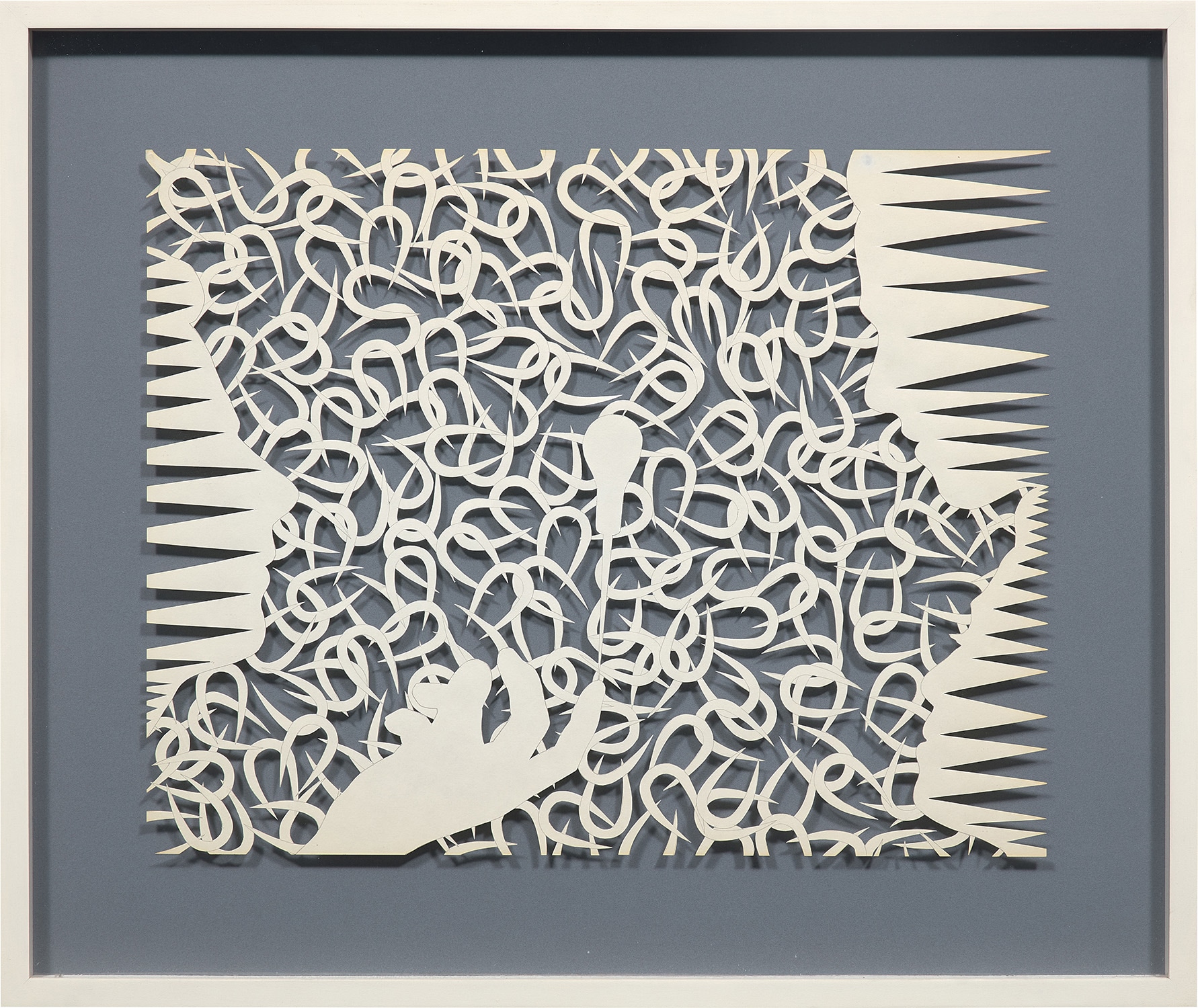
graphite on cut paper, 1968
Beginning in the early 1970s, he began working with Polaroid SX 70 film, manipulating the emulsion while it was still wet to distort, smear, and rebuild his own image before the photograph had fully set. The results are astonishing: self portraits that dissolve the figure into abstract fields of color, that stretch and compress the face into something mythological or monstrous, that seem to document not a person but a process of becoming. Works such as Photo Transformation dated July 30, 1976, and Photo Transformation from 1973 demonstrate the full range of this practice, from the intimately psychological to the purely painterly. Samaras was doing with chemistry and timing what digital artists would later attempt with software, and he was doing it by hand, in real time, alone in his apartment.
The market for Samaras has reflected the depth and breadth of his practice. His prints, including works published by Pace Editions in New York such as Hook and Ribbon, offer collectors an accessible point of entry into a body of work that spans multiple media. Signed and numbered editions like these carry the imprimatur of an artist who worked closely with his publishers and understood printmaking as a genuine extension of his artistic language rather than a secondary concern. For collectors building a serious engagement with American art of the 1960s and 1970s, Samaras represents an opportunity to acquire work that sits at the intersection of several major movements: assemblage and object art in the tradition of Joseph Cornell, body and identity work that anticipates Cindy Sherman and Nan Goldin, and psychologically charged self portraiture that connects to figures from Francis Bacon backward to Egon Schiele.
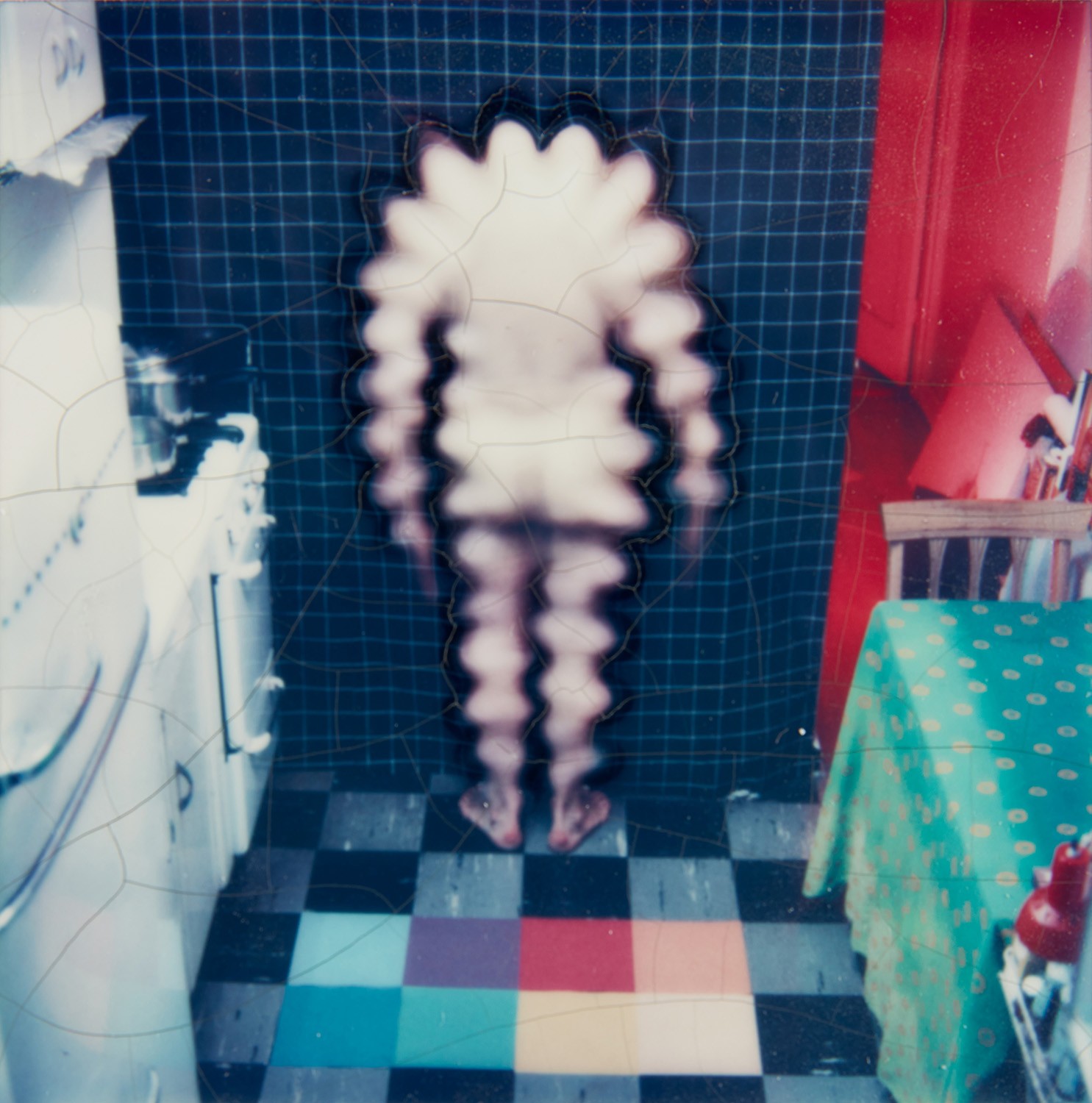
Lucas Samaras
Photo-Transformation, 7/30/76
In art historical terms, Samaras occupies a singular position. He emerged from the same milieu as the Pop artists but never embraced their ironic distance from personal experience. He worked in assemblage and installation alongside artists associated with Fluxus but was too subjective and too obsessive to be easily categorized there either. His closest kinship may be with artists such as Bruce Nauman and Yayoi Kusama, figures whose practices are similarly driven by the transformation of the self into a kind of primary material, and whose mirrored environments find an obvious parallel in Samaras's own mirrored rooms.
His Mirrored Room, first created in 1966 for the Albright Knox Art Gallery in Buffalo, is among the most influential installation works of the twentieth century and a clear precursor to the immersive environment work that dominates contemporary art today. What makes Samaras matter now, and what makes collecting his work feel like an act of genuine discernment, is the way his practice refuses easy resolution. His objects are beautiful and disturbing at once. His photographs are intimate and alienating.
His installations are seductive and disorienting. He spent decades exploring questions around identity, transformation, and the construction of the self that have only grown more urgent as those questions have moved to the center of cultural life. To own a Samaras is to own a piece of that inquiry at its most rigorous and most visceral, made by hand, made from the self, made with an intensity that no algorithm can replicate.
Explore books about Lucas Samaras
Lucas Samaras
Kim Levin
Lucas Samaras: Objects and Photographs
Various
Lucas Samaras: Boxes
Various
Lucas Samaras: A Retrospective
Robert Rosenblum
Samaras: The Photographs
Dimitri Papadimos