Louis le Brocquy
Louis le Brocquy: Painting the Luminous Human Soul
Artist Spotlight · The Collection Editorial
“I think of painting as a kind of archaeology. You search for something you cannot name.”
Louis le Brocquy, interview with Roald Dahl, 1970s
In 2016, the centenary of Louis le Brocquy's birth became an occasion for reflection across Ireland and far beyond its shores. The Irish Museum of Modern Art honoured his legacy with renewed attention, and galleries from Dublin to London revisited canvases that seemed, if anything, more urgently alive than when they were first made. That a painter born in Dublin in 1916 could still generate such genuine cultural heat spoke not to nostalgia but to something rarer: the sense that his vision had never quite been exhausted, that each encounter with those trembling, luminous faces emerging from white ground offered something new to whoever stood before them. Louis le Brocquy was born into a prosperous Dublin family with roots in Belgian commerce, and from the beginning his formation was unusually cosmopolitan for an Irish artist of his generation.
Louis le Brocquy
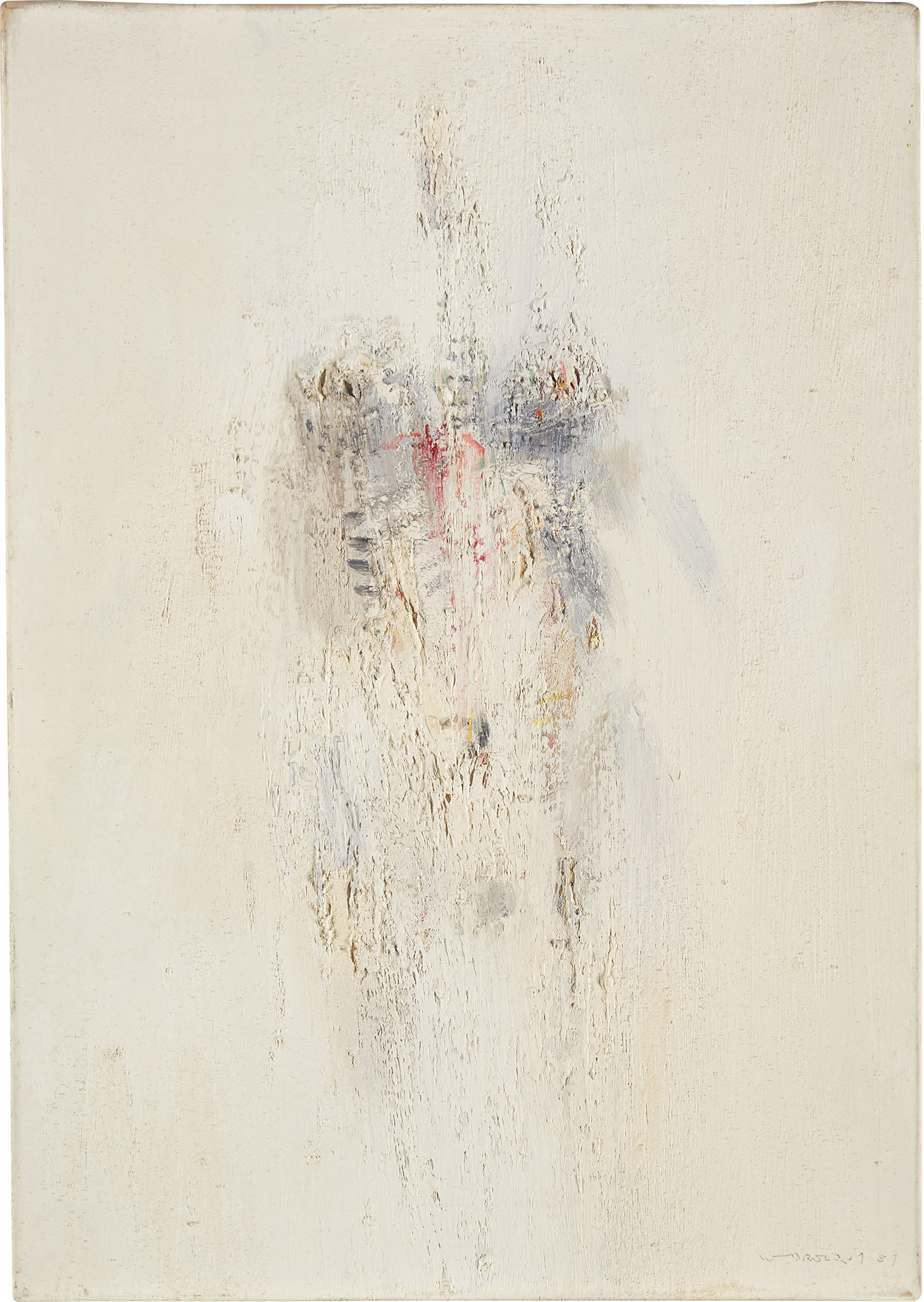
No. 24 Woman, 1957
He was largely self taught, a fact that shaped the fierce independence of his eye throughout his long career. In the late 1930s he travelled extensively in Europe, absorbing the lessons of Velázquez in Madrid, of Manet and the French moderns in Paris, and of the great Venetian colourists in Italy. These encounters gave him a foundation in the western tradition that he would spend decades quietly dismantling and rebuilding on his own terms. His early work, rooted in a sombre social realism, drew attention to the marginalised figures of Irish life.
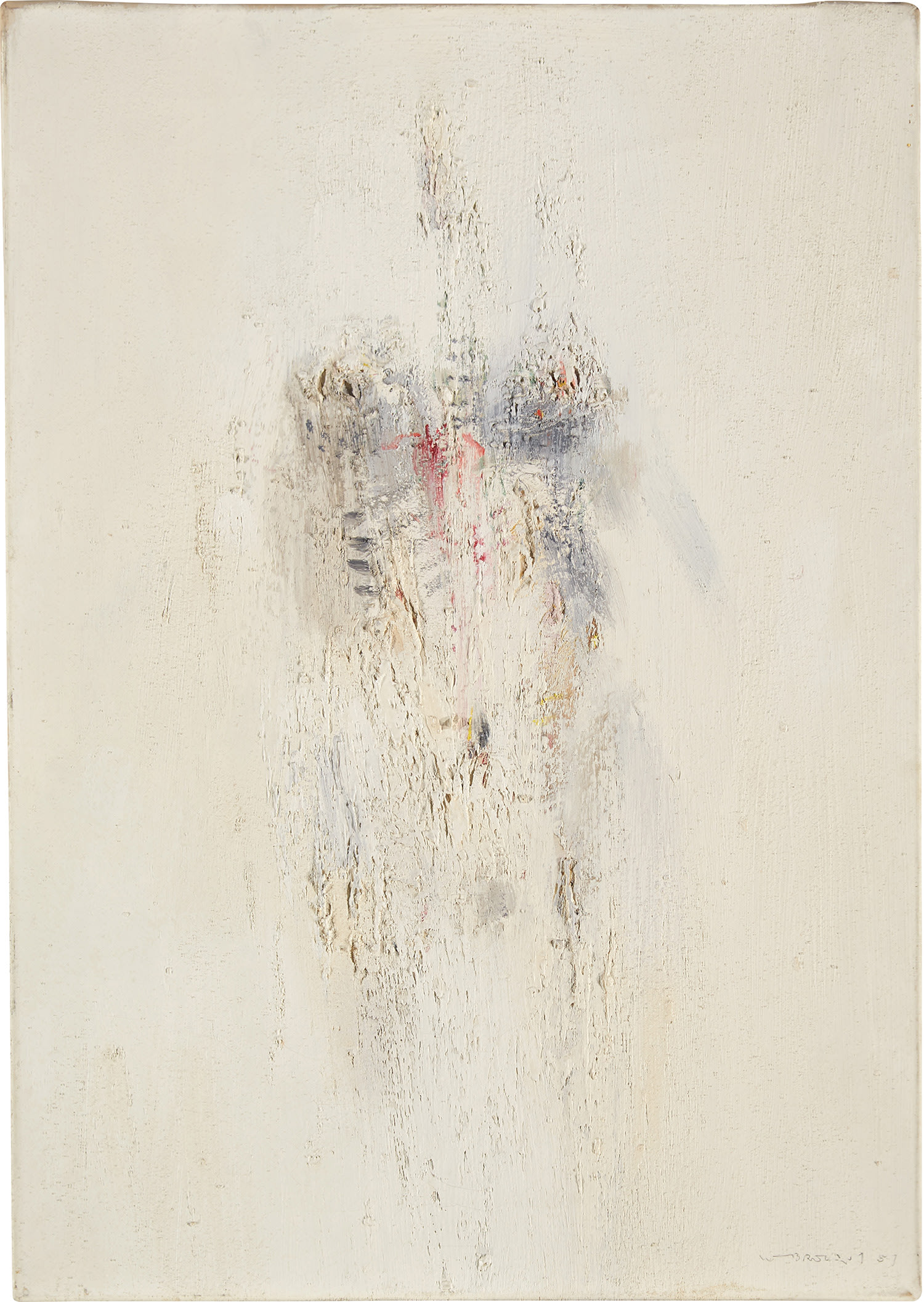
Works from the early 1940s such as the tender and observational Long the Stage Hand, executed in pen and ink with watercolour and gouache, show a young artist already committed to finding dignity in ordinary presence. By the late 1940s he had relocated to London and then to the south of France, and his palette began to lighten as his questions deepened. The extraordinary No. 24 Woman of 1957, an oil on canvas of striking restraint and psychological intensity, marks a pivotal moment: the figure is present but not fixed, caught somewhere between emergence and dissolution, the paint itself becoming a medium of uncertainty.
Louis le Brocquy
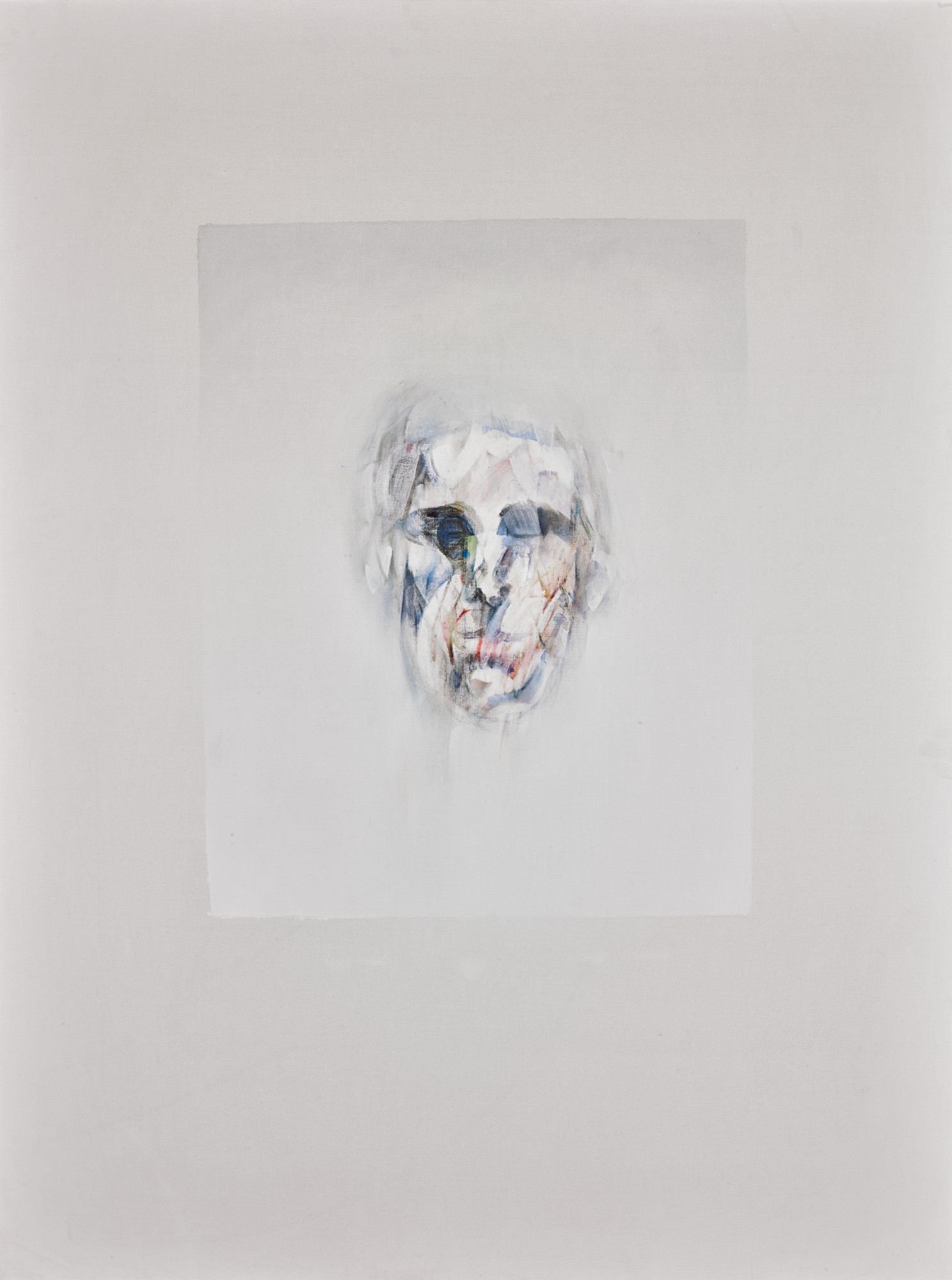
Image of W. B. Yeats, 1988
It was the series of head paintings, begun in earnest in the 1960s and pursued with extraordinary devotion for the remainder of his life, that secured le Brocquy's place in the canon of 20th century European art. He returned again and again to the faces of writers and poets he most admired, among them James Joyce, Samuel Beckett, Federico García Lorca, and W. B. Yeats, not to produce portraits in any conventional sense but to excavate what he called the presence behind the appearance.
“We do not see the world as it is. We see it as we are.”
Louis le Brocquy
His Image of W. B. Yeats from 1988 and his Image of Samuel Beckett from 1992, both on the platform, are luminous examples of this sustained enquiry. The faces materialise from fields of white and grey like images developing in a darkroom, full of suggestion rather than definition.
Louis le Brocquy
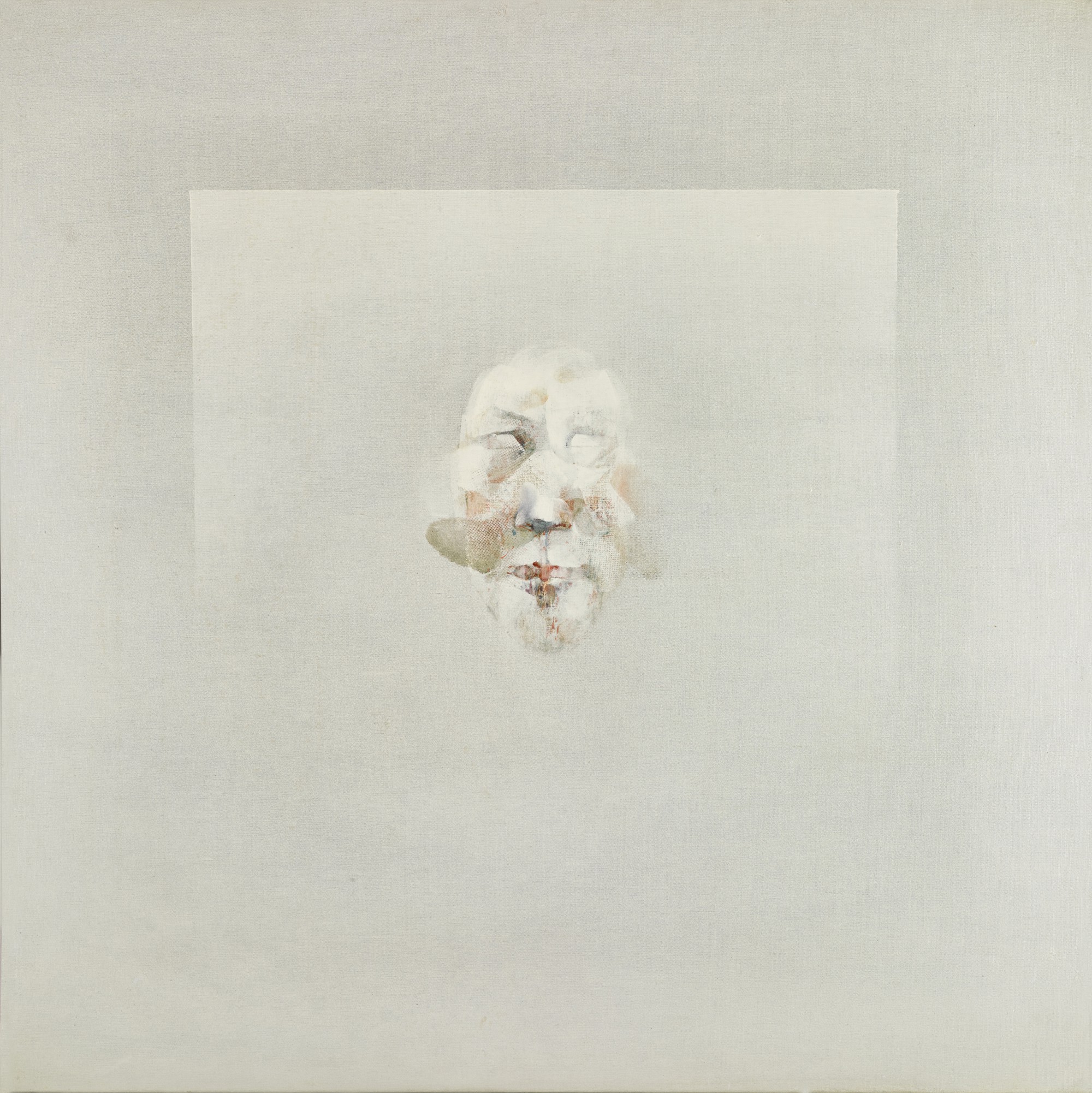
Head, 1971
It is no accident that these works read almost as devotional objects: le Brocquy understood portraiture as a form of archaeology, an attempt to reach the essential human core beneath the accidents of likeness. Le Brocquy's friendship and deep admiration for Francis Bacon added another dimension to this project. His Image of Francis Bacon from 1980, rendered in watercolour on paper, demonstrates how the medium itself could carry the weight of his enquiry with particular delicacy and immediacy. Bacon's influence is present not as imitation but as a kind of conversation, two artists circling the same terrifying and wonderful question of what a human face can bear witness to.
Works such as Head from 1971 and the layered Presence in oil on canvas with collage show how le Brocquy's method was never formulaic: each canvas or sheet of paper was a fresh negotiation, and the collage elements in Presence introduce a physical dimensionality that makes the emergent form feel almost tactile. For collectors, le Brocquy represents one of the most coherent and philosophically rich bodies of work to emerge from the British Isles in the postwar period. His paintings and works on paper sit comfortably alongside those of Bacon, Lucian Freud, and the School of London, though his sensibility remained distinctly his own, shaped as much by Celtic illuminated manuscripts and Japanese aesthetics as by continental modernism. The watercolour and gouache works, such as Being from 1997, offer collectors an entry into his world with particular immediacy: the medium allowed him a freedom and a directness that the large oil paintings achieve through accumulation and layering.
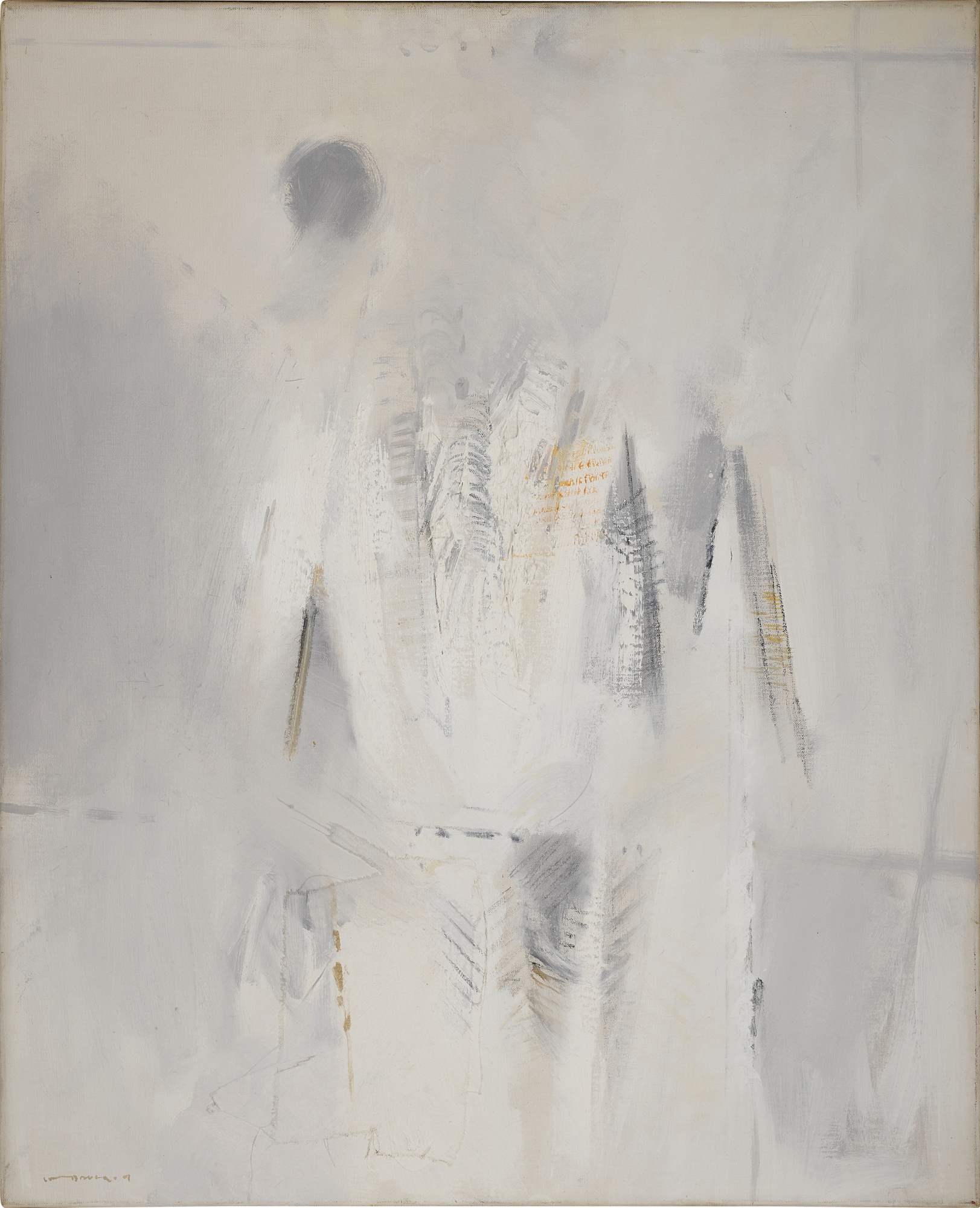
Louis le Brocquy
Presence
Auction houses in London and Dublin have seen sustained interest in his work across all price levels, and museum holdings from the Tate to the Centre Georges Pompidou in Paris confirm his international stature. Contextually, le Brocquy belongs to a generation of Irish artists who came of age during the mid century and refused the insularity that might have contained them. He was a co founder of the Irish Exhibition of Living Art in 1943, a watershed moment in Irish cultural life that opened the country to international modernism and challenged the conservatism of the Royal Hibernian Academy. In this sense he was not only a painter but a cultural force, someone whose ambitions for Irish art were as large as his ambitions for the canvas in front of him.
Louis le Brocquy died in Dublin in 2012, at the age of 95, having painted with discipline and intensity almost until the end. What he leaves behind is not simply a body of remarkable objects but a way of thinking about what painting can do when it is willing to be patient, to resist the easy answer, and to keep faith with the mystery of another human being. For those who collect his work, the experience of living with these paintings and drawings is precisely the experience he sought to create: a sustained, quietly transformative encounter with presence itself.
Explore books about Louis le Brocquy
Louis le Brocquy
Anne Crookshank and the Knight of Glin
Louis le Brocquy: A Retrospective
Michael Sheridan
Louis le Brocquy: The Tao of Painting
Brian Lynch
Louis le Brocquy: Works on Paper
Cyril Barrett
Louis le Brocquy: Irish Imaginings
Fintan Cullen
The Art of Louis le Brocquy
Peter Murray
Louis le Brocquy: A Living Image
Dorothy Walker