Louis Gauffier
Louis Gauffier: Italy's Most Devoted French Soul
Artist Spotlight · The Collection Editorial
Picture Rome in the last decade of the eighteenth century, a city trembling with political upheaval and artistic ferment, where French expatriates gathered in candlelit apartments to debate revolution and beauty in the same breath. Among them moved Louis Gauffier, a painter of quiet intensity and extraordinary gifts, sketching the volcanic landscapes of the south and the tender faces of his adopted homeland with equal devotion. He was not the loudest voice in that room, but he was perhaps the most attentive eye, and the work he left behind rewards that attention in full. Today, as collectors and institutions increasingly look beyond the canonical names of Neoclassicism toward the richly populated world of its secondary figures, Gauffier is emerging as one of the most compelling rediscoveries available to the discerning eye.
Louis Gauffier
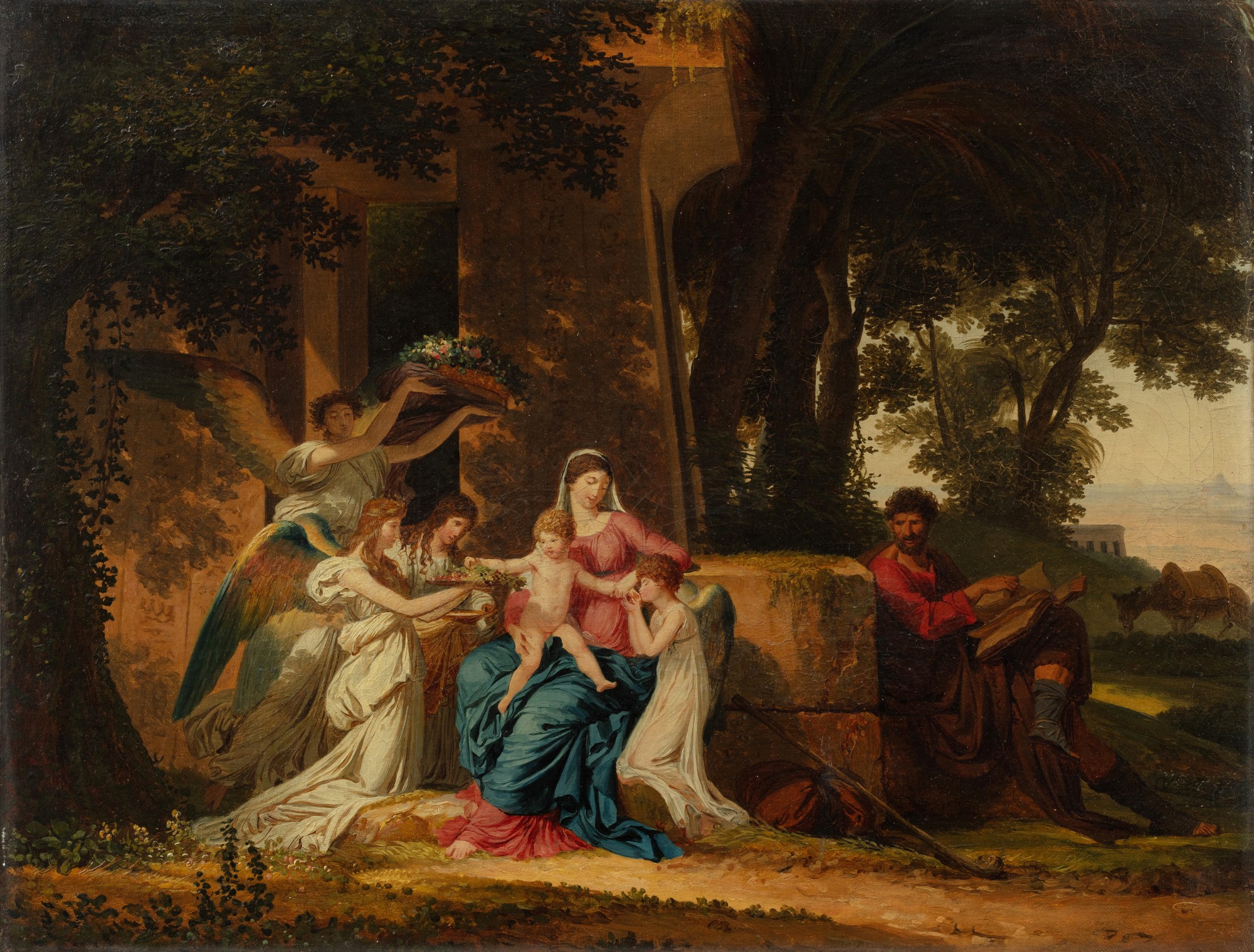
Esquisse pour Le Repos de la Sainte Famille pendant la Fuite en Égypte
Louis Gauffier was born in 1762 in Poitiers, a city in west central France with a long tradition of scholarship and civic culture. His early talent was recognized quickly enough to bring him to Paris, where he entered the studio of Hughes Taraval, a history painter of considerable standing who had himself trained in Rome and absorbed the grand manner of the Italian tradition. Under Taraval, Gauffier received a formation that emphasized the moral seriousness of history painting, the careful study of antique models, and the discipline of drawing as the foundation of all pictorial thinking. Paris in the 1770s was a city electrified by the Neoclassical movement, with Jacques Louis David beginning to reshape the terms of French painting entirely, and young Gauffier absorbed that atmosphere of rigorous ambition alongside his studio training.
The defining moment of his early career came in 1784, when Gauffier won the Prix de Rome, the most prestigious prize available to a French artist, for his painting Christ and the Woman of Canaan. This award, administered by the Académie royale de peinture et de sculpture, sent its winners to the French Academy in Rome to study the antique and the masters of the Renaissance and Baroque at firsthand. For Gauffier, the journey to Rome was not merely a professional milestone. It became a permanent reorientation of his life.
Louis Gauffier
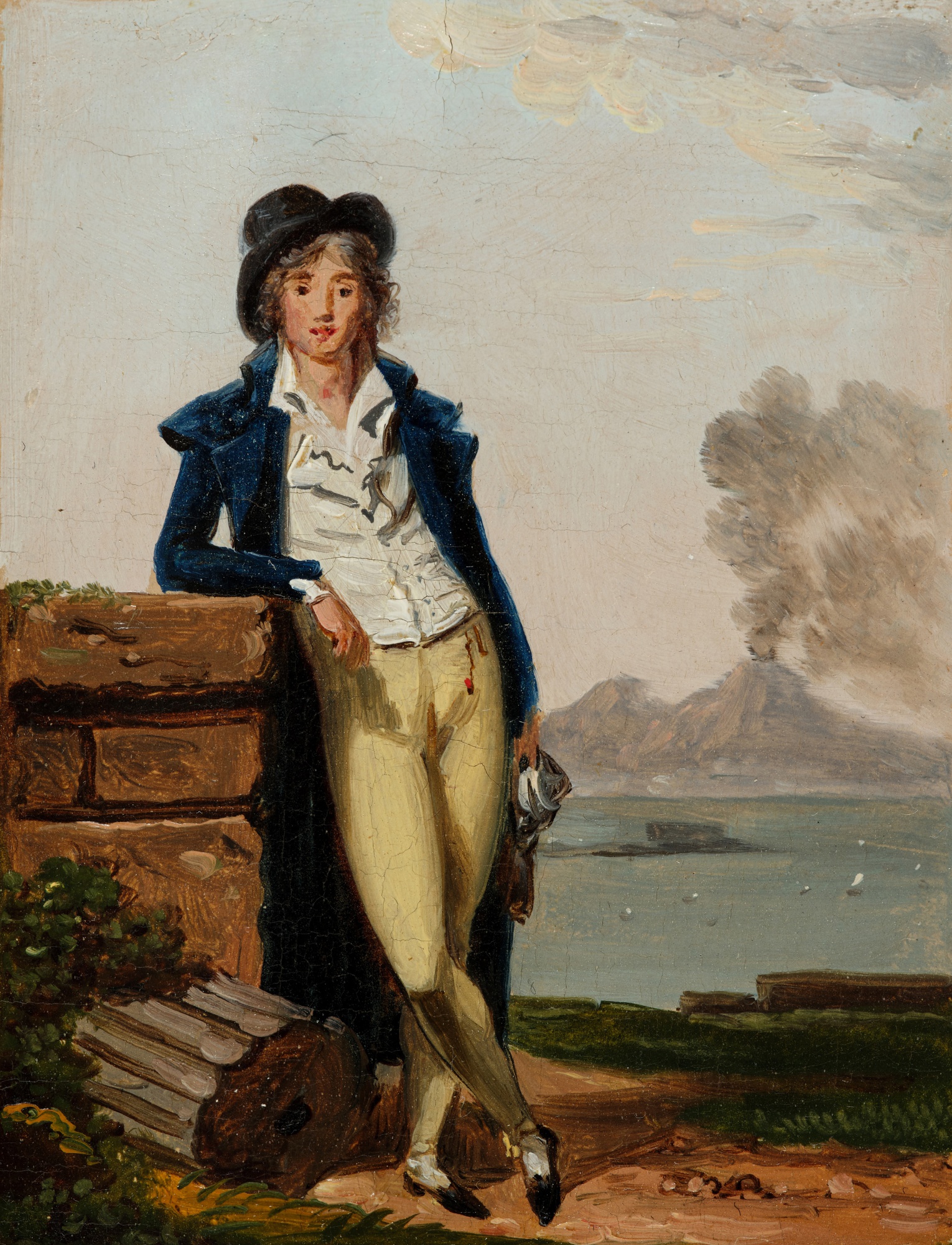
Portrait of a Young Man with Mount Vesuvius Beyond
He fell in love with Italy, with its light, its ruins, its people, and its landscapes, and he never fully returned. He would spend the great majority of his working life on Italian soil, making Rome and later Florence his home, and the experience transformed him from a promising student of the Parisian academic tradition into something more personal and searching. In Rome, Gauffier developed a practice that moved fluidly between history painting and portraiture, two genres that might seem distinct but that he unified through a consistent sensibility. His history paintings, including deeply felt religious subjects and scenes drawn from classical antiquity, are marked by a warmth of color and a tenderness of feeling that distinguishes them from the cooler, more austere manner of David and his closest followers.
His Neoclassicism is one of feeling as much as form, indebted to antiquity but never frozen by it. His portraits, meanwhile, are among the most psychologically alive produced in the late eighteenth century by any artist working in Italy. He had a particular gift for situating his subjects within landscape, allowing the grandeur of the Italian countryside to speak to the inner life of the sitter in ways that feel modern and emotionally intelligent. Among his most celebrated works is the Esquisse pour Le Repos de la Sainte Famille pendant la Fuite en Égypte, an oil on canvas that captures the Holy Family in a moment of tender rest against an Italianate landscape.
The work exemplifies Gauffier at his most lyrical, balancing the compositional gravity of the academic tradition with a warmth and intimacy that feels genuinely devotional rather than merely decorous. Equally arresting is his Portrait of a Young Man with Mount Vesuvius Beyond, an oil on canvas laid down on panel, in which the smoking volcano in the distance charges the portrait with a quiet drama that lifts it well above the merely conventional. Both works demonstrate his ability to make landscape and figure speak to one another, to find in the physical world a resonance with human emotion that is the hallmark of the very best portraiture. From a collecting perspective, Gauffier represents a remarkable opportunity.
His relative obscurity outside specialist circles means that works of genuine quality remain available at prices that do not yet reflect their historical significance or aesthetic achievement. Collectors who have built around the stronger market names of French Neoclassicism, figures such as David, Jean Baptiste Greuze, or Elisabeth Vigée Le Brun, will find in Gauffier a natural and illuminating companion. His work holds up beautifully in the same rooms as these artists while offering a quieter, more contemplative register. For those drawn to the tradition of the Grand Tour and the rich intersection of French and Italian culture in the late eighteenth century, Gauffier is an essential voice.
His portraits in particular, with their combination of psychological penetration and landscape poetry, speak directly to the contemporary collector's appetite for intimacy and emotional depth. Gauffier's place in art history sits at a productive crossroads. He shares with David and the broader Neoclassical movement a commitment to the lessons of antiquity and a belief in painting as a vehicle for serious human meaning. But his long immersion in Italian life also connects him to the tradition of the view painter and the landscape portraitist that would find its great flowering in the Romantic generation that followed.
Artists such as François Marius Granet and Jean Auguste Dominique Ingres, both of whom spent formative years in Rome and developed a similarly nuanced relationship between figure and setting, offer useful points of comparison. Gauffier anticipated something of that Romantic feeling for place and atmosphere while remaining rooted in the classical discipline of his training. Louis Gauffier died in Florence in 1801, at only thirty nine years of age, cut off before he could fully consolidate the reputation his gifts deserved. That early death is one reason his name has not always received the prominence it merits in the standard accounts of French painting.
But the work he left behind makes a quiet, persistent, and ultimately irresistible case for his importance. In an era when collectors and curators alike are undertaking a long overdue reassessment of the full breadth of Neoclassical painting beyond its most famous champions, Gauffier stands out as an artist of genuine distinction, one whose combination of intellectual seriousness, emotional warmth, and painterly refinement makes him not merely a historical footnote but a living presence in any collection fortunate enough to include him.