Linnaeus Tripe
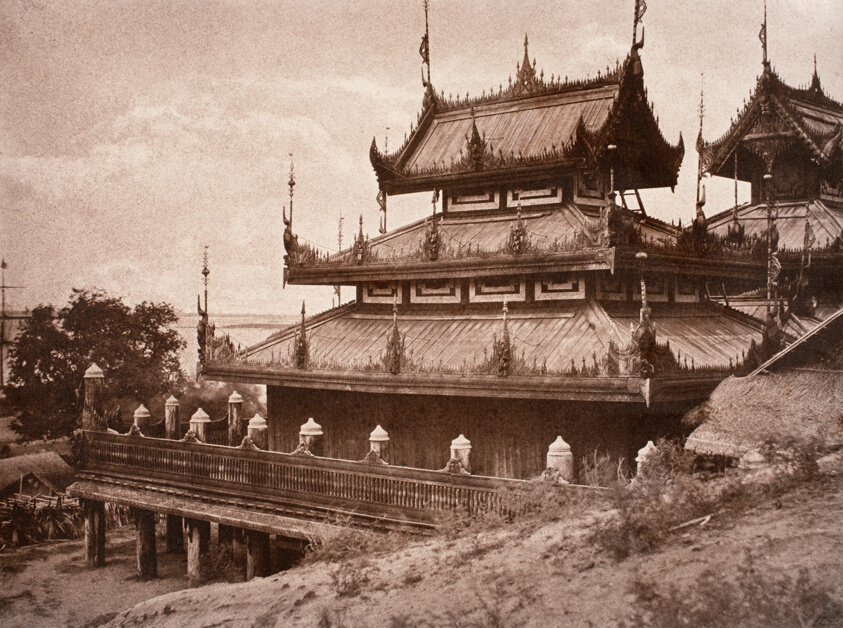
Linnaeus Tripe: Light Across Ancient Worlds
Artist Spotlight · The Collection Editorial
There is a photograph that stops you cold. A monastery courtyard in Yenangyaung, Burma, captured in 1855, the timber and plaster of a kyoung rendered in tones of silver and amber on salted paper. The stillness in the image is absolute, the architecture both monumental and intimate, as though the building itself has leaned forward to be seen. This is the world of Linnaeus Tripe, a British army officer who also happened to be one of the most gifted and consequential photographers of the nineteenth century.
Linnaeus Tripe
No. 8. Ye-nan-gyoung [Yenangyaung]. Kyoung., 1855
His work is currently enjoying a sustained and well deserved renaissance among scholars, curators, and collectors who recognize that what he made in a brief six year window represents an irreplaceable visual inheritance for both Western and South and Southeast Asian cultural memory. Linnaeus Tripe was born in 1822 in Devonport, a naval town on the southwestern tip of England. The son of a merchant, he grew up in a port culture defined by trade, geography, and the constant awareness of distant places. He joined the British East India Company's Madras Infantry and shipped out to India as a young officer, beginning a military career that would carry him across the subcontinent and eventually into Burma.
The practical discipline of military service and the empirical culture of the East India Company shaped his sensibility in ways that would later prove essential to his photography. He was a man trained to observe carefully, to record faithfully, and to move through unfamiliar terrain with methodical attention. Tripe came to photography at a pivotal moment in the medium's history. The 1850s saw the technology mature just enough to be portable in difficult conditions, and the British imperial apparatus saw in photography a practical tool for documentation and survey.
![Linnaeus Tripe — No. 23. Pugahm Myo [Pagan]. Figures in Damayangyee Pagoda [Dhamma-yan-gyi].](https://rtwaymdozgnhgluydsys.supabase.co/storage/v1/object/public/artwork-images/aic-photo/373b9c3b-ad67-43b0-ac52-fcd475319aeb/216582.jpg)
Linnaeus Tripe
No. 23. Pugahm Myo [Pagan]. Figures in Damayangyee Pagoda [Dhamma-yan-gyi]., 1855
Tripe trained himself in the calotype and later the waxed paper negative process, and by 1854 he was producing work of remarkable sophistication. He was appointed as official photographer to several major British missions and surveys, including the political mission to the Court of Ava in Burma in 1855 and the Madras Presidency's photographic survey from 1856 to 1860. These appointments gave him access to sites and structures that very few Westerners had ever seen, let alone recorded. What Tripe achieved within that access was something far beyond dutiful documentation.
His photographs of temples, pagodas, monastery balconies, and urban streetscapes in Burma and southern India are compositionally extraordinary. He understood light in the way a painter understands it, as a structural element rather than simply an illuminating condition. His salted paper prints carry a warmth and depth that later albumen prints rarely matched. Works such as his 1855 views of the Dhamma Yan Gyi pagoda at Pagan, with its carved stone figures rendered in extraordinary tonal nuance, reveal an artist working at the absolute limit of what his medium could express.
![Linnaeus Tripe — No. 92. Amerapoora. Another part of the Balcony of Kyoung No. 86 [Maha-too-lo-Bounghian Kyoung].](https://rtwaymdozgnhgluydsys.supabase.co/storage/v1/object/public/artwork-images/aic-photo/373b9c3b-ad67-43b0-ac52-fcd475319aeb/216583.jpg)
Linnaeus Tripe
No. 92. Amerapoora. Another part of the Balcony of Kyoung No. 86 [Maha-too-lo-Bounghian Kyoung]., 1855
The figure studies within that pagoda sequence feel almost archaeological in their precision, and yet they carry an undeniable sense of reverence. Tripe was not merely measuring these spaces. He was honoring them. The Burma series, compiled into albums including Views of Burma in 1856 and Burma Views in 1857, represents the heart of his legacy.
These albums circulated among a small audience of officials, scholars, and patrons, and their relative obscurity for most of the twentieth century only makes their rediscovery more exciting. The Victoria and Albert Museum and the J. Paul Getty Museum have both collected his work and featured it in significant exhibitions, most notably the Getty's landmark 2014 survey Linnaeus Tripe: Photographer of India and Burma, which brought his practice to a global audience for the first time at the scale it deserved. The Getty show traveled and catalyzed a new generation of scholarship, firmly establishing Tripe's place in the history of photography alongside figures such as Roger Fenton, Maxime Du Camp, and John Thomson.
For collectors, Tripe's work presents a genuinely compelling proposition. His salted paper prints are among the most technically accomplished of the period, and the subjects he documented carry historical significance that extends well beyond the art market. Many of the temples and urban environments he photographed have since been substantially altered or destroyed, which means that his images function simultaneously as aesthetic objects and as primary historical documents. The rarity of his work in the open market reflects both the institutional appetite for his prints and the limited number of original album examples that have entered private hands.
When Tripe works do appear at auction or through specialist dealers, they consistently attract serious attention from both photographic print collectors and those whose focus is South and Southeast Asian cultural heritage. Tripe belongs to a fascinating cohort of nineteenth century photographers whose practice was shaped by imperial commission but whose vision consistently exceeded those administrative origins. His peers in spirit include Samuel Bourne, whose landscape photographs of the Himalayas redefined how the subcontinent was seen in Britain, and Francis Frith, who brought a similar grandeur to his documentation of Egypt and the Near East. Like Tripe, both Bourne and Frith are now understood as artists first and documentarians second, their institutional contexts acknowledged but no longer allowed to diminish what they actually made.
Tripe fits naturally into this constellation, and his Burmese work in particular occupies a unique position within it, since no other photographer of comparable skill worked in that region during the same period. Linnaues Tripe retired from active photographic work around 1860, his military duties and personal circumstances drawing him away from the practice that had briefly made him exceptional. He died in 1902, largely unknown outside a narrow circle of specialists. The distance between that quiet ending and the recognition he now receives is a reminder of how patient history can be, and how richly patient attention is eventually rewarded.
To collect Tripe is to participate in that act of recognition, to place oneself alongside institutions and scholars who have understood that his photographs are among the most luminous and important ever made in the service of seeing the world clearly and with genuine feeling.
Explore books about Linnaeus Tripe
Linnaeus Tripe: A Photographic Journey Through India
Pauline Rohatgi
The Photography of Linnaeus Tripe
Hermione de Almeida and George Gillespie
Early Photography in India
Paul Greenough
Linnaeus Tripe: Photographer of India and Burma
Peyton Skipwith