Li Keran
Li Keran: Mountains, Ink, and Timeless Wonder
Artist Spotlight · The Collection Editorial
“I have one foot in tradition and one foot in life. Only by standing in both can I move forward.”
Li Keran
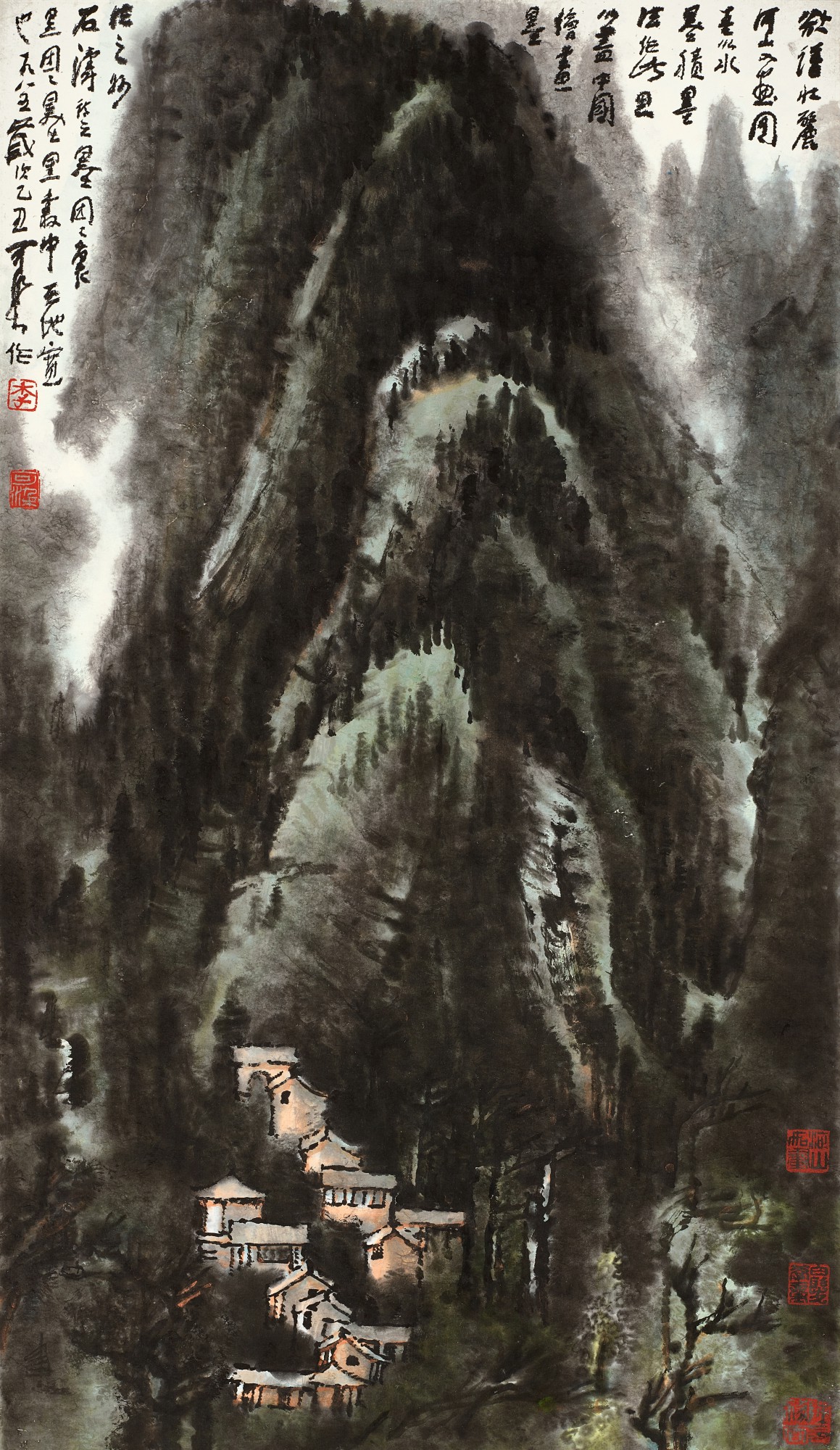
In the grand auction rooms of Beijing and Hong Kong, a Li Keran landscape commands a particular kind of silence. Bidders lean forward. The ink is dense, the mountains loom with a weight that feels geological rather than painted, and the light filtering through his characteristic use of counter light technique seems almost impossible for a medium so ancient. In 2015, his monumental work "Wanshan Hongbian" set a record of over 193 million RMB at China Guardian, cementing his position not merely as a titan of modern Chinese art but as one of the most consequential painters of the twentieth century globally.
Li Keran
Li Keran, Village by the Mountains
That auction moment felt less like a transaction and more like a cultural reckoning, a public acknowledgment of what serious collectors had understood for decades. Li Keran was born in 1907 in Xuzhou, in the Jiangsu province of China, a city with deep roots in Chinese history and culture. His beginnings were modest, far removed from the elite scholarly painting traditions that had long defined Chinese ink art. He began studying painting as a young boy under local masters, demonstrating an early seriousness of purpose that would define his entire life.
By his early twenties he had enrolled at the Shanghai Academy of Fine Arts, and later at the Hangzhou National Academy of Fine Arts, where he studied under Lin Fengmian, one of the great reformers of Chinese art who was himself deeply influenced by European modernism. That encounter with Lin Fengmian planted a seed that would take decades to fully flower. The formative arc of Li Keran's practice is one of the great stories of artistic synthesis in modern art history. In 1946, he moved to Beijing and became a student of Qi Baishi, the legendary master of traditional Chinese ink painting, who was then in his eighties.
Li Keran
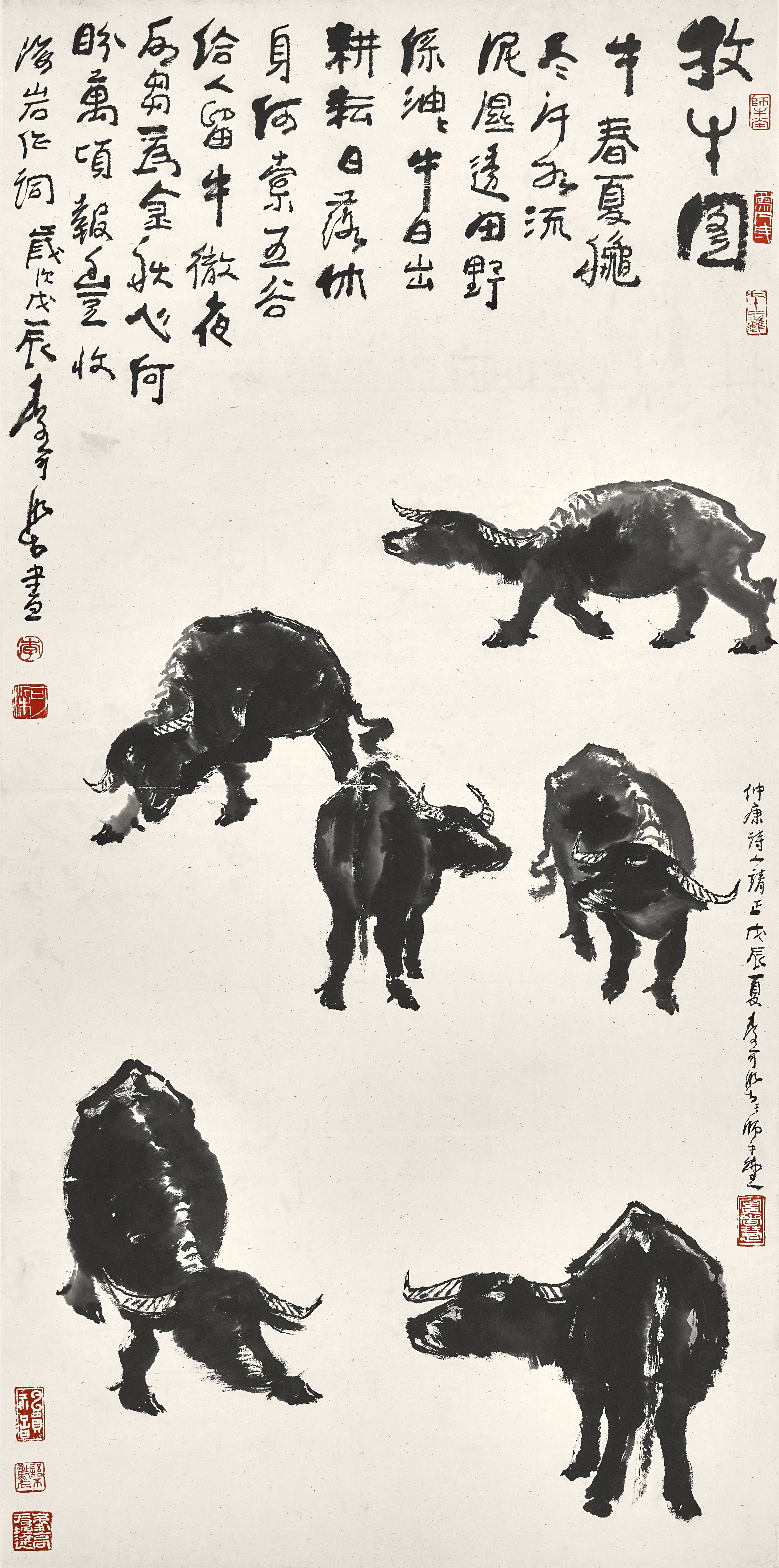
Li Keran, Buffaloes
This was an act of profound intellectual humility from a painter who already had significant training, and Qi Baishi reportedly admired his young student's courage to learn. Simultaneously, Li Keran studied under Huang Binhong, another towering figure of classical ink tradition. From these two elders he absorbed the philosophical and technical foundations of literati painting, the calligraphic brushstroke, the relationship between emptiness and form, the spiritual weight of simplicity. Yet Li Keran was not content to be a faithful inheritor.
Through the 1950s he undertook a series of sketching journeys across China, traveling to Guilin, the Yellow Mountains, the Li River, and beyond, filling notebooks with observations drawn directly from nature. He also engaged seriously with Western painting, particularly the tonal drama of Rembrandt and the structural landscapes of Cézanne, integrating principles of light and shadow into a practice that had traditionally approached space and illumination in entirely different terms. The result was a pictorial language that was genuinely new. His mountains are not the flat, rhythmic peaks of classical Chinese painting.
Li Keran
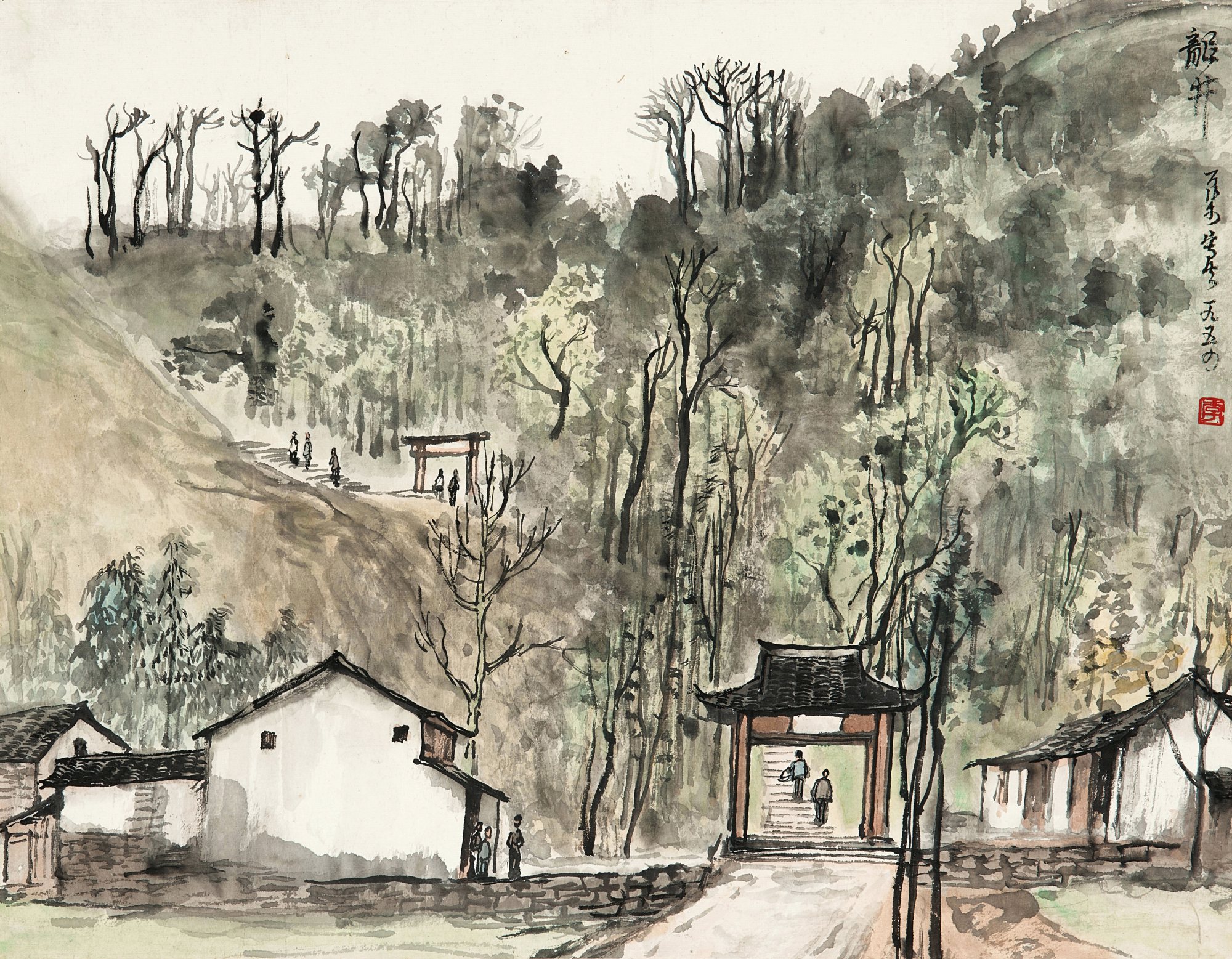
李可染 龍井 │ Li Keran, Scenery of Longjing
They press toward the viewer with mass and atmosphere. His forests are dark and luminous at once, suffused with a back lit glow that he achieved by working deep washes of ink and then building light from within, a method he described as absorbing from reality and transforming it. Among his most celebrated subjects are the water buffalo and the landscape, and it is worth pausing on both. His buffalo paintings, loose and tender in their brushwork yet grounded in careful observation, carry an extraordinary sense of calm vitality.
Works such as "Buffaloes" demonstrate his ability to say everything necessary with the minimum of marks, a quality he absorbed from Qi Baishi and made entirely his own. His landscapes, by contrast, are maximalist in their emotional ambition. "Village by the Mountains" exemplifies the warmth he brought to the genre: ink and colour working together to suggest not just a place but a feeling of dwelling, of belonging within a vast natural world. "Scenery of Longjing" reveals his sensitivity to specific locations, capturing the misty, tea garden valleys near Hangzhou with a particularity that goes beyond documentation into genuine lyrical feeling.
Li Keran
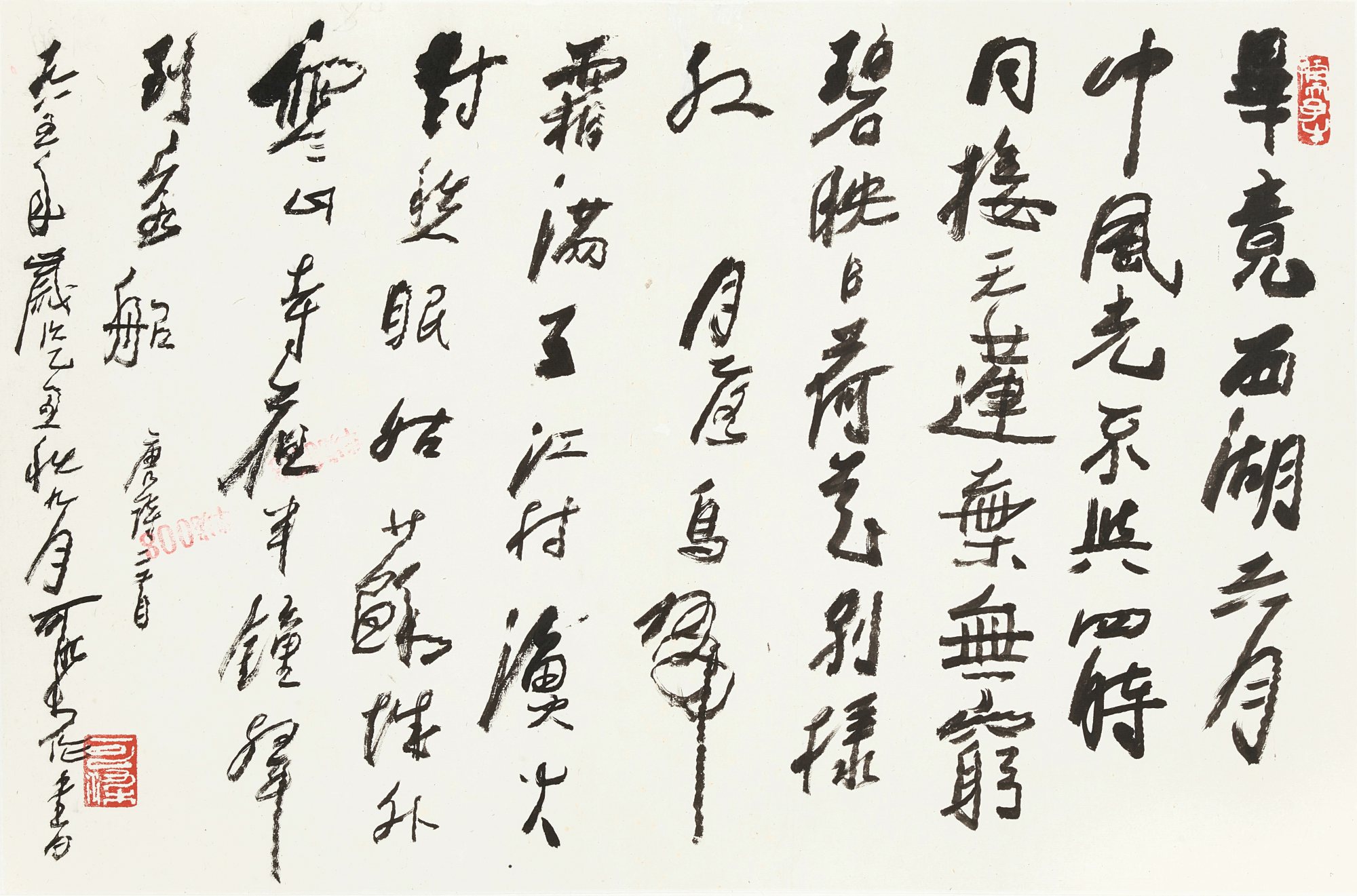
李可染 行書唐宋兩家詩 │Li Keran, Poems in Xingshu
"Lofty Cliffs" shows his bolder, more architectural side, where rock faces become almost abstract presences, built up through layered ink with a physical insistence that borders on the sculptural. For collectors, the appeal of Li Keran operates on multiple registers. There is the art historical significance, the clear documentation of a figure who shaped the direction of Chinese ink painting for generations. There is the formal beauty, works that reward sustained looking across different scales and moods.
And there is the market intelligence: Li Keran's works have shown consistent strength at the major auction houses including Sotheby's, Christie's, China Guardian, and Poly Auction, with landscape paintings and buffalo subjects both performing strongly. Collectors who have engaged with his work often speak of a quality that is difficult to articulate but immediately felt, an aliveness in the brushwork that distinguishes a genuine Li Keran from the many works that have circulated in his name. Provenance and scholarly attention matter enormously in this market, and works that come with clear documentation and have been examined by specialists carry a meaningful premium. His calligraphic works, such as the elegant "Poems in Xingshu," also attract collectors interested in the full range of his practice and tend to offer accessible points of entry compared to his major landscapes.
Within the broader landscape of twentieth century Chinese art, Li Keran stands alongside figures such as Wu Guanzhong, who similarly sought a bridge between Chinese tradition and Western modernism, and Fu Baoshi, whose atmospheric landscapes share a concern with mood and natural drama. Internationally, the dialogue his work opens with Cézanne and with the broader tradition of landscape as philosophical inquiry places him in a global conversation about what painting can do and mean. Museums including the National Art Museum of China in Beijing hold significant collections of his work, and retrospective exhibitions have appeared in major institutions across Asia and beyond. Li Keran passed away in Beijing in 1989, leaving behind a body of work that continues to grow in stature.
His legacy is not simply a matter of aesthetic achievement, remarkable as that is. He demonstrated that a tradition of over a thousand years could be renewed rather than abandoned, that engagement with the wider world of art need not mean the erasure of one's own inheritance. For anyone drawn to the expressive possibilities of ink, to the particular intelligence of Chinese pictorial thought, or simply to paintings that carry genuine feeling in every mark, Li Keran remains an artist of the first order. To spend time with one of his landscapes is to understand something essential about what it means to look at a mountain and decide, carefully, lovingly, how to bring it into being on paper.
Explore books about Li Keran
Li Keran: A Chinese Painter in the Twentieth Century
Alfreda Murck
Li Keran
Michael Sullivan
The Art of Li Keran
Xu Fuguan
Li Keran and Modern Chinese Painting
James Cahill
Li Keran: Catalogue Raisonne
Li Keran Museum