Léonard-Tsuguharu Foujita
Foujita: The Master Who Bridged Two Worlds
Artist Spotlight · The Collection Editorial
“I am Japanese when I paint, but I am also French. I cannot separate the two.”
Léonard-Tsuguharu Foujita
In the spring of 2018, the Musée Maillol in Paris mounted a sweeping retrospective of Léonard Tsuguharu Foujita that drew queues stretching along the Rue de Grenelle, a testament to the enduring magnetism of an artist who spent his life standing gracefully between two cultures. The show brought together paintings, drawings, and intimate works on paper that collectively traced one of the twentieth century's most singular artistic journeys. Visitors who came expecting novelty left having encountered something rarer: a vision so coherent and so personal that it transcended the categories critics had spent decades trying to assign to it. Foujita was born in Tokyo in 1886, the son of a military doctor whose cultured household gave the young Tsuguharu early exposure to both Japanese artistic traditions and the Western imagery that was flooding Japan during the Meiji era.
Léonard-Tsuguharu Foujita
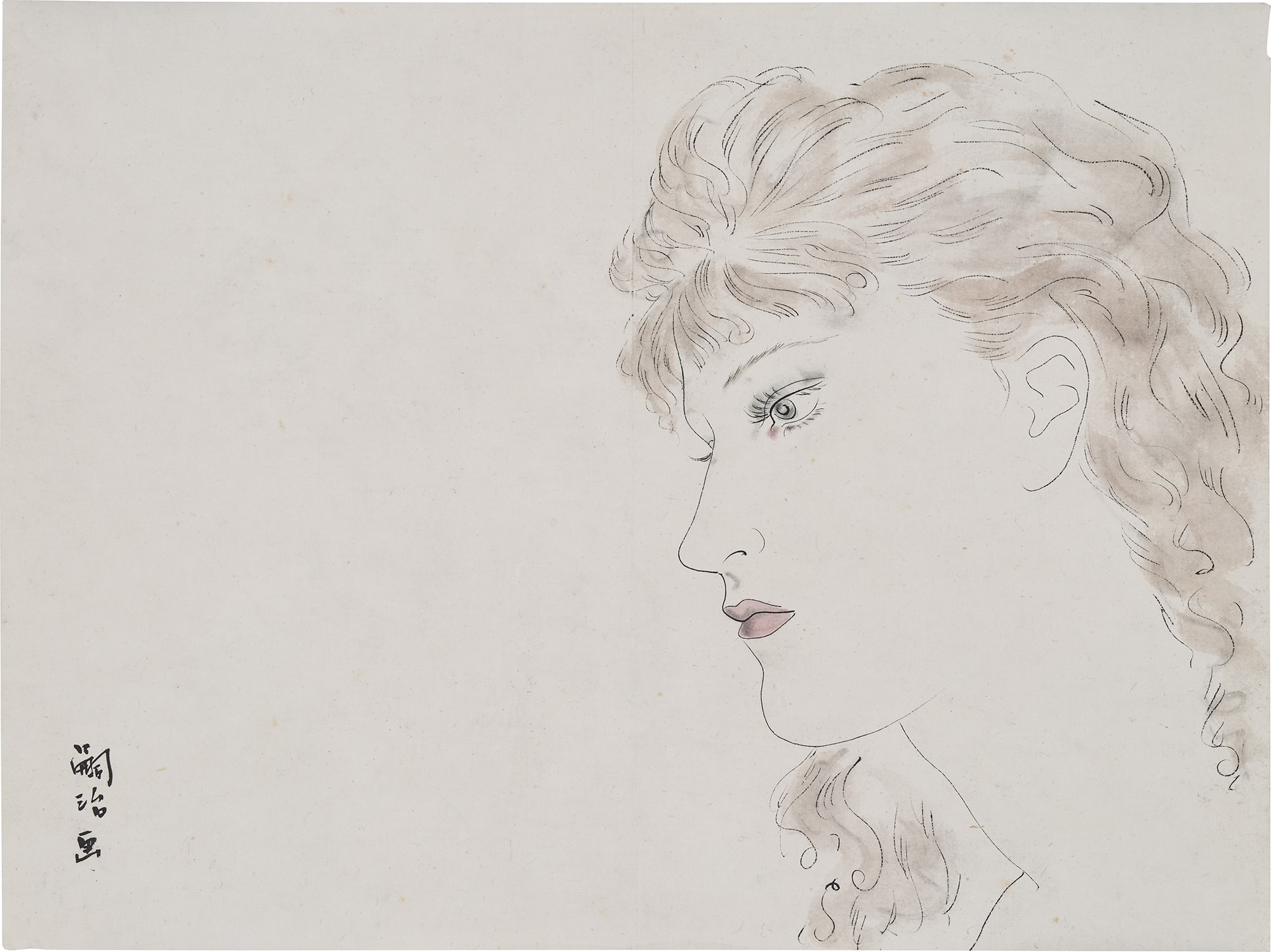
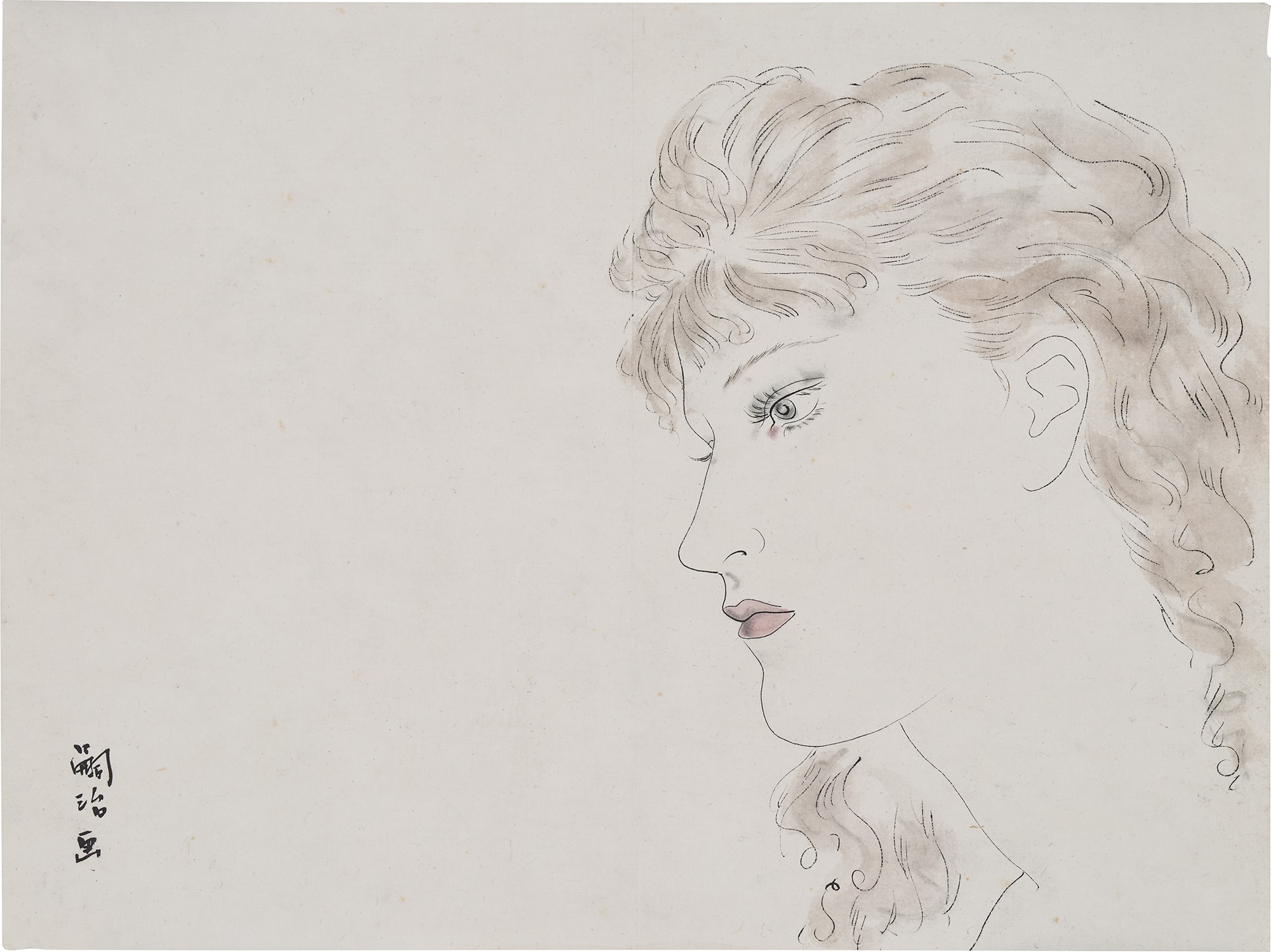
Jeune femme blonde, 1937
He studied Western style painting at the Tokyo Fine Arts School, graduating in 1910, and within a few years had resolved to take himself to the source. In 1913 he arrived in Paris with very little money and an extraordinary determination, settling into the fermenting creative world of Montparnasse at precisely the moment when it was becoming the most consequential neighborhood in modern art. He befriended Modigliani, Picasso, Soutine, and Pascin almost immediately, absorbing the energy of the avant garde while quietly nurturing a sensibility that none of them possessed. The decade that followed was one of transformation and invention.
Foujita found that the lessons of Japanese ink painting, with its disciplined line, its comfort with negative space, and its meditative relationship to the white ground, could be woven into the language of European figuration in ways that neither tradition had imagined. Around 1917, he developed the technique that would define his career: a luminous, milky white ground achieved through a proprietary emulsion he kept secret for years, applied to canvas with a careful layering process that gave human skin a quality simultaneously ethereal and intensely present. Over this surface he drew with a fine brush loaded with ink, producing contours of extraordinary delicacy that recalled the finest Japanese calligraphy while serving the figurative demands of Western portraiture and the nude. His breakthrough came definitively at the Salon d'Automne of 1922, where five large paintings depicting reclining nudes on this white ground caused a sensation.
Léonard-Tsuguharu Foujita
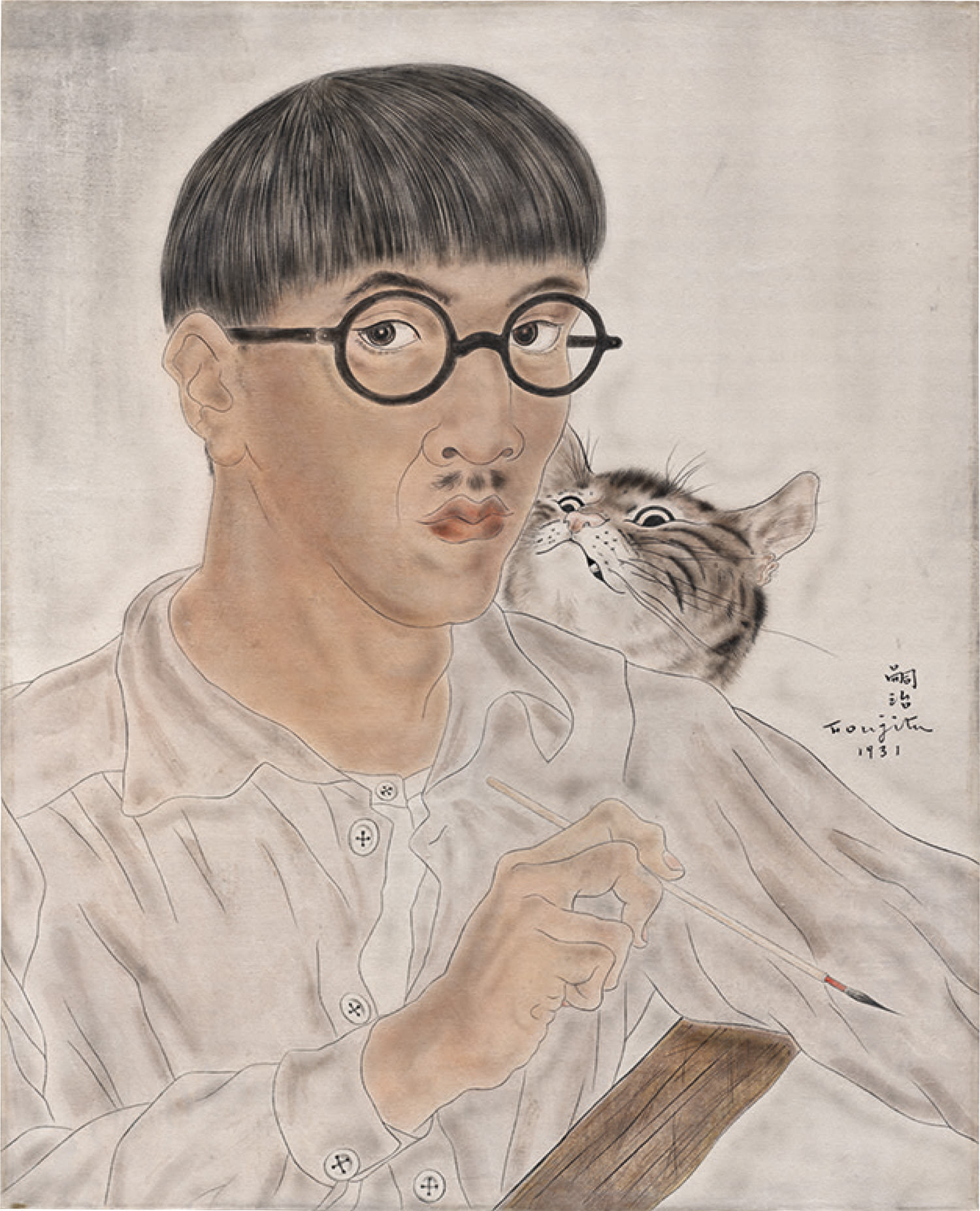
Self-Portrait with a Cat, 1931
Critics reached for superlatives they rarely used. The works sold immediately, and Foujita found himself celebrated across Paris as the artist who had achieved what the theoretical conversations of the École de Paris had only gestured toward: a true synthesis rather than a pastiche. Through the 1920s he was one of the most sought after figures in Montparnasse, as famous for his shaved head, his round spectacles, and his tattooed arms as for the paintings that appeared regularly at the Salon and in the galleries along the Rue La Boétie. His portraits of Kiki de Montparnasse, the legendary model and muse of the quarter, stand among the defining images of that era.
The works available on The Collection reveal the full breadth of his practice across several decades and offer an exceptional opportunity to study his evolution. The 1917 work "Femme au voile sous la neige" demonstrates how early he had mastered the integration of India ink and watercolour enhanced by gouache, creating atmospheric effects of exceptional refinement at a moment when he was still finding his footing in Paris. "Portrait de Kiki" from 1925, executed in oil on canvas, captures the celebrated model with the directness and psychological presence that made Foujita the portraitist of choice for the Montparnasse circle. The 1931 "Self Portrait with a Cat" on silk is a particularly rare object: silk was a support he returned to throughout his career as a deliberate invocation of his Japanese heritage, and the cats that appear throughout his work were not merely charming accessories but recurring figures through which he explored themes of independence, sensuality, and watchful intelligence.
Léonard-Tsuguharu Foujita
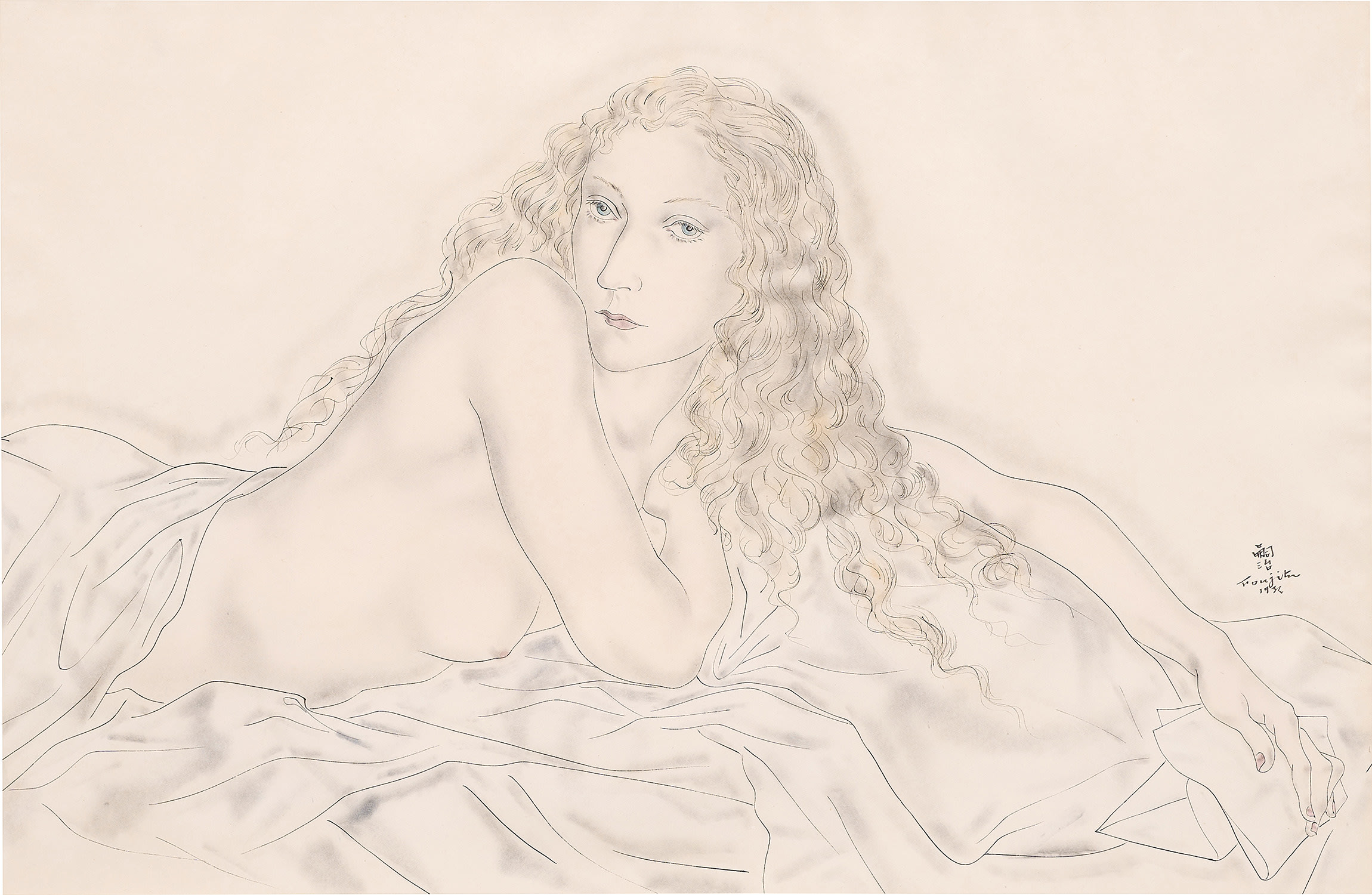
Nu allongé (Reclining Nude), 1932
The 1932 "Nu allongé" in watercolour and ink distills his signature nude formula into an intimate format, the line work precise enough to reward close study through a magnifying glass. For collectors, Foujita represents a compelling proposition that the market has recognized with increasing confidence over the past two decades. Works on paper, which constitute a substantial and important portion of his output, offer points of entry at a range of price levels, while his paintings on canvas and silk command serious attention at the major auction houses. Christie's and Sotheby's have both seen strong results for his nudes and portraits at Paris and London sales, with exceptional examples achieving figures well into seven digits.
What distinguishes a great Foujita from a competent one is almost always the line: collectors should look for works in which the ink contours carry genuine calligraphic energy, where each stroke shows the confident hesitation free movement of a trained hand. The white ground paintings are the canonical form, but his works on paper, from pencil studies to ink wash compositions, often reveal the most intimate and direct expression of his thinking. To understand Foujita's place in art history, it helps to consider him alongside the other artists who defined the École de Paris: Modigliani, whose elongated figures share something of Foujita's distilled approach to the human form; Pascin, whose drawings have a comparable linear fluency; and Soutine, whose emotional intensity represents the expressive pole from which Foujita's cooler, more meditative sensibility stands apart. Among Japanese artists working in Western modes, Seiji Togo and Tsurugoro Ishii were contemporaries navigating related questions, but none achieved Foujita's degree of synthesis or his international recognition.
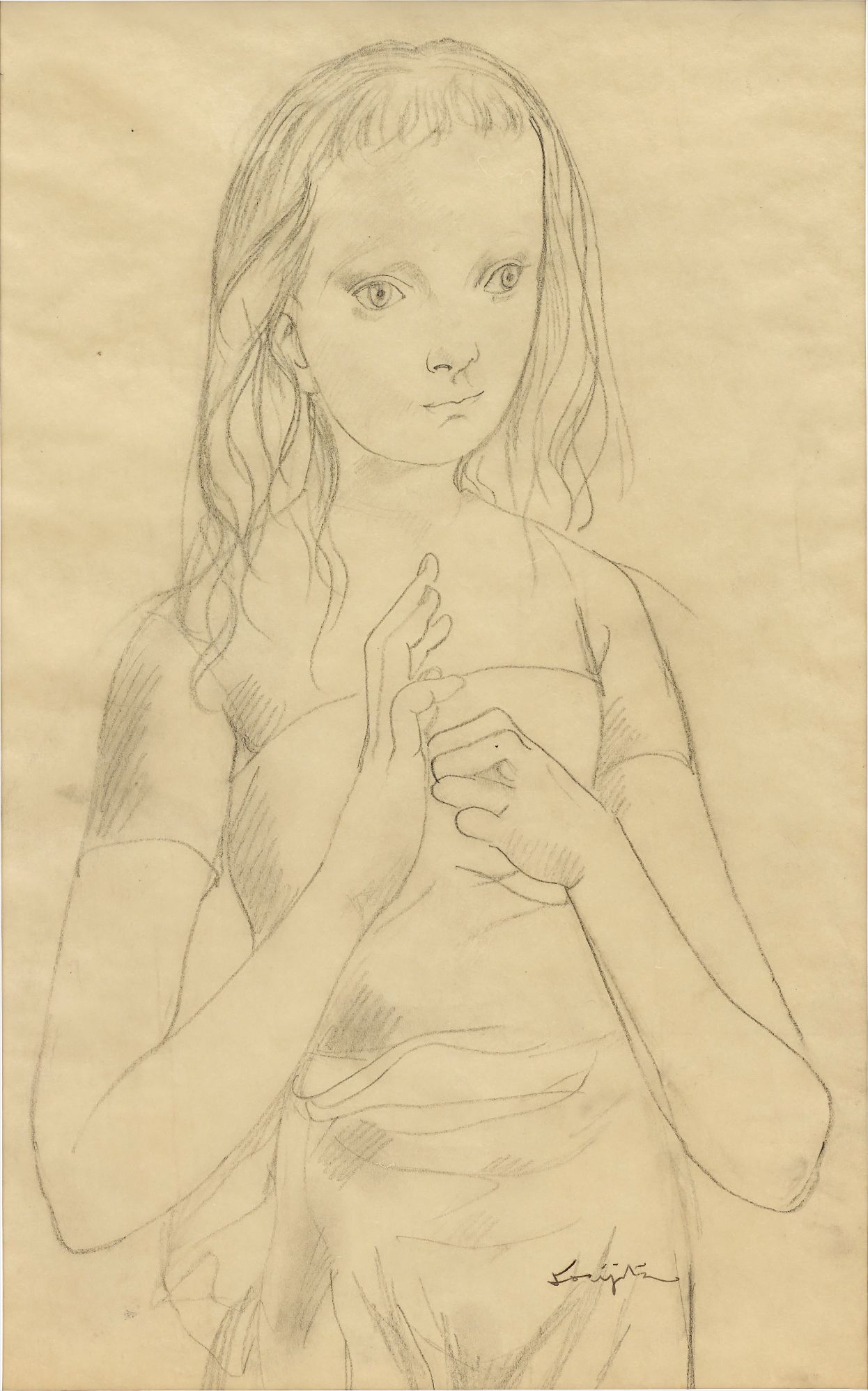
Léonard-Tsuguharu Foujita
Jeune fille a la robe bustier
He is, in this sense, genuinely singular: an artist whose work cannot be fully claimed by either the Japanese or the European tradition because it belongs entirely to itself. Later in life, Foujita underwent a profound personal transformation. He converted to Roman Catholicism in 1959, taking the baptismal name Léonard in homage to Leonardo da Vinci, and devoted his final years partly to religious painting, most notably the remarkable Chapel of Notre Dame de la Paix in Reims, which he designed and decorated himself and which stands as one of the most extraordinary sacred spaces created in twentieth century France. He died in Zurich in 1968, a French citizen, a Knight of the Légion d'honneur, and an artist whose reputation has only deepened in the decades since.
The ongoing scholarly attention to his work, the museum acquisitions, and the collector enthusiasm that continues to build around his drawings and paintings all confirm what the crowds at Montparnasse intuited a century ago: that Foujita made something genuinely new, and that its beauty has not diminished with time.
Explore books about Léonard-Tsuguharu Foujita
Foujita: A Retrospective
Sylvie Buisson
Tsuguharu Foujita: The Artworks
Dominique Buisson

Foujita: Artiste Maudit à Paris
Gérard Xuriguera
Leonard Foujita: His Japanese Spirit and European Modernism
Noriko Aso
Foujita in Exile: A Life Between Cultures
Ellen D'Oench

The Paris School and Tsuguharu Foujita
Paris Musées
Foujita: A Life
Phyllis Birnbaum