Leon Gaspard
Leon Gaspard: A World Painted in Light
Artist Spotlight · The Collection Editorial
Picture the high desert town of Taos, New Mexico, sometime in the 1920s. A Russian born painter arrives home from yet another journey across continents, his luggage stuffed with sketches of Mongolian horsemen, Siberian trading posts, and the crowded souks of North Africa. He unpacks his canvases and sets to work, transforming memory and observation into something blazing and immediate. That painter was Leon Gaspard, and his story remains one of the most remarkable in American art history, a life of restless curiosity rendered in jewel bright color that still stops viewers cold today.
Leon Gaspard
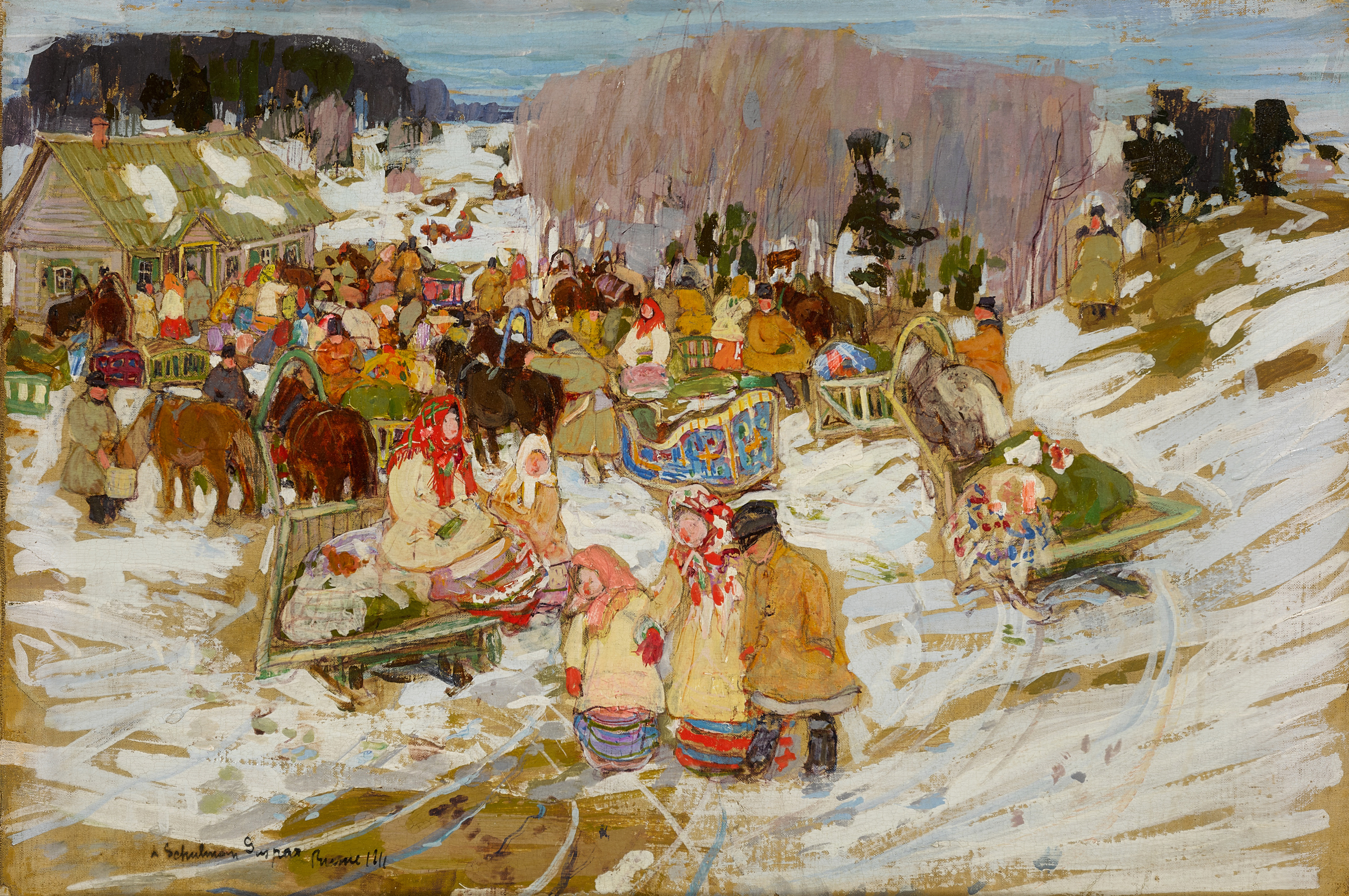
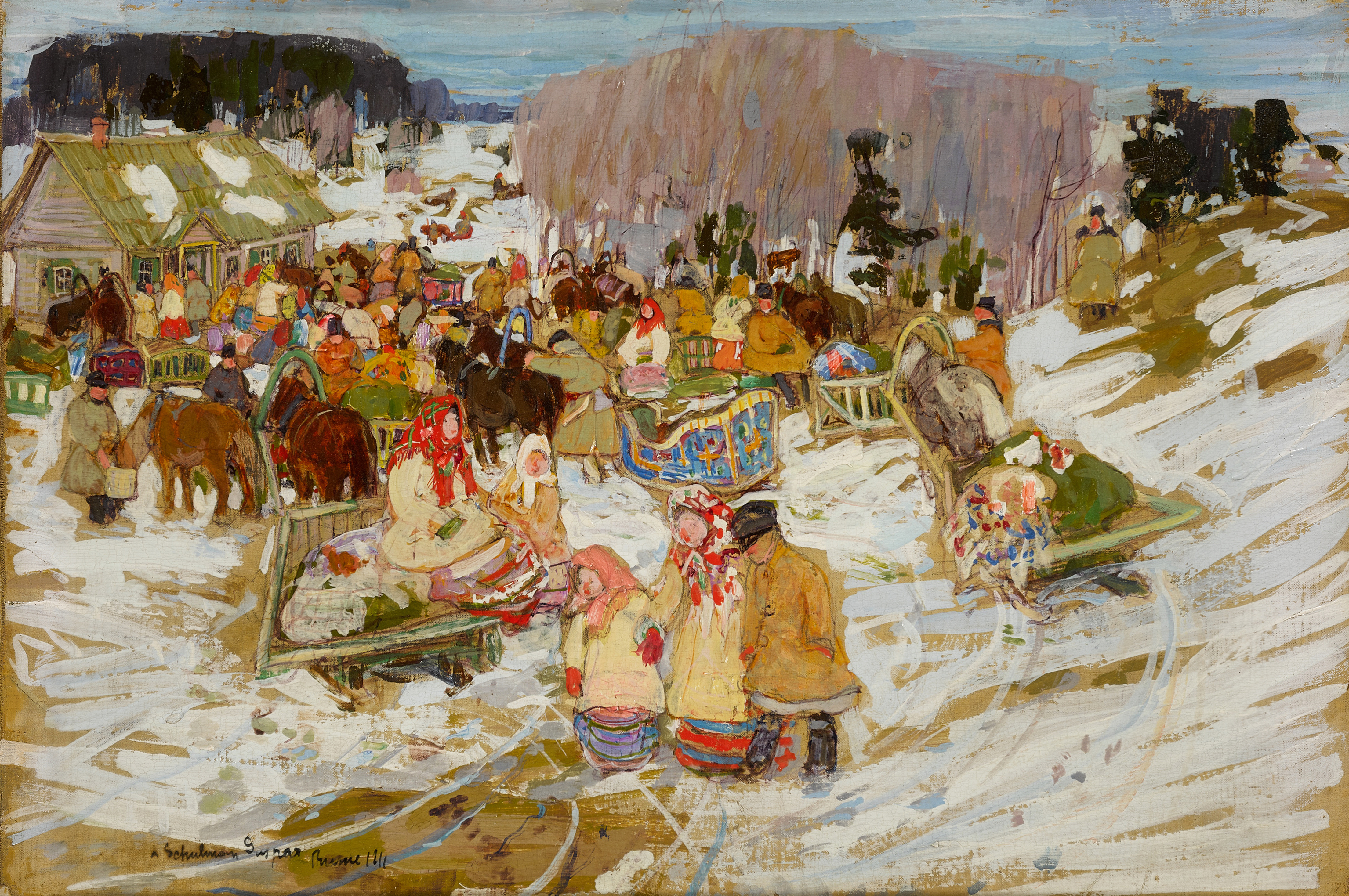
Snowy Day in a Russian Village, 1911
Gaspard was born in 1882 in Vitebsk, a city in what is now Belarus that also produced Marc Chagall. The two shared not only a birthplace but a sensitivity to the particular textures of Russian Jewish life, though their paths diverged sharply. Where Chagall turned inward and symbolic, Gaspard became an insatiable documentarian of the outward world. He left Russia as a young man to study painting in Paris, enrolling in the atelier of Fernand Cormon, the celebrated academic painter whose studio had earlier shaped the early careers of Henri de Toulouse Lautrec and Vincent van Gogh.
Under Cormon, Gaspard absorbed rigorous draughtsmanship while also absorbing the post Impressionist energy crackling through Paris at the turn of the century. Paris at that moment was the center of everything, and Gaspard moved through it with ambition and open eyes. He exhibited at the Salon and connected with the broader current of painters fascinated by travel, ethnography, and the visual cultures of distant lands. But formal Salon success was never quite the point for Gaspard.
Leon Gaspard
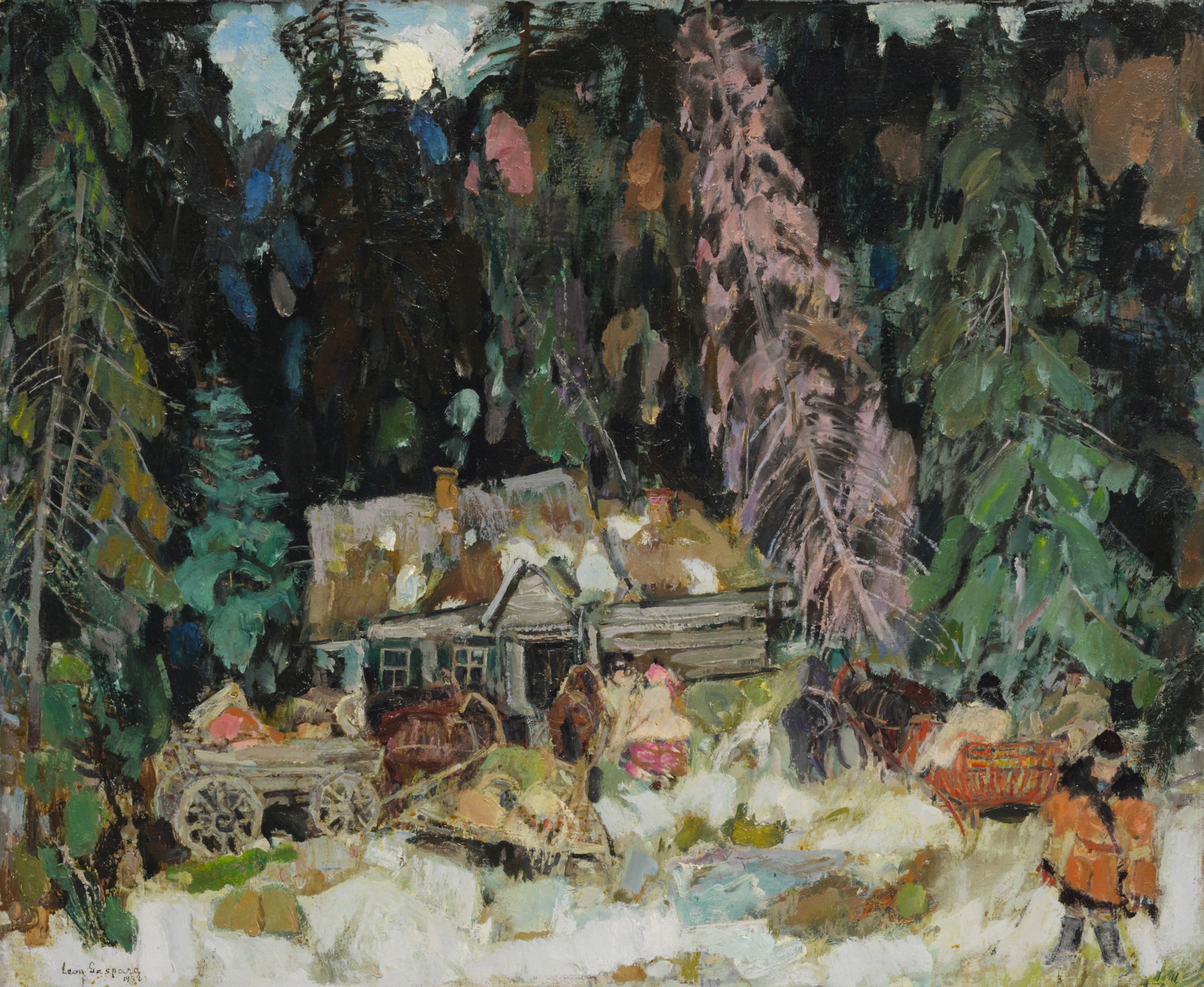
Moonlight - Trading Post - Siberia
He was more interested in direct experience, in going places and painting what he found there. This impulse drove him east, through Russia, across Siberia, and into Central Asia and China, journeys that filled sketchbooks and canvases with images that no European or American painter had captured in quite the same way. He brought back a visual vocabulary that was genuinely his own. The First World War interrupted this wandering life in dramatic fashion.
Gaspard enlisted and flew as a military aviator, suffering a severe crash that left him with lasting injuries. During his long recovery in the United States, he traveled through the American Southwest. Taos, with its luminous air, its Pueblo communities, and its gathering of like minded painters, held him. He settled there permanently around 1918 and became a foundational member of what would grow into the celebrated Taos Society of Artists.
Leon Gaspard
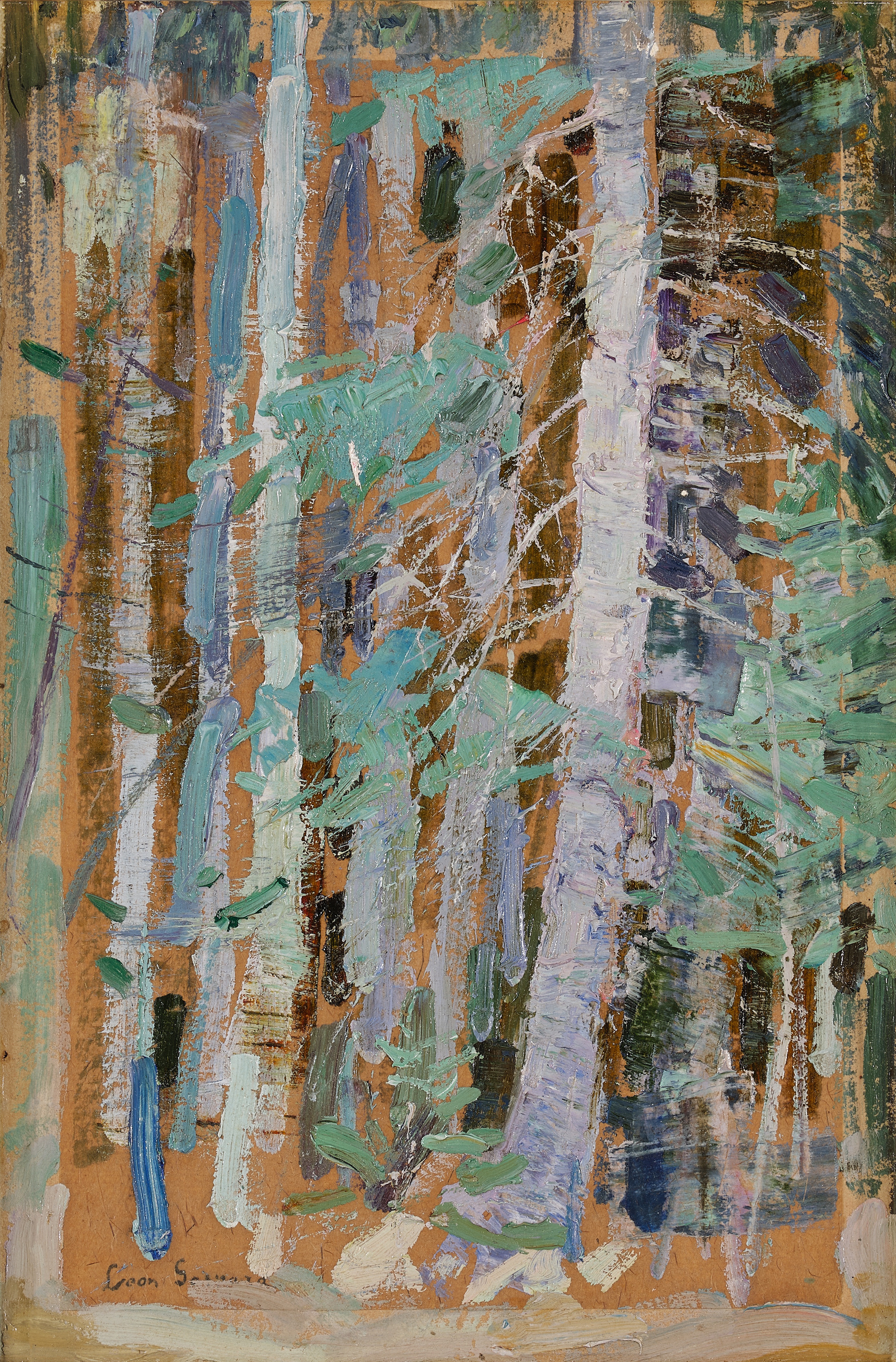
Trees
His neighbors and colleagues included Ernest Blumenschein, Bert Phillips, and E. Irving Couse, painters who shared his conviction that the Southwest offered subject matter of profound visual and cultural richness. Gaspard brought something the others lacked, however: a global perspective earned through decades of actual travel. His signature style is instantly recognizable and genuinely difficult to categorize, which is part of its appeal.
The paint is laid on with a confidence that owes something to Impressionism but never dissolves into atmosphere. Colors remain saturated and declarative, reds and golds and deep blues sitting against one another with the intensity of enamels or illuminated manuscript pages. Figures in his market scenes and village views are caught in the midst of life, not posed. The sense of observed reality is strong even when the palette feels almost operatic.
Works such as Snowy Day in a Russian Village, painted in 1911, demonstrate this balance perfectly. The canvas captures the muffled quality of a winter day in rural Russia, the architecture dusted in white, figures bundled against cold, and yet the color still vibrates. It is documentary and lyrical simultaneously, a combination that defines Gaspard at his best. Moonlight Trading Post Siberia occupies different emotional territory, quieter and more nocturnal, but equally characteristic in its affection for a specific cultural moment.
Gaspard painted trading posts and markets not as exotic spectacle but as places of genuine human exchange, sites where commerce and community overlapped. His time in Siberia and Central Asia gave him access to scenes that were already beginning to disappear under the pressures of modernization and political upheaval. In this sense his body of work carries real historical value beyond its purely aesthetic pleasures. Even a smaller and more intimate piece such as Trees, rendered in oil on brown paper, shows the spontaneity and economy of a painter completely at home in any medium and on any surface.
For collectors, Gaspard presents a compelling case on multiple levels. His work occupies a space where the American West, Russian realism, and French Post Impressionism converge, making him genuinely unusual in the landscape of early twentieth century painting. Collectors who respond to the Taos School often come to Gaspard and find that his international dimension adds a layer of complexity that purely regional painters cannot offer. His works have appeared regularly at major American auction houses including Bonhams, Heritage Auctions, and Coeur d'Alene Art Auction, the latter being a premier venue for Western American art where strong Gaspard results have reflected consistent collector demand.
Oil on canvas works from his Russian and Siberian period, particularly those with strong figure groups and market or village settings, tend to attract the most attention. The combination of rarity, historical resonance, and sheer visual pleasure makes him a serious acquisition target. Gaspard belongs to a generation of painter travelers that also included artists such as Wassily Kandinsky in his earlier ethnographic mode, John Singer Sargent in his peripatetic wandering years, and the Orientalist influenced painters working out of Paris in the late nineteenth century. Yet he sits comfortably alongside his Taos contemporaries as well, sharing with Blumenschein and the others a deep respect for the communities they painted and a commitment to working from direct observation rather than studio invention.
He is not easily filed into a single category, and that resistance to easy categorization is increasingly understood as a strength rather than a complication. Gaspard painted until late in his long life, dying in Taos in 1964 at the age of eighty two. The arc of his career stretched from Tsarist Russia through two world wars to the Cold War era, a span of history he witnessed with the particular clarity of someone who had chosen, always, to keep moving and keep looking. His house in Taos, a compound he built and filled with objects gathered across a lifetime of travel, became a gathering place and is today part of the cultural heritage of that region.
His legacy is that of a painter who refused every boundary, geographic, cultural, and stylistic, and left behind a body of work that continues to reward close looking with fresh discoveries.