Length: 15 in (38.1 cm)
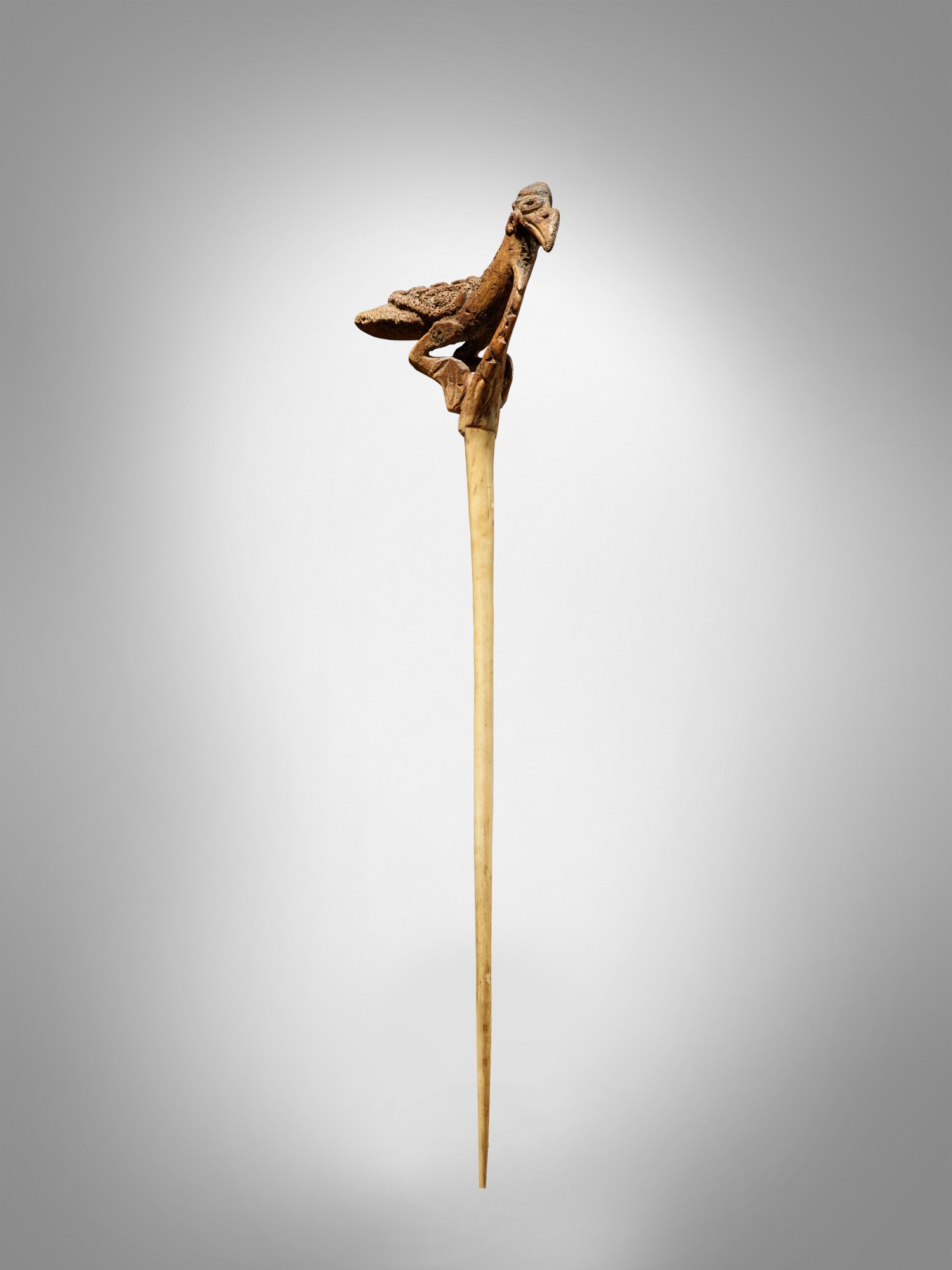
Ancient Craft Glowing With Timeless Purpose
Artist Spotlight · The Collection Editorial
There are objects in the world that resist easy categorization, that sit at the intersection of tool and art, of ritual and daily life, and demand that we reconsider every assumption we carry into a collecting space. The Iatmul Cassowary Bone Lime Stick from the Middle Sepik River region of East Sepik Province in Papua New Guinea is precisely such an object. In recent years, tribal and ethnographic art from Melanesia has surged in institutional attention, with major presentations at the Musée du quai Branly in Paris and the Metropolitan Museum of Art in New York bringing the visual traditions of the Sepik River basin to wider audiences than ever before. This single extraordinary object arrives on the market at a moment of genuine cultural reckoning, when the depth and sophistication of Oceanic art is finally receiving the sustained scholarly and collector attention it has always deserved.
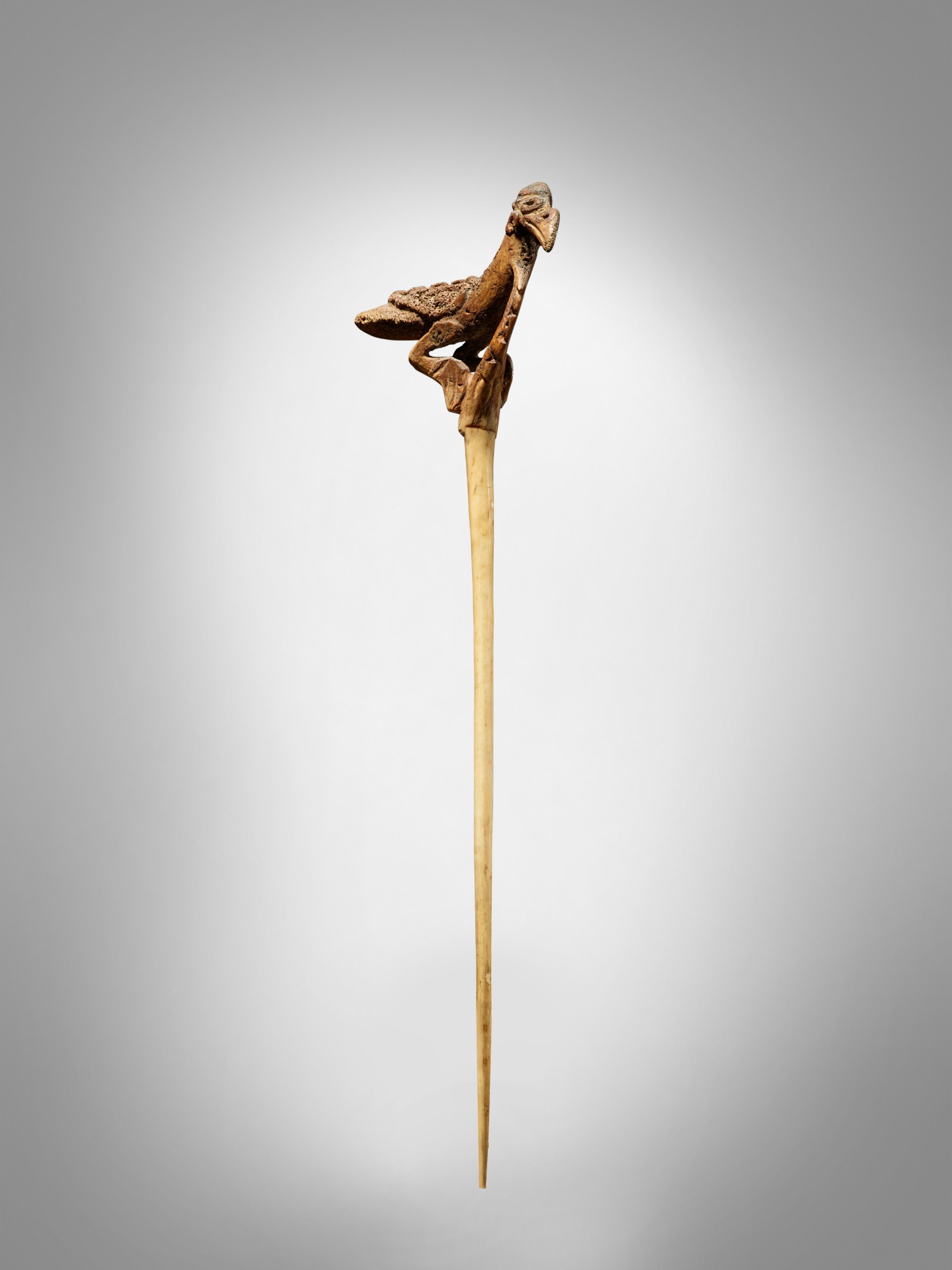
Length: 15 in (38.1 cm)
Iatmul Cassowary Bone Lime Stick, Middle Sepik River, East Sepik Province, Papua New Guinea
The Sepik River is one of the great rivers of the world, running roughly 1,100 kilometers through the heart of Papua New Guinea before emptying into the Bismarck Sea. Its basin has been inhabited for tens of thousands of years, and the cultures that developed along its banks produced some of the most visually and conceptually powerful art traditions in human history. The Iatmul people, who settled the middle stretches of the river, built elaborate ceremonial systems around the haus tambaran, or spirit house, and developed material traditions of extraordinary refinement. Their carvers, weavers, and craftspeople worked within complex cosmological frameworks, understanding each object they created as a participant in ongoing relationships between the living, the ancestral, and the spirit world.
The cassowary, a large flightless bird native to the forests of New Guinea and northern Australia, holds profound significance across many Melanesian cultures. Its bones, particularly the long bones of the leg, were prized for their density, their smooth surface, and their association with the bird's formidable spiritual power. Among the Iatmul and related groups, cassowary bone was worked into lime sticks used in the preparation of betel nut, a mild stimulant whose consumption was and remains deeply embedded in social and ceremonial life across the Pacific. The act of preparing betel nut with a lime stick was never merely practical.
It was a gesture freighted with meaning, a performance of identity, status, and connection to ancestral force. What distinguishes the finest Iatmul lime sticks is the level of carving applied to what might initially seem a purely functional object. Skilled carvers incised geometric patterns, figural imagery, and clan insignia into the bone with tools of extraordinary precision, creating surfaces that reward close looking for as long as you are willing to give them. The best examples show a quality of line that reflects years of training within a tradition transmitted across generations, a lineage of knowledge as real and rigorous as any academic fine art education.
The lime stick represented here belongs firmly in that category, exhibiting the kind of assured, deeply intentional surface treatment that separates a masterwork from a merely competent one. For collectors, ethnographic and tribal art from the Sepik River has demonstrated consistent strength across major international auction houses. Works from the region have appeared at Christie's Paris, Sotheby's New York, and Millon in Paris, with exceptional pieces achieving prices that reflect the scholarly consensus around their importance. The lime stick as a category is particularly interesting to collectors because it combines portability and intimate scale with some of the most concentrated carving energy in the entire Sepik tradition.
Collectors drawn to objects where craft and belief are inseparable, where every square centimeter of surface has been considered, tend to find these pieces deeply rewarding. The provenance and condition of any Sepik bone carving matter enormously, and works that can demonstrate a clear and documented history of collection are rightly valued above the field. Within the broader landscape of Oceanic art collecting, Sepik River material sits in conversation with the great traditions of the Asmat of West Papua, the Maori of Aotearoa New Zealand, and the varied carving traditions of the Solomon Islands and Vanuatu. Collectors who have built meaningful holdings in one of these traditions frequently find their interests naturally expanding toward the others, drawn by a shared formal language of geometric abstraction, figural power, and the integration of spiritual intention into every aspect of making.
The Iatmul, however, occupy a particular place within this broader conversation. Their work has attracted serious scholarly attention since the pioneering fieldwork of Gregory Bateson and Margaret Mead in the 1930s, and the ethnographic literature surrounding their material culture is rich enough to support deep engagement from collectors who want to understand what they are living with. The legacy of Sepik River art in the twenty first century is inseparable from larger conversations about the ethics of collecting, the circulation of objects across cultures, and the responsibilities that come with custodianship of works from living or recently living traditions. These are conversations the most thoughtful collectors are already having, and they do not diminish the beauty or the power of the objects themselves.
If anything, they deepen the encounter, asking us to hold simultaneously the aesthetic experience of a supremely made thing and an awareness of the human world that produced it. The Iatmul Cassowary Bone Lime Stick invites exactly that kind of full attention, the attention of someone willing to meet an object on its own terms, to learn its language, and to take seriously the intelligence and vision of the hands that shaped it. For the collector ready to engage at that level, there are few more rewarding places to begin.