Lee Bontecou
Lee Bontecou: Visionary Force, Endlessly Wondrous
Artist Spotlight · The Collection Editorial
“I want to express something of the fear and wonder and savagery of the universe.”
Lee Bontecou, artist statement
When the Museum of Modern Art and the UCLA Hammer Museum jointly organized a landmark retrospective of Lee Bontecou's work in 2003 and 2004, the art world was reminded of something it had, perhaps inexcusably, allowed to drift to the edges of its collective attention. Here was an artist of singular, almost terrifying originality, whose welded steel and canvas reliefs from the late 1950s and 1960s had anticipated so much of what followed in American sculpture, and whose decades of quietly devoted studio work had accumulated into one of the most personal and coherent bodies of art of the twentieth century. The retrospective, which traveled to the Art Institute of Chicago and the Museum of Contemporary Art in Los Angeles, restored Bontecou to her rightful place at the very center of postwar American art, and collectors who encountered her work there have never forgotten it. Lee Bontecou was born in Providence, Rhode Island in 1931 and grew up in Nova Scotia, where she developed an early and abiding relationship with the natural world.
Lee Bontecou
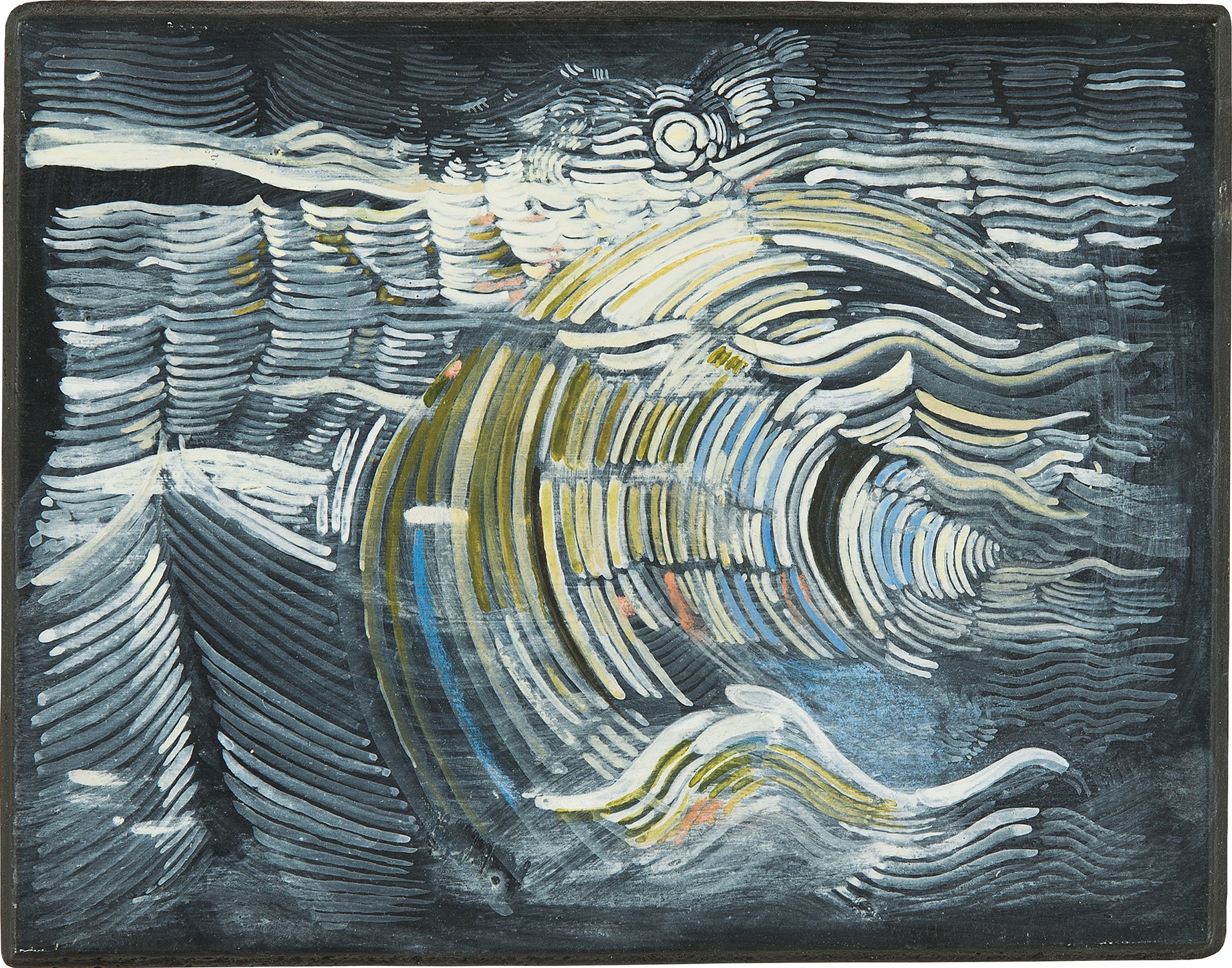
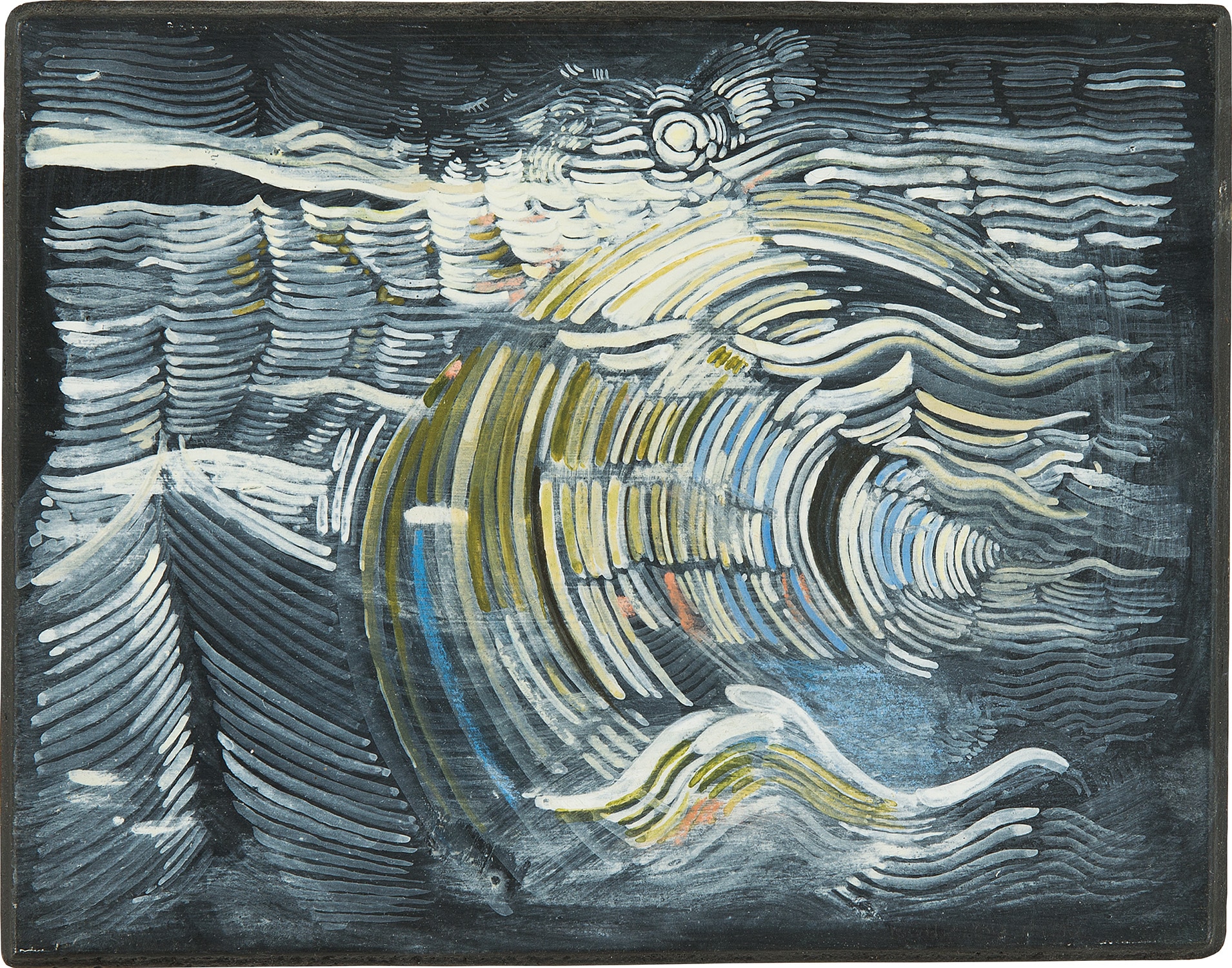
casein on wood panel
The landscapes, creatures, and geological formations she encountered as a child would resurface throughout her entire career, transmuted into forms at once alien and deeply familiar. She studied at the Art Students League in New York in the early 1950s, training under William Zorach, whose emphasis on direct carving and material engagement left a lasting impression. A Fulbright scholarship took her to Rome in 1956 and 1957, where she worked in bronze and began to understand sculpture as something that could carry psychological weight as well as physical presence. Returning to New York, Bontecou settled into a studio in Lower Manhattan and began to develop the breakthrough work that would define her early reputation.
Working with salvaged canvas, wire, and welded steel, she constructed a series of wall mounted reliefs that were unlike anything being made at the time. These were not paintings and not conventional sculptures. They projected from the wall like architectural fragments or organic specimens, their central voids drawing the eye into a darkness that felt genuinely vertiginous. The first major presentation of these works came through Leo Castelli Gallery, where she showed from 1960 onward, placing her in immediate dialogue with the most important artists of her generation.
Lee Bontecou
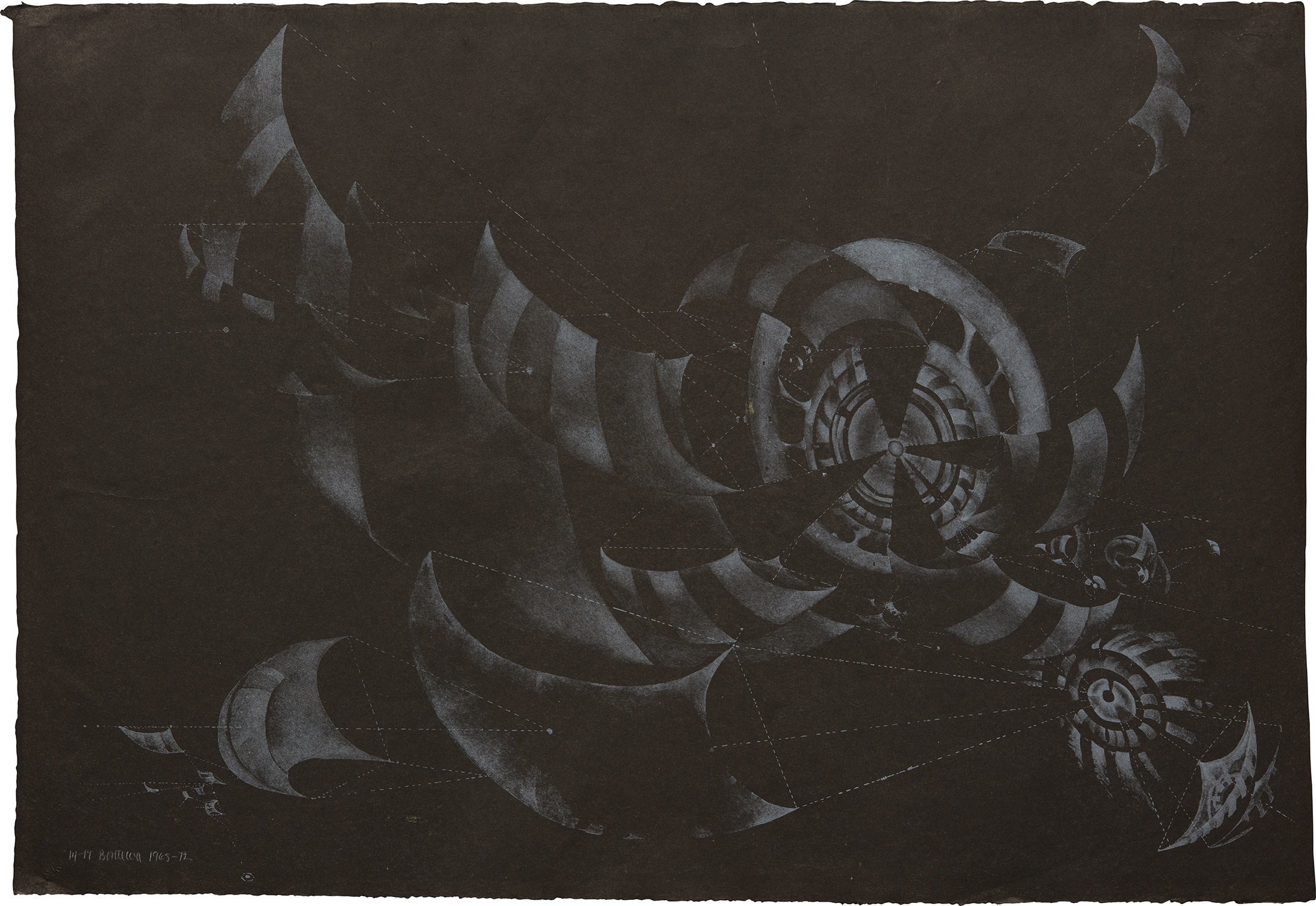
Fourteenth Stone
Donald Judd wrote admiringly of her work. Her pieces entered major museum collections almost immediately, including those of MoMA and the Whitney Museum of American Art. The reliefs of the late 1950s through the mid 1960s are now considered among the most important sculptures of the postwar era. A work from 1959 in welded iron, canvas, muslin, wire, and velvet exemplifies the quality that made her so remarkable: the tension between industrial material and something almost visceral, between control and the suggestion of forces barely contained.
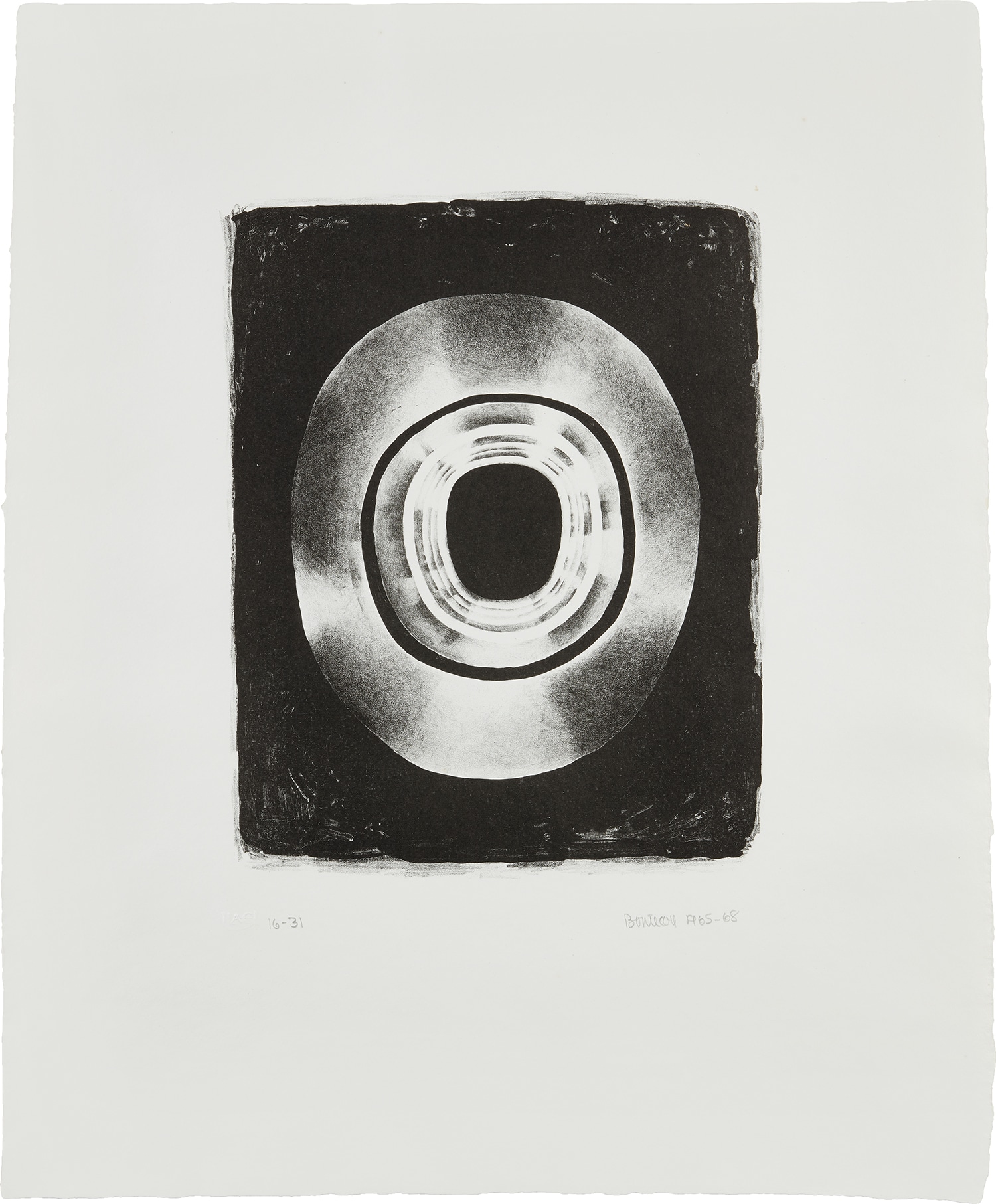
These pieces occupy a space between Abstract Expressionism's emotional urgency and Minimalism's structural clarity, but they belong fully to neither. They are entirely Bontecou's own. Her printmaking practice developed in parallel, and her lithographs produced with the printer Zigmunds Priede at the Universal Limited Art Editions workshop in the 1960s are among the most inventive prints of that decade. Works like the Fourth Stone, Sixth Stone I, Sixth Stone II, and Seventh Stone demonstrate her ability to translate her sculptural language into the intimacy of works on paper, deploying deep blacks, layered tones, and a sense of cosmos and biology intertwined.
Lee Bontecou
Seventh Stone (S. 21)
In the early 1970s, Bontecou withdrew from the commercial art world almost entirely. She moved to rural Pennsylvania, where she taught at Brooklyn College and continued to make work in sustained privacy. This period produced a remarkable evolution: the hard industrial materials gave way to vacuum formed plastic, wire, and fish line, resulting in a new body of work that was lighter, more transparent, and visionary in a different register. Drawings and paintings on Masonite in casein and tempera, including works from 1982 in her preferred materials, reveal an artist deep in a personal iconography of fish, flowers, insects, machines, and celestial forms, all rendered with microscopic precision and genuine wonder.
These works circulated rarely, which has made them all the more precious to the collectors who have managed to acquire them. For collectors approaching Bontecou's work today, the range of entry points is genuinely exciting. Her lithographs, produced in defined editions and available through the secondary market, offer access to the full complexity of her vision at a scale suited to intimate spaces. The Stone series in particular rewards close attention: the interplay of light and shadow, the suggestion of both geological time and biological process, and the sheer technical command on display make these among the finest prints in any collection of American postwar art.
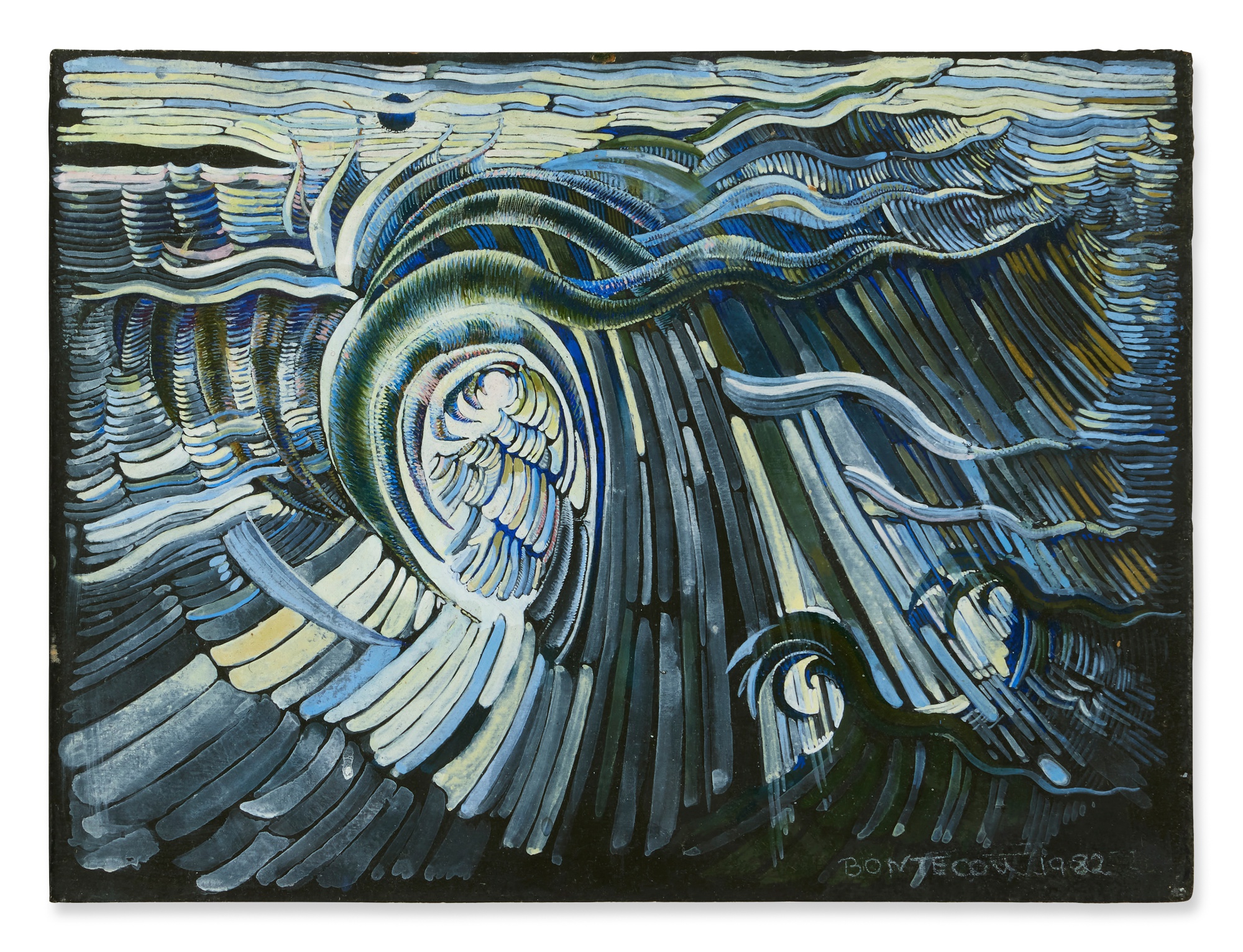
Lee Bontecou
Untitled, 1982
Her drawings and works on paper in graphite and casein represent a more private face of her practice, documents of an imagination working without constraint. The 1982 casein and tempera works on Masonite are especially compelling for serious collectors, combining the intimacy of drawing with the permanence and surface of painting. Bontecou's place in art history becomes clearer the more one understands the artists who surrounded her and those who followed. Her early work shares a raw, confrontational energy with that of John Chamberlain, whose welded automobile bodies were being made at the same moment, and with the assembled constructions of Robert Rauschenberg and Louise Nevelson.
Yet her insistence on the void, on the opening at the center of her reliefs as a space of genuine psychological depth, sets her apart from all of them. Younger artists including Mike Kelley have acknowledged her influence, and the generation of sculptors working with organic and industrial materials in the 1980s and 1990s owes more to Bontecou than is always acknowledged. Lee Bontecou passed away in 2022, leaving behind a body of work that grows in stature with every passing year. She worked for decades outside the spotlight, not from obscurity but from a kind of fierce commitment to the work itself rather than its reception.
That independence is written into every piece she made: in the industrial materiality of the early reliefs, in the luminous intricacy of the later drawings, and in the cosmic scope of a practice that never stopped asking what the world actually looks like when you pay it your full and most serious attention. To own a work by Bontecou is to have a piece of that attention in your home, and it is a genuinely rare and sustaining thing.
Explore books about Lee Bontecou
Lee Bontecou: A Retrospective
Paul Kasmin Gallery and Museum of Modern Art
Lee Bontecou: Sculpture and Drawings
Paul Kasmin
Lee Bontecou: Metal and Canvas Constructions
Museum of Contemporary Art Chicago
Lee Bontecou: Recent Works
Marian Goodman Gallery
Lee Bontecou: The Oval Works
Paul Kasmin Gallery