Lê Phổ
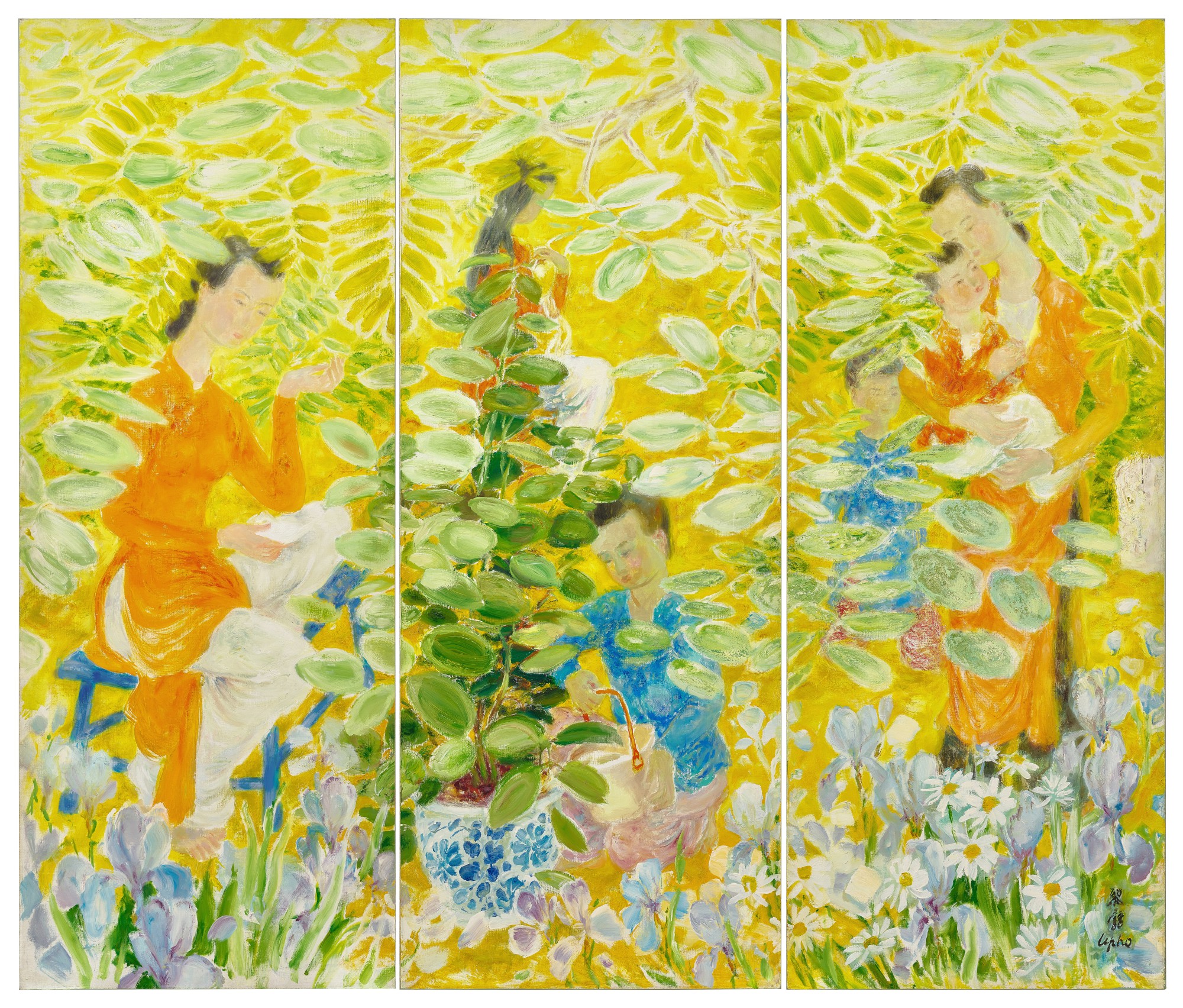
Lê Phổ: Where Two Worlds Bloom
Artist Spotlight · The Collection Editorial
There is a particular quality of light in the paintings of Lê Phổ that seems to exist outside of any single tradition, any single continent, any single century. It is the light of silk itself, the way pigment rests on woven threads rather than sinking into them, giving his figures and flowers an almost luminous translucency. In recent years, auction houses including Christie's and Sotheby's have seen his works achieve strong results across their Asian and Impressionist sale categories, a telling sign that the market has come to understand what discerning collectors long knew: Lê Phổ belongs to no single category, and that is precisely his power. He was born in 1907 in Hanoi, then the administrative heart of French Indochina, into a family of considerable social standing.
Lê Phổ
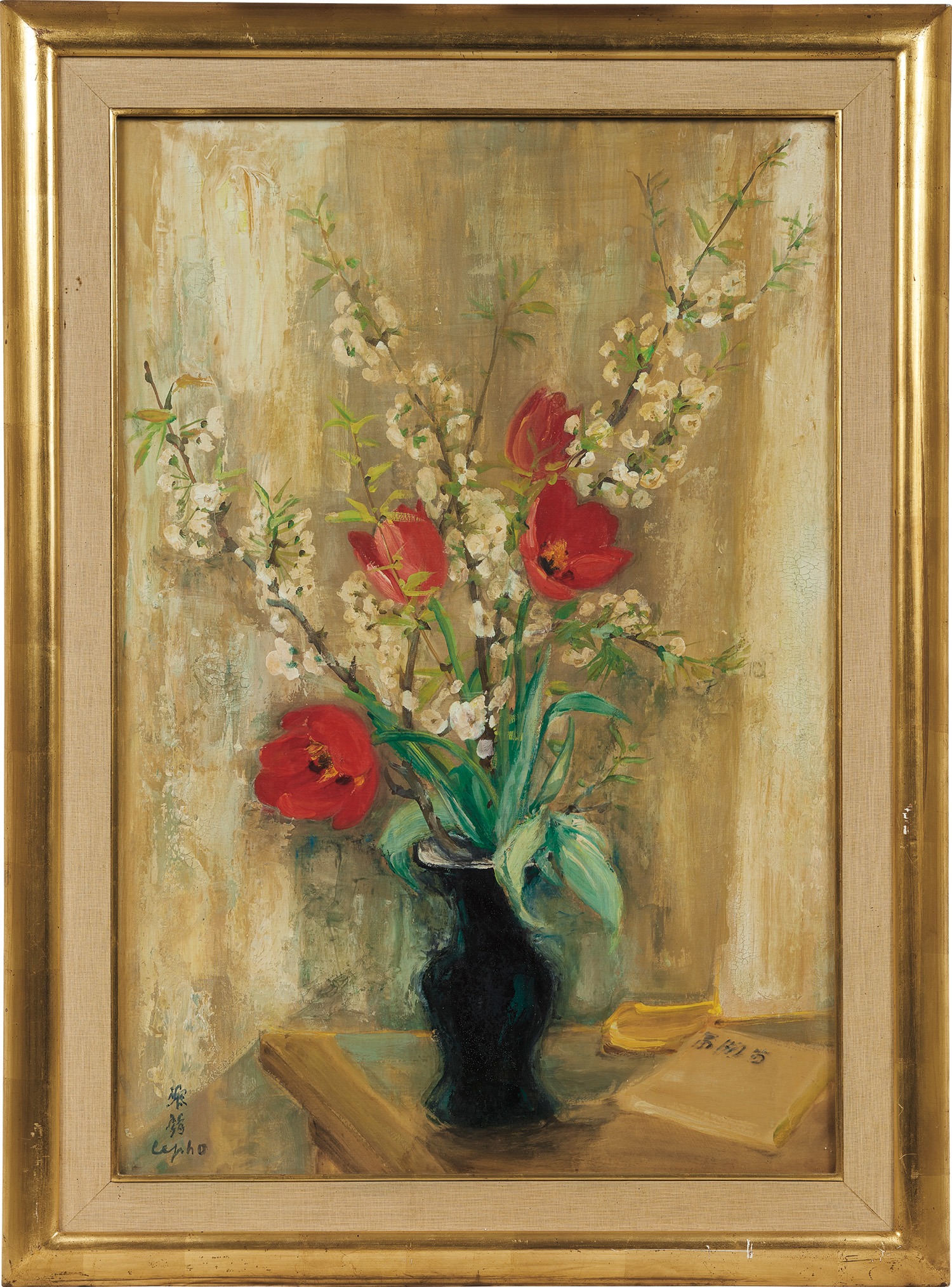
Les tulipes rouges et les fleurs de pommier (Red Tulips and Apple Blossoms)
His father served as a senior official under the imperial administration, and the household carried the weight and refinement of Vietnamese scholarly culture. From an early age, Lê Phổ was immersed in the classical visual language of East Asia, in the disciplined economy of ink brushwork, the reverence for nature, the poetic restraint that defines Vietnamese and Chinese painting at its finest. That foundation would never leave him, even as his horizons expanded dramatically. In 1925, he became one of the founding students of the École des Beaux Arts de l'Indochine in Hanoi, the institution established by the French painter Victor Tardieu to bring Western academic training into dialogue with local artistic traditions.
The school was a remarkable experiment, and Lê Phổ thrived within it, absorbing lessons in oil painting, figure drawing, and compositional structure while remaining deeply connected to the ink and silk techniques of his heritage. He graduated with distinction and in 1931 traveled to Paris to continue his studies, an experience that would prove transformative. He immersed himself in the collections of the Louvre, encountered the chromatic freedom of the Impressionists, and absorbed the decorative sensibility of artists working in and around the École de Paris. By the mid 1930s, Lê Phổ had made the decisive choice to remain in France permanently.
Lê Phổ
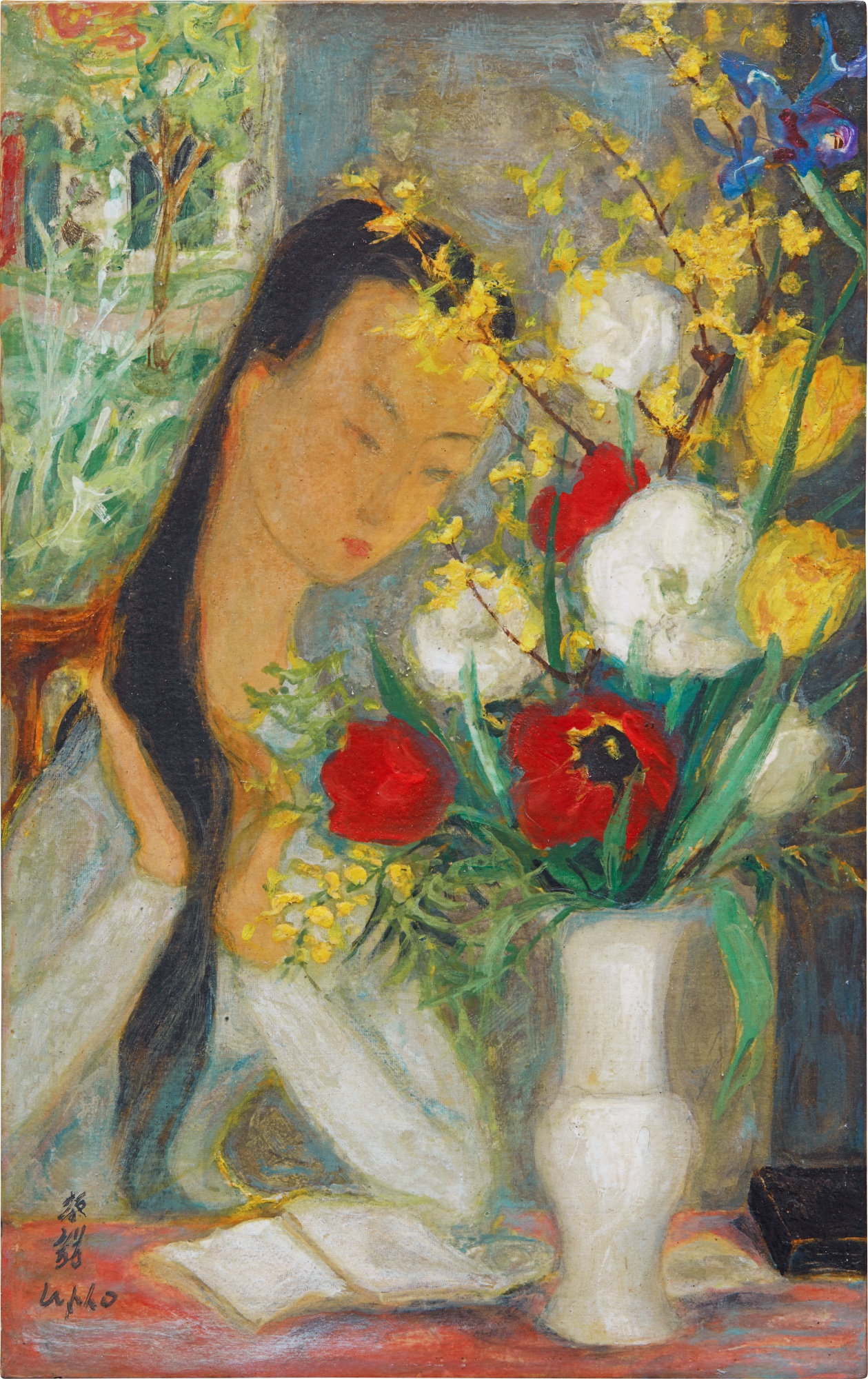
Femme aux Fleurs 女人與瓶花, 1950
It was a turning point that shaped everything that followed. Settled in Paris, he refined a visual language that was genuinely his own rather than a compromise between competing influences. He worked predominantly on silk, a surface that placed him immediately in dialogue with the Eastern traditions of his youth, but he layered it with oil, gouache, and ink in combinations that produced effects no purely Western or purely Eastern painter would have arrived at. His palette grew warmer and more luminous, his compositions more intimate, and his subject matter settled into the themes that would define his career: elegant Vietnamese women in ao dai, lush arrangements of flowers, quiet domestic interiors suffused with a dreamy, almost otherworldly stillness.
The signature works of his long career demonstrate this synthesis at its most assured. "Les tulipes rouges et les fleurs de pommier," executed in ink, colour and oil on silk, shows his mastery of botanical beauty rendered with the precision of classical Asian painting and the sensory richness of French Post Impressionism. "Femme aux Fleurs," created in 1950 in oil and gouache on silk mounted on cardboard, is among his most celebrated figure paintings, presenting a Vietnamese woman whose grace is inseparable from the blossoms surrounding her, the human and the natural merged into a single, seamless reverie. "Jeune femme accoudée" from 1943, in ink and gouache on silk, demonstrates an earlier period in his practice where the ink line still dominates, producing a work of exceptional delicacy.
Lê Phổ
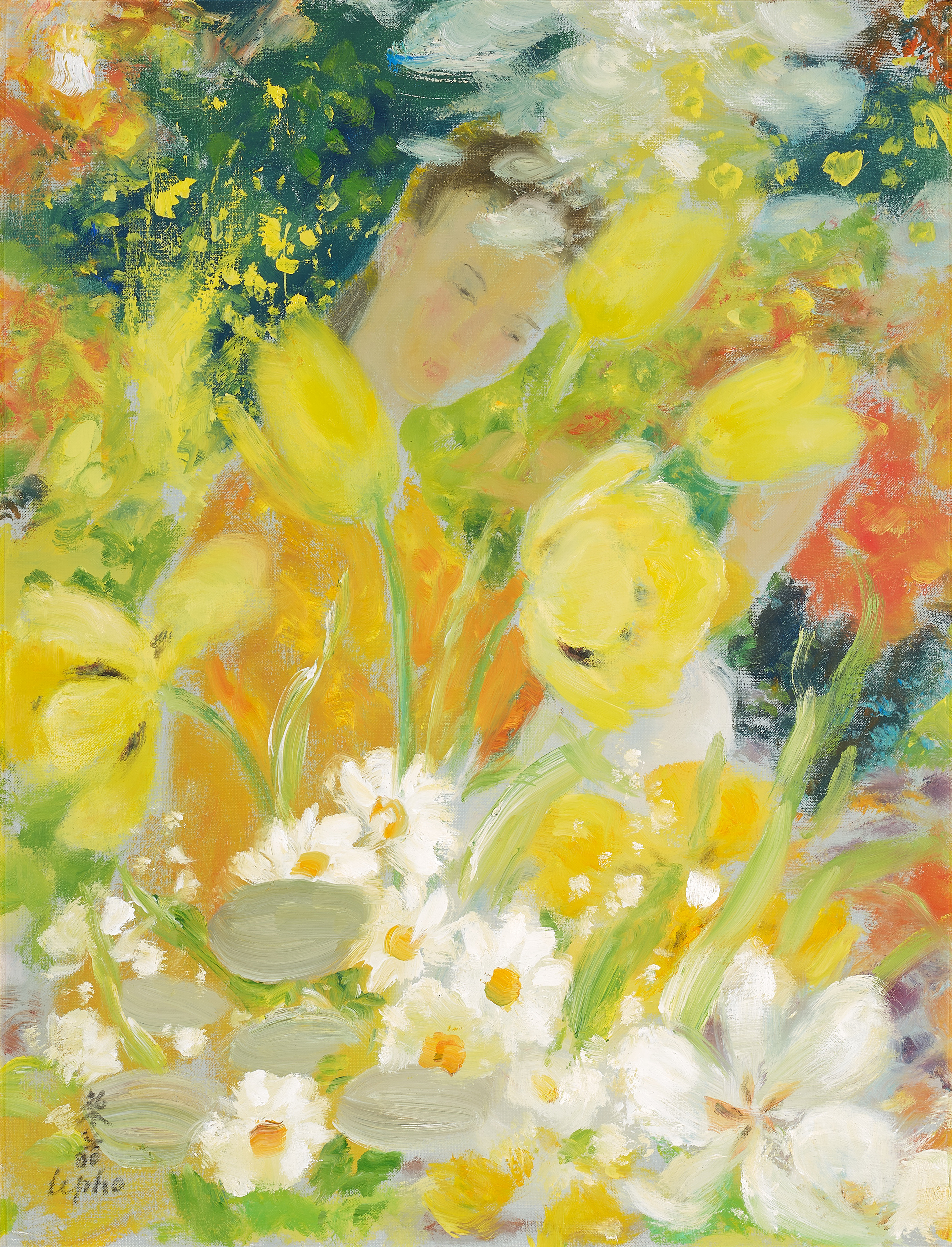
Femme aux tulipes jaunes, 1984
Across all of these, the silk ground is not merely a surface but a collaborator, lending a softness and depth that canvas or paper could not replicate. For collectors, Lê Phổ presents a particularly compelling proposition. His career spanned seven decades, from the 1930s to the late 1990s, and across that time his practice evolved with consistency rather than rupture. Works on silk, especially those from his peak years of the 1940s through the 1960s, command the greatest attention at auction and in the gallery market.
Collectors are advised to look closely at the condition of the silk support, the freshness of the pigment, and the balance of ink line against painted colour, all of which distinguish the most resolved examples from works produced in greater volume later in his career. His still lifes, particularly those featuring roses, tulips, and sunflowers, offer an accessible entry point, while his figure paintings, when they reach the market, attract the broadest international interest. Lê Phổ is best understood in the company of his contemporaries from the École des Beaux Arts de l'Indochine and the broader Vietnamese artistic diaspora. Mai Trung Thu and Vũ Cao Đàm both made similar journeys from Hanoi to Paris and developed careers that balanced Eastern and Western sensibilities with comparable elegance.
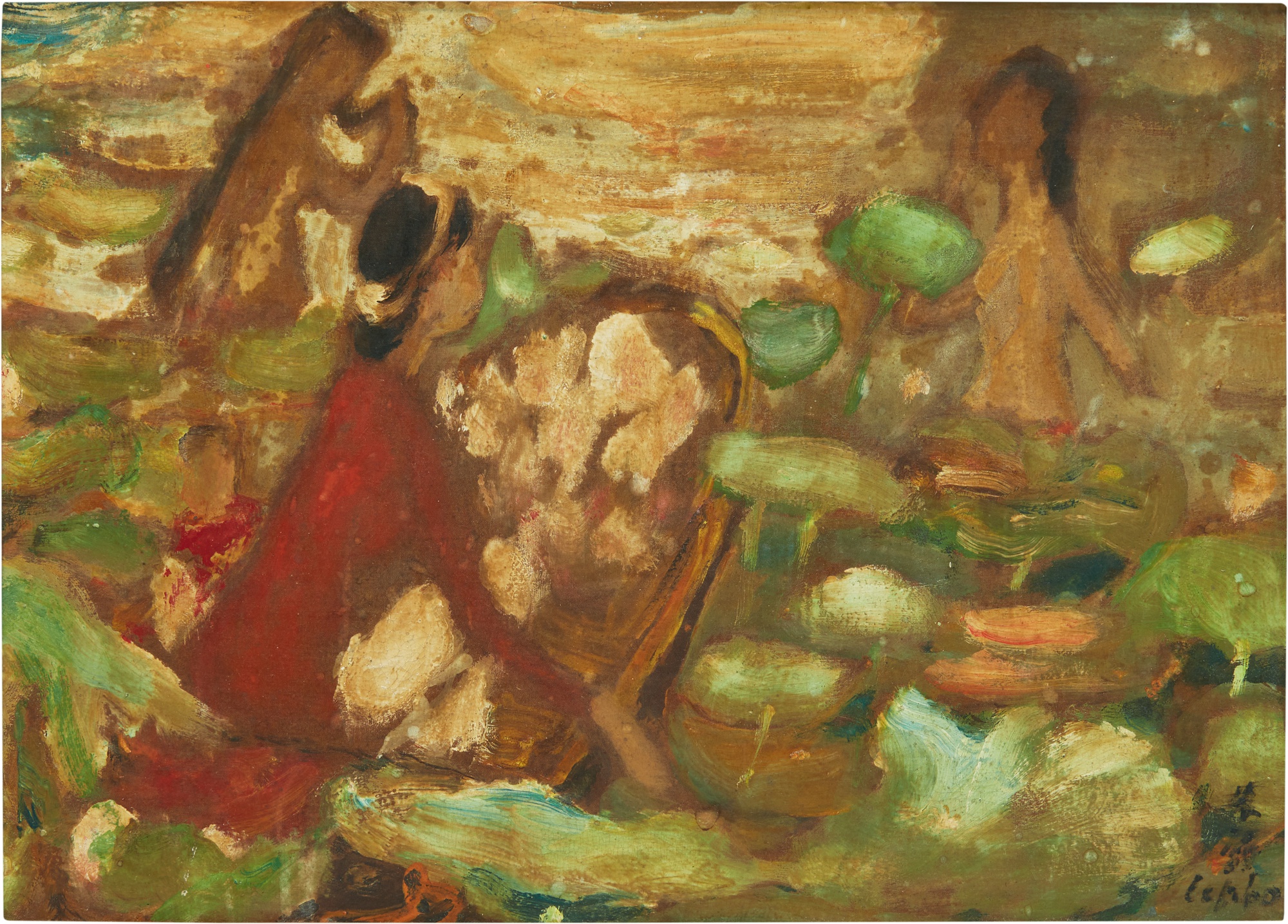
Lê Phổ
Le barque 在船上
Together, these three painters form the core of a generation that transformed Vietnamese art from a regional tradition into a genuinely international practice. Beyond this circle, Lê Phổ's work invites comparison with figures like Tsuguharu Foujita, the Japanese French painter whose silk smooth surfaces and East West synthesis made him a celebrated figure in Paris during the same era. Like Foujita, Lê Phổ achieved something that neither French academic painting nor Asian classical art alone could have produced. His legacy today feels more vital than ever, as the art world continues to reassess the contributions of artists who worked across cultural boundaries rather than within any single national tradition.
Lê Phổ died in Paris in 2001, at the remarkable age of 93, having witnessed the full arc of modernism and remained serenely himself throughout. He never chased movements or manifestos. He simply painted beauty, with a skill and sincerity that time has done nothing to diminish. To encounter his work is to be reminded that the most enduring art is often the quietest, the kind that asks you to slow down, to look again, and to feel the particular pleasure of a world rendered with love.