Lê Minh
Lê Minh: Vietnam's Luminous Urban Chronicler
Artist Spotlight · The Collection Editorial
There is a particular quality of light that falls on the waterways and backstreets of mid century Saigon, a warm, particulate glow that seems to hold the whole world in suspension between the old and the new. No painter captured that quality with more quiet authority than Lê Minh, born in 1937, whose oils on canvas stand today as some of the most evocative documents of Vietnamese urban and rural life produced in the decades surrounding the country's most turbulent transformations. As collectors and institutions across Southeast Asia and beyond have turned their attention to the postwar Vietnamese canon, Lê Minh has emerged as a figure of genuine importance, an artist whose modest scale belies an enormous emotional and historical range. Lê Minh was born in 1937, coming of age in a Vietnam shaped simultaneously by the legacies of French colonial culture, the urgent energies of a nascent national identity, and the practical realities of a society in constant flux.
Lê Minh
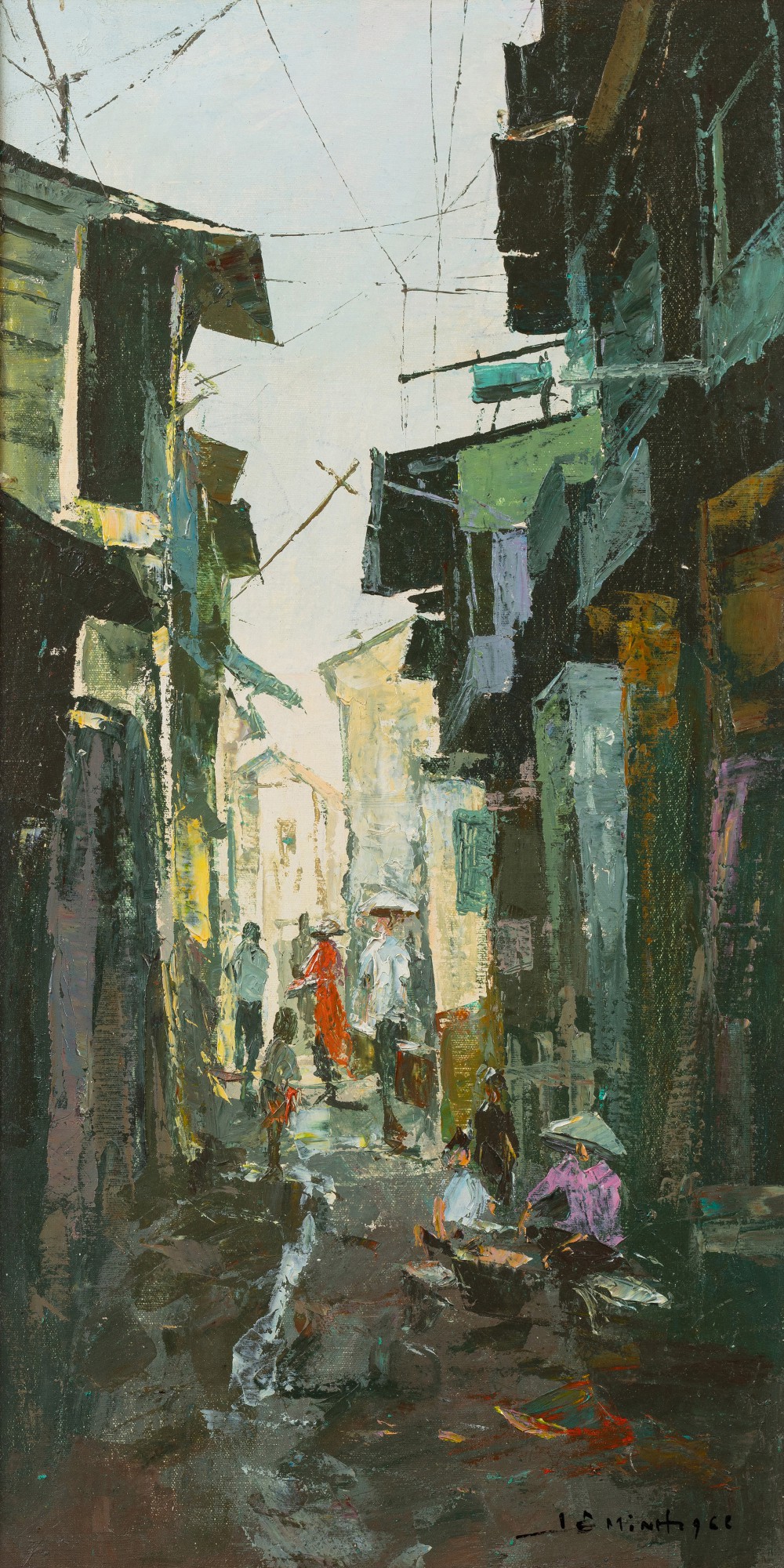
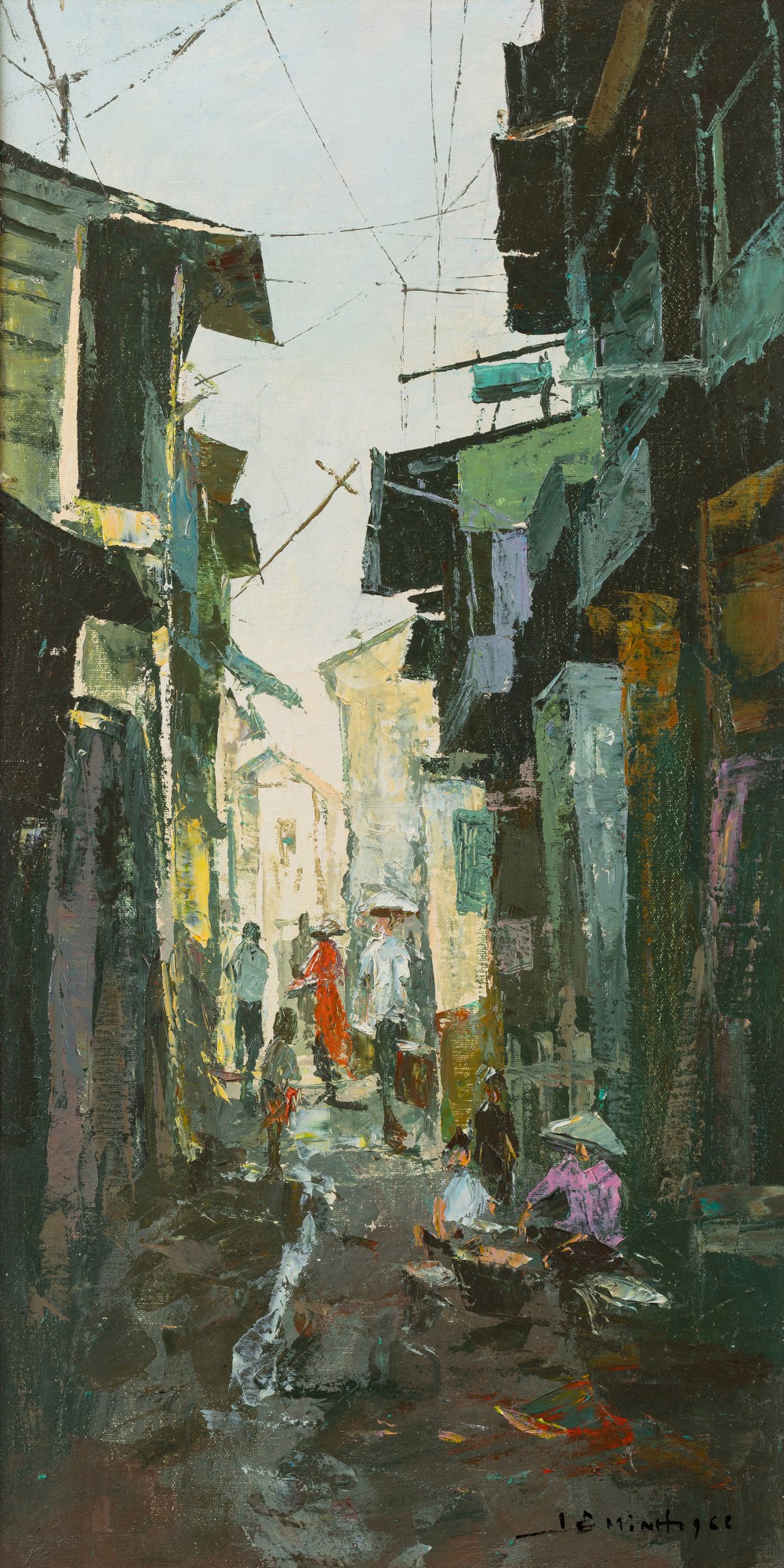
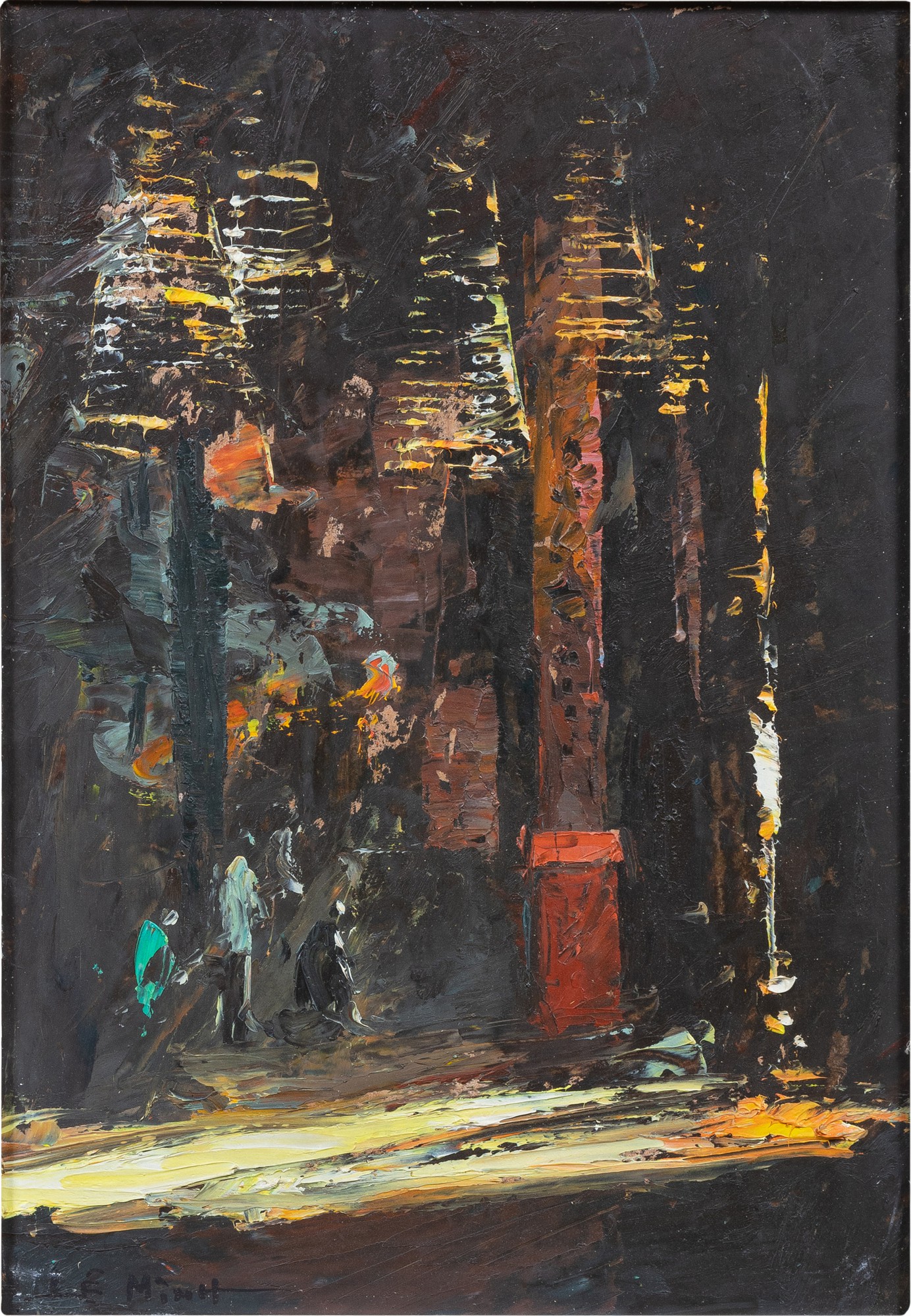
黎明(1937年生), 背街小巷, 1968
The French academic tradition had left deep institutional marks on Vietnamese fine arts education through the École des Beaux Arts de l'Indochine, founded in Hanoi in 1925, and the generation of painters who trained in that lineage absorbed both Western technique and a persistent, searching engagement with Vietnamese subject matter. Lê Minh was part of the generation that inherited this dual legacy and made it entirely their own, working in oil on canvas with a fluency that speaks to rigorous formal training while always directing that fluency toward the streets, rivers, temples, and markets of home. The earliest dated work currently known among his paintings places him as an active painter by 1960, when he completed a temple study that already announces his mature concerns. That canvas, rendered with careful attention to architectural form and the play of natural light across surfaces, shows a painter who understood that the sacred and the everyday were not separate categories in Vietnamese life but continuous expressions of the same human need for beauty and meaning.
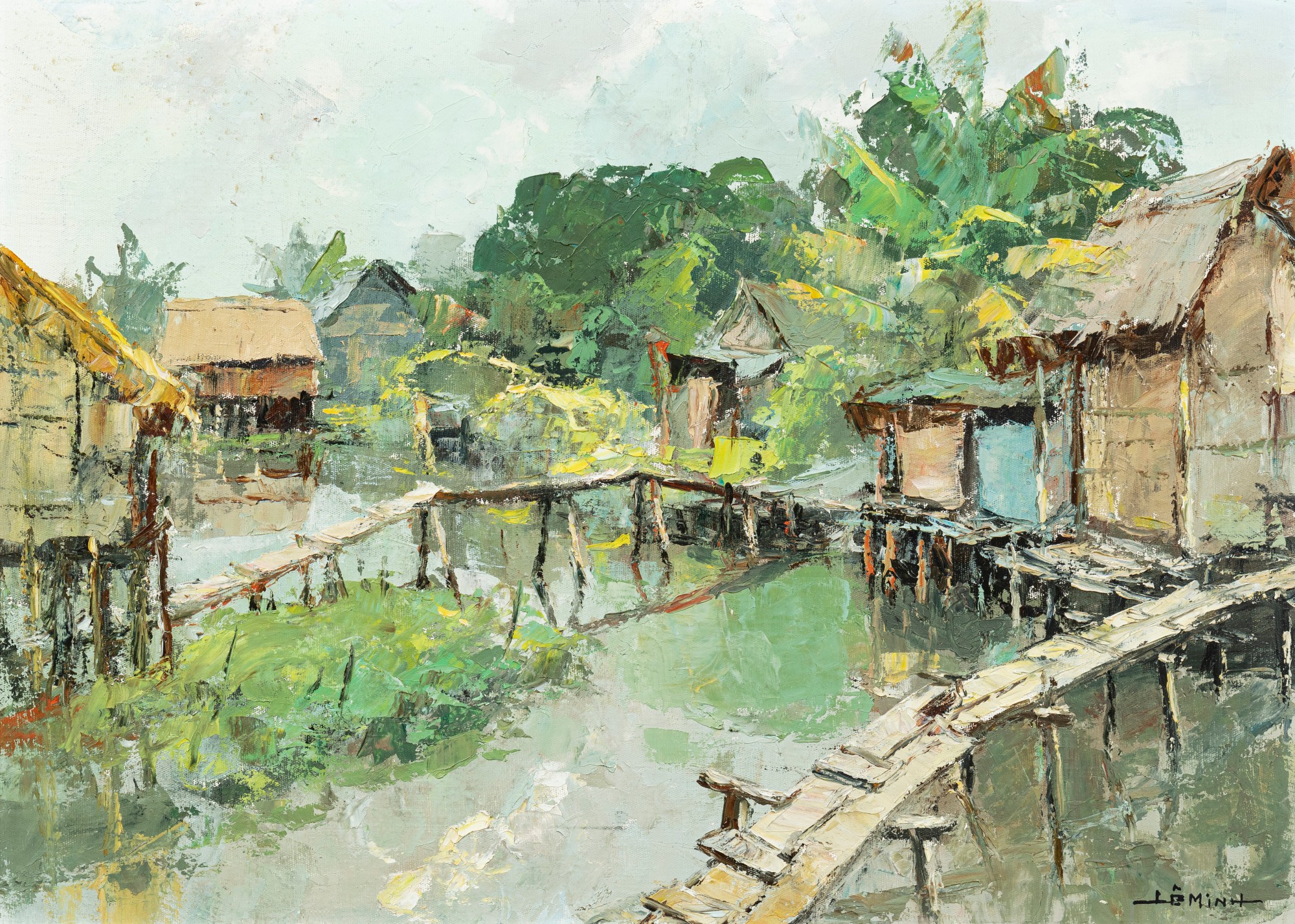
By 1965 he had moved toward scenes of village life along the rivers, producing at least two known oils depicting floating communities on the waterways near Saigon. These works carry within them a kind of documentary tenderness, a desire to fix in paint what was already beginning to change beyond recovery. His 1968 canvas depicting a backstreet alleyway, known by its Chinese title referencing narrow lanes behind the main thoroughfares, represents perhaps his most fully achieved urban composition. Painted at a moment of extraordinary historical pressure, the work turns away from the grand narrative and toward the texture of ordinary life.
Lê Minh
Lê Minh (1937年生), 河上村莊, 1965
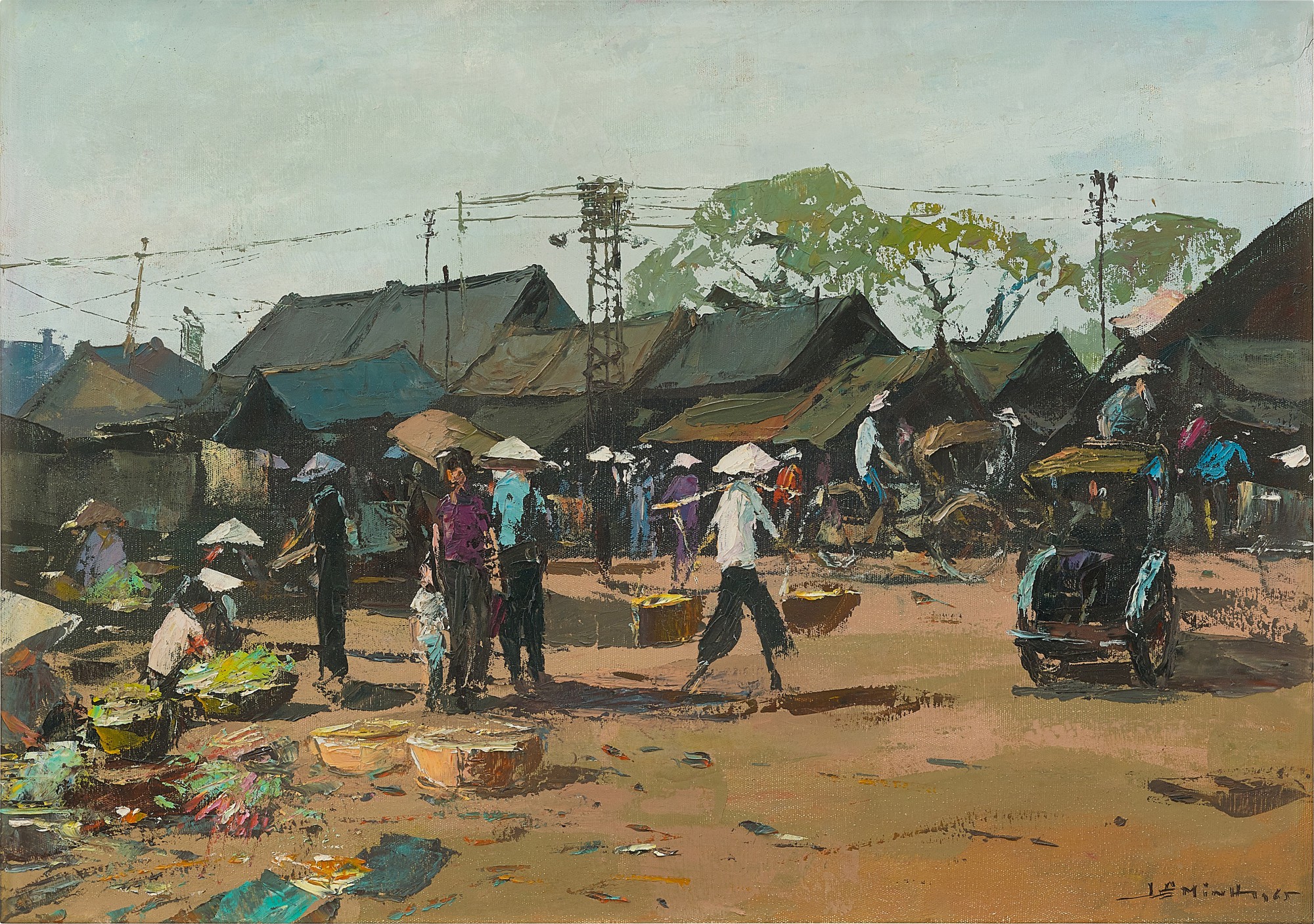
A certain stillness inhabits the composition, the compressed perspective of a lane seen from within, the layered architecture of a city that had been building and rebuilding itself across centuries. This is the kind of painting that rewards sustained looking. The handling of shadow and reflected light within tight urban spaces shows a painter working at the height of his powers, confident enough in his technique to let observation do the heaviest work. The market scene set in central Saigon operates in a similar register, moving outward from the intimate alley to the busy commercial heart of the city, with figures and goods rendered in a manner that is neither purely documentary nor purely lyrical but lives in the productive tension between those two impulses.
What draws serious collectors to Lê Minh today is precisely this quality of balance. He did not aestheticize poverty or romanticize the picturesque in the manner of some of his contemporaries working for outside audiences. Nor did he retreat into abstraction or political allegory. He painted what he saw with an honest eye and a technically accomplished hand, and the result is work that feels genuinely intimate with its subject matter.
Lê Minh
Market Scene in Central Saigon 西貢中的市場
The watercolor and oil traditions that flourished in Vietnam during the 1950s and 1960s produced a generation of painters working in relative obscurity outside the country, and the current moment of expanded institutional and market interest in Southeast Asian modernism has created new contexts for understanding artists like Lê Minh within a broader international story. His work invites comparison with figures such as Nguyen Trung and Nguyen Gia Tri, contemporaries working in overlapping traditions, as well as with the broader movement of mid century Asian figurative painters who engaged the post colonial question of how to paint one's own world in forms that had arrived from elsewhere. For collectors approaching Lê Minh's work now, the most important thing to understand is the rarity of the paintings that have entered the market. Works dating from the 1960s in particular, when the artist was producing his most concentrated and historically resonant canvases, represent a category of Vietnamese modern painting that is genuinely finite.
Condition and provenance are the primary considerations, as with any mid century work that has traveled from Southeast Asia into private collections in the region and beyond. The subjects he returned to repeatedly, river villages, temple architecture, market activity, urban alleyways, constitute a coherent and deeply personal vision of a place and time that no longer exists in quite the same form. That historical dimension adds a layer of significance that purely aesthetic considerations cannot account for. Lê Minh matters today not only as a painter of accomplished oils but as a witness.
Lê Minh
黎明(1937年生), 寺廟, 1960
His canvases from the 1960s preserve a visual record of Saigon and its surrounding communities in the years before the city's fundamental transformation, and they do so with the kind of attentive love that only an insider can bring to a subject. As the global art world continues to expand its sense of what constitutes the modern tradition, making room for the parallel modernisms that developed across Asia, Africa, and Latin America throughout the twentieth century, painters like Lê Minh move from the margins toward the center of the story where they always belonged. To encounter his work is to understand that the great project of mid century painting, the effort to find a visual language adequate to the complexity of contemporary life, was undertaken with equal seriousness and equal beauty in the backstreets and on the waterways of Vietnam.