Le Corbusier
Le Corbusier: The Visionary Who Remade Everything
Artist Spotlight · The Collection Editorial
“Space and light and order. Those are the things that men need just as much as they need bread.”
Le Corbusier
Few figures in the history of modern art and architecture cast as long and luminous a shadow as Charles Édouard Jeanneret, known to the world as Le Corbusier. In 2024, the Centre Pompidou in Paris hosted a renewed engagement with his graphic and painterly legacy, drawing fresh attention to dimensions of his practice that too often recede behind the monumental concrete forms of Chandigarh and the Unité d'Habitation in Marseille. For collectors and cultural observers alike, Le Corbusier is experiencing something of a renaissance, with auction houses regularly achieving strong results for his prints, watercolours, and designed objects, and museum curators revisiting his multidisciplinary output with new eyes and new frameworks. The moment feels right to consider the full breadth of what this extraordinary mind gave the world.
Le Corbusier
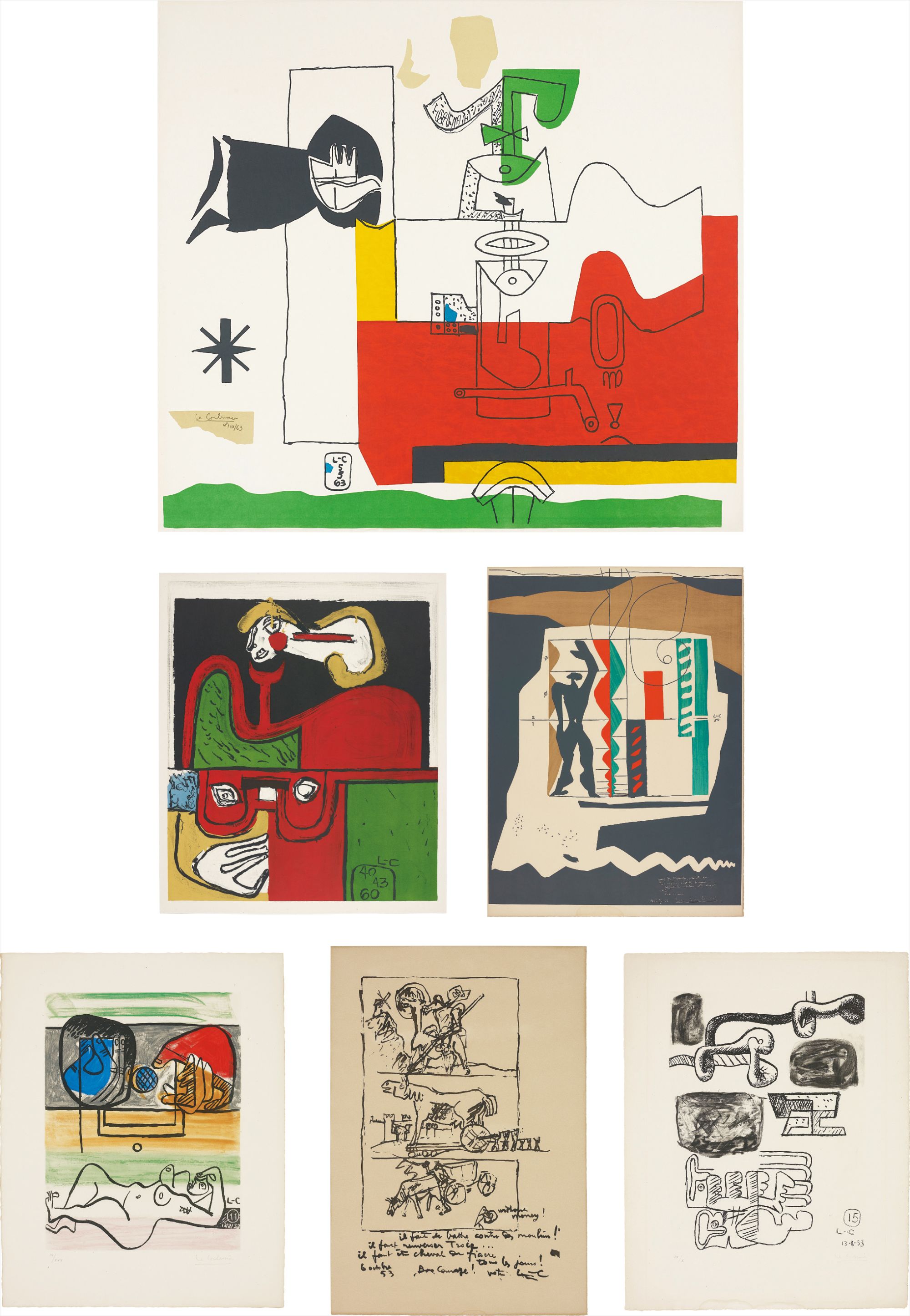
Totem; Portrait; Modular; Unité: two plates; and Don Quijote
Le Corbusier was born Charles Édouard Jeanneret on October 6, 1887, in La Chaux de Fonds, a watchmaking town in the Swiss Jura mountains. The precision and ornamental geometry of the watchmaking tradition surrounded him from childhood, and his early training at the local school of applied arts under Charles L'Eplattenier introduced him to the decorative grammar of Art Nouveau before he began to shed it decisively. Formative travels through Italy, Greece, and the Near East in his early twenties exposed him to classical monuments and vernacular architecture in ways that would never leave him. A period working in the Paris studio of Auguste Perret introduced him to reinforced concrete as a structural and aesthetic material, and time with Peter Behrens in Berlin placed him alongside a young Walter Gropius and Ludwig Mies van der Rohe, three architects who would collectively transform the built environment of the twentieth century.
He settled permanently in Paris around 1917 and, with the painter Amédée Ozenfant, founded Purism, a post Cubist movement that sought to strip painting of its decorative excesses and return it to what they called the pure, primary forms of modern industrial life. Their joint manifesto, Après le Cubisme, published in 1918, announced a new visual order rooted in geometry, clarity, and the machine aesthetic. The journal L'Esprit Nouveau, which Le Corbusier co founded in 1920, became the intellectual engine of this vision, publishing ideas about architecture, city planning, art, and industrial design that reached audiences across Europe and beyond. It was in this period that he adopted his now famous pseudonym, derived from the name of a distant ancestor, a gesture toward reinvention that suited a man perpetually in the act of becoming.
Le Corbusier
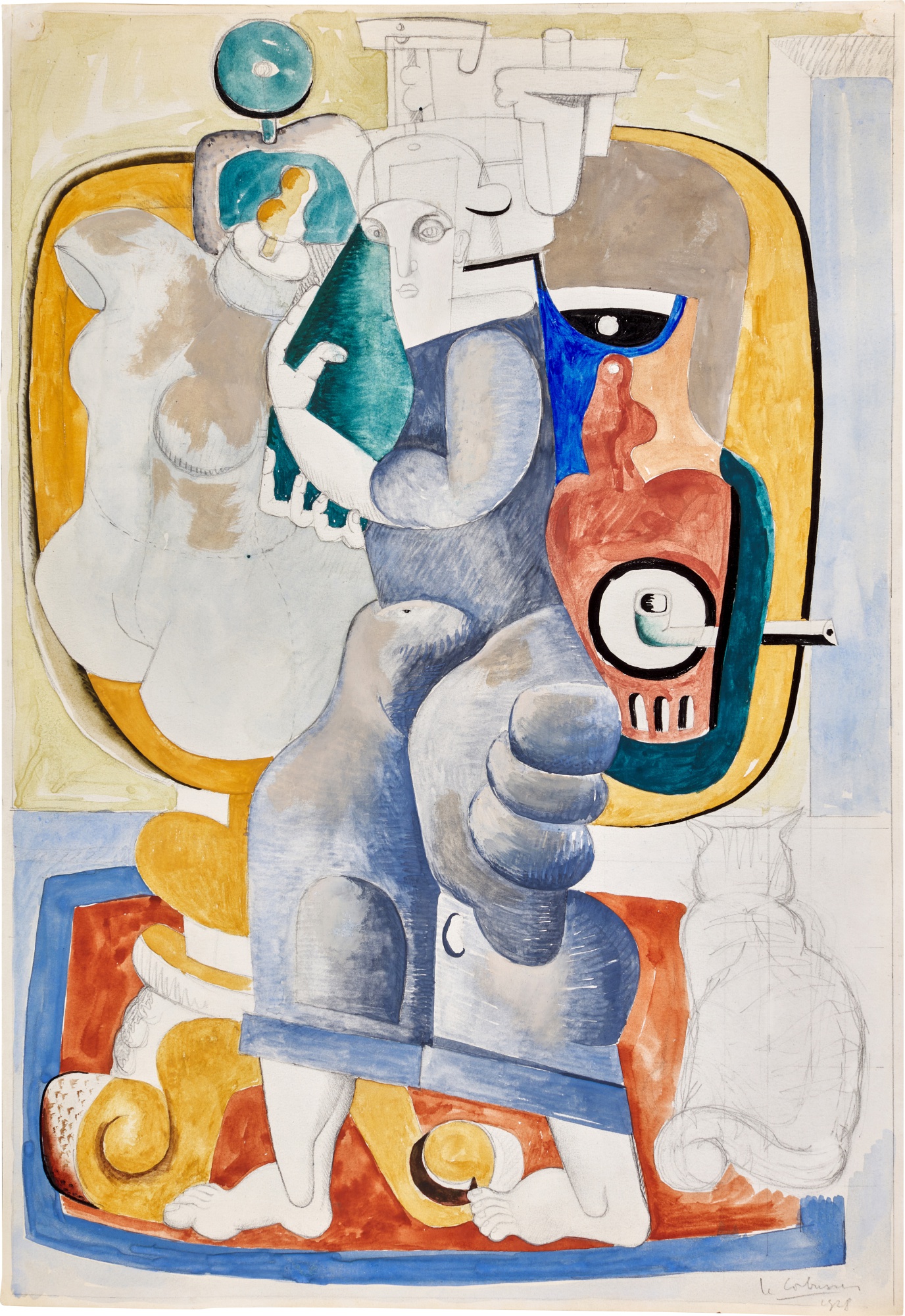
Femme au guéridon au mannequin et au chat, 1928
As a visual artist, Le Corbusier produced an astonishing body of work across painting, drawing, printmaking, tapestry, and sculpture. His paintings of the 1920s, featuring still life arrangements of bottles, glasses, guitars, and pipes rendered in cool, planar Purist idiom, are among the most elegant responses to Cubism ever made. By the 1930s and especially after the Second World War, his imagery grew warmer and more sensuous, incorporating the female figure, totemic forms, and the iconography of the open hand that became one of his signature symbols. Works such as Femme au guéridon au mannequin et au chat from 1928, a remarkable fusion of watercolour, pencil, ink, and collage, reveal the intimacy and spontaneity that coexisted with his public reputation for rational severity.
“Architecture is the learned game, correct and magnificent, of forms assembled in the light.”
Vers une Architecture, 1923
Here was an artist of genuine feeling, translating the same spatial intelligence that governed his architecture into images of startling personal warmth. Among the most significant bodies of work available to collectors today are his print portfolios, which deserve far more sustained attention than they typically receive. The Unité series, published by A.C.
Le Corbusier
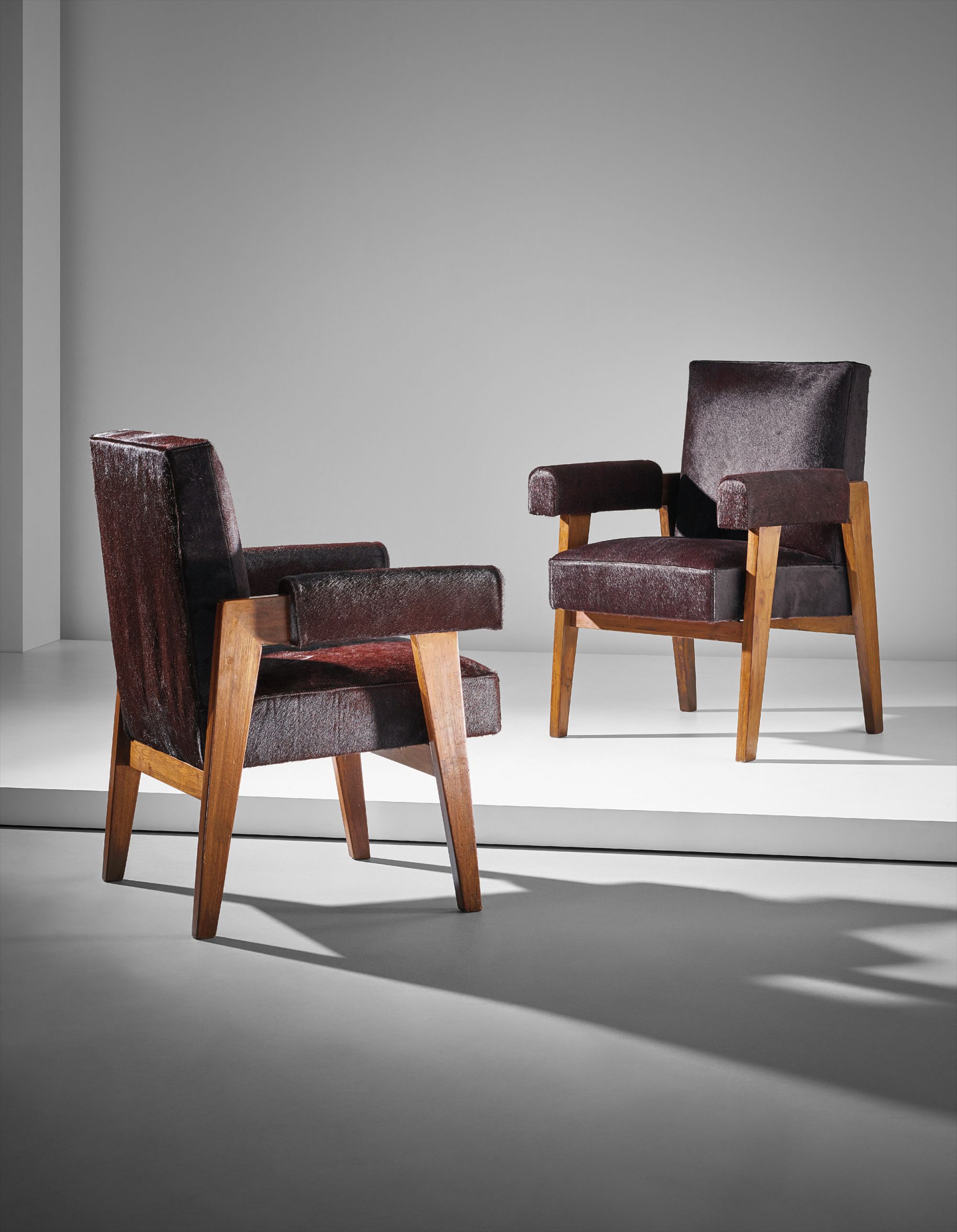
Pair of 'Advocate and Press' armchairs, model no. LC/PJ-SI-41-A, from the High Court, Chandigarh, 1955
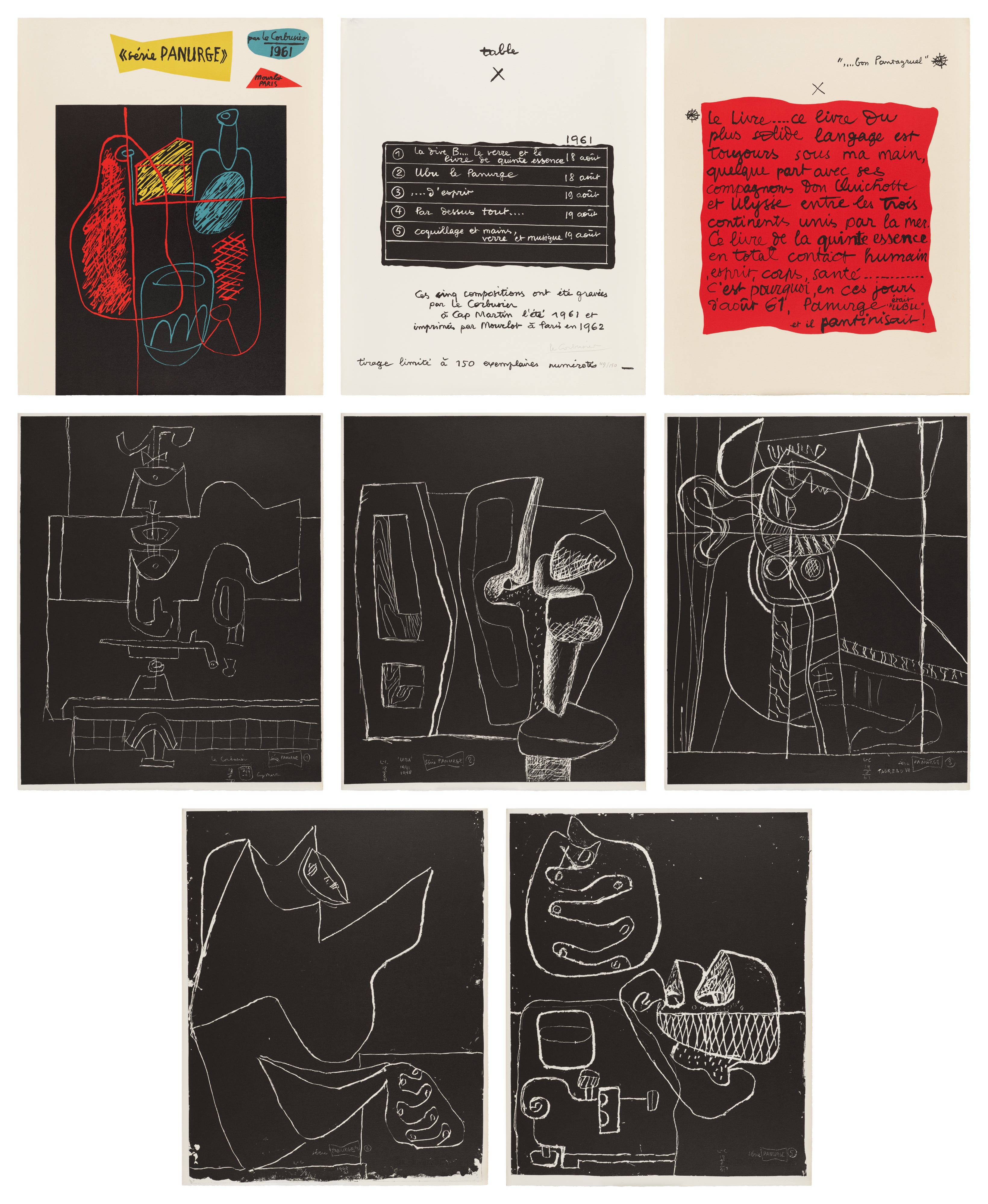
Mazo et Cie. in Paris, comprises etchings and aquatints in rich colour on Rives BFK paper that distil the forms and philosophies of his greatest architectural project into a purely graphic language. The Série panurge, published by Mourlot, one of the most celebrated print workshops in Parisian history, demonstrates the same lithographic mastery that Picasso, Matisse, and Miró sought from that legendary house. Le poème de l'angle droit, his extended visual and poetic meditation on geometry and human harmony, exists as both a published book and a suite of lithographs, and stands as one of the most genuinely original artist's books of the twentieth century.
“I prefer drawing to talking. Drawing is faster and leaves less room for lies.”
Le Corbusier
Collectors drawn to the intersection of intellectual weight and visual pleasure will find these works endlessly rewarding. The market for Le Corbusier's art and design objects has shown consistent strength over recent decades. His furniture designs, created in collaboration with Charlotte Perriand and Pierre Jeanneret in the late 1920s and refined across subsequent years, regularly appear at auction with considerable results. Pieces from the institutional commissions at Chandigarh, the great planned city he designed for the new Indian state of Punjab following independence, have attracted particular collector enthusiasm.
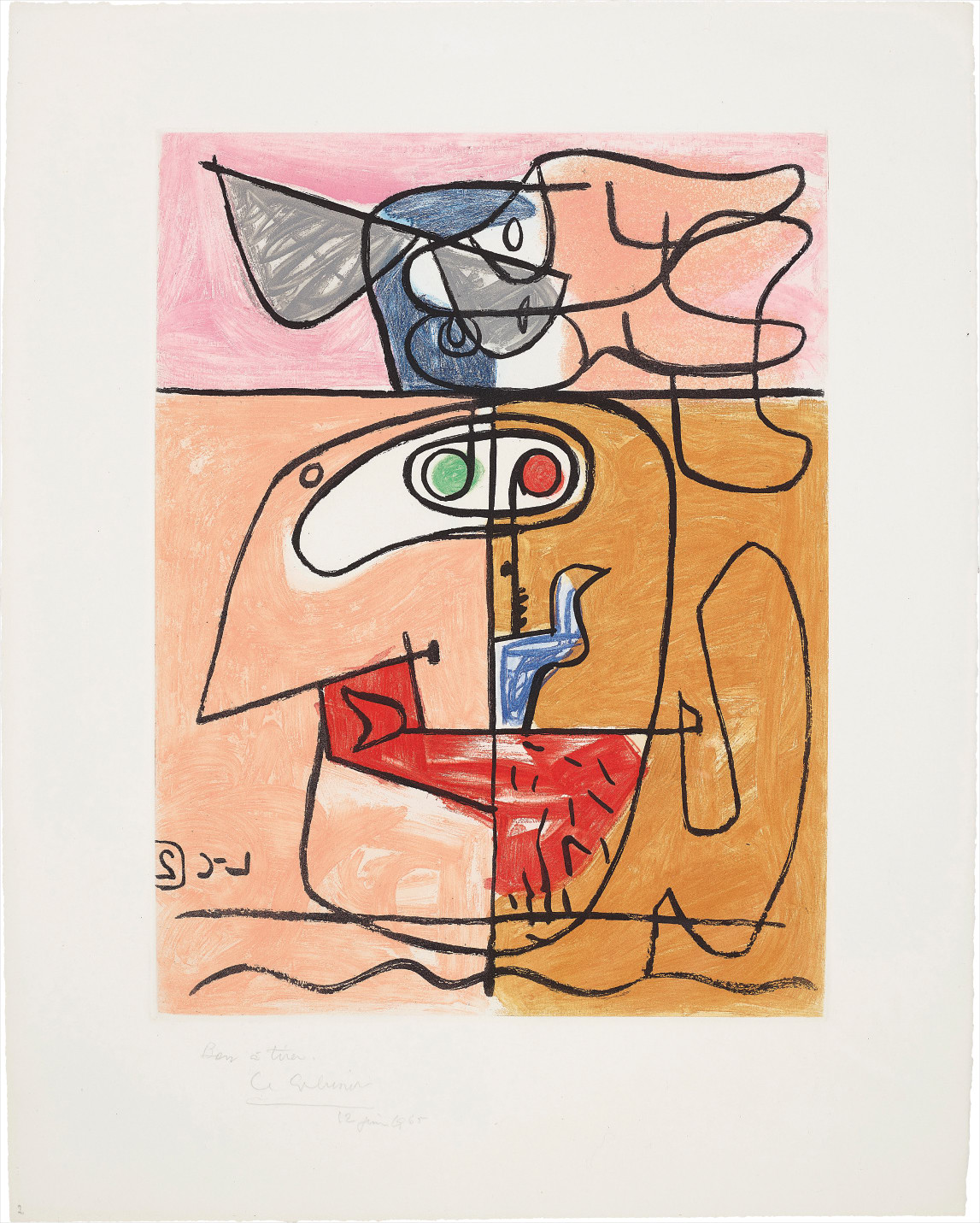
Le Corbusier
Unité: plate 2
The Pair of Advocate and Press armchairs from the High Court at Chandigarh, dating to 1955, represent the point where his design philosophy touched lived civic life on a grand scale, and their provenance gives them an aura few design objects can match. For those entering the market, signed and numbered works from his major print editions offer an accessible and historically rich point of engagement, with the added advantage of exceptional documentation and publication provenance. To understand Le Corbusier fully is to place him within a constellation of artists and thinkers who collectively reimagined modern experience. His Purist alliance with Ozenfant rhymes with the geometric abstraction being pursued simultaneously by Fernand Léger, with whom he shared both friends and arguments.
His engagement with primitivism and the female form connects him to Picasso, though always on his own rigorous terms. His design furniture work parallels the Bauhaus experiments of Marcel Breuer, while his urbanism anticipates and in some ways enables the post war city planning debates that figures like Jane Jacobs would later reframe. He was never simply an architect who painted on the side. His visual practice and his spatial thinking were one continuous act of imagination.
Le Corbusier died on August 27, 1965, swimming in the Mediterranean near Roquebrune, a death as elemental and sunlit as the forms he spent a lifetime celebrating. His legacy is vast and genuinely complex, generating passionate debate among architects, urban historians, and social critics that shows no sign of quieting. But for collectors of art and design, the conversation is less contentious and more purely pleasurable: here is a body of work of the highest intellectual seriousness, made with exceptional technical skill, and imbued with a vision of human life lived in dignity and beauty. To live with a Le Corbusier print, watercolour, or chair is to share space with one of the most ambitious and humane minds that the twentieth century produced.
Explore books about Le Corbusier
Towards a New Architecture
Le Corbusier
Le Corbusier: A Life
Anthony Flint
Le Corbusier and the Continuum Revisited
Roger Connah
Le Corbusier: Elements of a Synthesis
Stanislaus von Moos

The Le Corbusier Archive
Le Corbusier Foundation
Le Corbusier: The Noble Savage
Nicholas Fox Weber
Le Corbusier: Architect of the Century
William J.R. Curtis
The Modulor: A Harmonious Measure to the Human Scale
Le Corbusier