Laurence Stephen Lowry
Lowry: The Poet of Industrial England
Artist Spotlight · The Collection Editorial
“I was not a lonely man. I was a lonely boy, but I got used to it.”
Lowry, interviewed by Mervyn Levy
There is a moment, standing before a Lowry canvas, when the grey skies and smoking chimneys stop feeling like documentary evidence and start feeling like music. That sensation has drawn millions of visitors to Salford's The Lowry centre, the landmark arts venue on the banks of the Manchester Ship Canal that bears his name and houses the largest public collection of his work. Since its opening in 2000, the institution has become a pilgrimage site for those who feel, instinctively and powerfully, that Laurence Stephen Lowry painted something true about human life in the industrial age, something that no amount of critical theorising can fully contain or explain. His reputation, far from settling into comfortable retrospection, continues to grow with each passing decade.
Laurence Stephen Lowry
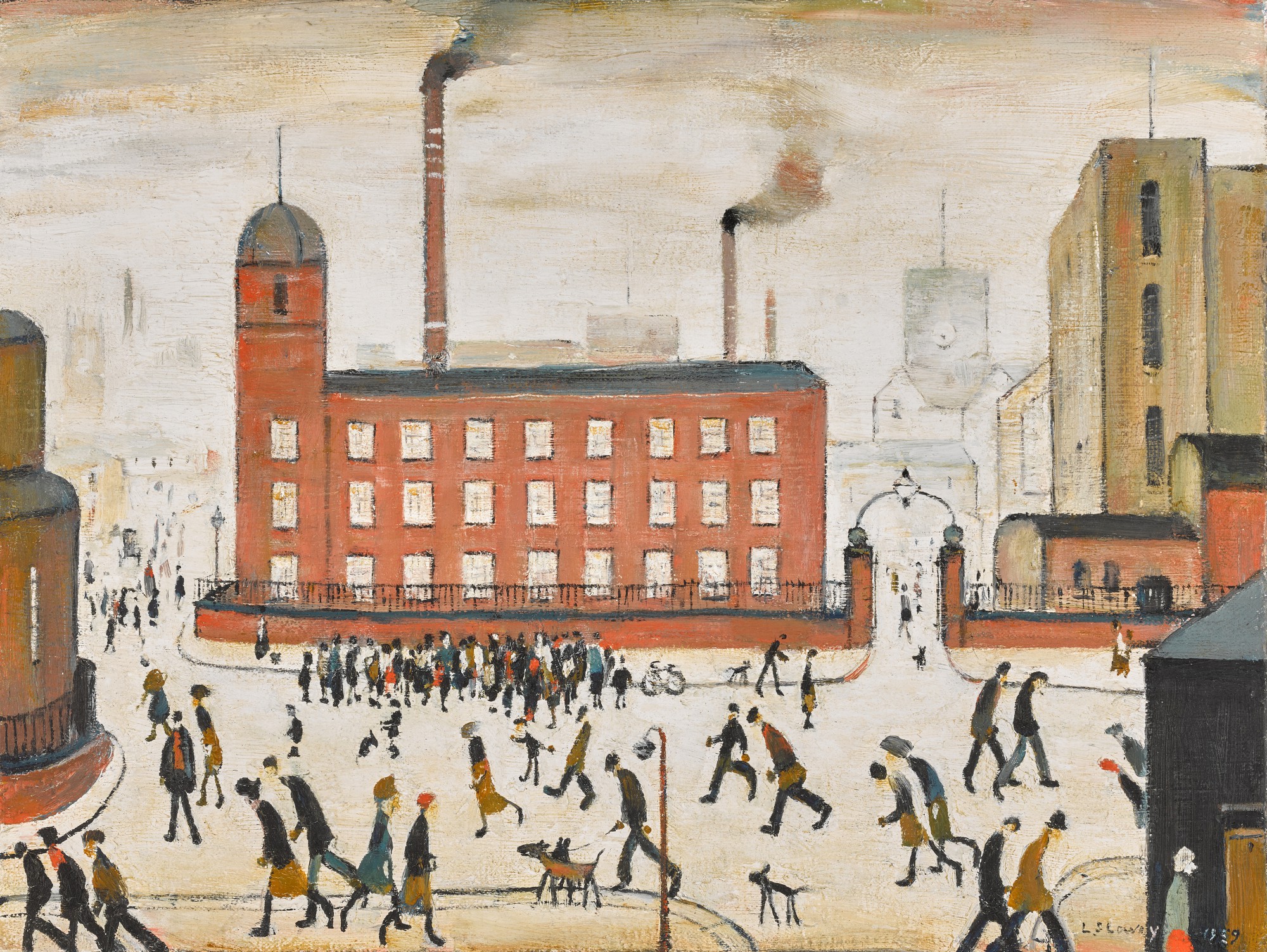
Mill Scene, 1959
Lowry was born in Stretford, Manchester, in 1887, into a lower middle class family that would later move to the Pendlebury area of Salford. It was a relocation that would define his entire artistic vision. Pendlebury sat at the heart of industrial Lancashire, surrounded by cotton mills, terraced streets, and the constant presence of labour and its rhythms. His mother, Elizabeth, was a gifted amateur pianist who had harboured ambitions of a more refined life, and her sense of disappointment with their circumstances cast a long shadow over the household.
Lowry was a devoted, even dutiful son, caring for his parents well into his middle age, and it is difficult to separate the particular quality of his melancholy from that intimate domestic context. He began studying art as a young man, attending classes at the Manchester Municipal College of Art from 1905, and later at the Salford School of Art. One of his most formative influences was the French Impressionist painter Adolphe Valette, who taught at the Manchester Municipal College and brought a genuine Parisian sensibility to his instruction. Valette's atmospheric paintings of Manchester in fog and rain showed Lowry that the industrial city was not merely subject matter to be endured but a landscape worthy of serious artistic attention.
Laurence Stephen Lowry
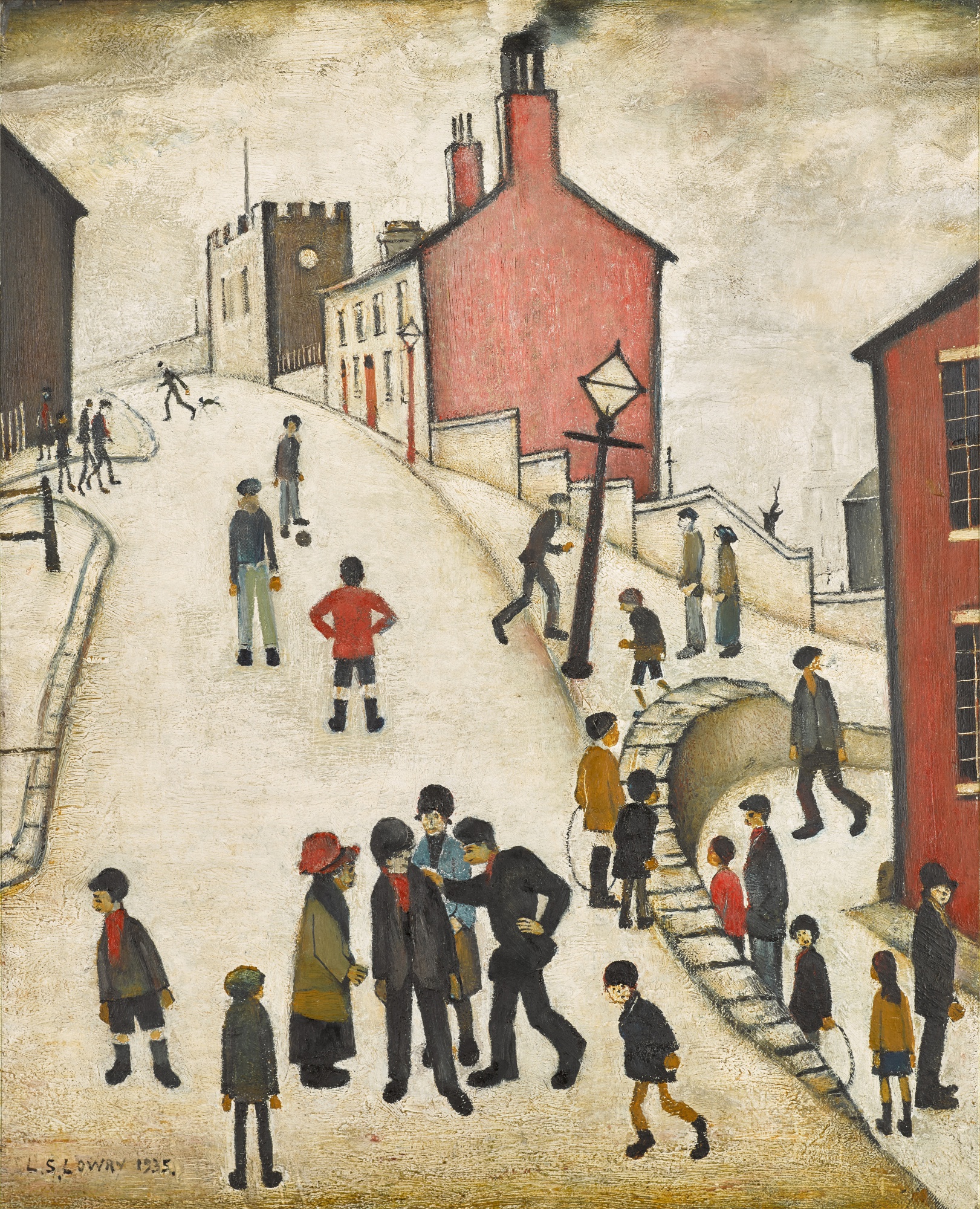
Road Over the Hill, 1935
That lesson took deep root. At the same time, Lowry was working as a rent collector and later a clerk for the Pall Mall Property Company, a job he held for over forty years, walking the streets of Salford and observing the lives of its inhabitants with the patient, unobtrusive eye of someone who was simultaneously an insider and a perpetual outsider. The artistic development that followed was slow, deliberate, and entirely self determined. Through the 1920s and 1930s, Lowry refined the elements that would become his unmistakable signature: a stark, luminous white ground, often achieved by layering flake white over years rather than days; a palette of greys, blacks, and ochres broken by accents of red and blue; and the celebrated matchstick figures, crowds of small urgent people who seem simultaneously isolated and part of a collective tide.
“I have found beauty in the most unlikely places.”
L.S. Lowry
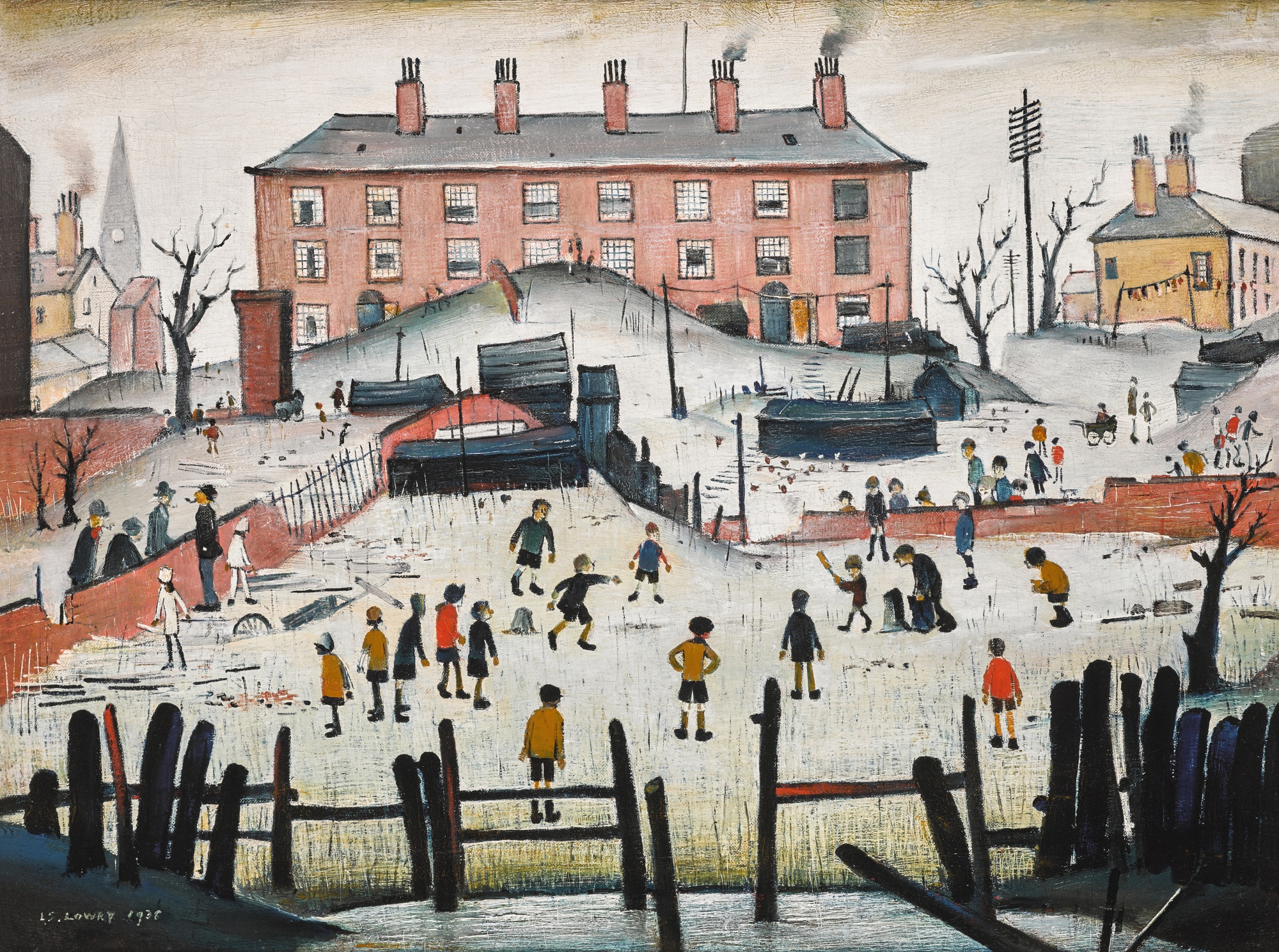
Works like Road Over the Hill, painted in 1935, demonstrate how fully formed his vision had become by the mid decade. The composition is spare and confident, the figures moving through a landscape that feels both specific and timeless. A Cricket Match from 1938 shows a different register entirely, warmer and almost playful, a reminder that Lowry's relationship with the communities he depicted was never simply elegiac. His major breakthrough with the wider British public came after the artist Middleton Murry championed his work and the Lefevre Gallery in London began exhibiting him from 1939 onward.
Laurence Stephen Lowry
A Cricket Match, 1938
The Lefevre shows introduced collectors and critics to a painter who seemed to have emerged fully formed from an entirely different tradition than the one dominating London's art world at the time. Mill Scene, painted in 1959, captures the mature Lowry at his most authoritative: the mill buildings loom with architectural certainty while the figures below enact their small dramas with total conviction. Street in Salford, also from 1958, is among the most emotionally direct works of his career, the terraced facades rendered with a tenderness that suggests deep familiarity rather than mere observation. The Auction from the same year shows his ability to structure a crowd scene with the compositional intelligence of a master draughtsman, every figure placed with intention.
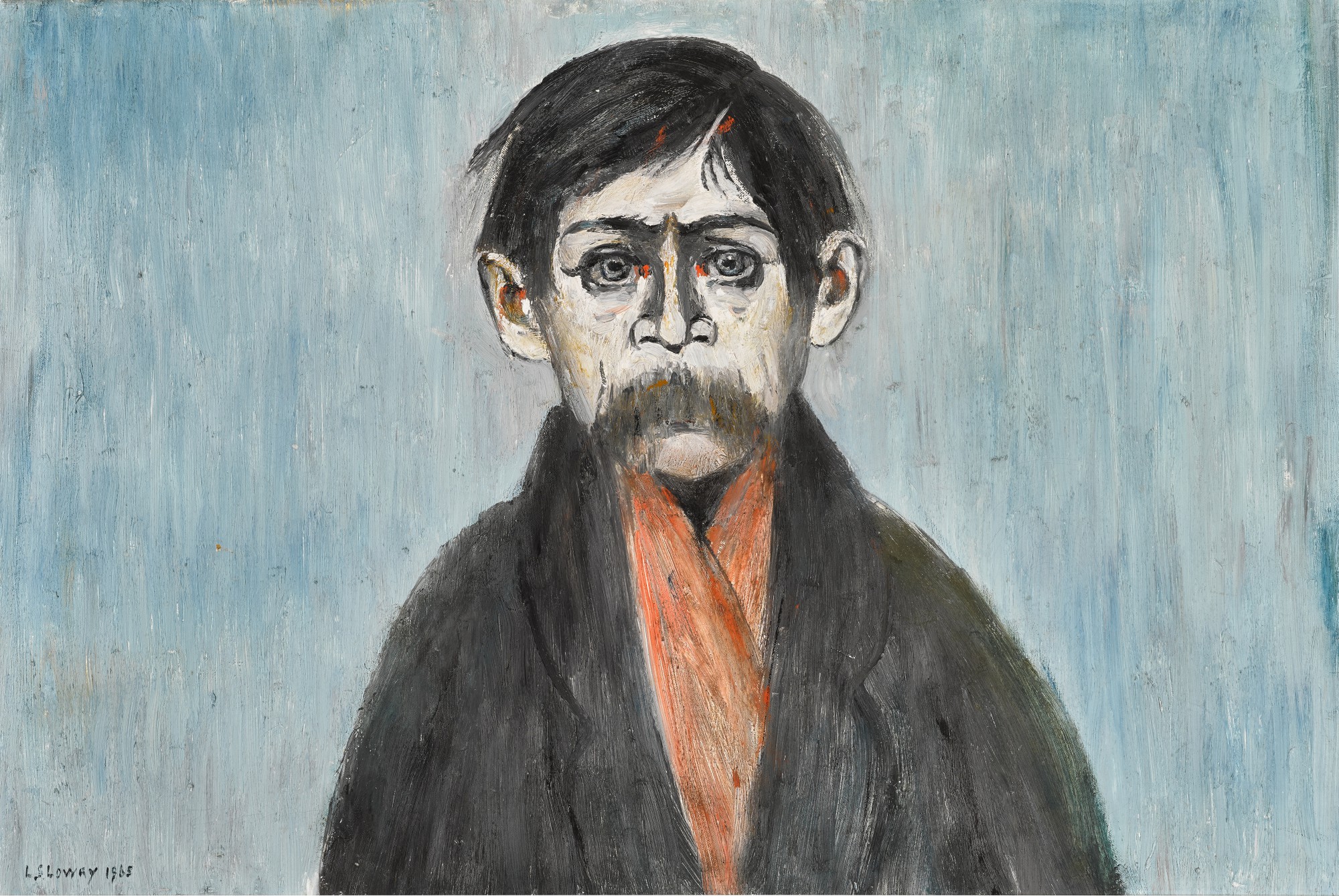
For collectors, Lowry presents one of the most compelling propositions in the entire field of twentieth century British art. His work spans an enormous range of scale, medium, and register, from the panoramic industrial canvases that command the highest prices at auction to intimate pencil drawings such as The Gateway of 1931, which reveal the precision and delicacy underlying even his most atmospheric painted works. Head of a Man, dating to 1965, demonstrates a side of his practice that surprises many first time viewers: a psychological intensity in his portraiture that stands entirely apart from the industrial scenes, raw and unsettling in its directness. Lowry's works have achieved significant results at the major British auction houses, with important paintings regularly reaching seven figures at Christie's and Sotheby's, reflecting a collector base that spans institutional buyers, serious private collectors, and passionate admirers of British social history.
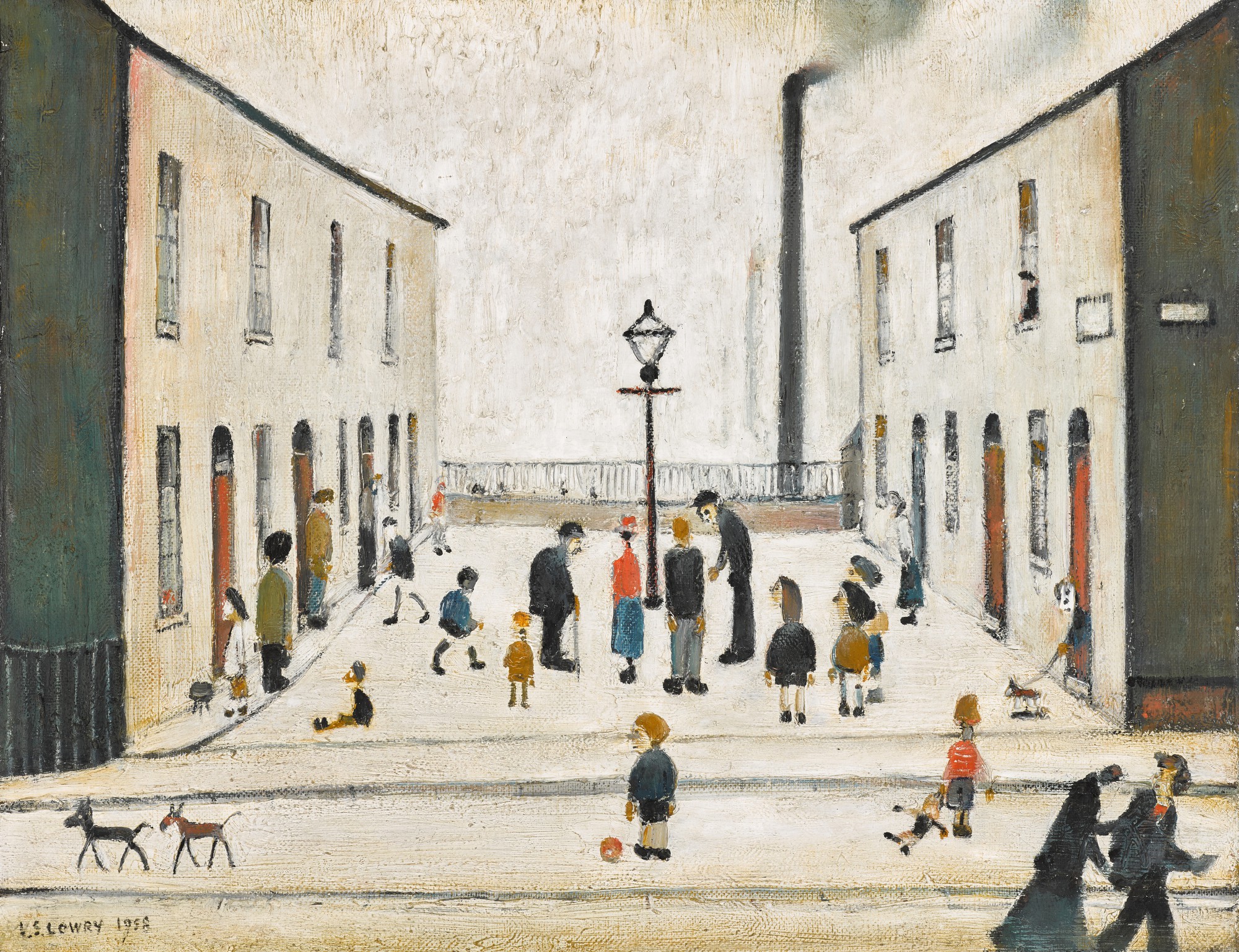
Laurence Stephen Lowry
Street in Salford, 1958
The consistency of demand across his career, from the early Salford streetscapes to the later seascapes and figure paintings, speaks to a practice of extraordinary coherence. Within the broader sweep of art history, Lowry occupies a position that resists easy categorisation, which is part of what makes him so enduring. He shares with the American Ashcan School painters, figures like George Bellows and John Sloan, a commitment to depicting urban working life with dignity and without sentimentality. Closer to home, his work connects to the tradition of Walter Sickert's Camden Town scenes, though Lowry's emotional temperature is distinctly his own.
The Manchester School designation, which groups him with other Northern English painters engaged with industrial and social subjects, provides useful context without fully accounting for the singular quality of his achievement. He was elected an Associate of the Royal Academy in 1955 and a full Royal Academician in 1962, formal recognition that came after decades of work made entirely on his own terms. Lowry died in 1976, having famously declined a knighthood as well as several other major honours, a biographical detail that feels entirely consistent with the independence and self sufficiency that characterised his whole life and practice. His legacy today is not simply that of a chronicler of a vanished industrial world, though that historical value is real and substantial.
It is the legacy of an artist who looked at the lives of ordinary people with sustained, serious, loving attention, and found in those lives a subject equal to any in the history of painting. To collect Lowry is to participate in that attention, to bring into one's own space the particular quality of seeing that he spent a lifetime perfecting.
Explore books about Laurence Stephen Lowry
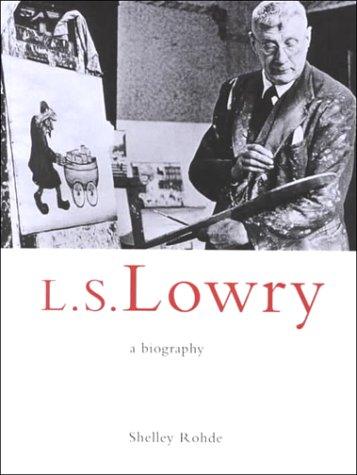
L.S. Lowry
Shelley Rohde

Lowry and the Painting of Modern Life
Andrew Causey
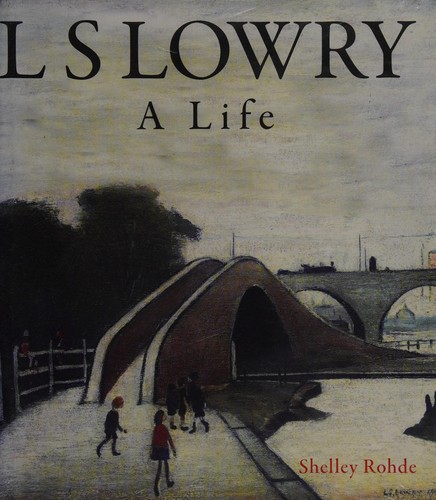
L.S. Lowry: A Life
Shelley Rohde
The Art of L.S. Lowry
Michael Howard

L.S. Lowry: The Man and His Work
A.J.P. Taylor
Lowry and Light
Andrew Causey
L.S. Lowry: Catalogue Raisonné
Judith Sandling