Kono Bairei
Bairei's Brushstrokes Bring Nature Vividly Alive
Artist Spotlight · The Collection Editorial
There is a moment, standing before a Kono Bairei painting, when the boundary between the observed and the imagined dissolves entirely. A spray of begonia bends with the suggestion of a breeze. A shrimp fisherman wades into ink dark water with the quiet certainty of someone who has made this crossing a thousand times. It is this quality, an almost breathing stillness, that has drawn renewed attention to Bairei's work among collectors and curators in recent years, as Western institutions and private buyers alike have deepened their engagement with the extraordinary flowering of Japanese visual culture during the Meiji period.
Kono Bairei
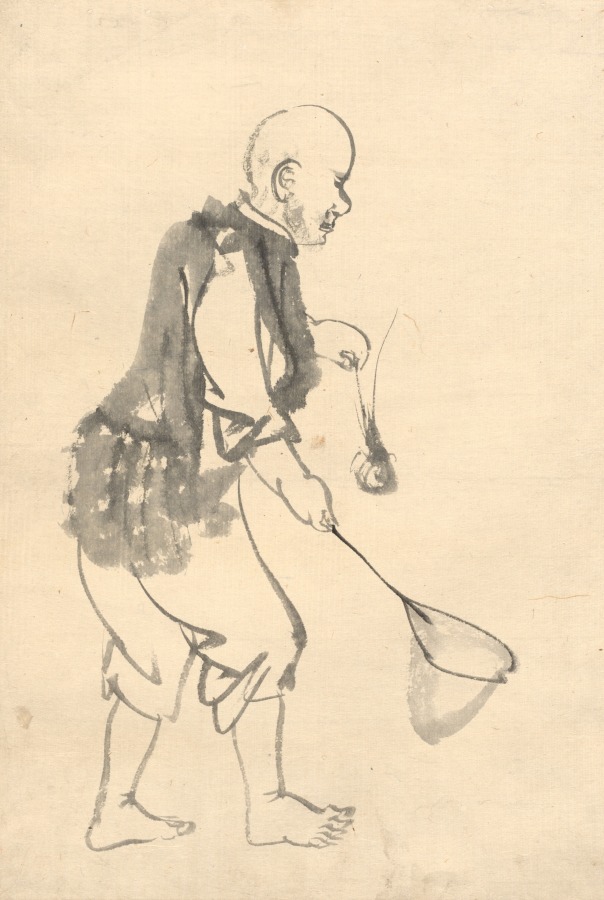
The Shrimp Fisherman, 1880
The Art Institute of Chicago and the Museum of Fine Arts Boston both hold significant holdings of Meiji era woodblock and ink work, and the broader critical reassessment of this period has placed artists like Bairei in a richly deserved new light. Kono Bairei was born in Kyoto in 1844, a city that remained the spiritual and artistic capital of Japan even as political power shifted and the country began its dramatic encounter with modernity. Kyoto in the mid nineteenth century was still saturated with centuries of painterly tradition, and Bairei absorbed that inheritance with rare attentiveness. He studied under Nakajima Raishō, a master of the Shijō school, which had established itself as one of the most vital lineages in Japanese painting by combining close observation of the natural world with a lyrical, accessible elegance.
The Shijō school traced its roots to Maruyama Ōkyo, whose commitment to drawing from life had transformed how Japanese artists looked at birds, plants, insects, and water. For a young painter of Bairei's temperament, this was a formative and galvanizing inheritance. Bairei came of age professionally at precisely the moment Japan was opening itself to the world with dizzying speed. The Meiji Restoration of 1868 brought not only political transformation but a profound cultural upheaval, as Western aesthetics and technologies flooded into a society simultaneously eager to modernize and anxious to preserve what was distinctly its own.
Kono Bairei
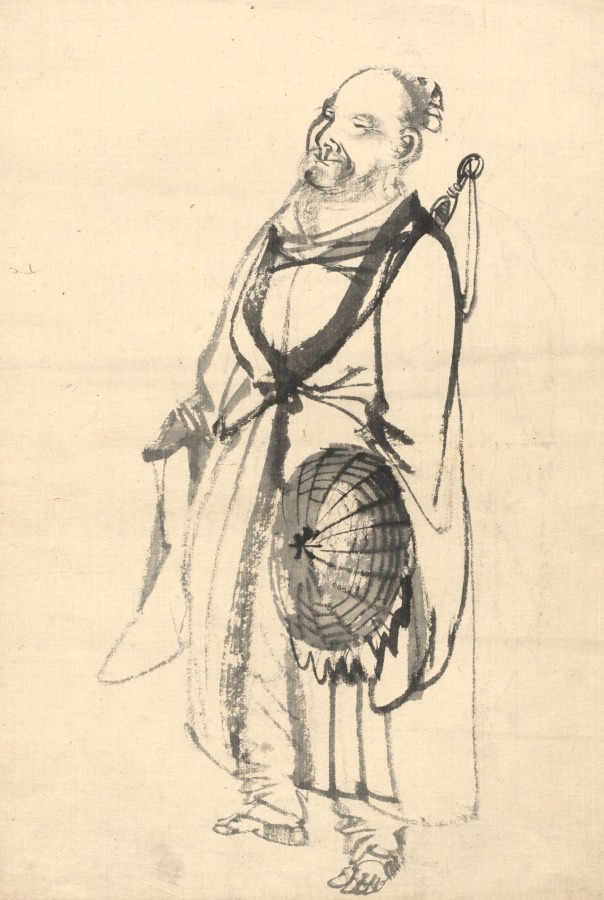
The Wandering Hermit, 1880
For artists, this tension was generative. Bairei navigated it with unusual grace, absorbing new influences without abandoning the refined sensibility he had cultivated through years of traditional study. His understanding of Western compositional ideas and printing techniques informed his later work without ever overwhelming its essential Japanese character. He remained, above all, a painter of extraordinary refinement and a printmaker of genuine invention.
The works that have come to define Bairei's reputation are his nature studies, and among these his bird and flower compositions occupy a special place. The genre known in Japanese as kachōga, literally bird and flower pictures, has a history stretching back centuries and draws on Chinese precedents as well as native traditions. What Bairei brought to this form was a combination of scientific attentiveness and poetic warmth that feels entirely his own. His brushwork is at once precise and generous.
Kono Bairei
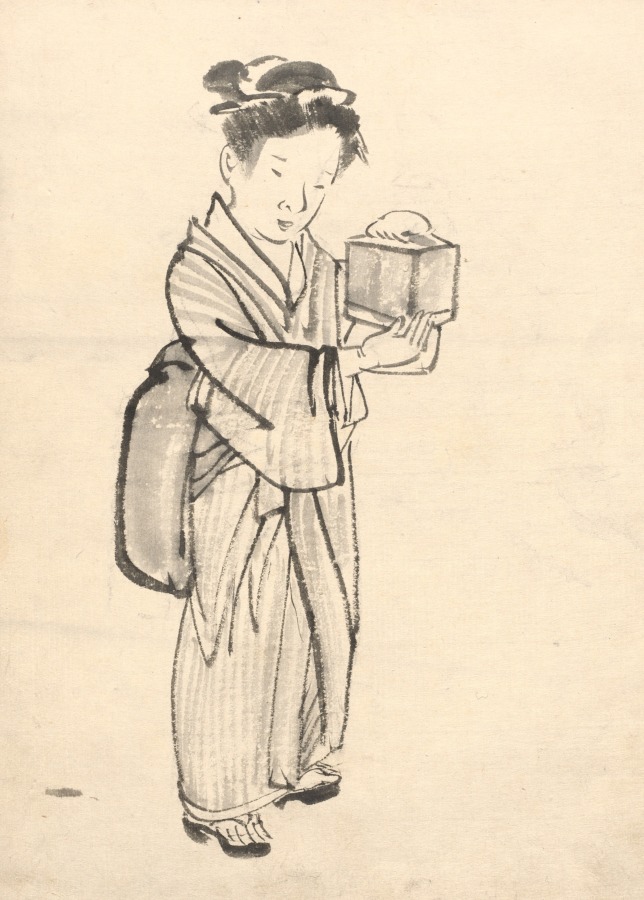
Girl Holding a Cricket Cage, 1880
In a painting like Branch of Begonia in Bloom, created around 1880, the petals carry both botanical accuracy and a kind of emotional tenderness, as if the artist genuinely loved the plant he was rendering. This quality of felt observation runs through everything he made. His encyclopedic woodblock print series, most notably the Bairei Gakan and the Bairei Hyakucho Gafu, published in the 1880s, gathered hundreds of bird species rendered with the kind of meticulous care that appeals equally to naturalists and aesthetes. The figurative works in Bairei's output reveal another dimension of his talent entirely.
The Shrimp Fisherman and The Wandering Hermit, both dating to 1880 and executed in ink on paper, demonstrate his command of human presence within a landscape. These figures are not merely staffage or compositional devices. They carry psychological weight, a sense of lives lived with intention and solitude. Girl Holding a Cricket Cage from the same year is a gem of quiet observation, a young woman's absorption in her small charge rendered with the same attentiveness Bairei would bring to a heron or a chrysanthemum.
Kono Bairei
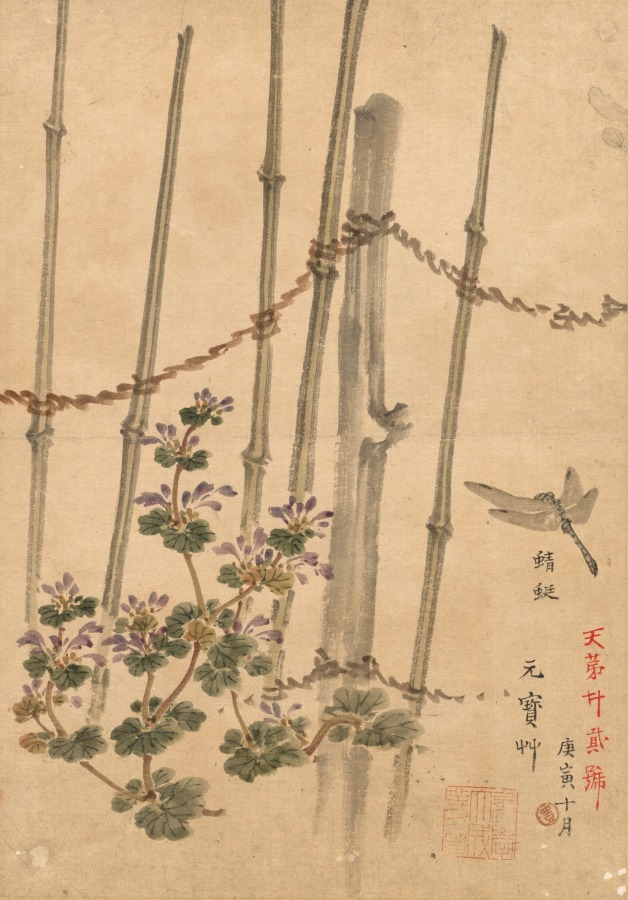
Bamboo Fence and Chrysanthemums, 1890
The Faggot Bearer and Dancer in a Fisherman's Costume complete a picture of an artist equally at home with genre subjects and natural history, moving between the human world and the world of living things with fluent ease. From a collecting perspective, Bairei occupies a particularly compelling position. His work sits at the intersection of several categories that serious collectors prize: Japanese Meiji period painting, woodblock print making at a moment of genuine technical sophistication, and the kachōga tradition that connects him to some of the most beloved imagery in all of East Asian art. Works on paper from his most productive decade, the 1880s, represent the full expression of his mature practice.
Pieces like Bamboo Fence and Chrysanthemums, with its subtle deployment of color against ink, show the careful calibration of tone and texture that distinguishes his finest output. Collectors drawn to the contemplative beauty of Japanese art and those interested in the broader story of artistic exchange between East and West in the nineteenth century will find Bairei's work speaks to both interests simultaneously. To understand Bairei fully it helps to place him within the remarkable constellation of Meiji period artists who were rethinking Japanese visual culture from within. His contemporary Shibata Zeshin was similarly steeped in tradition while responding alertly to a changing world.
The woodblock print master Ogata Gekkō, who came slightly after Bairei, shared his interest in natural subjects and refined line. Further back, the towering example of Hiroshige's nature prints and the exuberant biological curiosity of Hokusai both cast long shadows across Bairei's generation. Internationally, the Japonisme movement was transforming European painting and printmaking throughout the same decades, as artists from Monet to Whistler drew on precisely the aesthetic qualities that Bairei exemplified: asymmetry, economy of line, the expressive power of negative space and close natural observation. Kono Bairei died in 1895, at the age of fifty, leaving behind a body of work whose full richness continues to reveal itself to each new generation of viewers.
His legacy includes not only his paintings and prints but his role as a teacher: he trained numerous students who carried his approach forward into the twentieth century. In an era of accelerating change he demonstrated that tradition and innovation are not opposites but conversation partners, each enriching the other when held with the right kind of intelligence and humility. For collectors who believe that art should reward sustained attention, that looking slowly and looking often transforms a good work into a profound one, Bairei offers exactly that quality of inexhaustible return. His birds still fly.
His flowers still open. His fishermen still wade into the morning water as if time itself had agreed to pause.