Koak's World: Bold Lines, Boundless Feeling
Artist Spotlight · The Collection Editorial
Something quietly electric is happening around Koak, the San Francisco based artist whose pseudonymous practice has moved steadily from cult devotion to broader critical recognition. Her work has appeared in gallery exhibitions across the United States and Europe, and her self published artist books have become cherished objects among collectors who understand that the most vital art often arrives through channels outside the institutional mainstream. In a moment when figurative painting dominates gallery conversation, Koak stands apart not because she follows the trend but because she was already there, building a singular visual language long before the market caught up. Very little is publicly known about the biographical details of the person behind the Koak pseudonym, and that opacity feels entirely intentional.
Koak
The Naughty
She is based in San Francisco, a city with a rich tradition of artists who operate at the fertile intersection of counterculture and fine art, from the Beat generation's visual companions through the Mission School painters of the late 1990s and early 2000s. That lineage matters when thinking about Koak. Artists like Barry McGee and Clare Rojas, who also worked out of San Francisco and similarly bridged vernacular and gallery traditions, provide useful context, though Koak's sensibility is wholly her own. The Bay Area has long nurtured artists who resist easy categorization, and Koak thrives in that resistance.
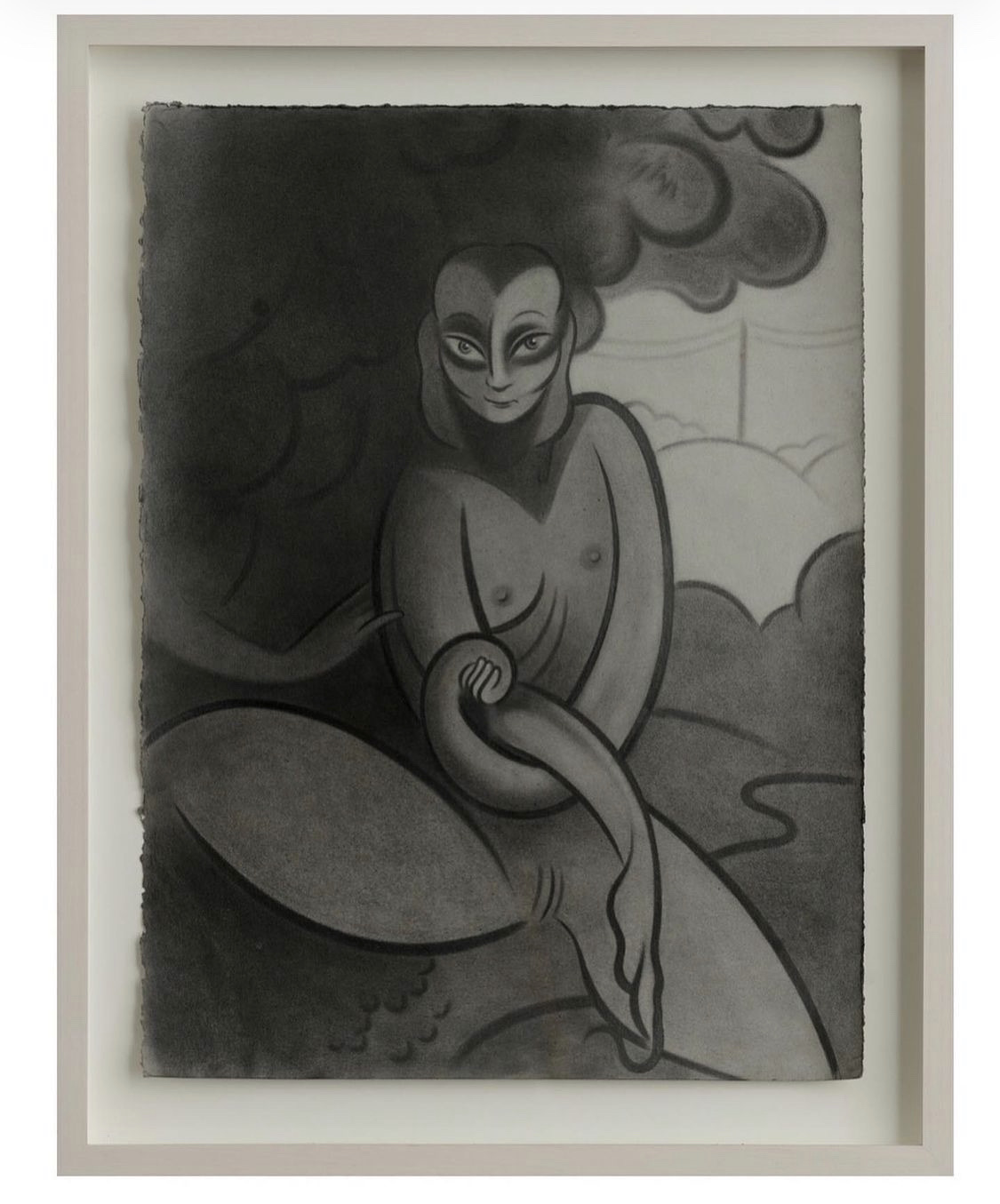
Her artistic development is rooted in drawing, and that foundation remains visible in everything she makes. The line in a Koak work is never decorative or incidental. It is load bearing, emotional, and alive. Her figures, elongated and expressive, seem to vibrate with an inner life that the flat color fields around them can barely contain.
Koak
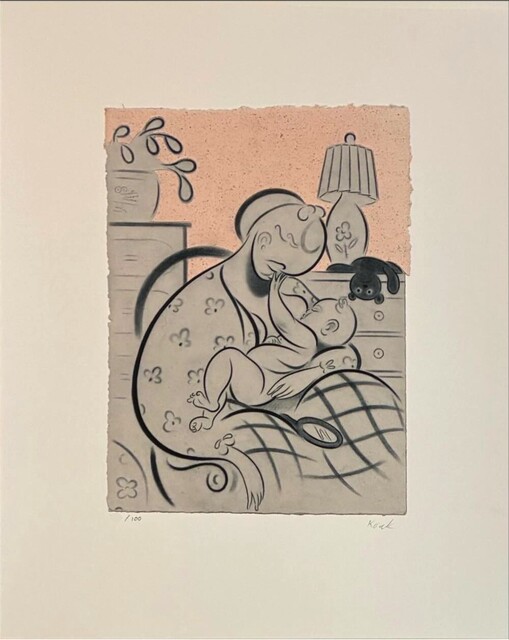
The Axis, 2022
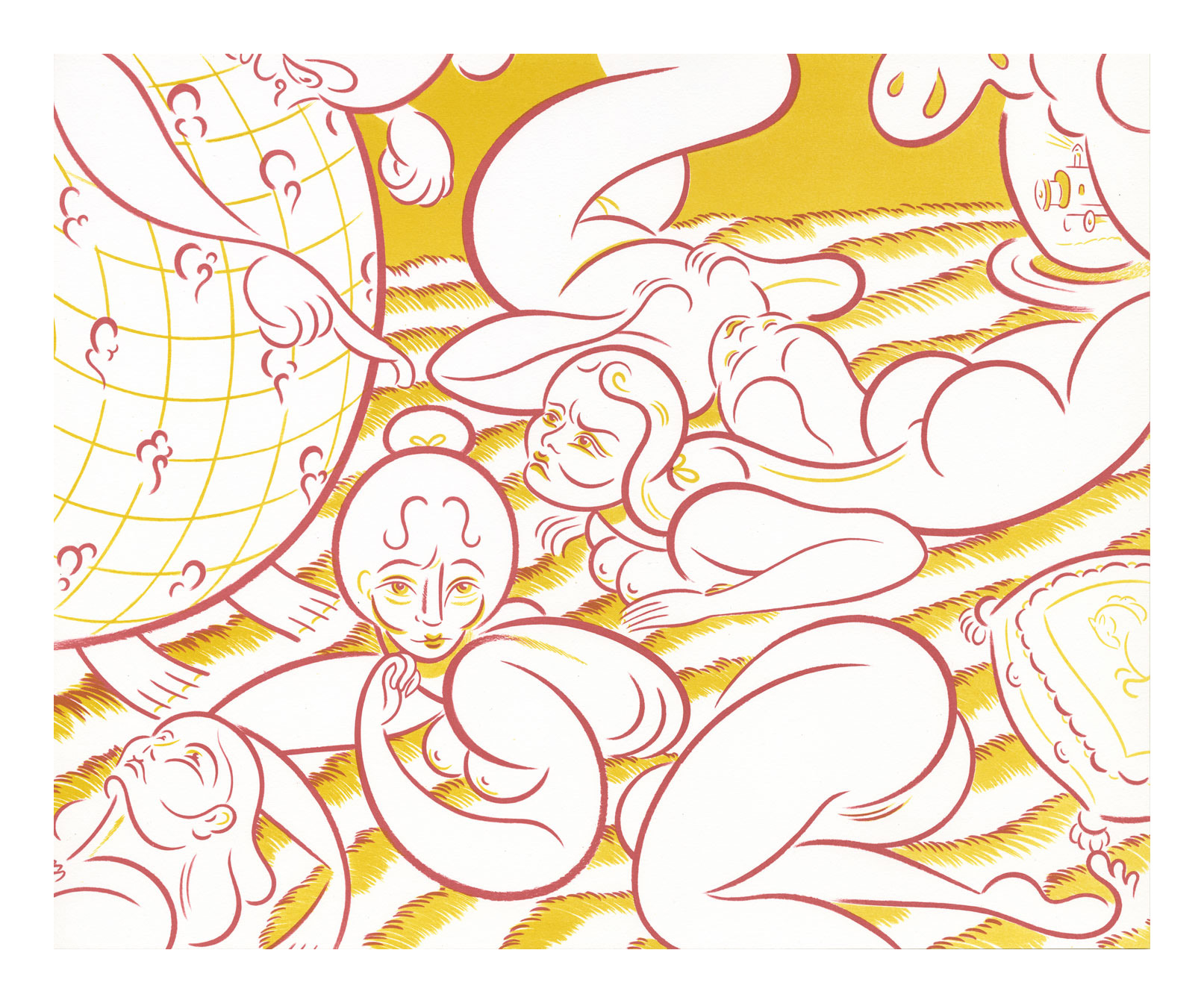
This tension between containment and overflow is one of the most compelling aspects of her practice. She has spoken about her deep engagement with the history of comics, and the influence is clear in the confident economy of her mark making, but she filters that influence through a sensibility attuned to fine art history, to the psychological intensity of artists like Egon Schiele and the flattened pictorial space of Japanese woodblock prints. Among her most discussed works are her lithographs, including the piece known as "The Naughty," which exemplifies her ability to charge a simple image with enormous psychological weight. Lithography suits her because the medium rewards directness and decisiveness.
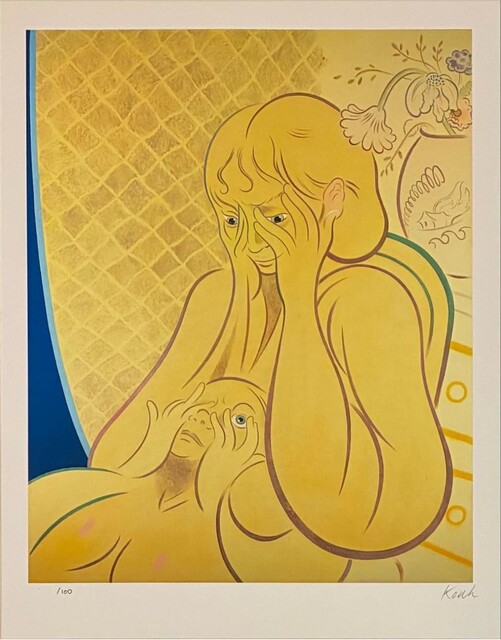
There is no hiding in a lithograph, and Koak does not hide. Her 2022 archival pigment prints, including "The Axis" and "Endless," produced on fine papers including Hahnemuhle photo rag and Moab Entrada Rag, show her bringing the same intensity to the printed image. These works on paper, whether charcoal drawings or editioned prints, demonstrate that Koak understands the intimacy of works that can be held, turned, and studied close. Her untitled charcoal and graphite drawings are particularly remarkable for the way raw material and finished image seem to arrive simultaneously.
Koak
Endless, 2022
The themes Koak returns to again and again are identity, femininity, desire, and psychological tension. These are not small subjects, and she does not treat them lightly. Her characters occupy ambiguous spaces, emotionally and physically. They are figures caught in the act of becoming, or perhaps in the act of resisting becoming.
There is humor in her work, a wry, knowing quality that prevents it from tipping into melodrama, but there is also genuine ache. This balance is difficult to achieve and rarer than it might seem. It places her in conversation with artists like Nicole Eisenman, whose figurative work similarly holds comedy and sorrow in productive suspension, and with the broader tradition of artists who have used the body as a site for thinking through social and psychological complexity. For collectors, Koak's work on paper and her editioned prints represent a compelling entry point into a practice that has appreciated steadily in critical esteem.
Koak
Untitled
Works on paper carry the directness of her hand and her thought process in a way that few mediums can match. Her prints on fine archival papers are produced with evident care for longevity and material quality, which matters enormously when considering a collection for the long term. The self published books that Koak has produced over the years are also worth seeking out. They function as both artist books and as repositories of her visual thinking, and they have become difficult to find as interest in her work has grown.
Koak's position in contemporary art is still being fully understood, which is part of what makes this moment so interesting for collectors and institutions paying attention. She sits at the intersection of several currents that define ambitious practice right now: the renewed seriousness around drawing, the critical reevaluation of figurative work, the embrace of publishing and multiples as legitimate artistic modes, and the growing recognition of artists who have built devoted audiences through persistence and vision rather than through institutional promotion alone. Her pseudonymous identity adds another layer of interest, reminding us that the work itself is the primary fact, and that biography, while useful, is not the whole story. What Koak offers, finally, is a body of work that rewards sustained looking and genuine feeling.
Her images do not resolve into simple meanings. They stay open, uncomfortable in the best sense, and generous in the way that only honest art can be. Collectors who live with her work report that it continues to reveal itself over time, that a drawing or print that seemed to be about one thing gradually discloses other possibilities. That quality of inexhaustibility is the mark of an artist working at the height of her powers, and it is the quality that ensures her place in the ongoing story of American art.