Kenny Scharf
Kenny Scharf Makes the Universe Smile
Artist Spotlight · The Collection Editorial
“I want my work to be fun and accessible, but also to have layers that reward deeper looking.”
Kenny Scharf
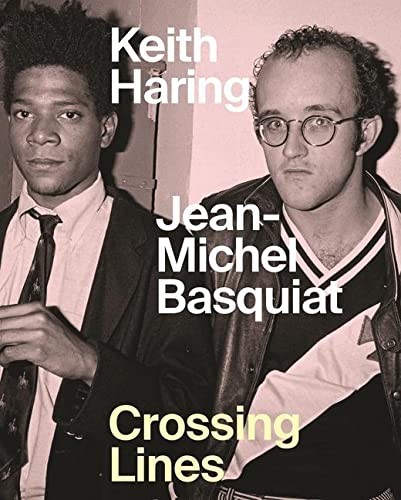
In 2023, Kenny Scharf brought his kaleidoscopic vision to the streets and galleries of Los Angeles with a renewed urgency, reminding a new generation that joy, ecological anxiety, and cosmic wonder can coexist on the same canvas. His long running public murals across Southern California continue to draw crowds, and his presence in major private collections alongside names like Keith Haring and Jean Michel Basquiat confirms what the art world has understood for decades: Scharf is not a footnote to the 1980s East Village explosion but one of its most enduring and relevant forces. At an age when many artists rest on established reputations, Scharf is still painting with the restless energy of someone who believes the world urgently needs more color, more creatures, and more laughter. Kenny Scharf was born in 1958 in Los Angeles, raised in the sun drenched sprawl of Southern California where television, science fiction, and the optimistic consumer culture of postwar America formed the raw material of his imagination.
Kenny Scharf
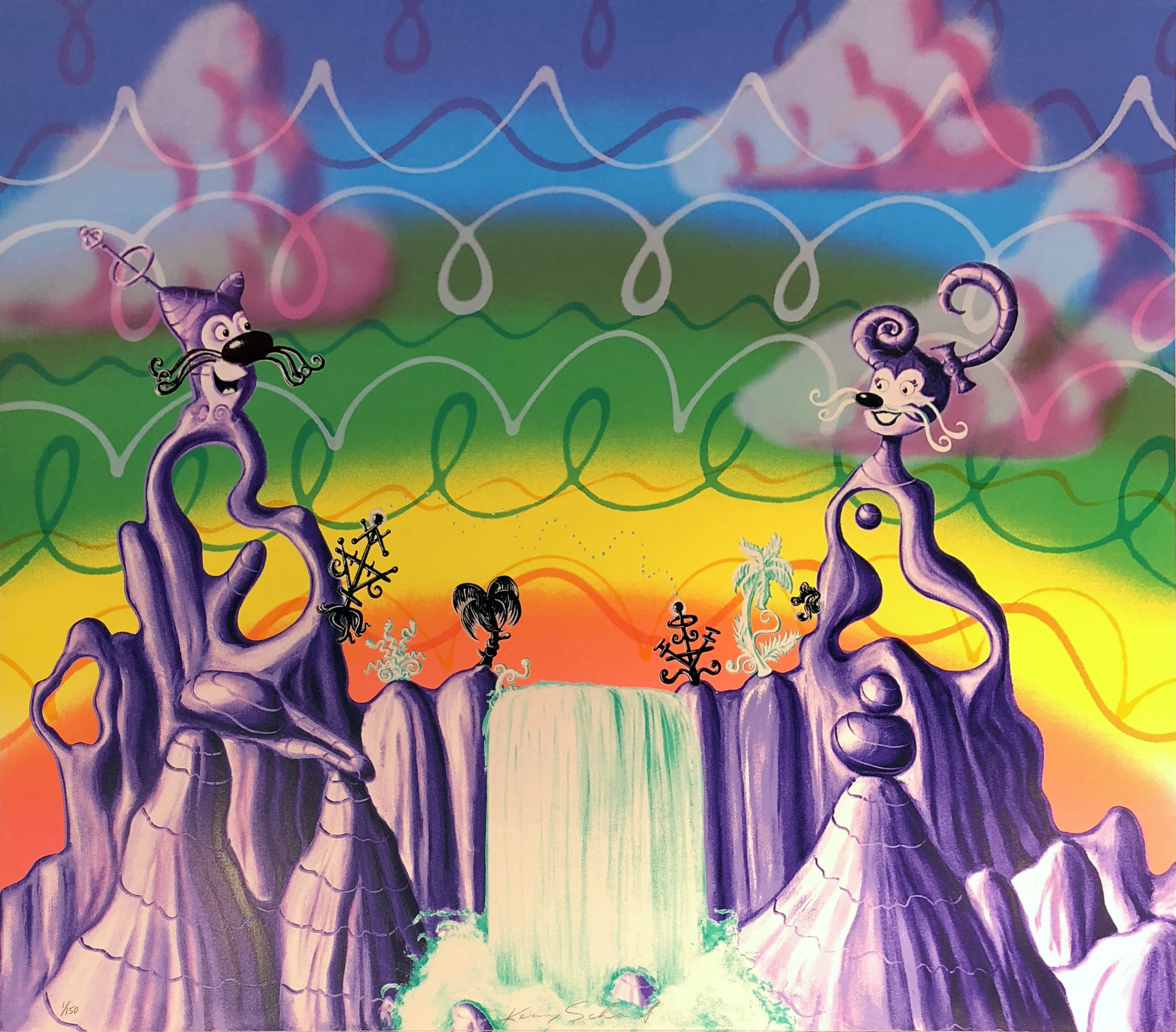
Aqua Pollination, 1988
He grew up watching Saturday morning cartoons and The Jetsons with the devotion of a student studying masterworks, absorbing the rounded forms and cheerful futurism that would later define his visual language. This was not passive consumption but a kind of artistic education, one that taught Scharf to see the mythologies embedded in popular culture long before academic theory gave that observation a name. In the late 1970s, Scharf made the pivotal move to New York City to study at the School of Visual Arts, arriving just as the downtown scene was crackling with creative electricity. He found his people quickly, sharing a dormitory room with Keith Haring and moving through the same clubs, galleries, and community spaces that were incubating one of the most exciting moments in American art history.
The Mudd Club, Club 57, and the informal galleries of the East Village became his classroom and his stage, places where the boundaries between fine art, performance, street culture, and nightlife dissolved entirely. It was an atmosphere that rewarded fearlessness and punished pretension, and Scharf thrived. His artistic development in the early 1980s was marked by a determination to bring the imagery of his California childhood into conversation with the rawness of New York street culture. While Haring developed his bold graphic vocabulary and Basquiat excavated history and language through frenzied mark making, Scharf carved out his own territory: a pop surrealist universe populated by blob like creatures, floating faces, Hanna Barbera inspired characters mutated by cosmic radiation and consumer excess.
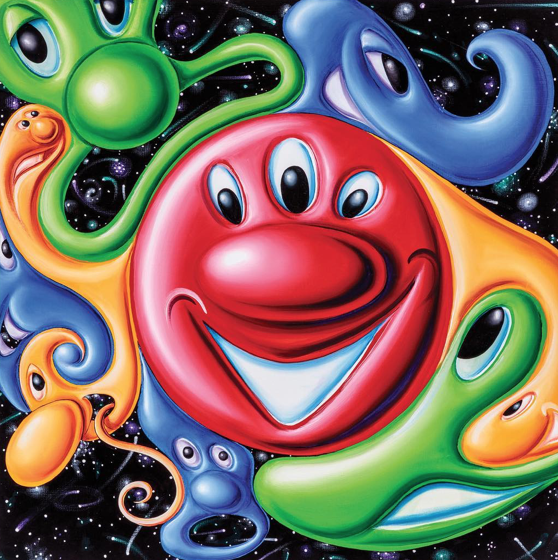
Kenny Scharf
Blobosistic, 2022
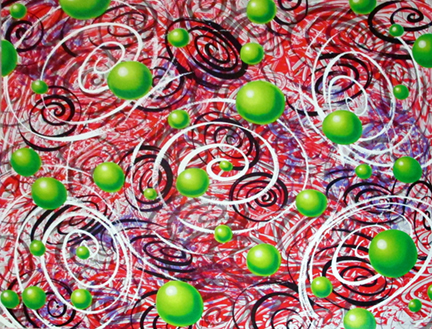
He began painting in the spaces between spaces, decorating the interiors of closets in friends' apartments in elaborate, immersive installations he called Cosmic Caverns, environments that enveloped visitors in glowing, densely layered worlds. These installations demonstrated from the very beginning that Scharf thought in three dimensions as naturally as he thought on canvas. The works available to collectors today span an impressive range of periods and media, offering a genuine window into the full arc of his practice. Screenprints from the late 1980s and early 1990s, including Spaceballs from 1990, Acid Rain from 1988, and Aqua Pollination from 1988, capture Scharf at the height of his commercial and critical momentum, their flat colors and dense compositions translating the energy of his paintings into multiples that remain highly sought after.
The title Acid Rain is not merely decorative but reflects a genuine ecological consciousness that Scharf brought to his work long before environmental anxiety became a dominant cultural theme. Later paintings such as Zentrum from 2005 in oil on canvas and Energala from 2013 in oil and acrylic on linen reveal a mature painter whose formal command has only deepened with time, the compositions more complex, the surface more richly worked. Recent prints like Paradis Perdu from 2022 and Blobosistic from 2022 demonstrate that his engagement with new printmaking technologies is as enthusiastic as his embrace of the streets. For collectors, Scharf occupies an unusually attractive position in the market.
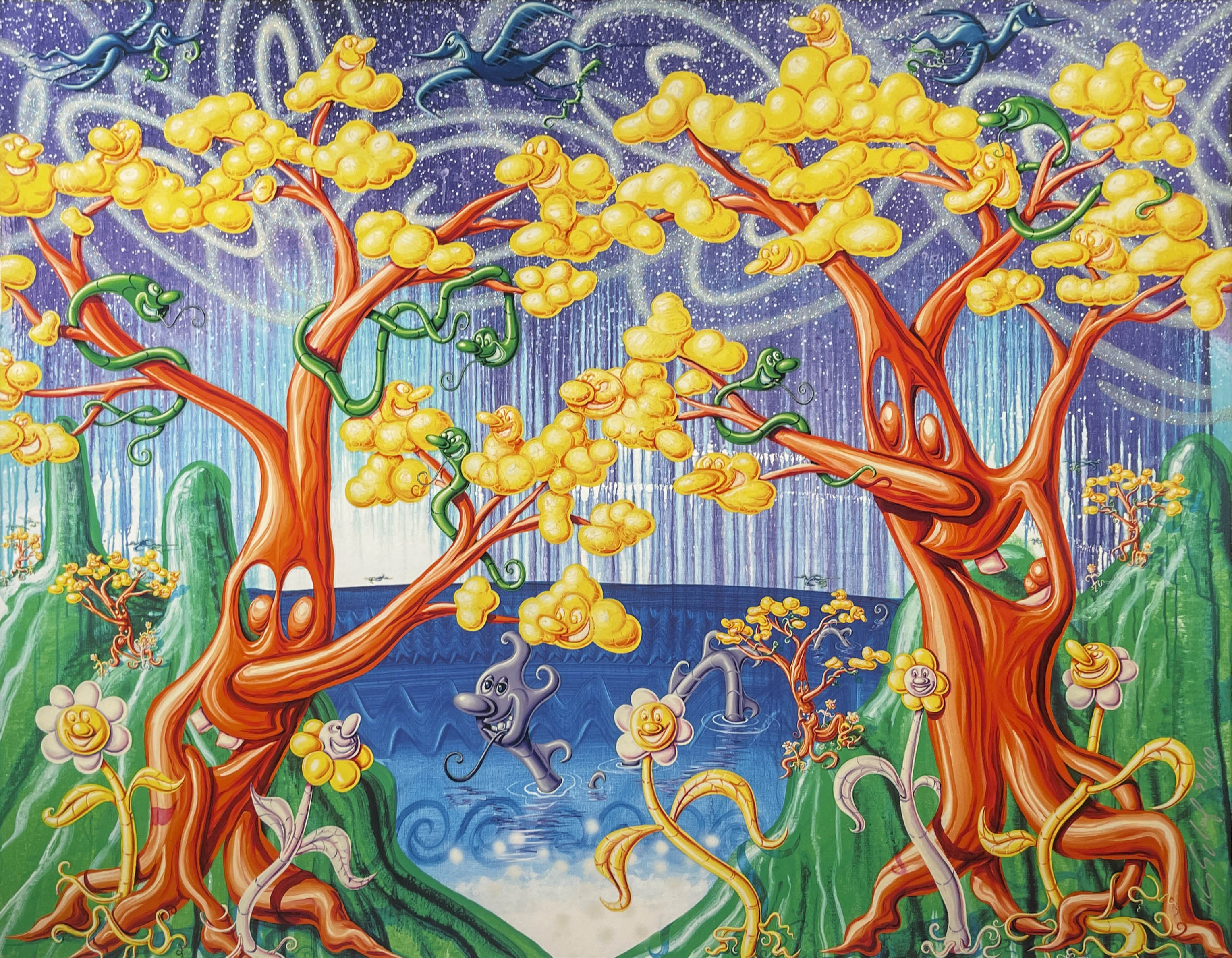
Kenny Scharf
Paradis Perdu, 2022
He is firmly established as a blue chip name whose association with Haring and Basquiat lends him significant art historical context, yet his works across various media offer entry points at a range of price levels that more rarefied names do not. His paintings have appeared consistently at major auction houses including Christie's, Sotheby's, and Phillips, with strong results that reflect sustained institutional and private demand. Collectors who came to him through his screenprints have often moved into acquiring his paintings as their understanding of his practice deepens, a natural progression that speaks to the coherence and richness of his overall vision. Works in the artist's own custom frames, as with Zentrum and Placadezz from 1997, carry an additional layer of provenance and intentionality that serious collectors rightly prize.
Within the broader narrative of art history, Scharf sits at a genuinely productive crossroads. He shares the neo expressionist energy of his generation with figures like Jean Michel Basquiat and Keith Haring while drawing on the legacy of Pop Art, specifically the way Andy Warhol and Roy Lichtenstein elevated the vernacular imagery of consumer culture into the domain of serious aesthetic inquiry. At the same time, his commitment to public art and mural work connects him to a tradition of democratic image making that predates the gallery system entirely. Contemporary artists working in pop inflected or street adjacent modes, from KAWS to Takashi Murakami, owe a visible debt to the generation Scharf helped define, even as Scharf himself remains distinctly irreducible to any single influence or category.
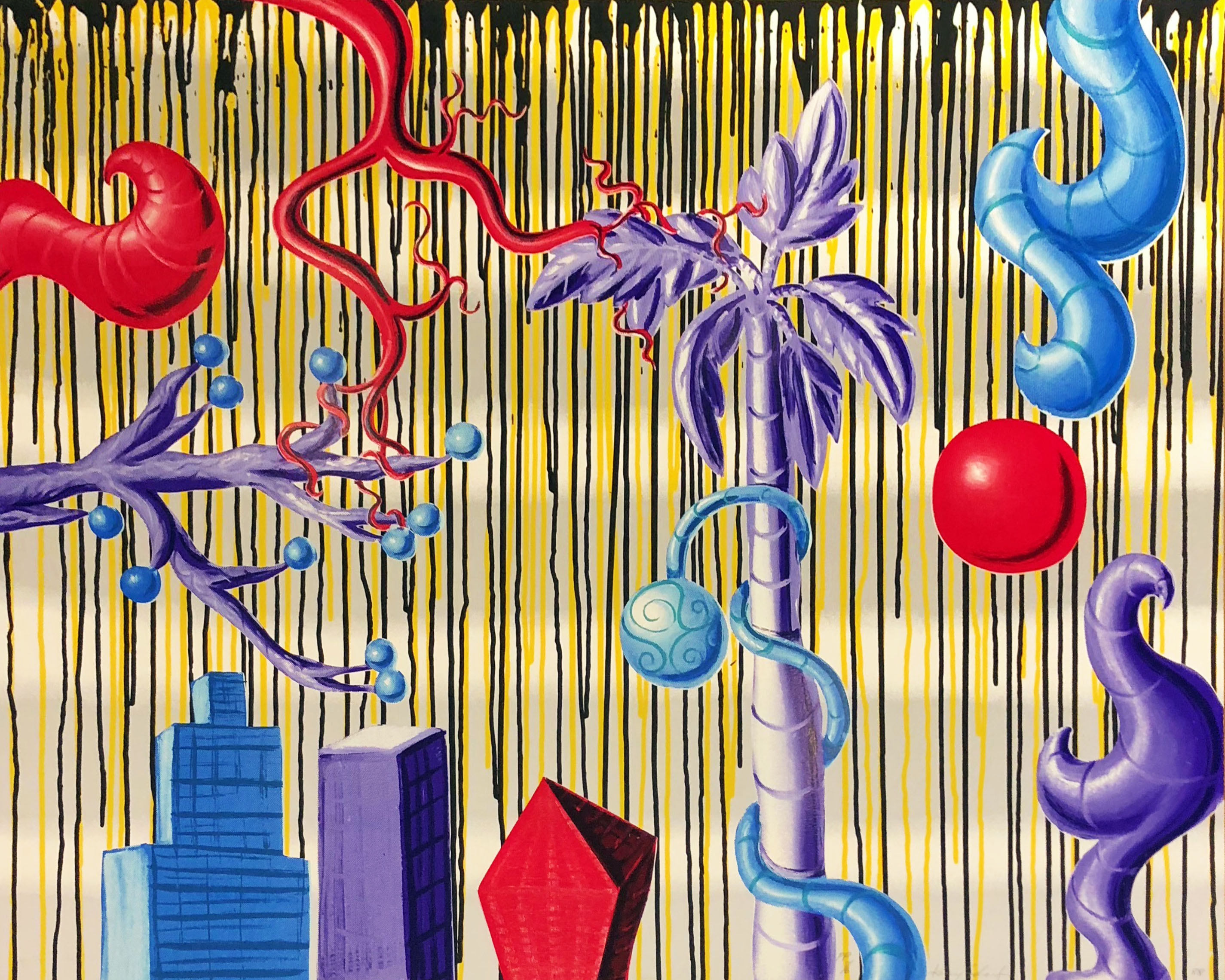
Kenny Scharf
Acid Rain, 1988
What makes Kenny Scharf matter today, perhaps more than anything, is his insistence that art can be simultaneously serious and joyful, politically aware and visually delightful, personal and utterly accessible. In an art world that sometimes mistakes difficulty for depth, his work is a generous and necessary counterargument. The creatures that populate his canvases and walls are not merely decorations but inhabitants of a cosmology, one in which humanity's excesses and its capacity for wonder are held in constant, luminous tension. To collect Scharf is to bring that cosmology into your home and to align yourself with one of the most consistently vital artistic imaginations of the past half century.
Explore books about Kenny Scharf