Ken Price
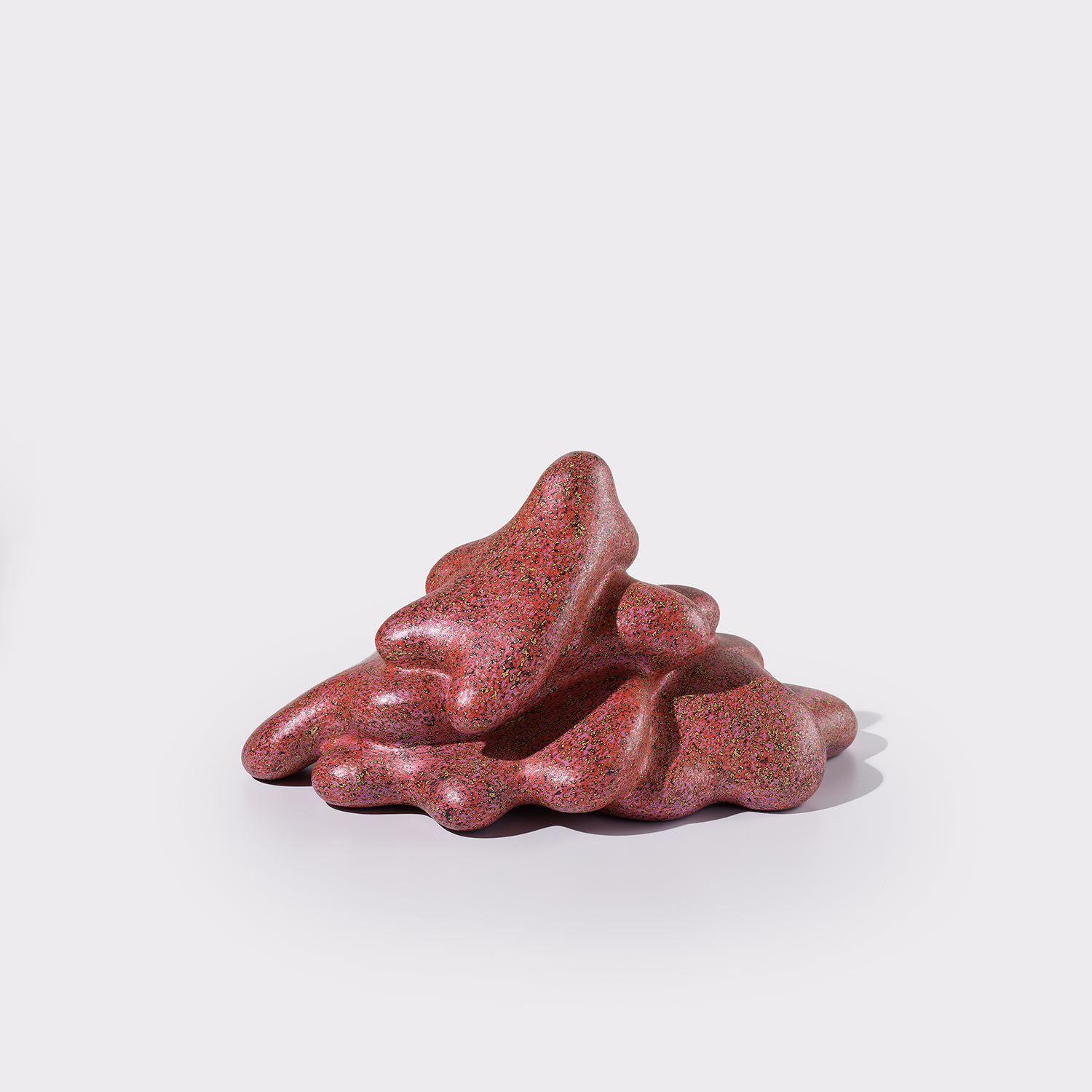
Ken Price: Ceramics Burning With Brilliant Life
Artist Spotlight · The Collection Editorial
“I want the work to have a life of its own, to exist as an independent object in the world.”
Ken Price, interview with Paul Karlstrom, Archives of American Art, 1998
When the Los Angeles County Museum of Art mounted its landmark retrospective of Ken Price's work in 2012, the art world was given a rare and overdue reckoning with one of the most quietly radical careers in postwar American art. The exhibition traveled to the Metropolitan Museum of Art in New York, bringing Price's luminous ceramic sculptures before an audience that had long sensed his importance but perhaps not fully absorbed the scale of his achievement. Price passed away that same year, and the retrospective became both a celebration and a farewell, confirming what his most devoted admirers had always understood: that he had spent five decades building a body of work unlike anything else in the history of American art. Ken Price was born in Los Angeles in 1935, and the city shaped him in ways both obvious and subtle.
Ken Price
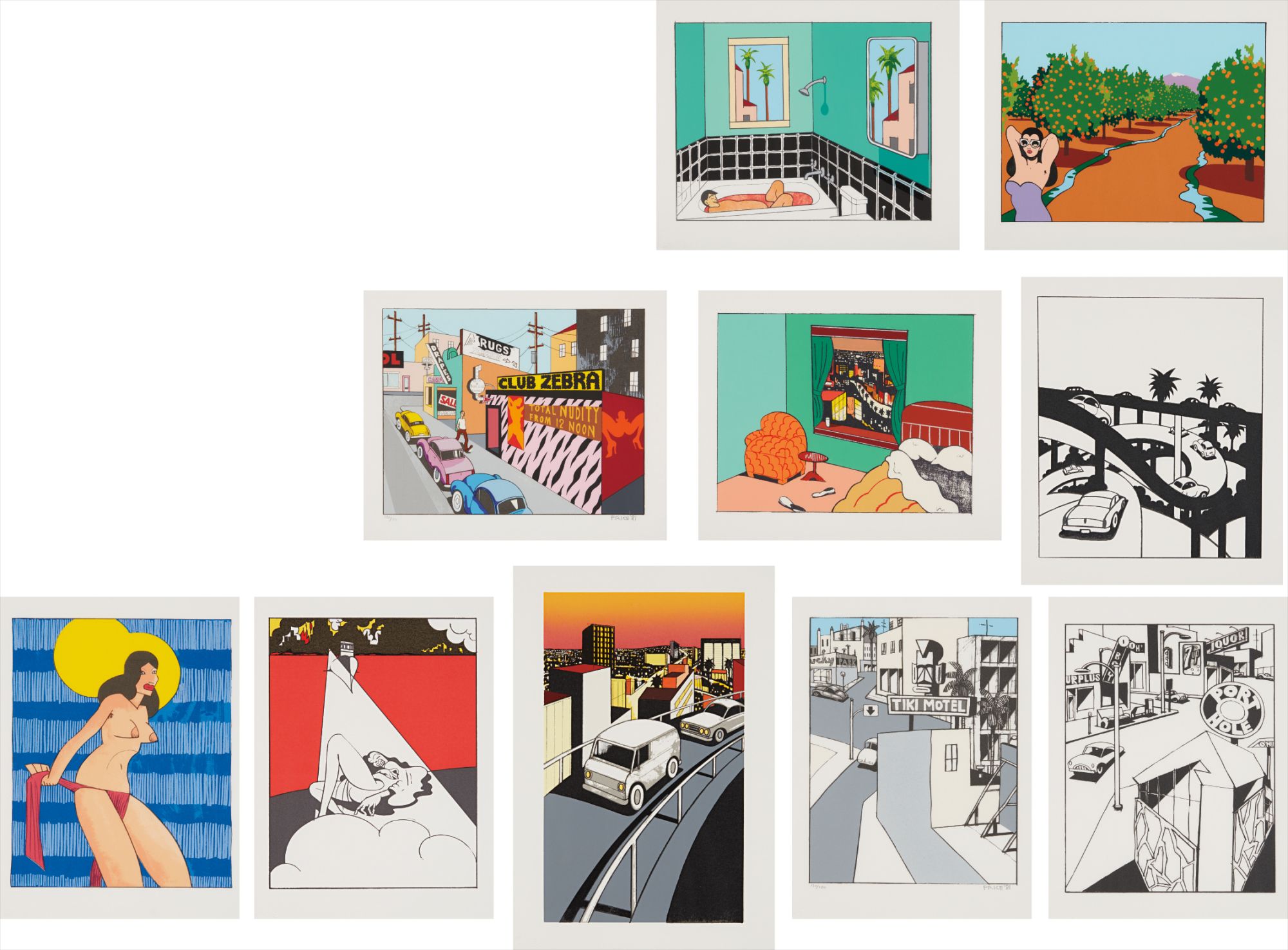
The Plain of Smokes
He came of age in a postwar Southern California that was inventing itself in real time, a place where fine art, car culture, surf culture, and a particular brand of sun bleached freedom were all colliding and cross pollinating. He studied at the Chouinard Art Institute and later at the University of Southern California, before completing his MFA at the New York State College of Ceramics at Alfred University in 1959. Alfred was the crucible of serious ceramic education in America, and Price arrived there already inclined toward the medium but left with a genuine technical mastery and a set of conceptual questions that would fuel his practice for the rest of his life. Returning to Los Angeles in the early 1960s, Price found himself embedded in one of the most generative artistic communities the city has ever produced.
He became close with Ed Ruscha, Billy Al Bengston, Larry Bell, and Robert Irwin, a group of artists who were collectively dismantling inherited ideas about what West Coast art could be. Price shared with these peers a love of sleek surfaces, vivid color, and the visual language of commercial and popular culture, but he was drawn to something more tactile and more intimate than the cool, flat vocabularies of hard edge painting or early conceptualism. Clay gave him what paint on canvas could not: an object you could hold, a form with interior space, a thing that existed fully in the world rather than on a wall. Price's early work in the 1960s introduced the cup as his primary formal unit, a choice that seemed almost perversely modest in an era of monumental ambition.
Ken Price
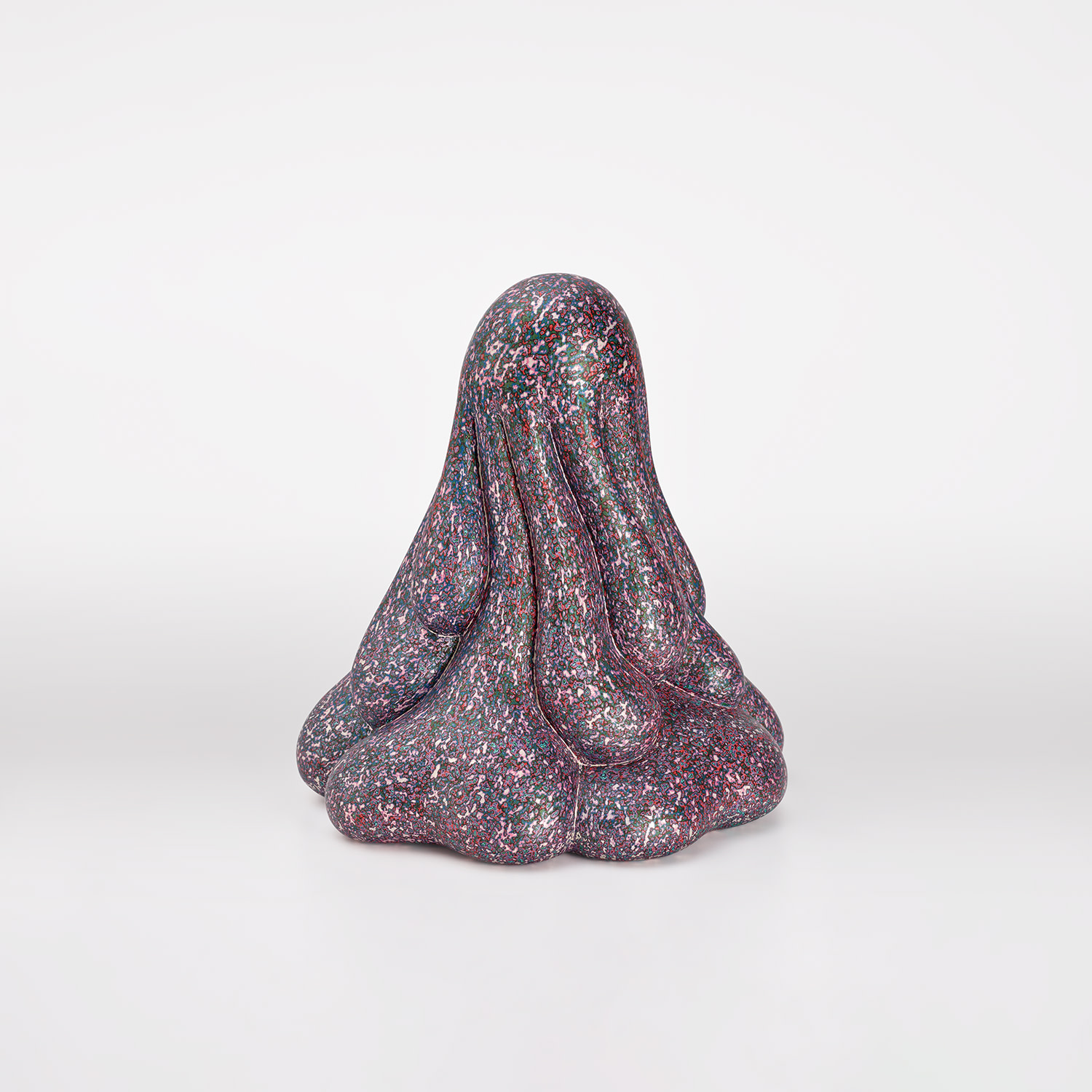
Zazz, 2004
But the cups were a provocation as much as a form. They sat at the exact boundary between functional craft and autonomous sculpture, forcing viewers and critics to decide which category applied and then questioning why the distinction mattered. Over the following decades Price expanded and mutated this vocabulary, moving from relatively contained cup forms toward increasingly biomorphic, organic shapes that seemed to pulse with inner life. He worked slowly and with extraordinary care, building up forms in clay, firing them, and then applying layer after layer of brilliantly colored acrylic paint before sanding back the surfaces to reveal a depth and luminosity that felt almost geological, as if the color existed beneath the surface rather than on top of it.
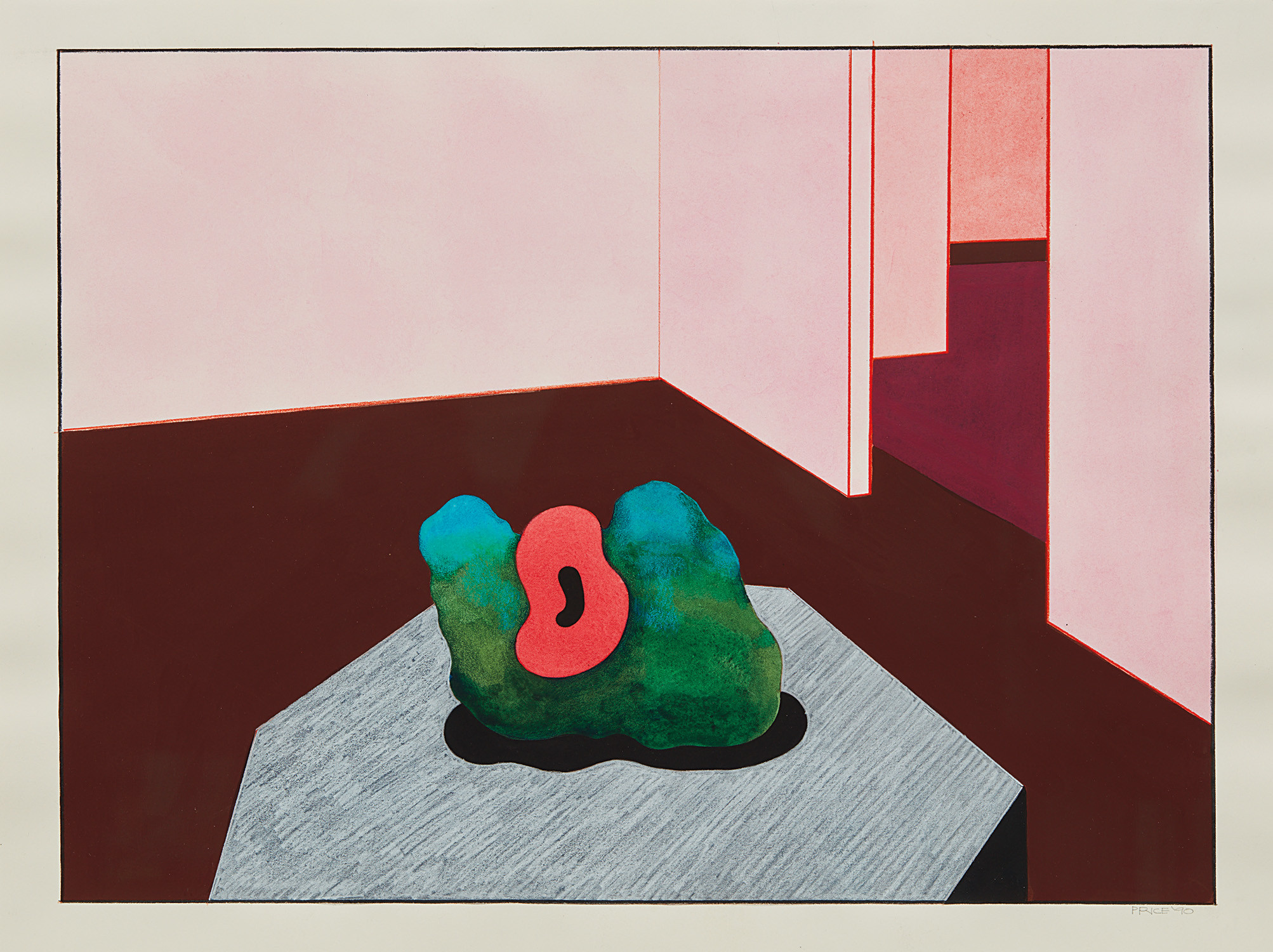
Among the works that best illuminate his achievement are the fired and painted clay sculptures of the 2000s, including pieces like "Zazz" from 2004 and "Lower" from 2006, which represent Price at the height of his formal confidence. These works are simultaneously ancient and futuristic, evoking organic life forms, geological specimens, and objects from some unnamed civilization all at once. His works on paper, including the acrylic and ink compositions like "Interior with Sculpture" from 1990 and "Vulcan Island," reveal a parallel practice that was no less inventive, combining precise draftsmanship with saturated fields of color to document imagined spaces where his sculptures might live. The portfolio "The Plain of Smokes," a collaborative publication produced with Arabesque Books in Santa Barbara, shows his ease with the print medium and his appetite for ambitious, carefully produced editions.
Ken Price
Lower, 2006
Even a work like "Bloodshot" from 1986, with its acid hued surface and almost alien materiality, demonstrates how consistently Price pushed the emotional register of ceramic art far beyond anything the medium had attempted before. For collectors, Price's work occupies a position that has become increasingly rare: genuinely innovative, materially exceptional, and still carrying something of the surprise it delivered when it was first made. His sculptures demand close attention. The surfaces reward sustained looking, and the forms carry a psychological charge that photographs rarely convey fully.
Collectors who have lived with Price's work tend to describe it in unusually personal terms, noting how the pieces seem to shift in different lights, how their oddness becomes familiar and then deeply pleasurable over time. At auction, Price's ceramics have commanded significant prices, with major sculptures regularly appearing at Christie's, Sotheby's, and Phillips, where they attract both institutional and private buyers who understand that his output was never large and his finest pieces appear infrequently. Works on paper and prints offer a compelling entry point for collectors building relationships with his practice, while the sculptures represent some of the most considered investments available in postwar American art. Price belongs to a lineage that connects American ceramics to the broader history of postwar sculpture, with meaningful parallels to the work of Peter Voulkos, his teacher and a foundational figure in elevating ceramic art in America.
Ken Price
Interior with Sculpture, 1990
But Price's sensibility was always more controlled, more ironic, and more visually refined than Voulkos's gestural expressionism. In the international context, his work resonates with the organic sculptural traditions of artists like Jean Arp and Constantin Brancusi, while his use of industrial color and pop cultural awareness aligns him with contemporaries in both the Los Angeles and New York scenes. He is a figure who belonged fully to his time and place while transcending both. The legacy of Ken Price continues to grow with each passing year, as younger generations of artists working with ceramics and sculpture discover in his practice a model of uncompromising ambition and genuine strangeness.
Museums from Los Angeles to New York hold his work in their permanent collections, and his influence on the current renaissance of ceramic art as a serious sculptural medium is difficult to overstate. He demonstrated that slowness, craft, and intimacy of scale were not limitations but sources of tremendous power. In a cultural moment that continues to reward spectacle and scale, Price's quietly luminous objects feel more necessary than ever, a reminder that the most radical acts in art are often performed at the size of something you could hold in your hands.
Explore books about Ken Price
Ken Price: A Retrospective
Hal Foster, Paul Schimmel
Ken Price: Sculpture 1959-1977
James Monte
Ken Price: Happy's Curios
Paul Schimmel
Ken Price: Sculpture and Drawings
Michael Darling

Ken Price: Ceramics
Craig R. Morey