Kelley Walker
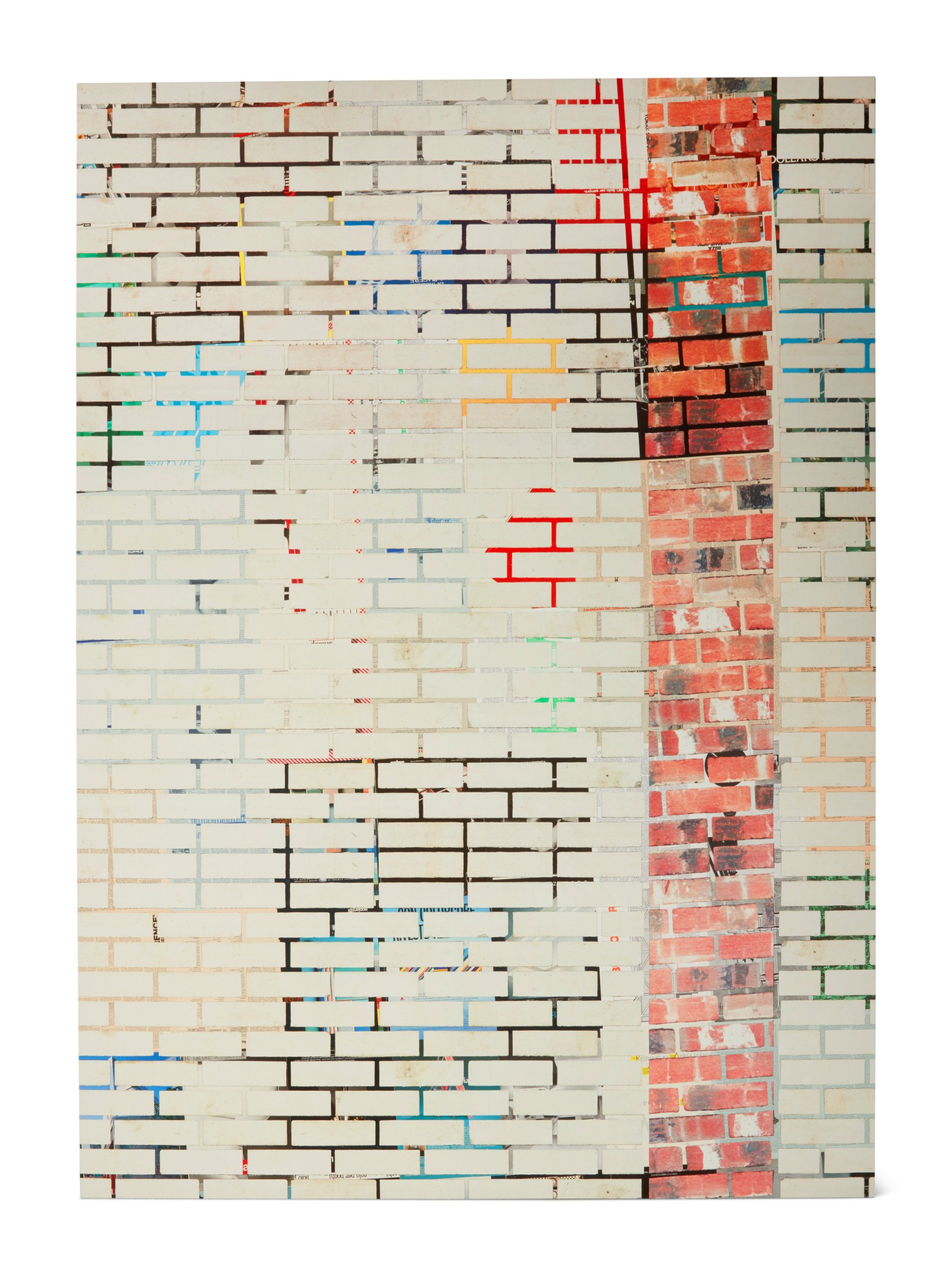
Kelley Walker Remixes the American Visual Dream
Artist Spotlight · The Collection Editorial
“I don't escape the effects of branding but think of the processes associated with appropriation as a way of dealing with branding as a social space.”
Kelley Walker
When the Whitney Museum presented Kelley Walker's work to its New York audience, the rooms hummed with a particular kind of productive unease. Here was an artist who had taken the slickest surfaces of American consumer culture and subjected them to processes of accumulation, distortion, and material transformation that left viewers simultaneously recognizing everything and understanding nothing in the way they once had. Walker's practice sits at the intersection of painting, sculpture, and conceptual provocation, and his presence in major institutional collections confirms what close observers of the contemporary art world have understood for some time: his is one of the most searching and formally rigorous bodies of work to emerge from American art in the past three decades. Born in 1969, Kelley Walker came of age in an America saturated with television advertising, mass print media, and the visual grammar of brand identity.
Kelley Walker
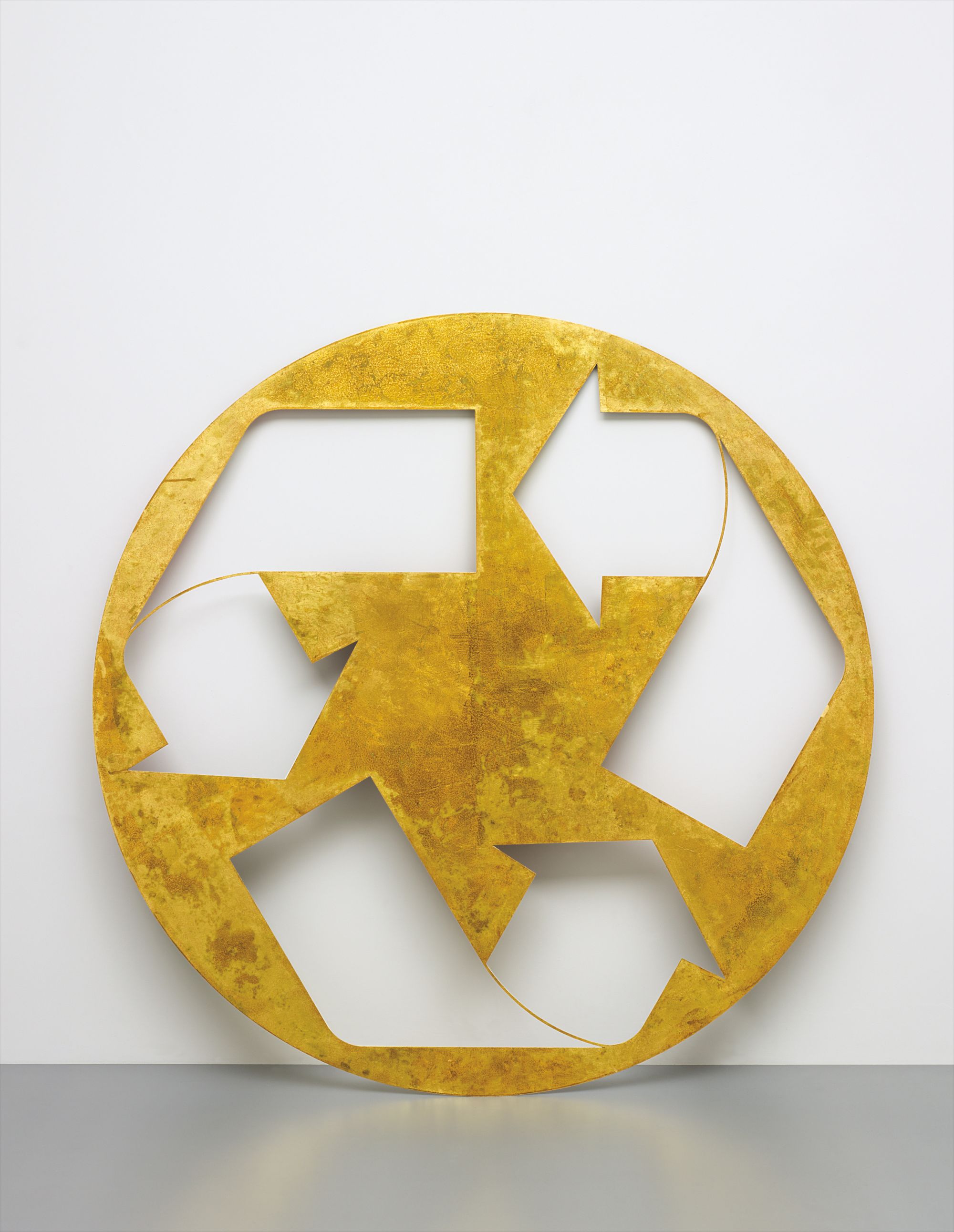
gold leaf, digital print on laser cut steel
That particular cultural formation shaped a generation of artists who understood images not as neutral carriers of meaning but as objects with histories, politics, and social weight. Walker absorbed these influences and developed a practice rooted in the idea that appropriation is not simply a formal strategy but a way of inhabiting and interrogating the cultural landscape. He began working seriously as an artist in the 1990s, a period when the legacy of Pop Art, Pictures Generation conceptualism, and the theoretical frameworks of postmodernism were all available as resources, and Walker drew on each of them with genuine intellectual seriousness. His artistic development accelerated in the early 2000s when he began producing the works that would define his reputation.
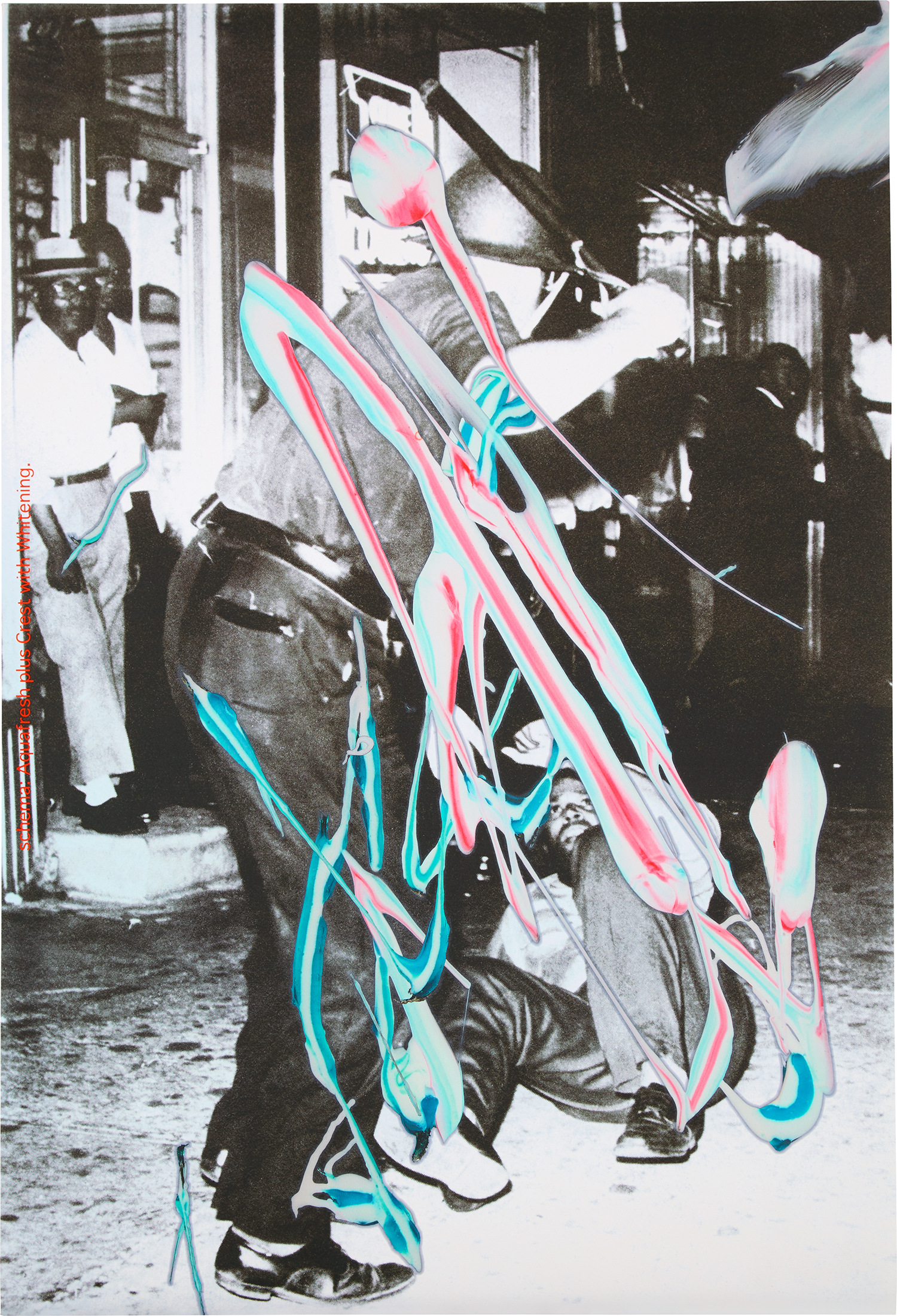
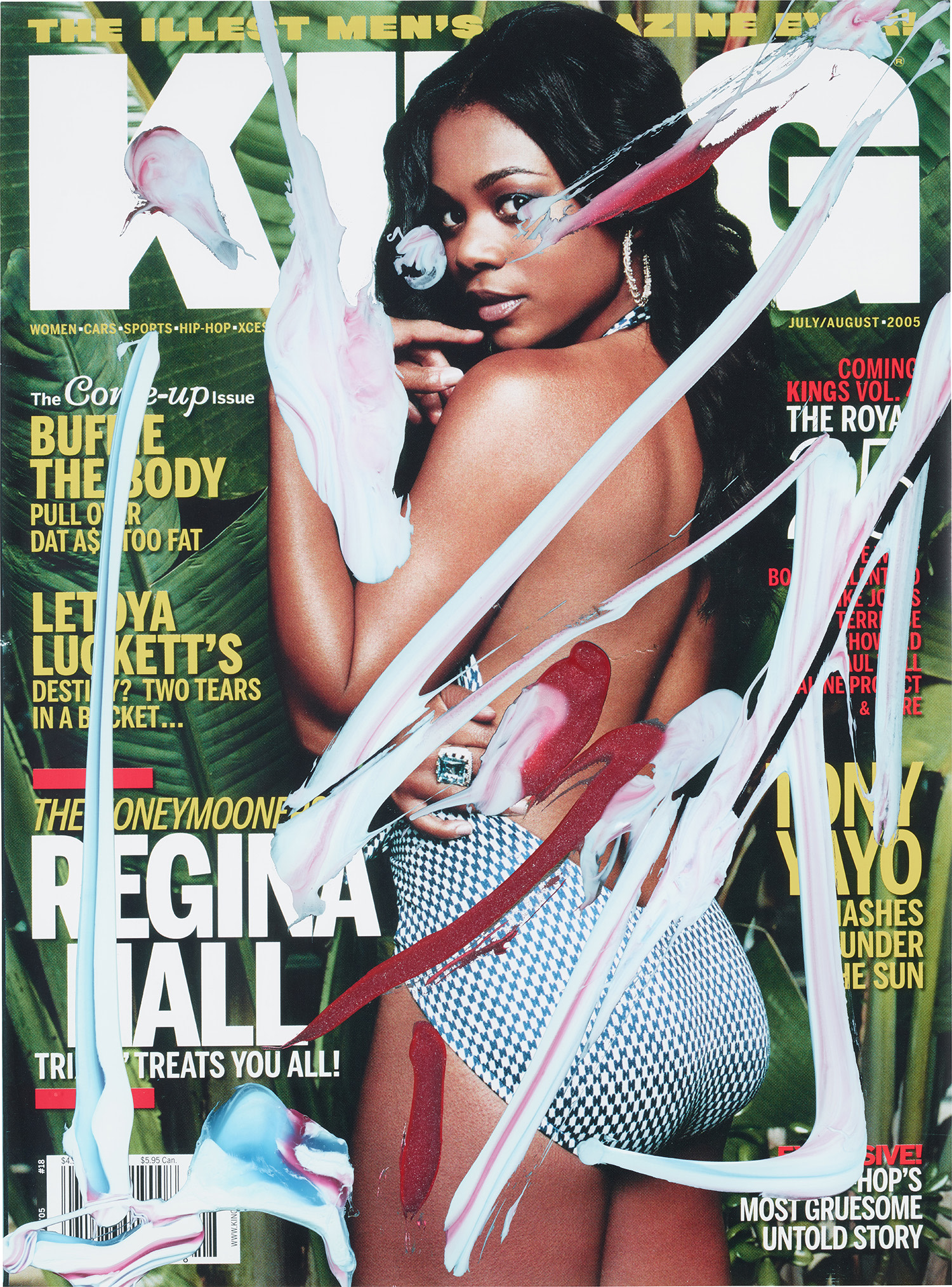
Walker started applying chocolate and toothpaste directly to printed canvases, pouring and spreading these everyday substances over appropriated imagery drawn from news photographs, advertising campaigns, and mass media archives. The gesture was formally audacious and conceptually dense: the materials carried their own brand identities, their own consumer associations, and their physical presence on the surface of the work created a dialogue between the image underneath and the substance on top. These were paintings that thought about their own conditions of production, about what it means to put one thing on top of another, to cover, to obscure, to transform. Among the works that best illuminate Walker's practice is the series of schema works that began around 2002, including schema; Aquafresh plus Crest with Whitening (riot) and subsequent iterations through 2003 and 2006.
Kelley Walker
schema; Aquafresh plus Crest with Whitening (riot), 2002
These pieces layer toothpaste brand identity directly onto appropriated imagery with a precision that makes their conceptual argument legible without reducing it to illustration. The Red Coconut Chandelier from 2006, constructed from coconuts, light bulbs, electrical wiring, and enamel spray paint, demonstrates Walker's equal command of three dimensional work. It is at once beautiful, absurd, and loaded with references to colonial commodity chains and the aestheticization of the exotic. Similarly, the Marantz Model 6300 with Yellow Stripe from 2004 takes the language of consumer electronics and subjects it to the same scrutiny Walker applies to food and hygiene products, finding in the designed object a record of cultural aspiration and social desire.
His works on laser cut polished stainless steel, including digital prints mounted on that industrial material, bring a gleaming, almost seductive finish to imagery that carries entirely different social connotations, creating a friction that is central to his method. Walker has exhibited at Kunsthalle Zürich and MoMA PS1 alongside the Whitney, institutions that recognized early the intellectual seriousness behind what might at first appear to be formally playful gestures. His gallery relationships have brought his work into sustained critical dialogue with peers including Wade Guyton and Tauba Auerbach, artists who share his interest in digital reproduction, the properties of printed surfaces, and the relationship between original and copy. Within a broader art historical frame, Walker's practice extends conversations begun by Andy Warhol and the Pictures Generation, particularly artists like Richard Prince and Barbara Kruger, who also understood that American visual culture was both the subject matter and the medium.
Kelley Walker
Schema; Aquafresh plus Crest with Whitening Expressions (Regina Hall), 2006
Walker's contribution is to push that inheritance toward a more explicitly material register, insisting that the substances applied to or used in constructing his works carry meaning as surely as the images themselves. From a collecting perspective, Walker's work offers both formal richness and sustained conceptual reward. The silkscreen, collage, and acrylic works on canvas, such as the 2009 piece whose title begins with the phrase about appropriating material from the public domain, are exemplary objects: they function as paintings in the fullest sense while simultaneously operating as arguments about what painting can be and what it costs to make images in a branded world. Collectors drawn to the Pictures Generation will find in Walker a natural extension of that lineage into the digital and post digital present.
The steel based works in particular have attracted serious attention for their combination of technical precision and conceptual ambition, and the relative intimacy of some formats, including circular laser cut stainless steel works at 24 inches in diameter, makes them accessible entry points into a practice that also encompasses much larger installations. What makes Walker's work durable and important is precisely its refusal to simplify the questions it raises. He does not offer critique as a form of comfort or appropriation as mere aesthetic cleverness. Instead, he constructs objects and images that hold multiple, sometimes contradictory possibilities open simultaneously.
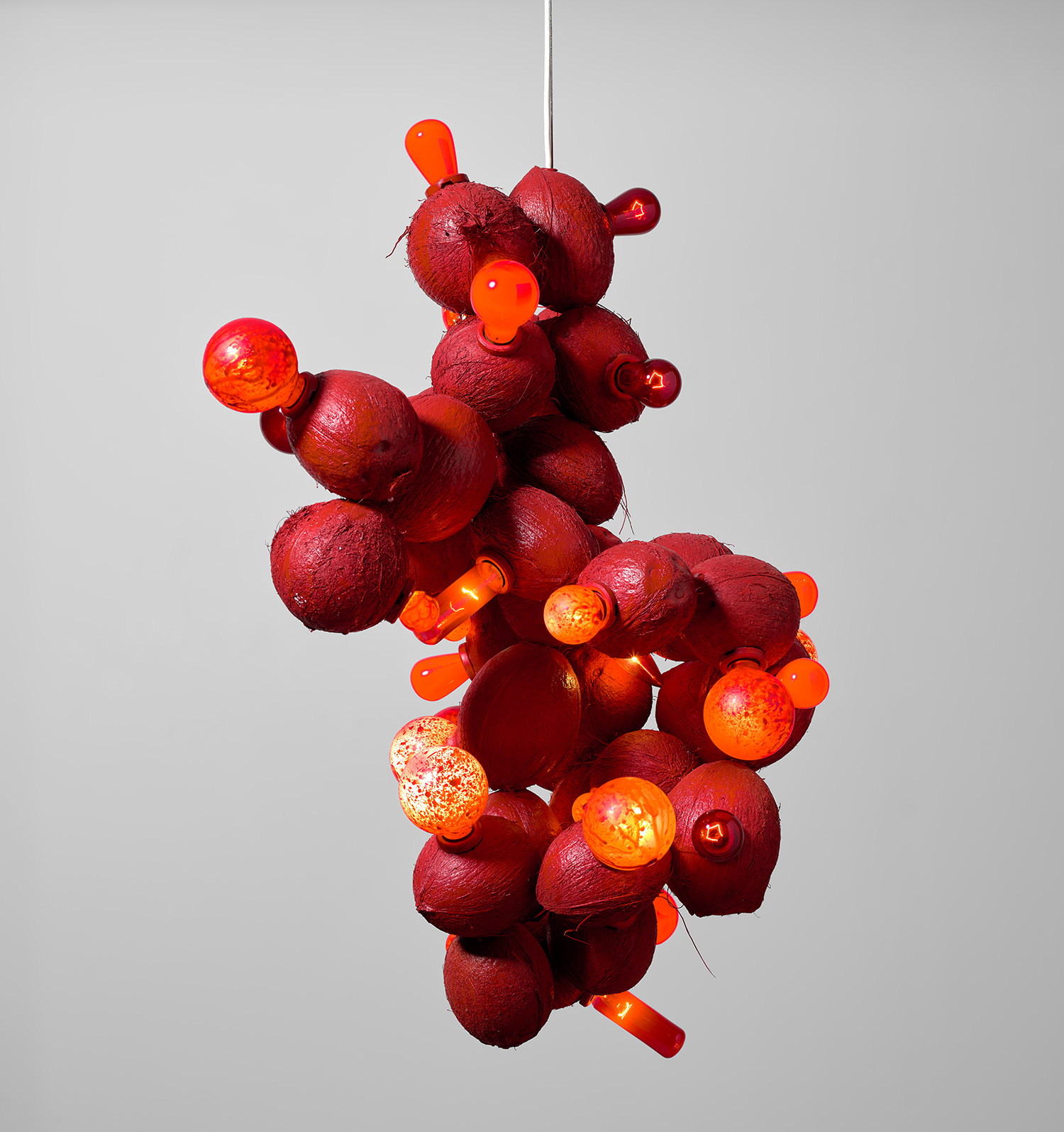
Kelley Walker
Red Coconut Chandelier, 2006
Race, consumerism, and the mechanics of American visual culture are not backdrop in his work but its very substance. Each canvas, each sculpture, each polished steel surface is a proposition about how images circulate, what they carry, and what happens when materials associated with the domestic and the quotidian encounter the grammar of fine art. That proposition remains as timely and as challenging as when Walker first articulated it, and the institutions and collectors who have gathered his work around them are participants in a conversation that shows no sign of exhausting itself.