Kees Van Dongen
Van Dongen: The Painter Paris Could Not Resist
Artist Spotlight · The Collection Editorial
“I paint women because they are the most beautiful things in the world.”
Kees Van Dongen
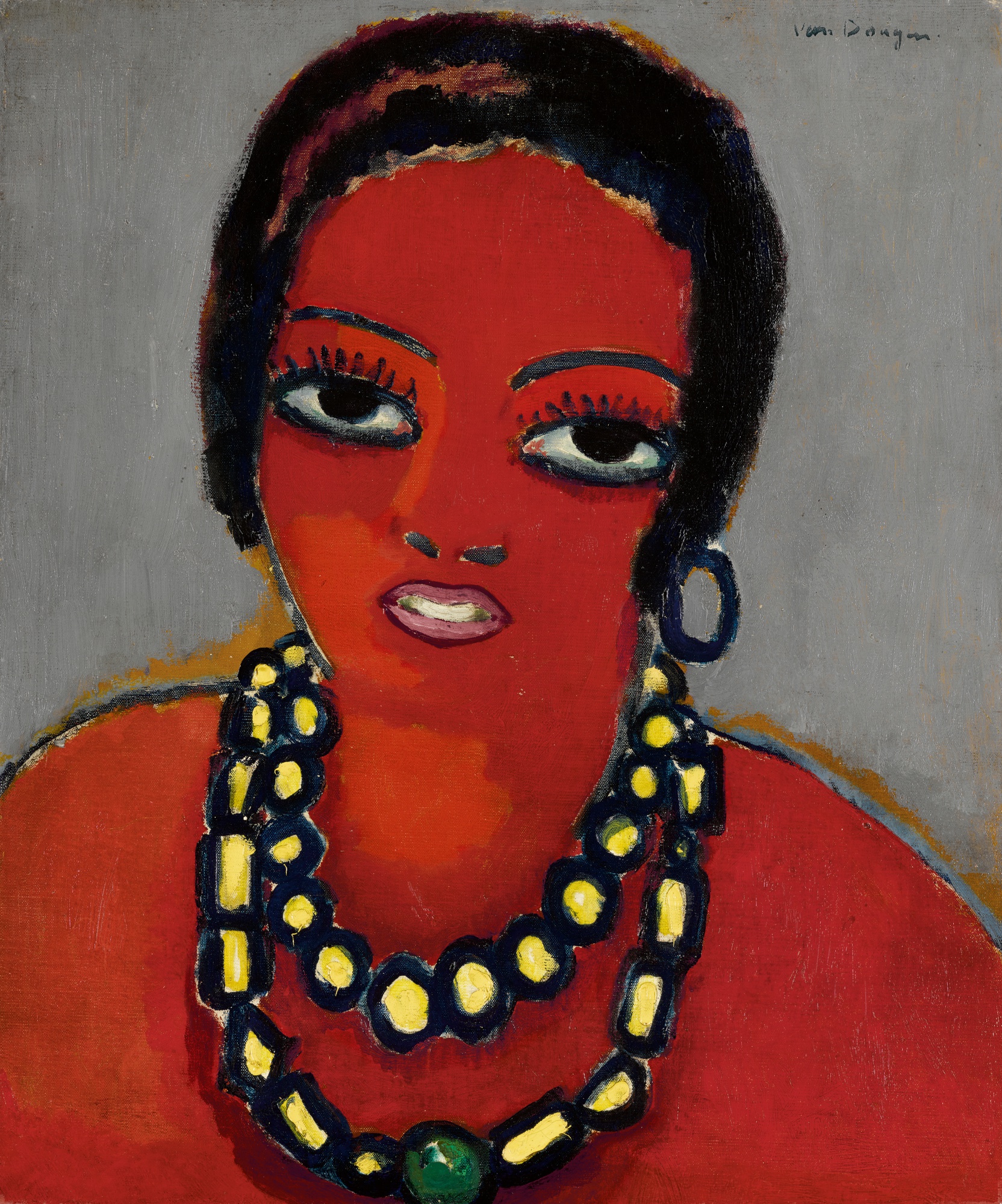
There is a moment, standing before a Van Dongen portrait at the Musée d'Art Moderne de la Ville de Paris, when the subject seems to look back with an almost unbearable self possession. The eyes are enormous, outlined in black, lit from within by some private amusement. The skin glows in hues no human face has ever actually worn: cadmium orange, rose madder, a green shadow at the jaw. Kees Van Dongen did not paint people so much as he conjured them, distilling personality into pure chromatic force.
Decades after his death in 1968, his portraits remain among the most electrically alive images the twentieth century produced. Cornelis Theodorus Marie van Dongen was born in 1877 in Delfshaven, a working port district near Rotterdam that was still independent enough in spirit to feel a world apart from the polished canals of Amsterdam. His father ran a malt factory, and the family was solidly bourgeois, but Dongen showed from childhood an attraction to the margins, to the dockworkers, the fairground performers, the sailors passing through. He enrolled at the Academie van Beeldende Kunsten en Technische Wetenschappen in Rotterdam in 1892, receiving a rigorous classical training that he would spend the rest of his life gleefully subverting.
In 1897, at twenty years old, he made the move that would define him: he arrived in Paris with almost no money and an absolute certainty that the city was where he belonged. Paris in the late 1890s was precisely the environment a young painter with a taste for nocturnal energy and a gift for caricature could flourish. Van Dongen settled in Montmartre, contributing illustrations to satirical publications including the anarchist journal L'Assiette au Beurre, and absorbing everything the city offered. He shared the cramped communal studios of the Bateau Lavoir alongside Pablo Picasso, Juan Gris, and a rotating cast of poets, dealers, and dreamers.
It was in this hothouse atmosphere that his painting began its decisive transformation. Exposure to the Post Impressionists, and particularly to the explosive liberation of color in the work of Paul Gauguin and Vincent van Gogh, both of whom he knew through exhibitions and reproductions, gave Dongen permission to push further than academic convention had allowed. The breakthrough came publicly in 1905 at the legendary Salon d'Automne, where Van Dongen exhibited alongside Henri Matisse, André Derain, Maurice de Vlaminck, and Albert Marquet. The critic Louis Vauxcelles famously described the gallery as a cage of wild beasts, and the name Fauvism was born.
Van Dongen was a full and committed member of this circle, but his particular contribution to the movement was singular. Where Matisse sought harmony and Derain pursued monumental structure, Van Dongen was drawn irresistibly toward figures, toward the human face, and toward the charged social world of cabarets, circuses, and ballrooms. He began exhibiting with the Galerie Vollard and later with the pioneering dealer Paul Cassirer in Germany, quickly building a reputation that extended well beyond Paris. His signature works from the first two decades of the twentieth century represent some of the most dazzling portraiture in modern art.
Canvases such as Anita the Spanish Dancer from 1910 and the many luminous portraits of women at leisure or at performance demonstrate his mastery of a specific formal device: the face and figure rendered with graphic boldness against backgrounds that flatten and intensify, borrowing from Japanese woodblock prints, from poster art, and from his own illustration work. The eyes in his portraits became his trademark, large and darkly accented, suggesting both vulnerability and power. He was equally capable of tenderness and provocation, and the best of his work holds both qualities in precise, unresolved tension. His 1913 portrait known as Femme au grand chapeau is an object lesson in how much psychological complexity a painter can pack into a single composition.
Collectors and dealers recognized Van Dongen's gifts early. By the 1910s and 1920s he had become genuinely fashionable, a status that brought its own complications but also brought remarkable patrons. His studio and his lavish parties became central fixtures of Parisian social life, and he moved with ease among aristocrats, film stars, and industrialists, painting them all with the same unflinching, affectionate intensity. At auction, his works now command significant attention in the international market.
Major canvases have achieved prices in the millions of euros and dollars at houses including Christie's, Sotheby's, and Bonhams, with particularly strong results for his Fauvist period works and his portraits of women from the 1900s through the 1930s. Collectors pursuing his work should attend to the quality of the drawing underlying the color, to the characteristic treatment of eyes and lips, and to the provenance of works from his most productive Paris decades. To understand Van Dongen fully is to understand the broader constellation of artists who defined the first half of the twentieth century. His closest formal and temperamental kinship was with the other Fauves, particularly Matisse and Derain, but collectors and curators have long noted his connections to Expressionism as practiced by the German Die Brücke group, which also claimed him briefly as a member when he exhibited with them in 1908.
There are also productive comparisons to be made with Amedeo Modigliani, whose elongated, psychologically intense portraits share much of Van Dongen's sensibility, and with Raoul Dufy, another painter who found in modern Parisian pleasure a subject worthy of serious chromatic investigation. Van Dongen occupies a space where hedonism and formal rigor coexist, where the social surface of modern life becomes the vehicle for genuine feeling. The legacy of Kees Van Dongen is one that continues to deepen as the twentieth century recedes into history and its achievements become clearer. He lived to ninety one years old, long enough to see his early radical work canonized and his later society portraits reassessed as something more than mere glamour.
His influence on fashion illustration, on graphic design, on the visual language of modernity itself, is pervasive in ways that are not always directly credited. For anyone building a collection that takes seriously the chromatic revolutions of the early twentieth century, Van Dongen is not a footnote but a central chapter: a painter who looked at the world with enormous eyes and painted it back in colors that still, more than a century later, refuse to be anything other than alive.
Explore books about Kees Van Dongen
Kees van Dongen: A Life
Pierre Courthion
Van Dongen
Jean Cassou
Kees van Dongen: Catalogue Raisonné of the Oil Paintings
Jacques Validire and Alexis Demeyer
Van Dongen: His Life and Work
Louis Chaumeil

Kees van Dongen 1877-1968
Museum of Modern Art

Van Dongen: Passion and Provocation
Elizabeth Easton
Kees van Dongen: Master of Color
Marina Ferretti Bocquillon