Kazuo Shiraga
Kazuo Shiraga: Power, Grace, and Pure Gesture
Artist Spotlight · The Collection Editorial
“I want to act more intuitively, more violently, and with greater concentration than ever.”
Gutai manifesto era writings, circa 1955
There is a photograph that stops you cold. A man suspended from a rope above a canvas spread across the studio floor, his body coiled and airborne, feet carving great arcs through thick pools of oil paint. It is not performance, exactly, and it is not painting in any conventional sense. It is something older and more primal, something that speaks directly to the body before the mind has time to intervene.
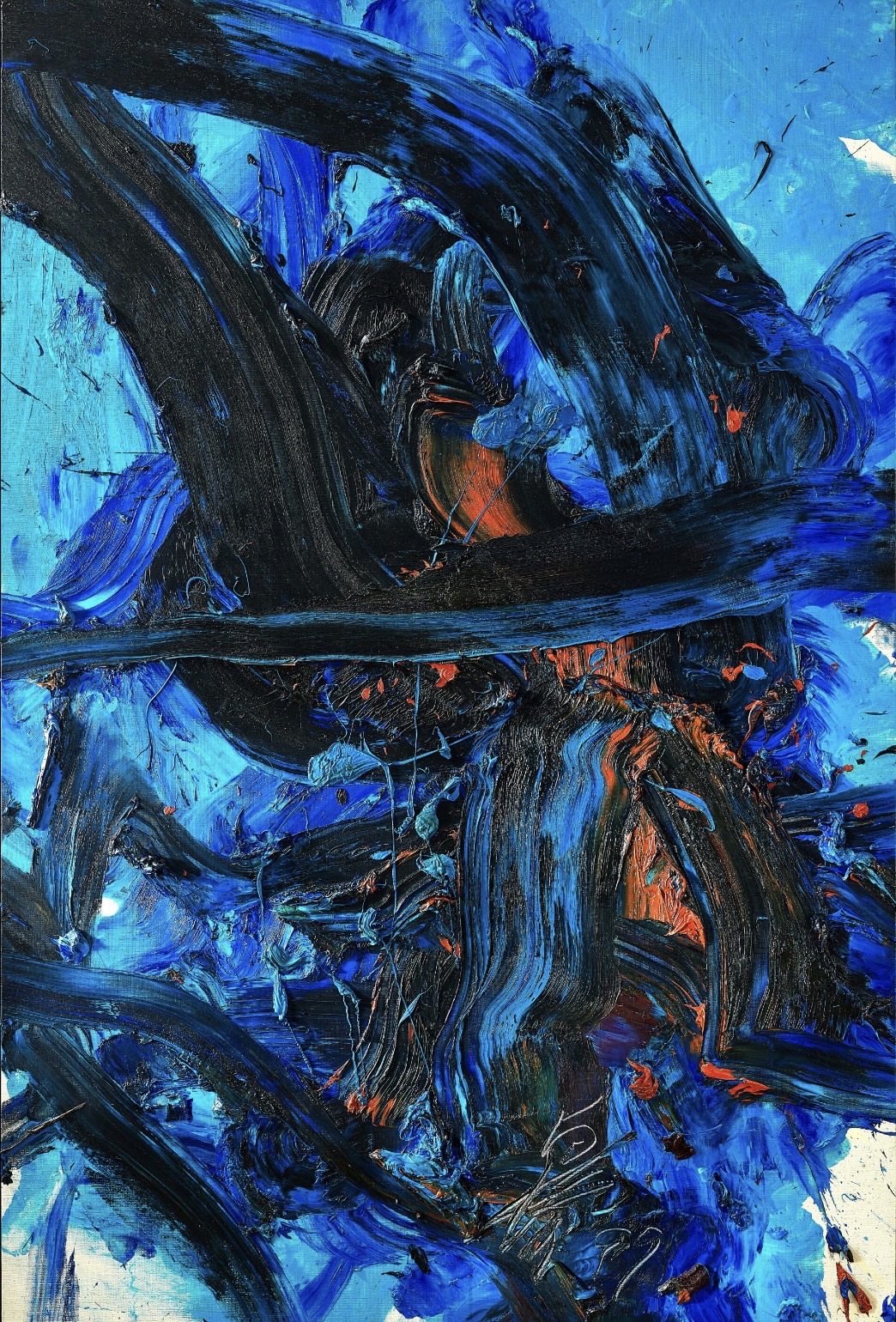
Kazuo Shiraga
Kaien, 1999
This is Kazuo Shiraga at work, and more than six decades after he first lowered himself into that charged space between artist and material, the world is still catching up to what he understood. Shiraga was born in 1924 in Amagasaki, in the Hyogo Prefecture of Japan, and came of age during a period of extraordinary national upheaval. He studied nihonga, traditional Japanese painting, at the Kyoto Municipal School of Arts and Crafts and later at the Kyoto City University of Arts. But the postwar moment in Japan was hungry for rupture, for ways of making that could hold the weight of a civilization that had been broken apart and was being remade from scratch.
Shiraga found his people in 1954, when he became a founding member of the Gutai Art Association in Osaka, the radical collective organized by Jiro Yoshihara whose central directive was simple and almost impossibly demanding: do what no one has done before. The Gutai group, whose name translates roughly as "embodiment" or "concrete," positioned the artist's body as the primary instrument of creation. Where European informalism and American Abstract Expressionism were arriving at gestural abstraction through the wrist and the brush, Gutai was pushing further, insisting that the whole self be implicated in the act of making. Shiraga took this philosophy to its most literal and astonishing conclusion.
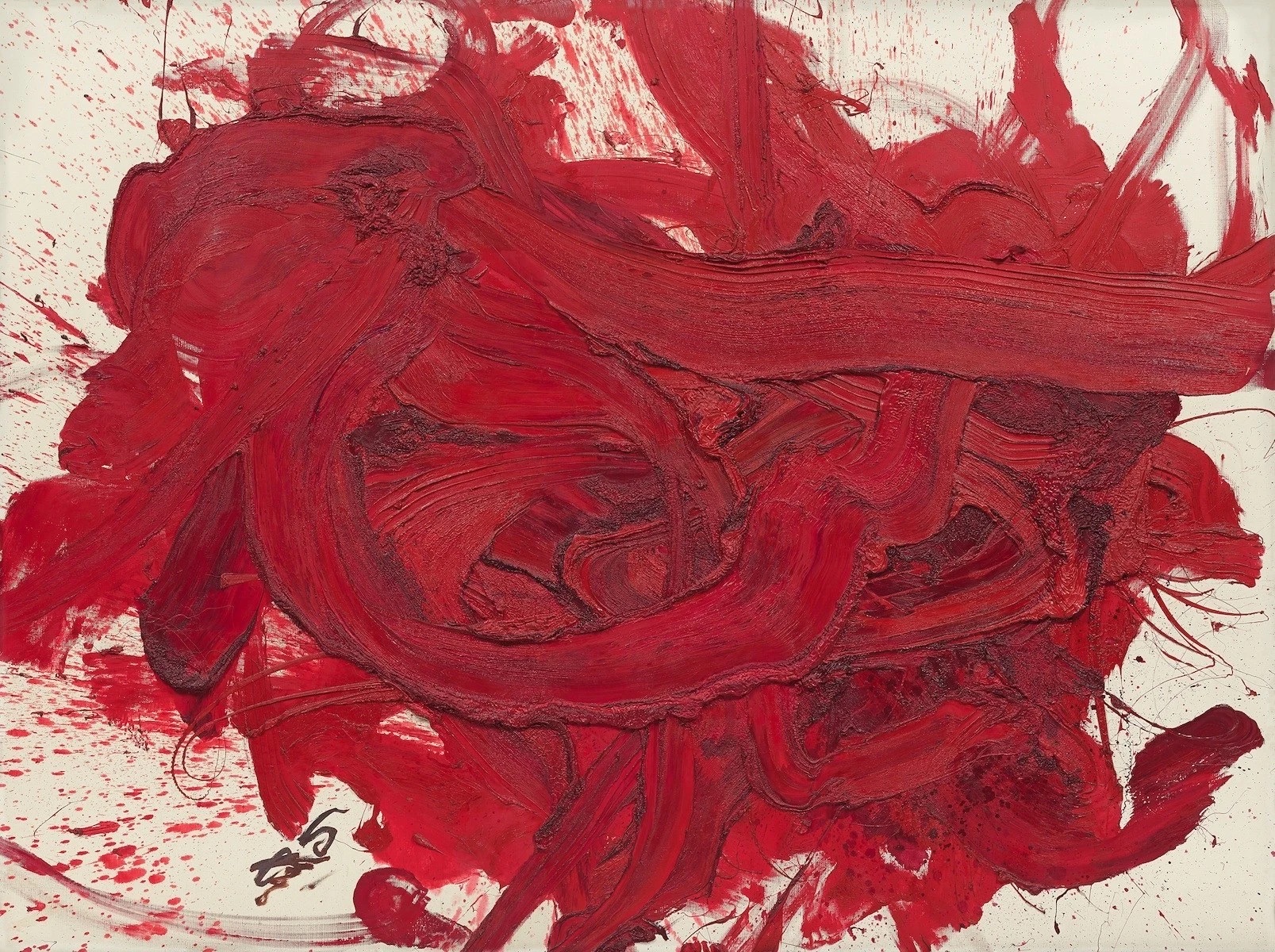
Kazuo Shiraga
Untitled
In 1955, he abandoned brushes entirely and began using his feet. He would hang from a rope suspended from the studio ceiling, swinging and plunging into paint spread across large canvases on the floor, using his entire weight and momentum to drag, smear, and sculpt color into forms of breathtaking energy. The works that emerged were not illustrations of movement; they were movement itself, preserved. Through the late 1950s and into the 1960s, Shiraga refined and deepened this practice, producing canvases of extraordinary visceral force.
Works from this period, including the remarkable T52 from 1962 and the related Untitled (T41) from the same year, reveal the full range of what his method could achieve. The paint is thick, almost topographical, built into ridges and valleys that record the exact pressure and trajectory of his body. There is nothing accidental about these surfaces; Shiraga was an exceptionally skilled craftsman of chaos, someone who understood the physics of his own body with the precision of a dancer or an athlete. His palette in this period tended toward deep reds, blacks, and earthy ochres, colors that carry both heat and gravity.
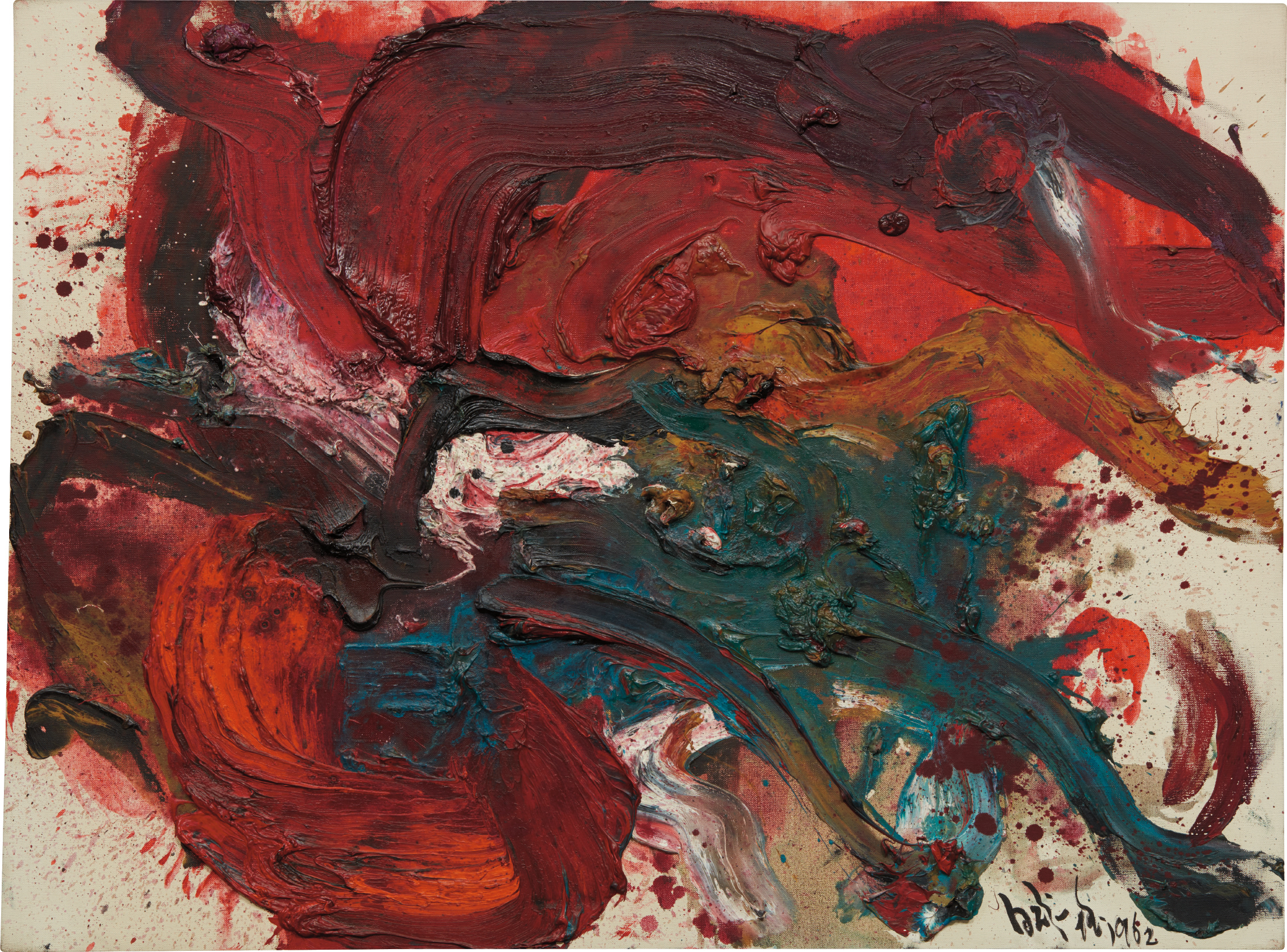
Kazuo Shiraga
T52, 1962
By the 1970s, Shiraga had deepened his engagement with Tendai Buddhism, eventually becoming an ordained monk in 1971, a commitment that added another dimension to his practice without diminishing its fierce physical character. Works from his mature period, such as Kaisho from 1967 and the luminous Exhilarating from 1989, demonstrate a painter who had fully integrated spiritual discipline with bodily intensity. The titles he chose across his career, among them Yougen, a Japanese aesthetic concept evoking mysterious grace, and Indra, the Vedic deity associated with storms and creative power, reveal an artist deeply engaged with questions of transcendence and elemental force. His 1999 work Kaien, one of his later major paintings, shows an undiminished command of the medium even in his eighth decade.
From a collecting perspective, Shiraga occupies a genuinely rare position: an artist of undeniable historical importance whose market has grown steadily and thoughtfully without losing its sense of discovery. Major auction houses including Christie's and Sotheby's have seen significant results for his works, with large format paintings on canvas from the late 1950s through the 1970s attracting the strongest attention. Collectors drawn to Gutai more broadly will find Shiraga to be the figure who most completely embodied the group's ideals, and his works reward close physical attention in ways that reproductions simply cannot capture. The impasto surfaces demand to be seen in person, where the sculptural depth of the paint becomes its own argument.
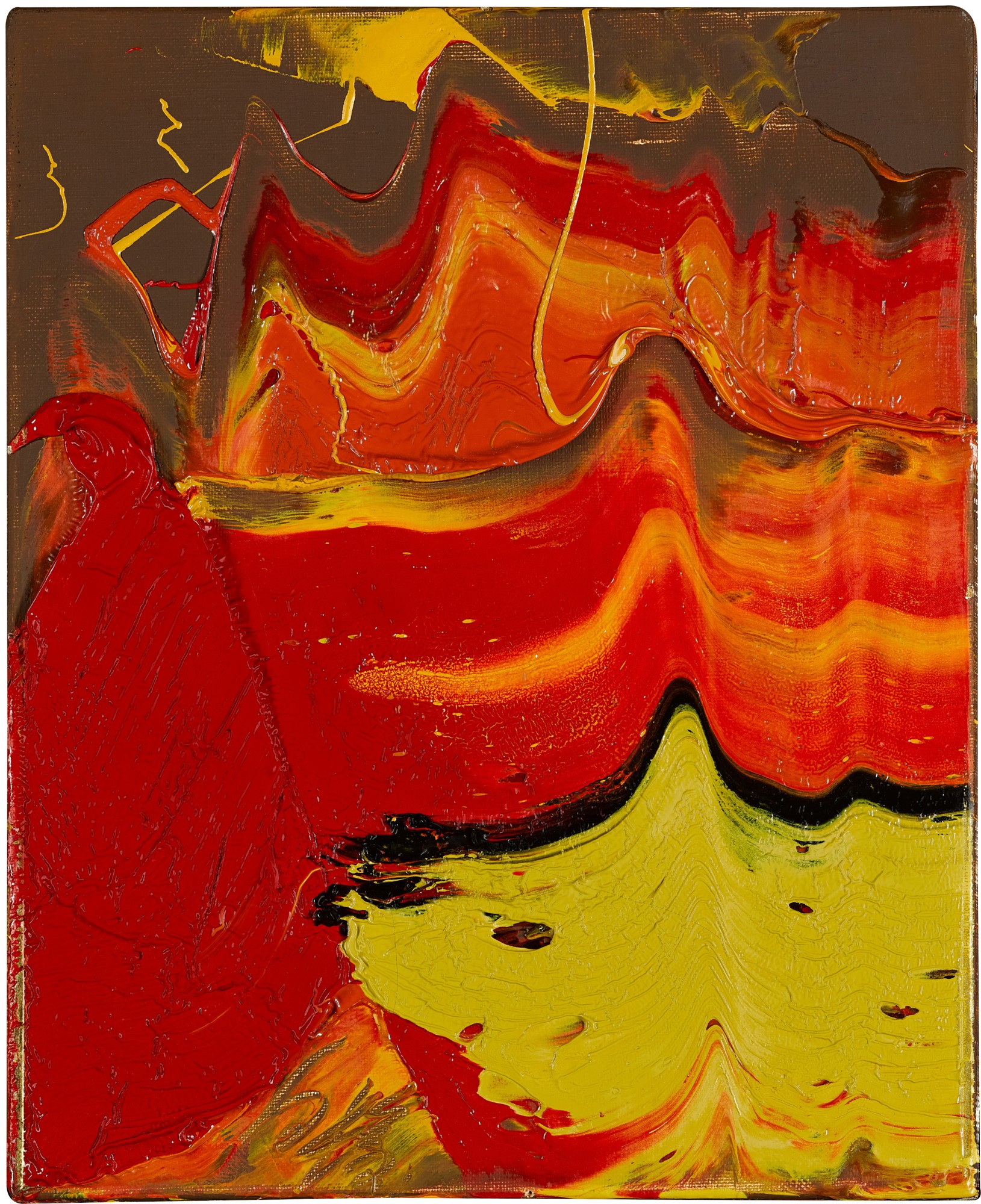
Kazuo Shiraga
Untitled, 1980
Works in oil on canvas from the 1960s and the mature period of the 1980s and 1990s represent particularly compelling entry points for serious collectors. To understand Shiraga fully, it helps to place him in conversation with contemporaries who were asking related questions. Within Gutai, Shozo Shimamoto and Sadamasa Motonaga were exploring the boundaries of action and material with comparable rigor. Internationally, the resonances with Yves Klein, who was also using the body as brush and staging painting as live event, are striking, though the two artists arrived at their methods independently and from very different philosophical roots.
Shiraga's work also invites comparison with the gestural energy of Franz Kline and the surface physicality of Antoni Tàpies, though his commitment to the body as sole instrument sets him apart from virtually all of his Western contemporaries. He was not translating an idea into paint; he was insisting that idea and paint and body were one continuous thing. Shiraga's legacy today is both secure and still expanding. Major retrospectives at institutions including the Museum of Contemporary Art in Los Angeles and sustained scholarly attention from the Ashiya City Museum of Art and History in Japan have ensured that his contribution to postwar art history is properly documented.
Yet there is a sense, shared by many serious collectors and curators, that his full significance is still being absorbed. He was a figure who compressed enormous intellectual ambition into purely physical terms, who insisted that the deepest questions about art and selfhood could only be answered by throwing the whole body into the work. In a moment when so much art is experienced through screens and at a remove, Shiraga's paintings serve as a powerful reminder of what presence actually means.
Explore books about Kazuo Shiraga
Kazuo Shiraga: A Retrospective
Museum of Modern Art, Kamakura
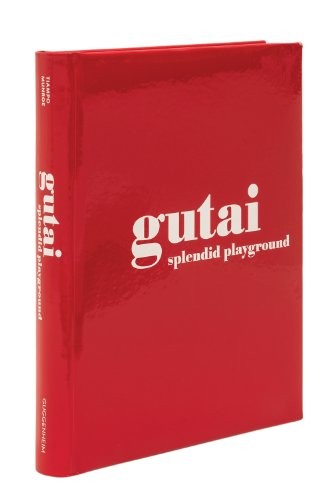
Gutai: Splendid Playground
Ming Tiampo
Kazuo Shiraga: Works 1954-2008
Yuko Hasegawa
Action Painting: Jiro Yoshihara and the Gutai Art Movement
Alexandra Munroe
Shiraga Kazuo: The Mud Paintings
Takeshi Murayama