K. G. Subramanyan
Mani Da, The Modernist Who Remembered Everything
Artist Spotlight · The Collection Editorial
“A living tradition is not a dead past but a past that is active in the present.”
K. G. Subramanyan, collected writings
In the winter of 2016, the art world paused to mourn and then, almost immediately, to celebrate. K. G. Subramanyan, known with deep affection across generations of Indian artists and students as Mani da, had passed at the age of ninety two, leaving behind a body of work so vast and so varied that its full measure is still being taken.
K. G. Subramanyan
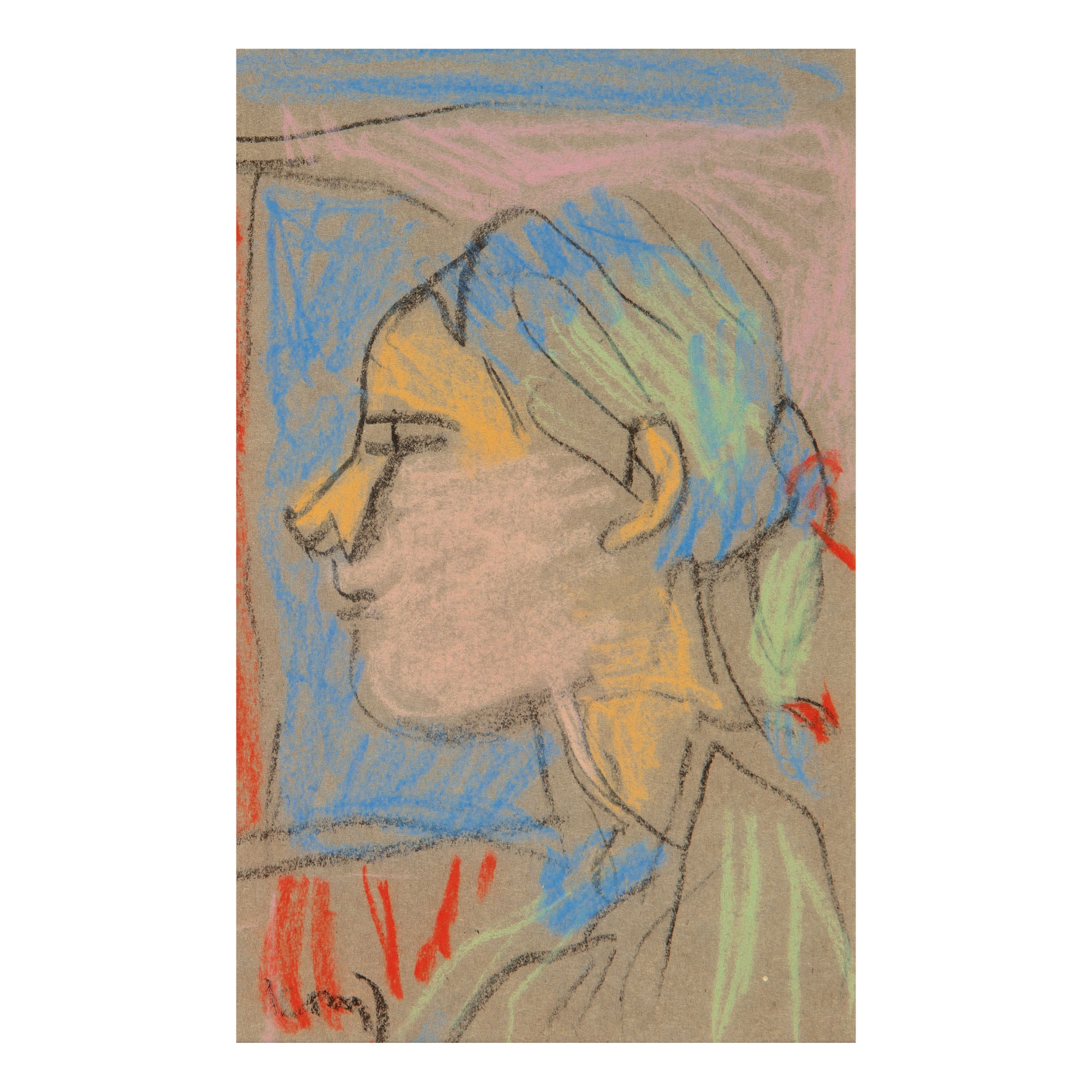
Untitled (portrait Of A Girl)
Memorial exhibitions appeared in Vadodara and Kolkata. Institutions that had collected his work for decades quietly placed his pieces in their most prominent galleries. What emerged from that collective reckoning was not grief exactly, but something closer to gratitude: here was an artist who had given Indian modernism a living, breathing vocabulary rooted in pleasure, narrative, and the irreducible joy of making things by hand. Kunniraman Ganesan Subramanyan was born in 1924 in Kuthuparamba, a small town in Kerala, into a family shaped by the independence movement and the intellectual currents of the era.
As a young man he was arrested by British authorities for participating in the Quit India Movement, an experience that confirmed in him a lifelong commitment to a kind of art that was rooted in community, in the vernacular, and in the long traditions of ordinary Indian life. It was this political and cultural consciousness that drew him to Santiniketan, the remarkable institution founded by Rabindranath Tagore in West Bengal, where he arrived in the 1940s to study under the legendary Nandalal Bose. Santiniketan was transformative. Under Nandalal Bose, who had himself drawn deeply on the Bengal School and on the crafts traditions of rural India, Subramanyan encountered a vision of art education that refused the colonial hierarchies separating fine art from craft.
K. G. Subramanyan
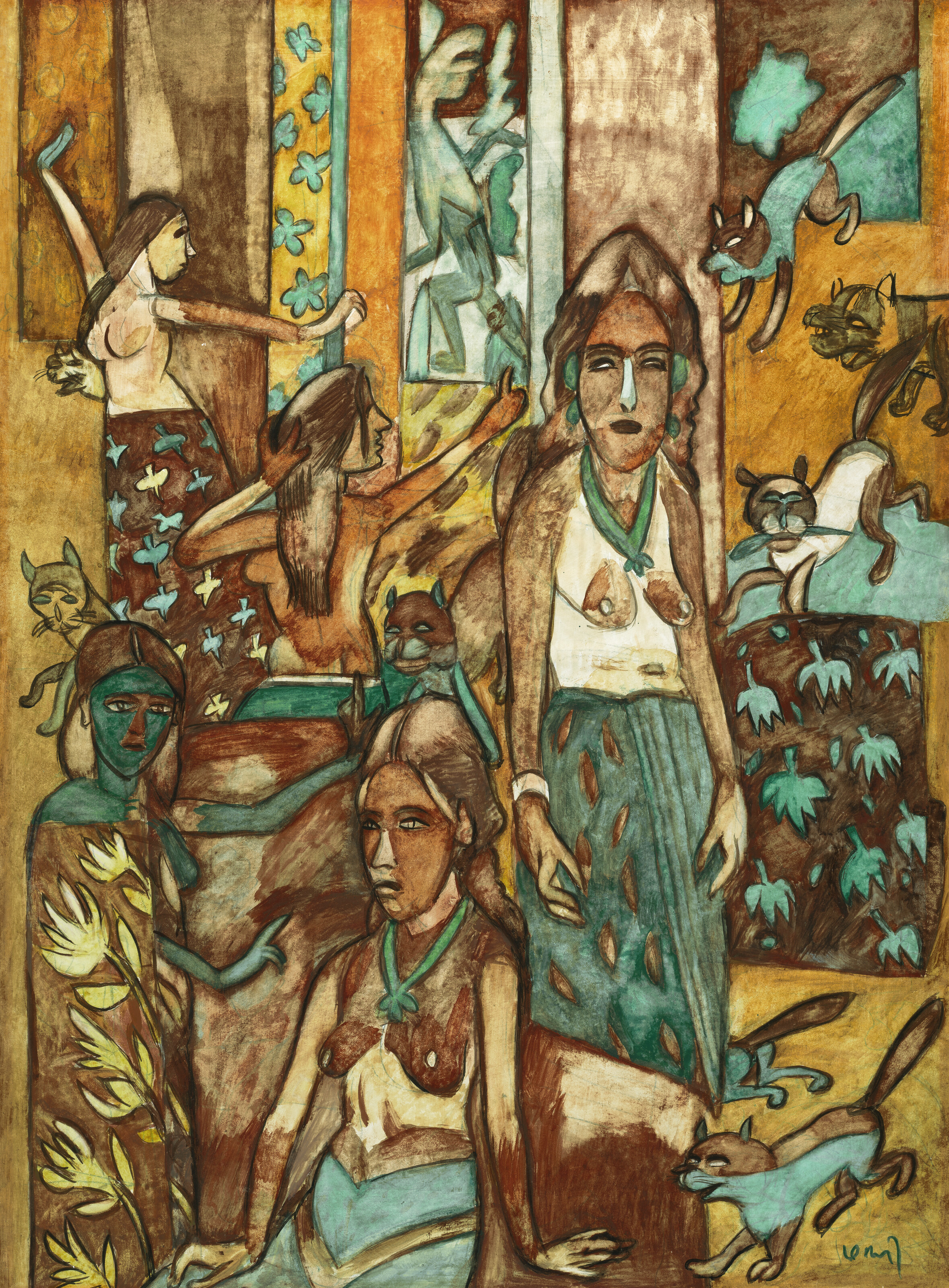
Girls and Cats
He absorbed lessons from Benode Behari Mukherjee as well, another towering Santiniketan figure whose mural work and engagement with folk traditions left a lasting mark. Subramanyan later studied at the Slade School of Fine Art in London on a fellowship, where he encountered European modernism firsthand. But the encounter, rather than displacing what he had learned in Bengal, only sharpened his sense of what Indian art could do on its own terms. His return to India marked the beginning of a career of extraordinary range.
He joined the faculty of the Faculty of Fine Arts at the Maharaja Sayajirao University of Baroda, one of the great centers of Indian modernism in the postwar decades, where he would teach for many years and become one of the most influential art educators the country has produced. Baroda in those years was alive with debate about the nature of a specifically Indian modernism, and Subramanyan was central to those conversations. He wrote prolifically, his critical essays developing arguments about the relationship between tradition and innovation that remain essential reading. His teaching shaped generations of artists, among them figures who went on to define contemporary Indian art.
K. G. Subramanyan
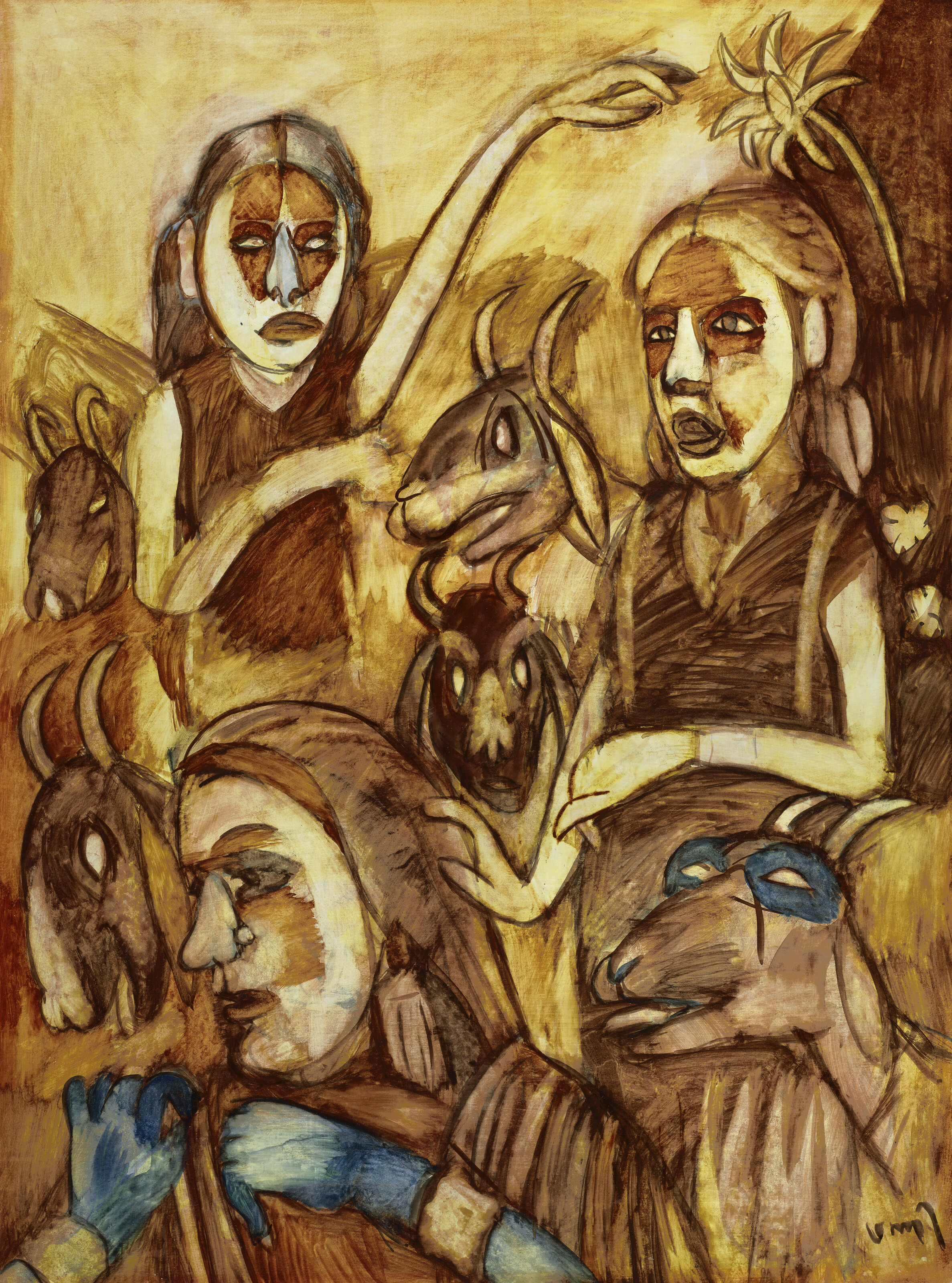
Girls and Goats
In his own studio practice, Subramanyan developed a visual language that is immediately recognizable and endlessly surprising. He worked across painting, sculpture, terracotta, illustrated books, and with particular brilliance in reverse painting on glass, a technique rooted in popular Indian craft that he elevated into a sophisticated pictorial form. His subjects were drawn from mythology, from folk narrative, from the everyday world of women, children, animals, and domestic life. The works pulse with a wit that is never frivolous and a tenderness that is never sentimental.
In paintings like Girls and Cats and Girls and Goats, the compositional energy is exuberant and knowing at once: figures press toward one another with a physical warmth that feels observed rather than invented, while the color and line carry the memory of Kalighat paintings, of terracotta temple friezes, of the entire deep archive of Indian visual storytelling. His works on paper occupy a special place in his practice and in the affections of collectors. A work like Untitled (Portrait of a Girl), rendered in pastel on paper, demonstrates the quality that makes his drawings so compelling: an absolute economy of means in service of an absolutely full presence. The figure exists with confidence and charm, neither idealized nor reduced, but caught in the particular aliveness that Subramanyan brought to every subject he touched.
Works on paper and smaller format works offer collectors a remarkable opportunity to engage directly with his draftsmanship, the foundation of everything else he did. For collectors, Subramanyan represents one of those rare junctures where historical importance and visual pleasure are entirely aligned. His place in the canon of Indian modernism is secure: alongside contemporaries such as M. F.
Husain, Tyeb Mehta, and Ram Kumar, he helped define what Indian painting could be in the second half of the twentieth century. But where some of those figures have been absorbed into the high visibility international auction market, Subramanyan's work retains a quality of intimacy and accessibility that makes collecting it feel genuinely personal. Major Indian auction houses including Saffronart and Pundole's have handled significant works, and prices for his paintings and works on paper have grown steadily as institutional appreciation for his full range has deepened. Collectors are increasingly drawn to his works on glass and his illustrated books, which offer a different dimension of his practice and often come with remarkable provenance.
The question of legacy is one that Subramanyan himself approached with characteristic modesty and rigor. He believed deeply in the idea of a living tradition, one that does not preserve forms in amber but allows them to breathe, change, and carry new meaning. That belief is everywhere in his work: in the way a goddess from the Puranas might share a canvas with a thoroughly contemporary woman, in the way a folk motif might anchor a composition that is also fully conversational with European modernism. He saw no contradiction in any of this, because he understood tradition as a practice rather than a museum piece.
What makes Mani da matter today, perhaps more than ever, is precisely that understanding. At a moment when questions of cultural identity, of the relationship between local and global, of whose visual languages count as universal, are at the center of art world debate, his work offers a decades long demonstration of how those questions might be lived rather than argued. He did not resolve the tensions. He made something beautiful and generous from them.
That is the gift his work continues to offer, to every collector, every viewer, every artist who encounters it.
Explore books about K. G. Subramanyan
K. G. Subramanyan: The Artist as Humanist
Girish Kasturirangan
K. G. Subramanyan: A Retrospective
Kala Bhavana, Santiniketan
The Craft of Survival: K. G. Subramanyan's Artistic Journey
Priya Ayyar
K. G. Subramanyan: Paintings and Drawings
National Gallery of Modern Art, New Delhi
The Art of K. G. Subramanyan
Mulk Raj Anand