Julian Opie
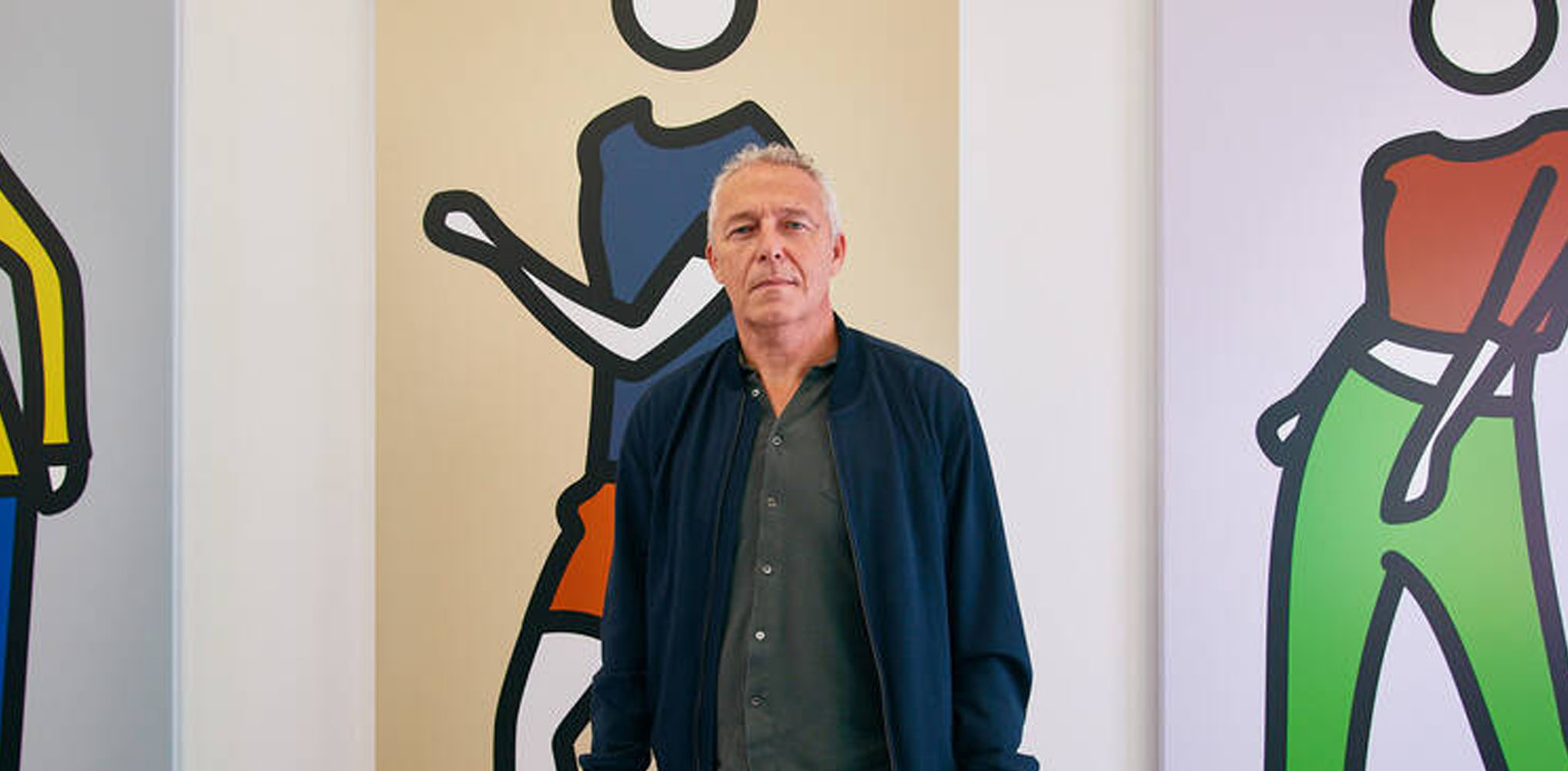
Julian Opie: The Art of Seeing Clearly
Artist Spotlight · The Collection Editorial
“I want the work to be immediately accessible, like a road sign. But also to reward longer looking.”
Julian Opie, Lisson Gallery interview
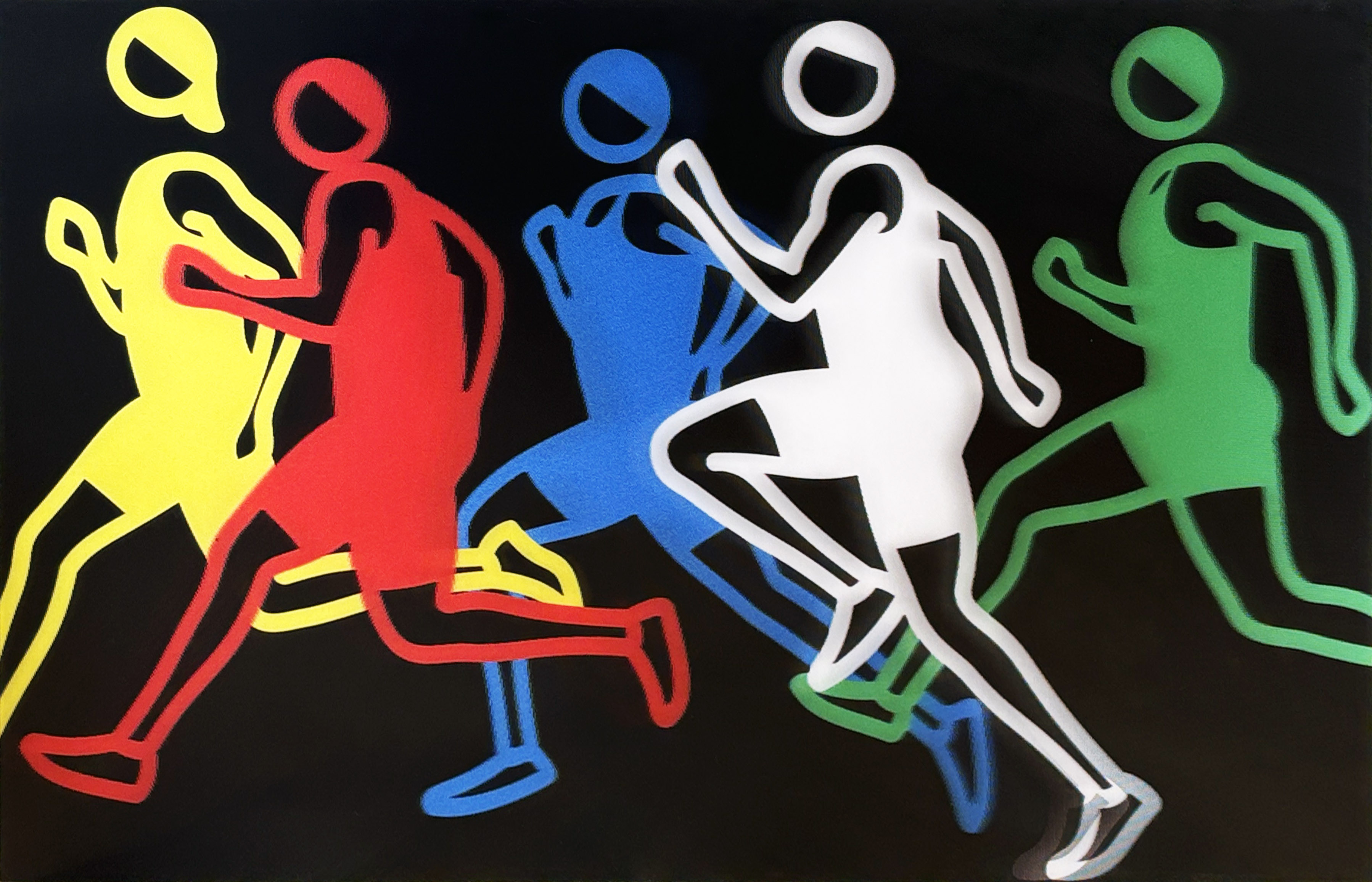
In the spring of 2024, visitors to art fairs from Frieze London to Art Basel encountered a familiar yet endlessly arresting sight: those bold black outlines, those flat fields of color, those faces stripped to the absolute minimum required for recognition. Julian Opie, now in his seventh decade and more prolific than ever, remains one of the most visually persuasive artists working anywhere in the world. His newest lenticular panels depicting sprinting figures seem to move as you pass them, a trick of optics that feels entirely contemporary and yet reaches back to the oldest impulse in image making, which is the desire to capture life in motion. At 66, Opie is not coasting on a signature style.
Julian Opie
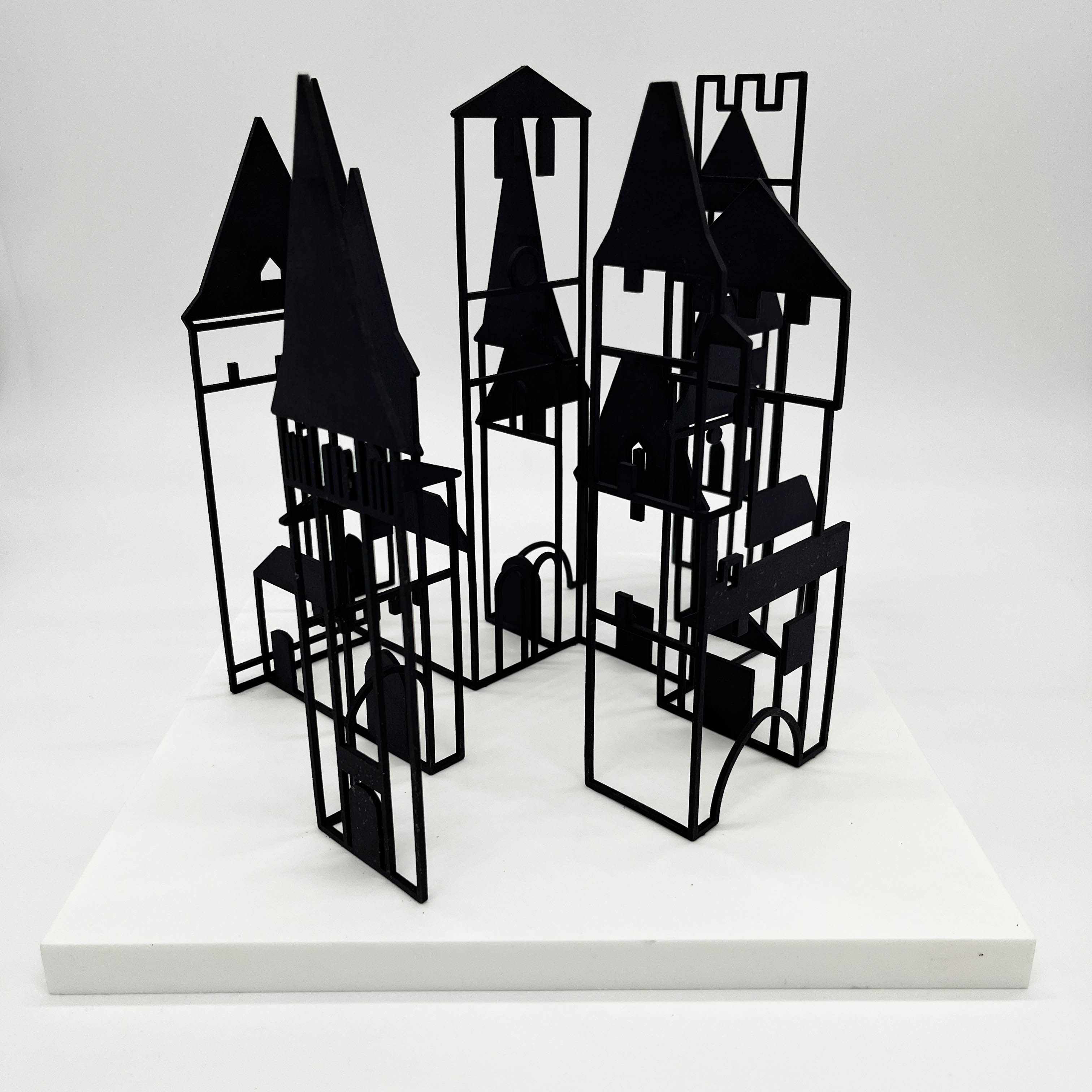
Bastide 3, 2021
He is deepening it. Opie was born in London in 1958 and grew up in an environment that was intellectually curious and culturally open. He studied at Goldsmiths College of Art in London during the late 1970s and early 1980s, an institution that would soon become the crucible of the Young British Artists movement. His tutor there was the influential sculptor Michael Craig Martin, whose own interest in everyday objects rendered with cool precision left a lasting mark on the younger artist.
Goldsmiths in that era was a place of extraordinary creative ferment, and Opie absorbed its ethos of questioning what art could look like without ever becoming dogmatic about the answer. His early work in the 1980s attracted serious attention almost immediately. The Lisson Gallery in London, one of the most respected platforms for international contemporary art, began representing him and provided a context in which his stripped back aesthetic could be understood alongside the broader conversation about representation and image making happening across Europe and North America. Those early painted sculptures, which reimagined mundane objects in a manner that felt simultaneously cartoonish and philosophical, pointed toward everything that would come later.
Julian Opie
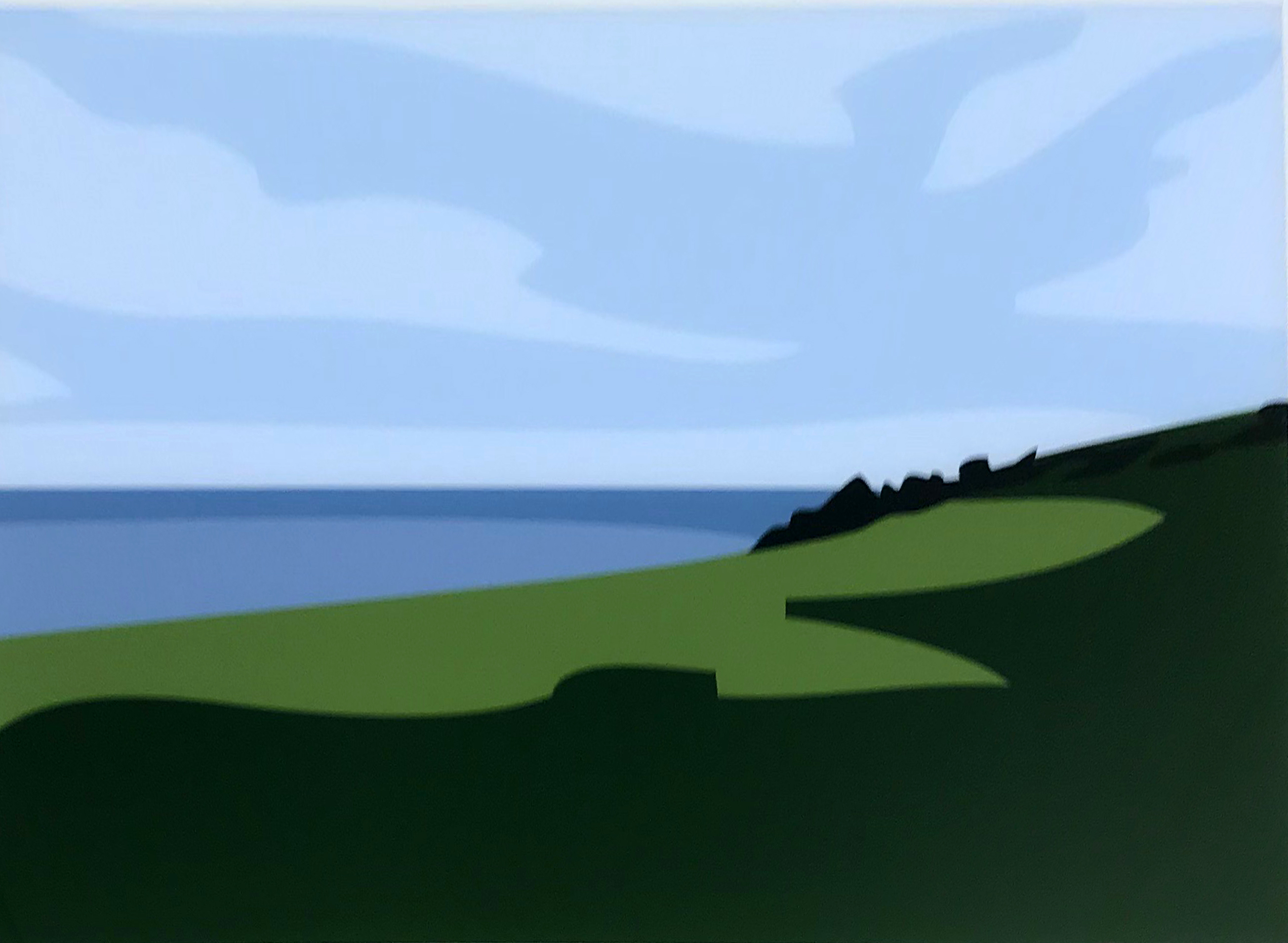
Cornish Coast 1: Lantivet Coast, 2017
Critics noted the influence of Roy Lichtenstein and the Pop Art tradition, but also something cooler and more detached, closer perhaps to the graphic clarity of road signs or the visual grammar of computer interfaces that were just beginning to enter everyday life. The breakthrough into portraiture in the 1990s marks the most recognizable chapter of Opie's development. Commissions and collaborations brought his reductive portrait style to wide public attention, and his ability to distill a human face into a handful of precisely chosen lines proved not just commercially successful but genuinely moving. The faces carry expression through absence as much as presence, a paradox that gives them a haunting quality beneath their apparent simplicity.
Around the same time, Opie began working seriously with LED technology, creating animated figures that walk, dance, and run on illuminated screens. These works sit beautifully in both domestic and institutional settings and represent one of the most elegant integrations of digital technology into fine art practice that any artist of his generation has achieved. The range of media Opie commands is genuinely remarkable and each format illuminates the others. The bronze statuettes, such as the Melbourne Statuettes series and the Boston Statuette from 2020, translate his flat visual language into three dimensional form with surprising success.
Julian Opie
Sprinters: Men Sprinters 3, 2024
Rendered in patinated black bronze and mounted on pale stone bases, these small figures carry a quiet monumentality. The Cornish Coast series from 2017 demonstrates his mastery of landscape, reducing the coastline of Cornwall to luminous horizontal bands that recall both Japanese woodblock prints and the spare serenity of Minimalist painting. The lenticular panels, including works from the Street Walkers series and the Sprinters series, exploit the inherent tension between stillness and movement in a way that feels genuinely inventive rather than merely technical. Each medium is a different language for the same essential inquiry: how little information does an image need before it stops being seen and starts being felt.
For collectors, Opie presents a compelling proposition across multiple price points and formats. His prints and digital works offer an accessible entry into a practice that has genuine art historical weight, while the bronzes and large scale LED works represent more significant acquisitions with strong institutional precedent. The secondary market for his work has remained consistently healthy, reflecting the broad and durable appeal of his visual language across cultures and generations. Collectors are drawn not only to the aesthetic pleasure of the work but to its remarkable adaptability: an Opie portrait commands a white cube gallery wall with the same authority it brings to a minimalist apartment or a corporate foyer.
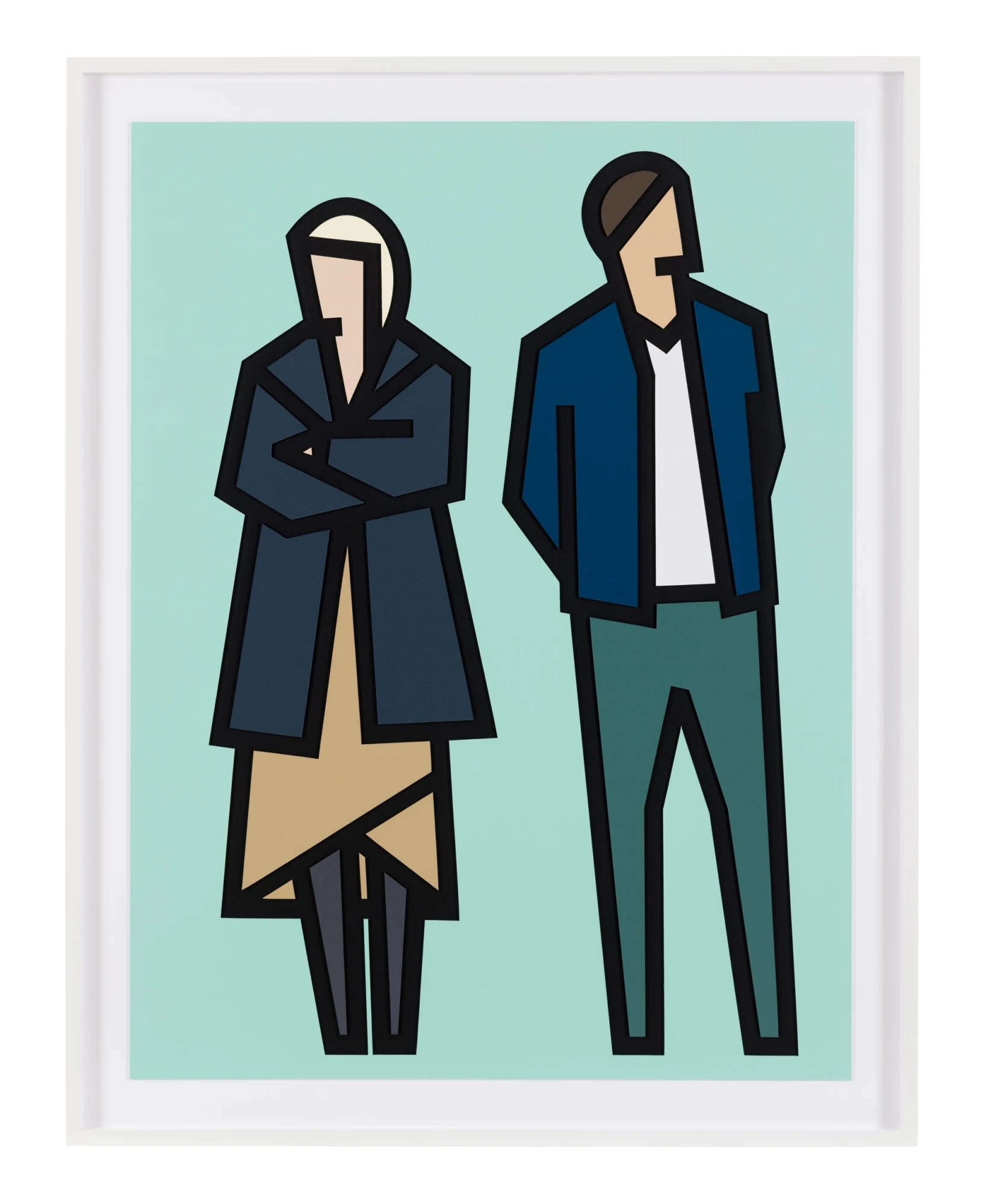
Julian Opie
Standing Couples: Stephanie and Joshua, 2024
This versatility is not a dilution of artistic seriousness but an expression of Opie's long held conviction that great images should be able to travel freely through the world. In the wider context of art history, Opie occupies a fascinating position. He inherits from Pop Art a willingness to engage with commercial visual culture without condescension, and from Minimalism a commitment to reduction as a form of clarity rather than evasion. Comparisons are often drawn to Alex Katz, whose flattened figurative paintings also find psychological depth through formal restraint, and to the conceptual lineage of Craig Martin himself.
There are echoes too of Bridget Riley in his interest in optical experience, and of David Hockney in his cheerful refusal to treat accessibility as an artistic failing. Yet Opie is fully himself, a sensibility that could not have been assembled from influences alone. What makes Opie matter today, perhaps more than at any previous moment, is the way his work speaks directly to a visual culture saturated with screens, icons, and compressed images. At a time when we communicate increasingly through simplified figures and reduced symbols, Opie's career long investigation of how much a face or a body or a landscape can be simplified before it disappears looks less like stylistic choice and more like prophecy.
He has spent four decades asking questions about recognition, representation, and the economy of visual attention that now feel urgently relevant to anyone thinking about how images function in the world. His answer, rendered in bold black lines and brilliant flat color, is that clarity is not the enemy of depth. It may be the only way in.
Explore books about Julian Opie