Jules Jacquemart
Jules Jacquemart: Beauty Rendered in Pure Line
Artist Spotlight · The Collection Editorial
There is a moment, standing before one of Jules Jacquemart's etchings of Chinese porcelain or Japanese stoneware, when the boundary between documentation and devotion dissolves entirely. The needle has moved across the copper plate with such tenderness, such acute observation, that the glazed surface of a celadon vase seems to breathe. It is this quality, at once scientific and deeply felt, that has brought renewed attention to Jacquemart's work among collectors of works on paper and decorative arts scholarship alike. In a cultural moment when the cross pollination of fine art and material culture feels urgently relevant, his life's work reads as a pioneering act of visual intelligence.
Jules Jacquemart
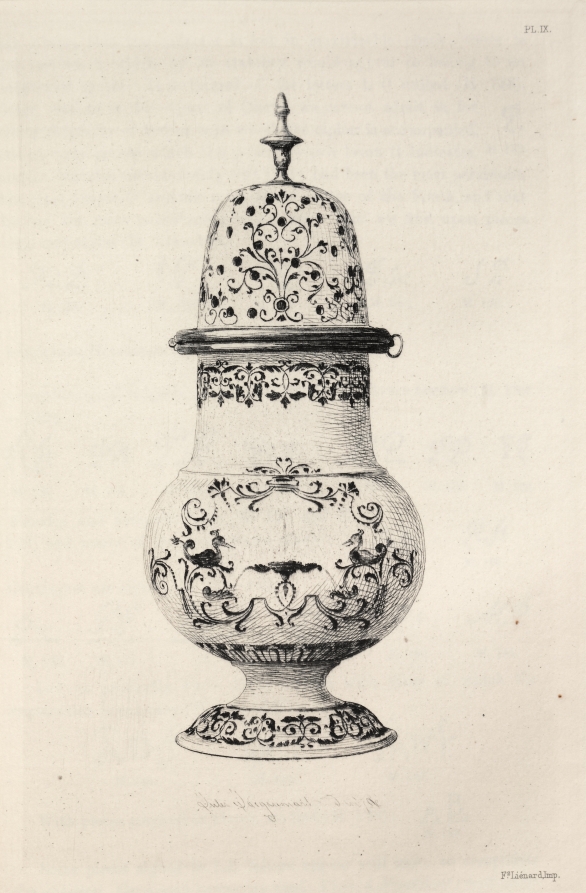
History of the Ceramic Art: A Descriptive and Philosophical Study of the Pottery of All Ages and All Nations: France: Moustieres- Sugar Caster, Blue Decoration (Plate IX), 1877
Jules Jacquemart was born in Paris in 1837, the son of Albert Jacquemart, a distinguished ceramics historian and connoisseur whose scholarly passion for the decorative arts would prove formative. Growing up in a household animated by the study of objects, by the weight of a Ming dynasty vase or the translucency of Sèvres soft paste porcelain, Jules developed an eye calibrated to surfaces, glazes, and the particular silence of things made by hand. Paris in the middle of the nineteenth century was a city electrified by the arrival of Asian art and craft objects through expanded trade routes, and the young Jacquemart absorbed this enthusiasm with the focused intensity of someone who understood that beauty had a history worth tracing. His training as a painter gave him a command of light and form that he eventually channeled almost entirely into the etching medium, where his gifts found their most precise and lasting expression.
The revival of etching as a serious artistic practice was well underway in France during the 1860s, with figures such as Charles Meryon and Francis Seymour Haden demonstrating that the intaglio process could carry the full emotional and intellectual weight of painting. Jacquemart joined this conversation not as a portraitist of urban life or landscape but as something rarer: an artist devoted to the rendering of objects, to the conviction that a Japanese jar or a Persian gargoulette deserved the same attentive gaze as any human subject. The partnership between Jules and his father Albert reached its fullest and most enduring expression in the landmark publication known in English as History of the Ceramic Art, which appeared in its French edition as Histoire de la Porcelaine and was published in an English translation in 1877. The volume stands as one of the most ambitious illustrated art historical surveys of the nineteenth century, drawing on collections across Europe to present ceramics from China, Japan, Persia, Italy, Spain, Germany, and France within a single comparative framework.
Jules Jacquemart
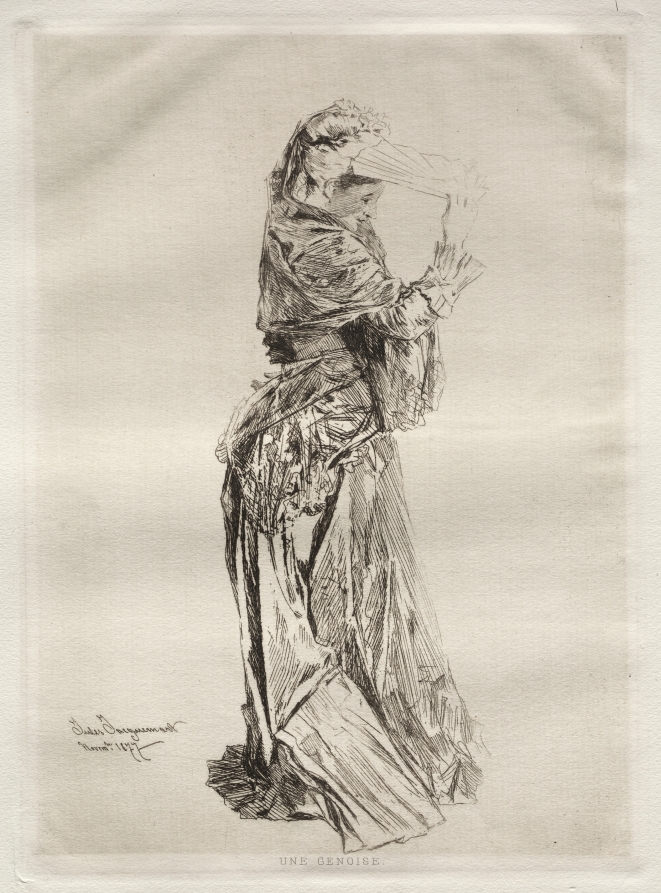
A Genoise, 1877
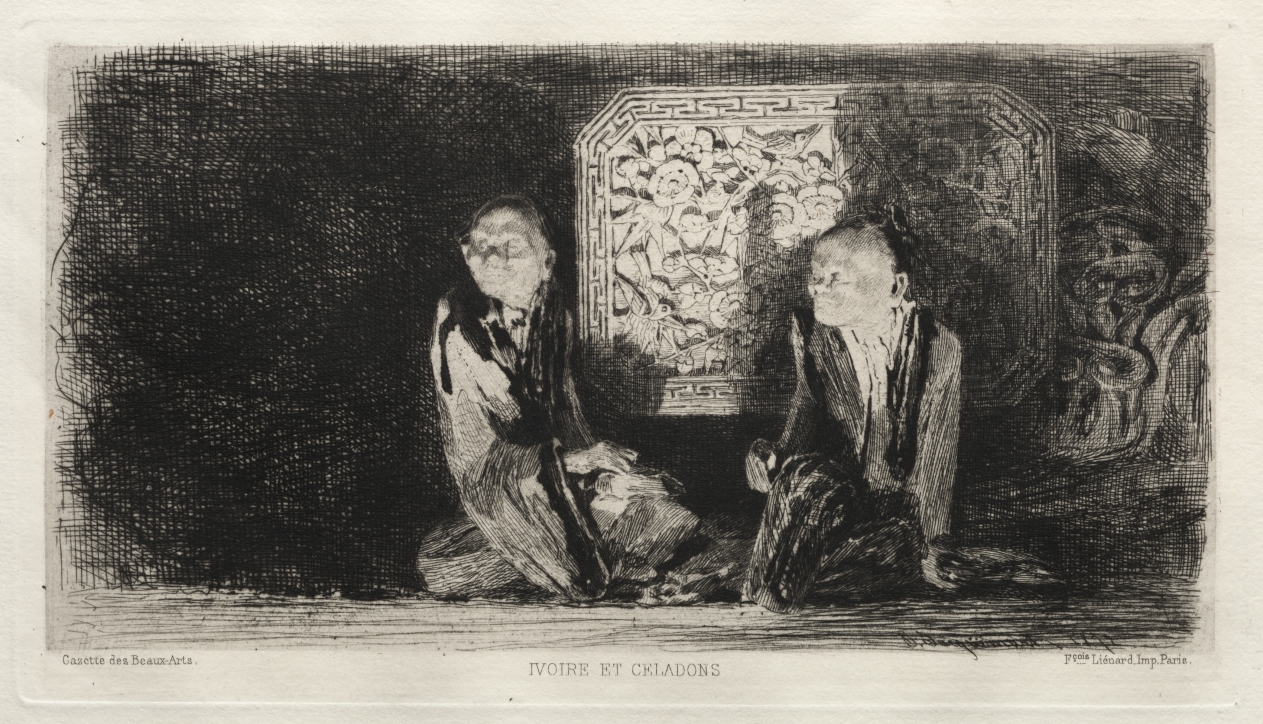
Jules provided the illustrations, a suite of etchings that transformed scholarly reference into visual poetry. Each plate required him to study an actual object, to understand its form in three dimensions, and then to translate that understanding into the purely linear language of etching. The results remain astonishing in their fidelity and their grace. Among the most celebrated of these images is Ivory and Celadon, dated 1872, an etching that distills the particular luminosity of celadon glazed ware into black and white with an economy that seems almost miraculous.
The work demonstrates Jacquemart's central technical achievement: his ability to suggest color through tone, to make a collector feel the coolness of a glaze or the warmth of an enamel ground through nothing more than the density and rhythm of engraved lines. His plate depicting the Sèvres vase commemorating the Battle of Fontenoy captures the banded decoration and rounded form of soft paste porcelain with comparable sensitivity, while his renderings of Japanese wares, including the celebrated jar with the Dog of Fo and the leaping carp, show his delight in the more exuberant vocabularies of East Asian ceramic ornament. The plates devoted to Spanish Talavera faience and Italian Urbino majolica reveal an equal appetite for the robust, earthier traditions of European tin glazed earthenware. For collectors, Jacquemart's etchings occupy a genuinely distinctive niche.
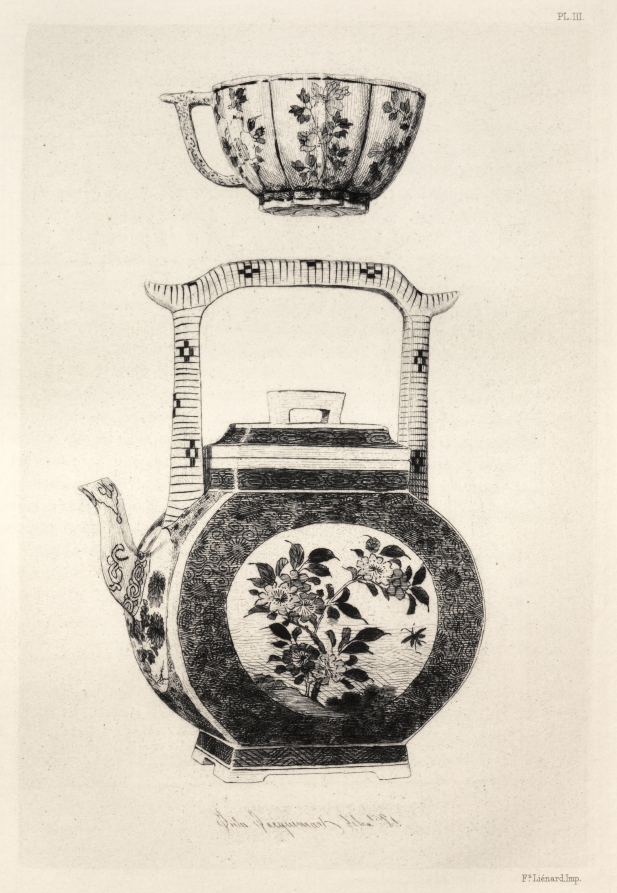
Jules Jacquemart
History of the Ceramic Art: A Descriptive and Philosophical Study of the Pottery of All Ages and All Nations: Japan: Artistic Decoration- Saucer with Rich Enamelled Ground, and Medallion Representing the Goddess Kouanin (Plate IV), 1877
They appeal simultaneously to the print collector interested in the technical and aesthetic achievements of nineteenth century French etching, and to the decorative arts enthusiast for whom the subjects carry their own layer of meaning and historical significance. Works from the History of the Ceramic Art series appear with some regularity in specialist print sales and at auction houses including Christie's and Bonhams, where individual plates and bound sets alike attract collectors who appreciate both their documentary value and their considerable beauty as standalone works on paper. Condition is, as always with works on paper, a primary consideration; Jacquemart's etchings reward close examination under good light, where the range of mark making from the finest descriptive hatching to broader tonal passages reveals its full sophistication. Jacquemart belongs to a fascinating moment in art history when the boundaries between fine art practice and connoisseurship were productively fluid.
His closest counterparts in spirit, though working in different registers, include Philippe Burty, the critic and printmaker who championed Japonisme with comparable scholarly passion, and Félix Bracquemond, whose celebrated discovery of Hokusai's woodblock prints helped transform French visual culture. The broader etching revival placed Jacquemart in distinguished company alongside Alphonse Legros and the French Etching Club milieu, though his singular subject matter gave his practice a coherence and purpose that stands apart from the landscape and figure work that dominated the medium in his era. Jules Jacquemart died in 1880 at just forty three years of age, a life cut short but not before he had assembled a body of work of real consequence. His legacy operates on several levels at once.
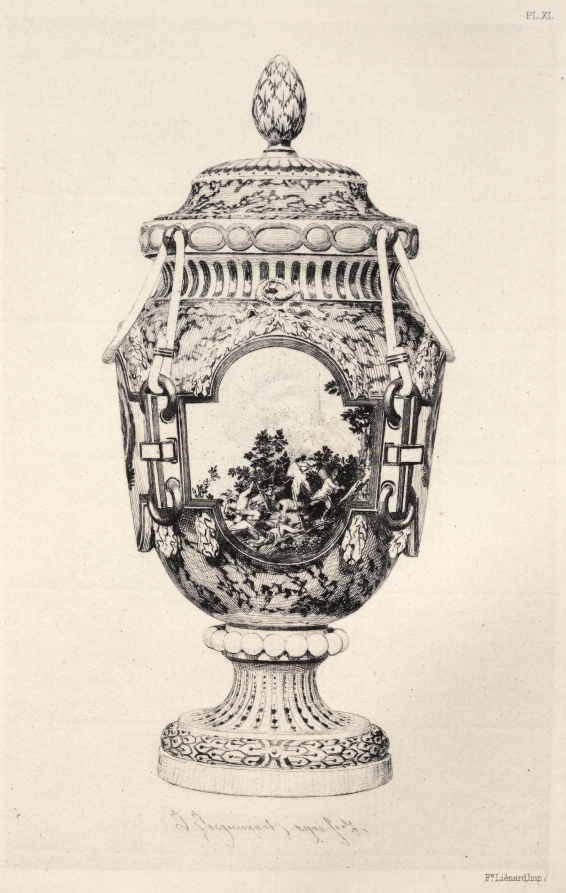
Jules Jacquemart
History of the Ceramic Art: A Descriptive and Philosophical Study of the Pottery of All Ages and All Nations: France: Sèvres- Soft Porcelain- Vase, Commemorative of the Battle of Fontenoy (Plate XI), 1877
As an art historian's illustrator he helped define how nineteenth century audiences understood and visualized the global history of ceramics at a time when that history was only beginning to be written with scholarly rigor. As a printmaker he demonstrated that the etching needle could be an instrument of connoisseurship, that looking carefully at objects and rendering them with love was itself a form of art making worthy of serious attention. For contemporary collectors drawn to works that sit at the intersection of aesthetic pleasure and intellectual substance, Jacquemart's etchings offer something increasingly rare: the precise record of an extraordinary eye, preserved in ink on paper, available to anyone willing to look as carefully as he did.
Featured Works
History of the Ceramic Art: A Descriptive and Philosophical Study of the Pottery of All Ages and All Nations: France: Moustieres- Sugar Caster, Blue Decoration (Plate IX)
1877
A Genoise
1877
History of the Ceramic Art: A Descriptive and Philosophical Study of the Pottery of All Ages and All Nations: Japan: Artistic Decoration- Saucer with Rich Enamelled Ground, and Medallion Representing the Goddess Kouanin (Plate IV)
1877
History of the Ceramic Art: A Descriptive and Philosophical Study of the Pottery of All Ages and All Nations: France: Sèvres- Soft Porcelain- Vase, Commemorative of the Battle of Fontenoy (Plate XI)
1877
Ivory and Celadon
1872
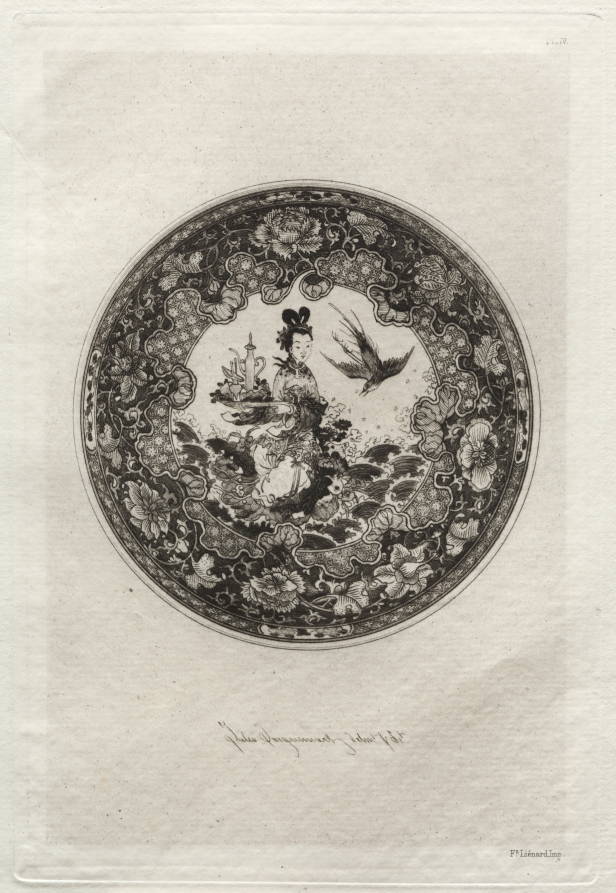
Saucer with Rich Enameled Ground and Medallion Representing the Goddess Kounin
1877
Explore books about Jules Jacquemart