Jules Dupré
Jules Dupré, Nature's Most Passionate Voice
Artist Spotlight · The Collection Editorial
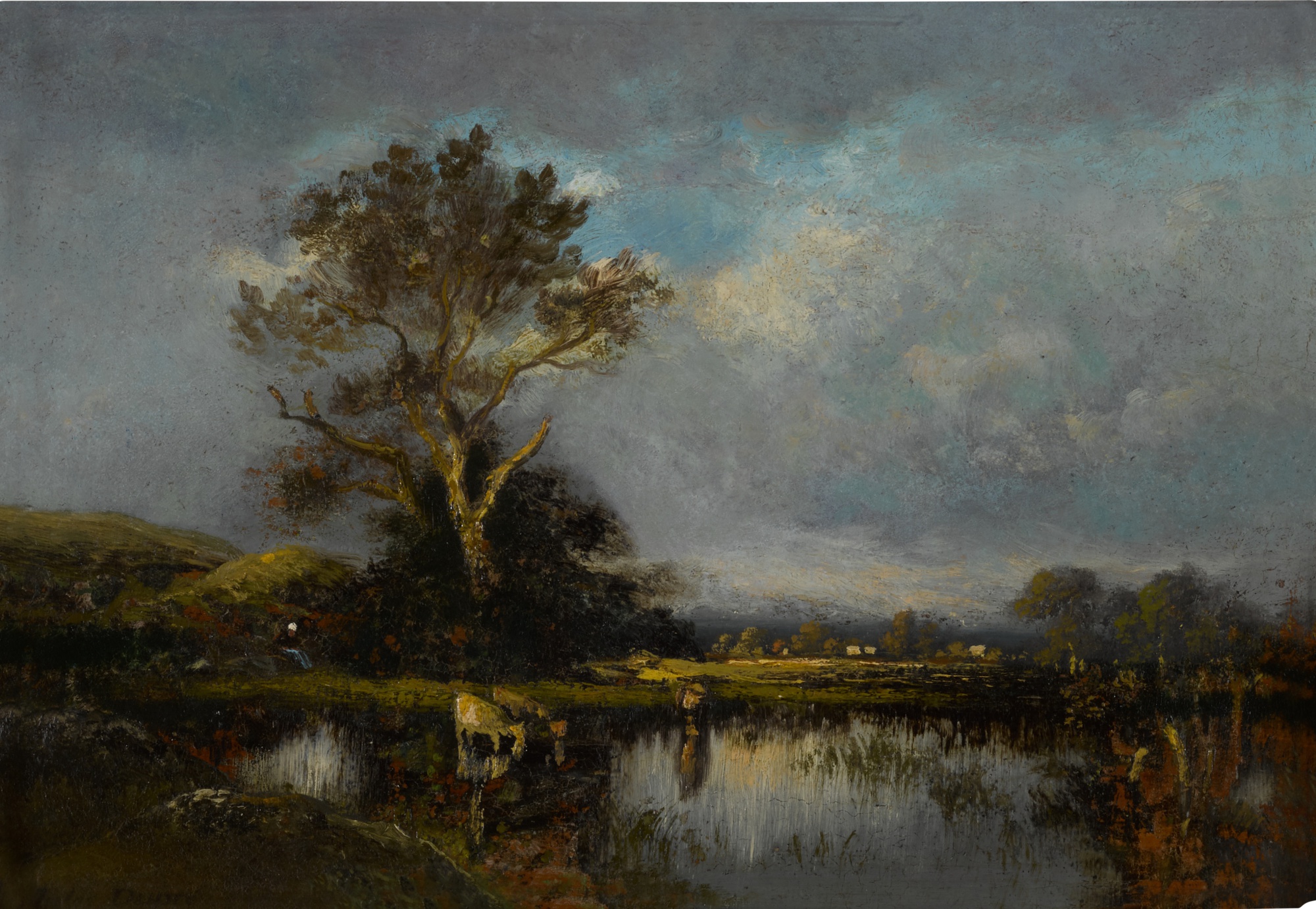
Stand before one of Jules Dupré's great storm lit landscapes and you feel something shift in your chest. The sky bears down with a weight that is almost physical, the trees strain and shudder, and the earth below seems to breathe. This is not the polite, ordered nature of the academic tradition that dominated French painting when Dupré first took up his brushes. This is nature as he encountered it in the fields and marshlands of rural France, raw and alive and utterly indifferent to human comfort.
Jules Dupré
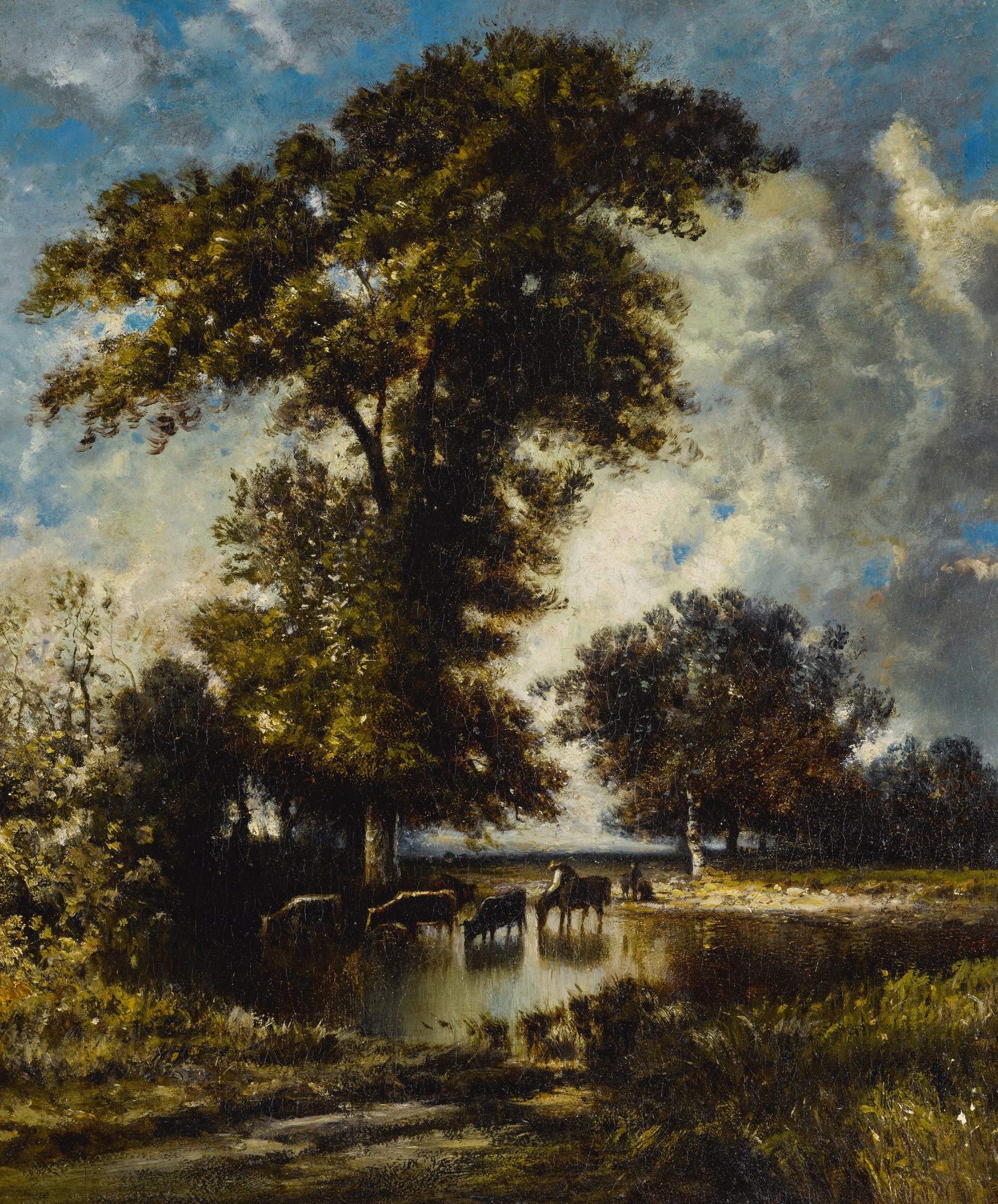
Watering the Herd
That quality of emotional urgency has made Dupré one of the most compelling and enduring figures to emerge from the celebrated Barbizon School, and collectors who discover his work tend to find themselves permanently changed by it. Jules Dupré was born in Nantes in 1811, the son of a porcelain manufacturer, and his early life was shaped by craft rather than fine art. He trained as a porcelain decorator, a discipline that demanded precision, patience, and a sensitivity to surface and color. It was unglamorous work measured against the ambitions of a young man who was already looking at the world around him with a painter's eye.
By his twenties he had made the decisive turn toward painting proper, and he brought with him from his decorative training an unusually refined understanding of how color and texture could be made to carry meaning. Paris received him, but it was the countryside that formed him. The decisive encounter of Dupré's formative years was his friendship with Théodore Rousseau, the visionary landscape painter who would become the central figure of the Barbizon School. The two men shared a belief, radical for their time, that the French landscape deserved to be painted directly, honestly, and with the same seriousness that history painters reserved for mythological and biblical subjects.
Jules Dupré
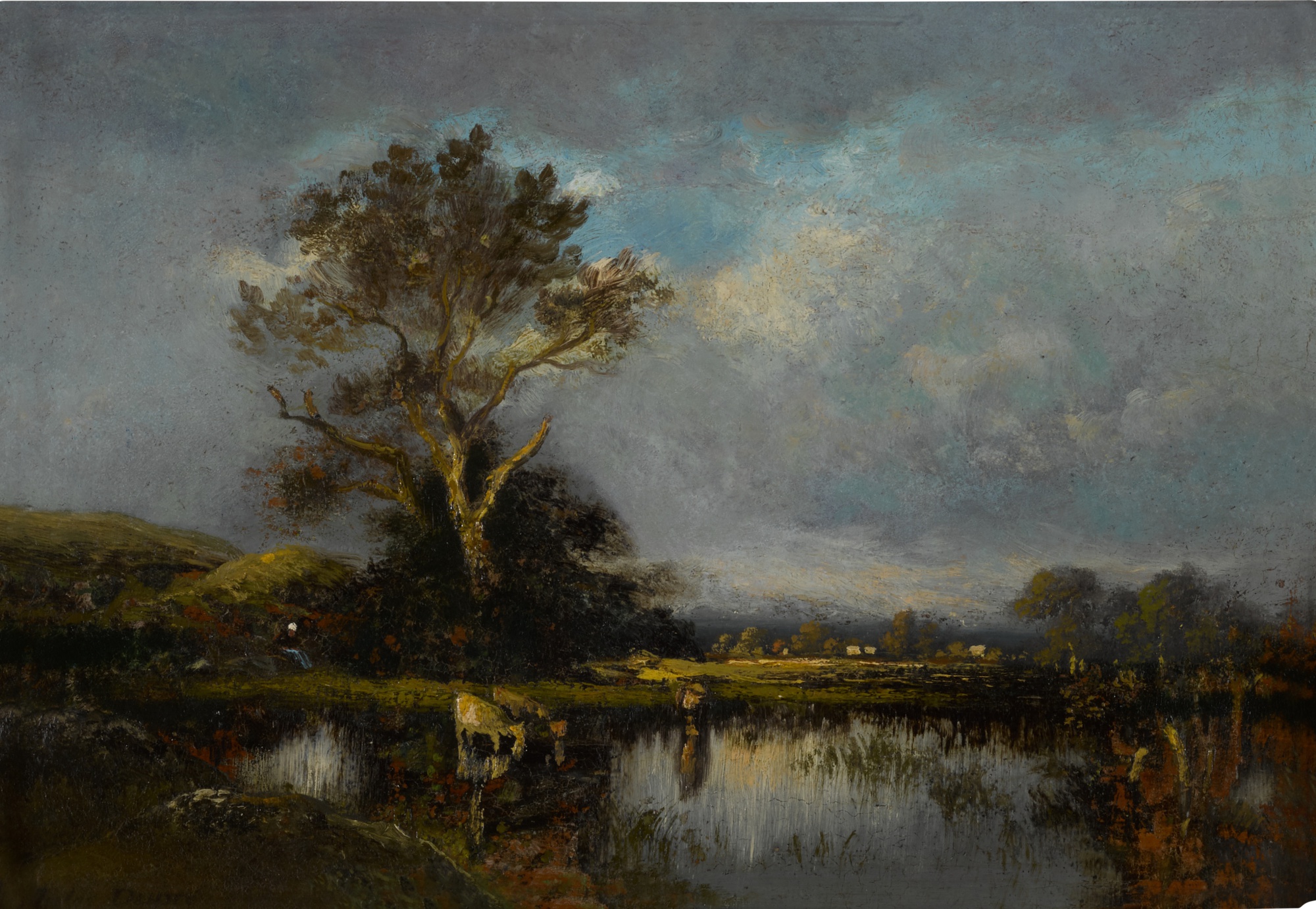
Landscape with Pond and Tree
They traveled together, sketched together, and pushed each other toward a greater naturalism and a greater emotional ambition. A journey Dupré made to England in the 1830s proved equally transformative. There he encountered the work of John Constable and Richard Parkes Bonington, artists who had already broken decisively with academic convention in their treatment of sky, light, and atmosphere. Dupré returned to France with his convictions deepened and his technique sharpened.
What followed was a sustained period of creative achievement that placed Dupré among the foremost landscape painters in Europe. He settled into a practice organized around the close observation of specific natural conditions, particularly the dramatic weather of the Île de France and the landscapes around the Forest of Fontainebleau, which served as the spiritual home of the Barbizon painters. His skies became his signature: enormous, churning, luminous constructions that occupied sometimes two thirds of a canvas and carried the full emotional weight of the composition. His trees, often solitary oaks or elms set against those turbulent heavens, took on an almost human expressiveness.
Jules Dupré
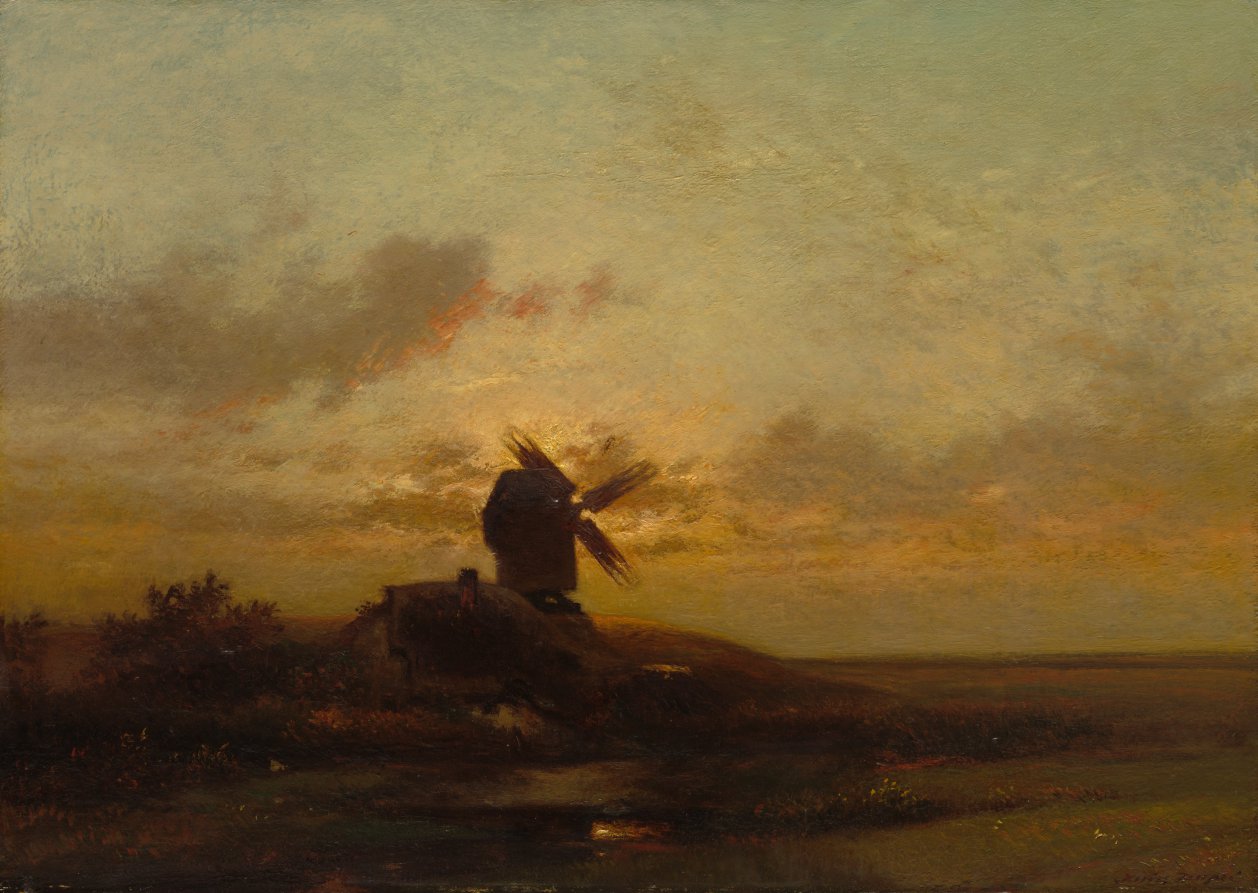
The Windmill, 1855
Critics at the time spoke of his work in terms more commonly applied to music or poetry, noting that Dupré seemed to be painting feeling itself rather than mere scenery. Among the works that best represent his achievement is The Windmill, completed in 1855, a composition that distills everything essential about his approach. The structure sits quietly in the middle distance while the sky above it performs its great drama, light breaking through cloud in shafts that animate the whole scene. Watering the Herd, rendered in oil on paperboard laid down on canvas, shows his gift for integrating animal life into landscape without sentimentality, the cattle and their surroundings forming a single organic whole.
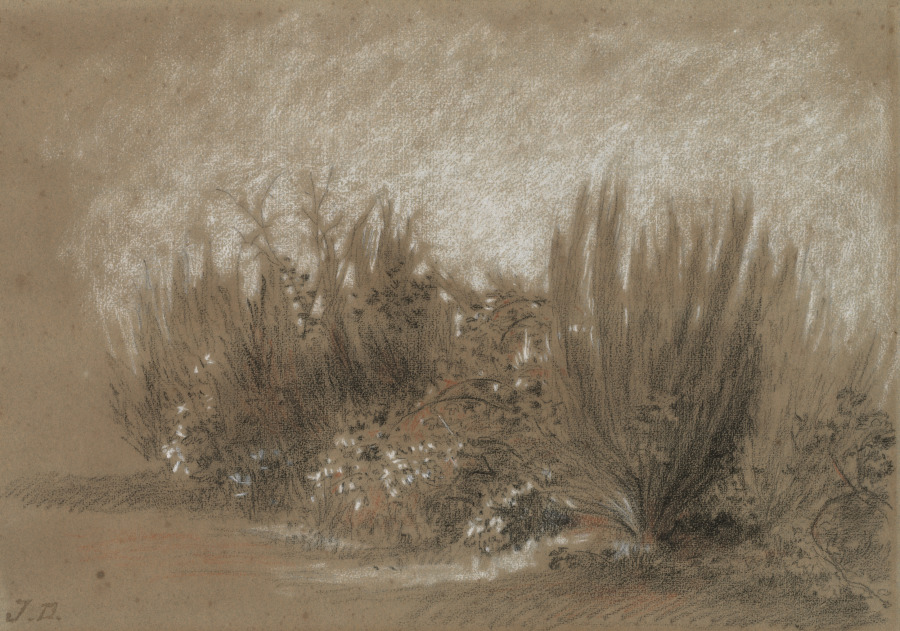
Landscape with Pond and Tree, worked in oil on a cradled panel, demonstrates his mastery of intimate scale, a smaller and more contemplative work that rewards extended looking with layer upon layer of observed truth. Genets et Ronces, a drawing in black, white, and red chalk from 1860, reveals the rigor underlying his painterly fluency. And Marshland, also from 1860, shows his sustained fascination with wet, reflective terrain where sky and earth seem to dissolve into each other. For collectors, Dupré presents a proposition that is both aesthetically rich and historically significant.
Jules Dupré
Genets et Ronces (Broom and Brambles), 1860
His work appears regularly at major auction houses in Paris, London, and New York, and quality examples continue to attract serious attention from institutions and private buyers alike. What distinguishes the most sought after works is precisely that quality of emotional intensity combined with technical control: the paintings that feel simultaneously observed and felt, grounded in a specific moment of weather or light but reaching toward something universal. Collectors drawn to the broader Barbizon tradition often come to Dupré after encountering Rousseau, Camille Corot, or Charles François Daubigny, and they frequently conclude that Dupré's drama and psychological charge offer something those other masters do not. His work in oil on panel is particularly prized for its sense of immediate contact between artist and subject.
To understand Dupré fully is to understand his place within a larger revolution in European landscape painting during the nineteenth century. He belongs to the same broad current that produced Constable and J. M. W.
Turner in England, and his work anticipates the Impressionists in its insistence on painting atmospheric conditions rather than fixed appearances. The Barbizon painters as a group are now recognized as a crucial bridge between the classical tradition and the modernist liberation of perception that Monet, Pissarro, and Sisley would complete in the decades following Dupré's most productive years. Dupré's particular contribution to that bridge was his insistence on emotional truth, his refusal to prettify or domesticate what he saw in the natural world. Dupré died in 1889, the same year that the Eiffel Tower rose over Paris as a symbol of the modern age the Barbizon painters had never sought.
Yet his relevance has only grown with time. In an era when our relationship to the natural world has become urgent in new and pressing ways, his paintings speak with a directness and a seriousness that feels entirely contemporary. There is nothing nostalgic about standing in front of a Dupré sky. It demands something from you.
It asks you to pay attention, to feel the weight of the air, to recognize the world beyond human making as something magnificent and alive. That is the gift he left, and it remains as vital now as the day it was painted.
Explore books about Jules Dupré
Jules Dupré 1811-1889
Hélène Toussaint
Jules Dupré: Catalogue Raisonné of Paintings
Piérard and Hédouin
The Barbizon School and 19th Century French Landscape Painting
Robert L. Herbert
Jules Dupré et son temps
Roger Bruyère-Ostells
Dupré: L'homme et l'artiste
Henry Rochefort