Jules Desbois
Jules Desbois, Sculptor of the Soul
Artist Spotlight · The Collection Editorial
There is a moment, standing before Jules Desbois's La Misère, when the breath catches. The figure seems to collapse inward upon itself, all sinew and sorrow rendered in clay and bronze with a tenderness that borders on the unbearable. It is not a comfortable work, but it is an utterly alive one, and that aliveness is precisely why collectors and curators are rediscovering Desbois with such urgency. In the broader reassessment of late nineteenth century French sculpture now underway across European institutions, Desbois is emerging not as a footnote to Auguste Rodin but as a distinct and profoundly gifted voice in his own right.
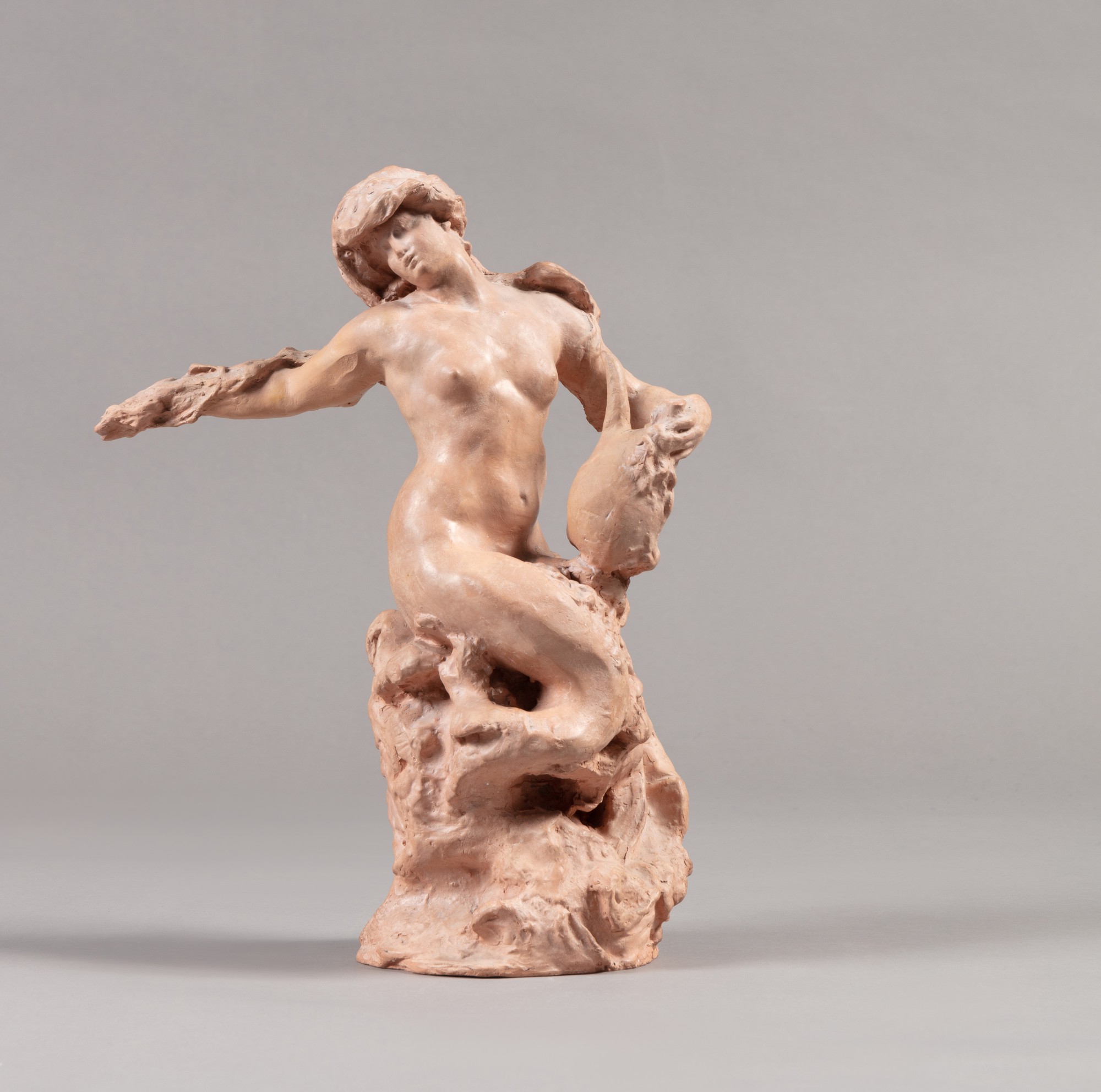
Jules Desbois
La Musique (Music)
Jules Desbois was born in 1851 in Parçay les Pins, a small commune in the Maine et Loire department of western France. Like many sculptors of his generation, he came from modest provincial origins, and his path to Paris followed the well worn route of ambition and talent seeking a larger stage. He trained rigorously in the classical tradition, absorbing the technical foundations that would later allow him to push material and form toward something altogether more personal. The academic discipline he acquired gave him the vocabulary, but it was the charged intellectual climate of 1880s Paris that gave him the grammar of feeling.
His early professional life brought him into close orbit with Auguste Rodin, and this association proved formative in ways both practical and philosophical. Desbois worked alongside Rodin during some of the most fertile years of French sculpture, a period when the entire discipline was straining against its neoclassical constraints. The two artists shared a fundamental belief in the expressive potential of the human figure, in the idea that a torso or a hand or a tilted head could carry the full weight of human emotion. Yet Desbois was never merely a satellite.
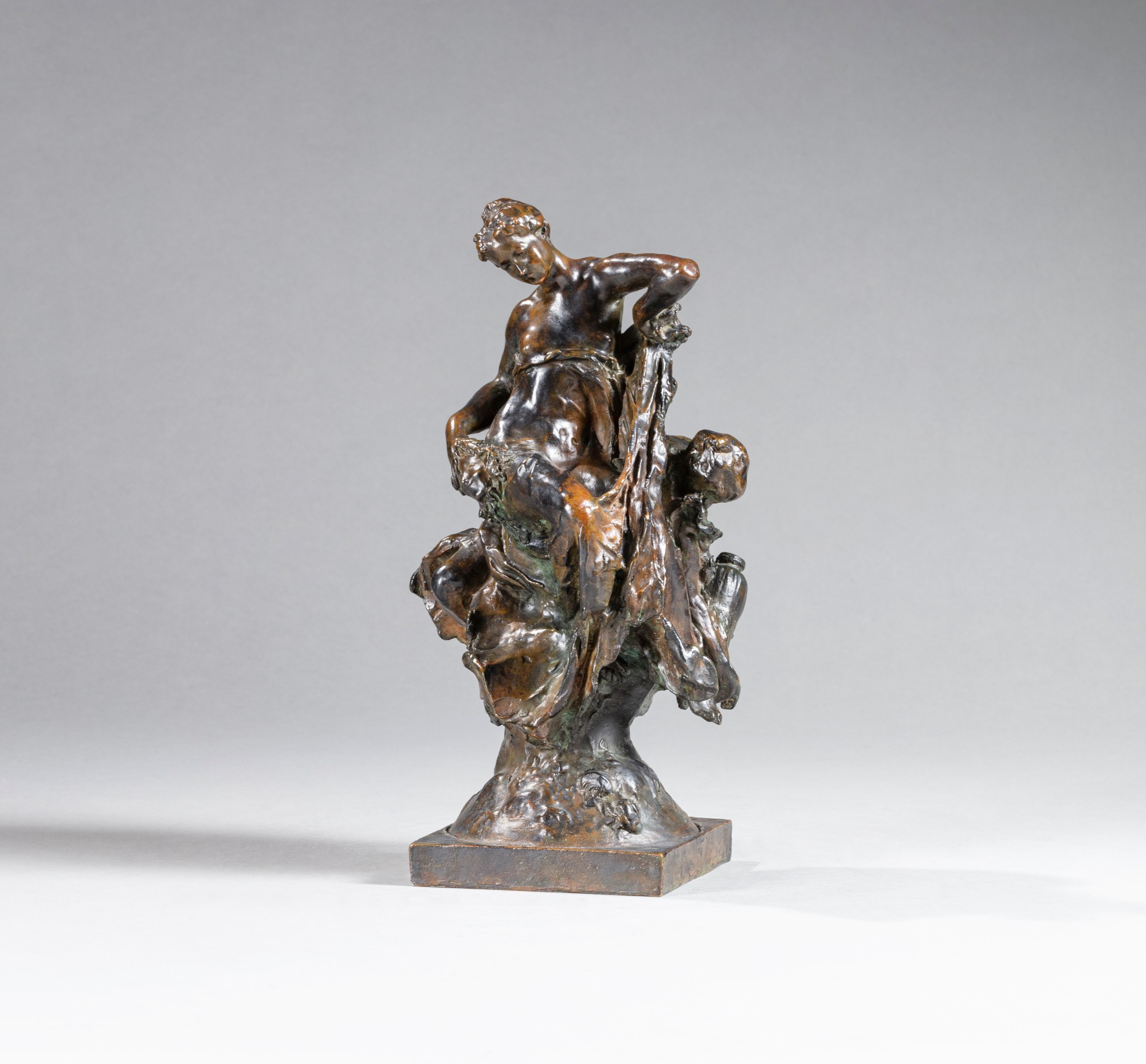
Jules Desbois
La Comédie
Where Rodin commanded monumentality, Desbois often sought intimacy, turning toward the symbolist register that was reshaping literature, music, and the visual arts across Europe in the final decades of the nineteenth century. The symbolist current runs through Desbois's mature work like a deep, sustaining tide. His figures do not illustrate stories so much as embody states of being. Eve tentée, cast in a rich dark brown patina bronze, captures the heroine of Genesis not at the moment of transgression but in the trembling instant of temptation itself, all longing and unresolved anticipation.
Salomé, another bronze with a nuanced warm patina, treats its notorious subject with a psychological complexity that resists easy readings of seduction or villainy. These are works that reward sustained looking, revealing new tensions and subtleties with each encounter. The surface qualities of Desbois's bronzes deserve particular attention: his patinas are not merely decorative finishes but active components of meaning, modulating light and shadow to amplify the emotional temperature of each piece. Among his most celebrated works, La Musique stands as a testament to his lyrical gifts.
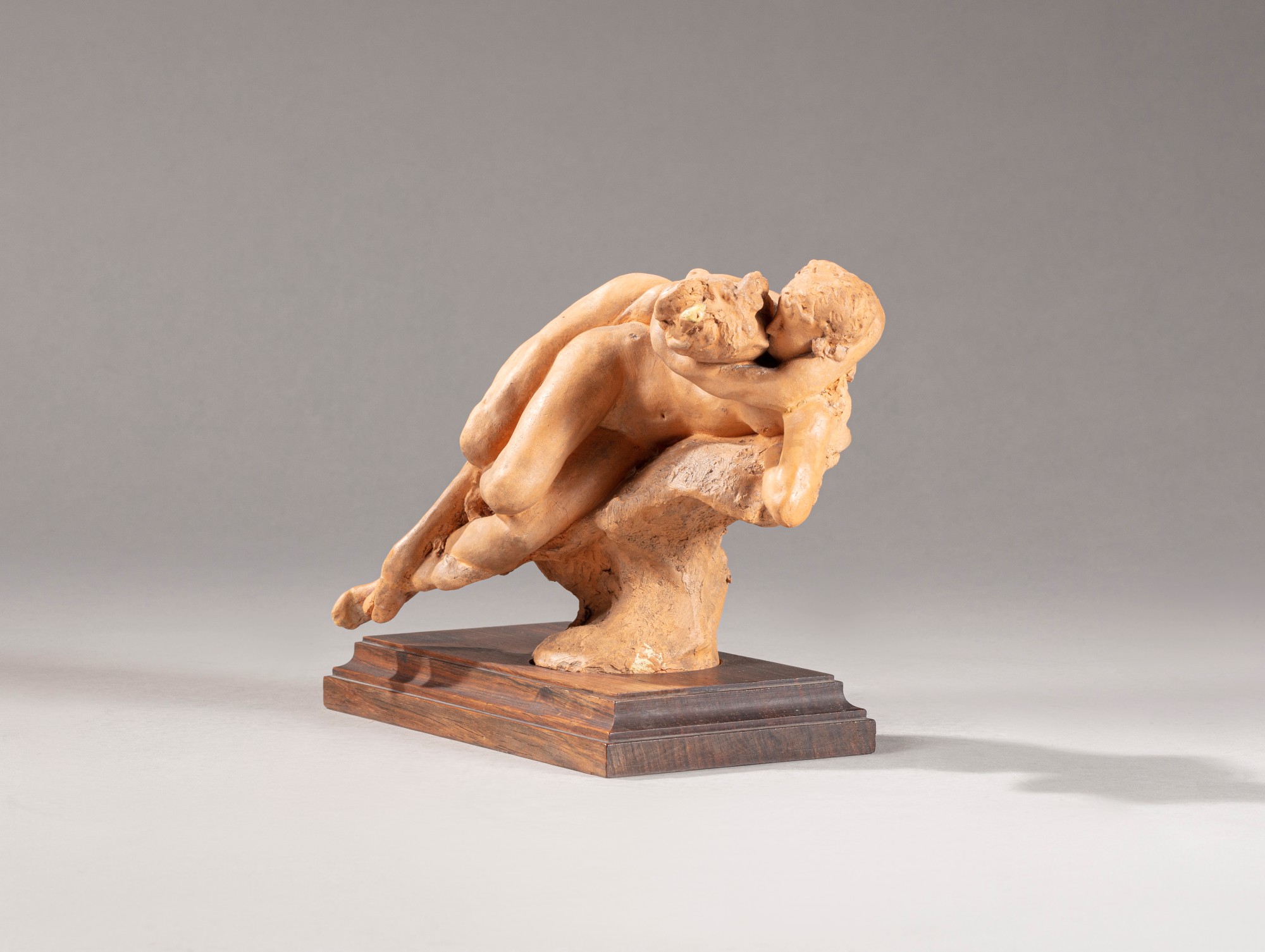
Jules Desbois
Le Baiser (The Kiss)
The piece channels the symbolist conviction that sculpture and music shared a common ambition, both reaching toward states of feeling that language could not fully contain. Le Baiser, his treatment of the kiss as subject, invites inevitable comparison to Rodin's famous version, but Desbois approaches the theme with his own characteristic restraint and psychological nuance. Baigneuse au rocher, depicting a bather at rest against stone, demonstrates his mastery of the female nude in a mood of contemplative ease rather than idealized display. And Gust of Wind reveals an artist willing to pursue the most difficult sculptural problem of all, the representation of pure movement and force, with complete confidence.
For collectors, Desbois presents a compelling and still relatively accessible proposition within the broader landscape of late nineteenth century French sculpture. His works occupy a space of genuine art historical significance without yet commanding the stratospheric prices associated with Rodin, making this a moment of real opportunity. The quality of casting and patination across his bronzes is consistently high, and the emotional range of his subjects, from mythological figures to symbolist allegories to intimate nudes, offers collectors considerable scope for building a meaningful holding. Works on the market tend to attract serious attention from institutional buyers and private collectors alike, and the growing scholarly reassessment of his career is likely to continue supporting values across the coming years.
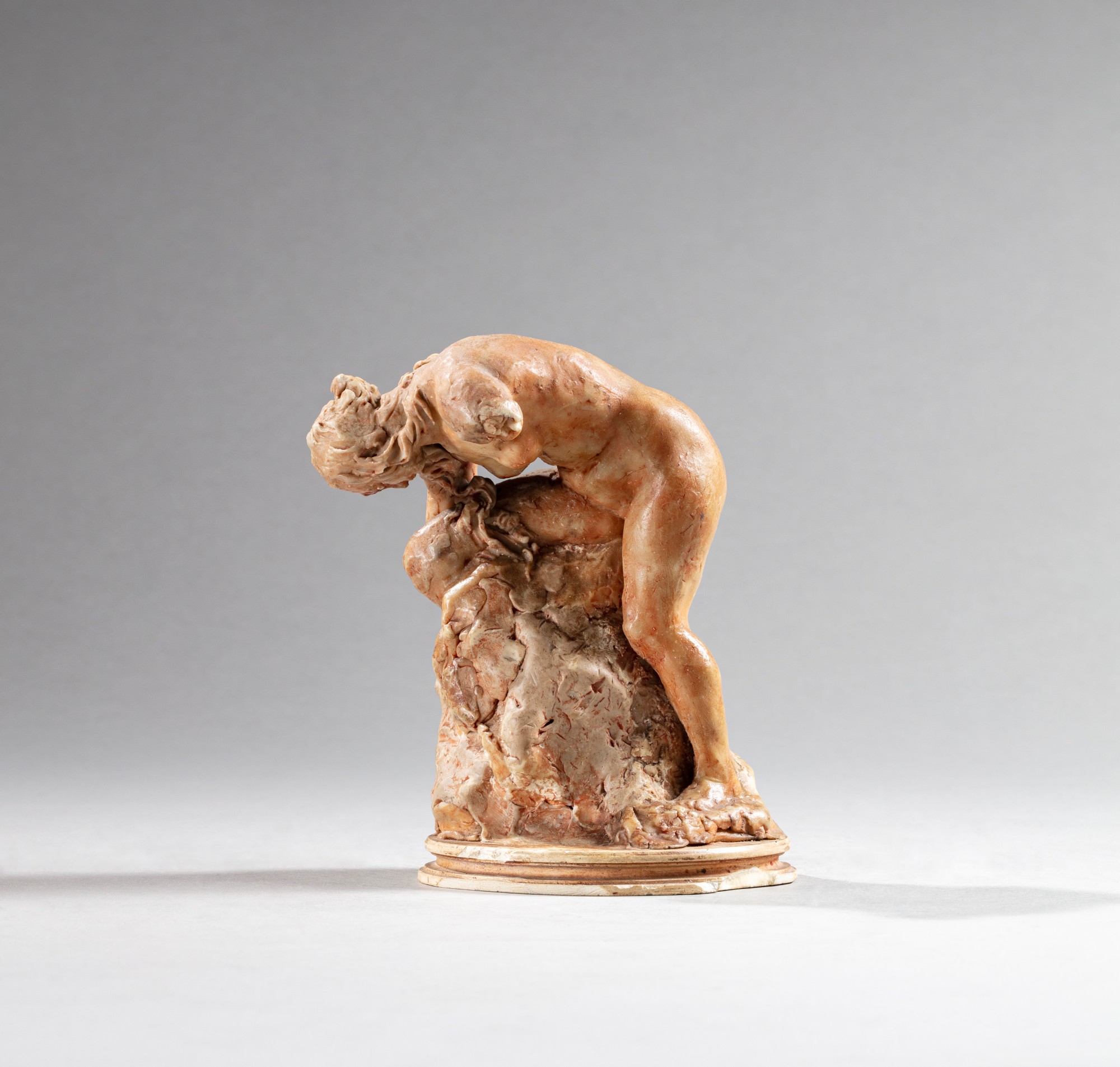
Jules Desbois
Baigneuse au rocher (Bather on a rock)
To understand Desbois fully is to understand the remarkable richness of French sculpture in the period running from roughly 1880 to 1920. He belongs to a constellation of artists that includes Camille Claudel, whose own tortured brilliance illuminated many of the same symbolist themes, as well as Alexandre Falguière and Jean Baptiste Carpeaux, each of whom grappled with the tension between academic tradition and expressive modernity. Desbois also worked across materials in ways that aligned him with the broader decorative arts revival of the period, producing pieces in ivory and silver alongside his bronzes, a versatility that speaks to his technical command and his engagement with the total aesthetic ambitions of the Art Nouveau moment. The legacy of Jules Desbois is that of an artist who pursued emotional truth with unflinching seriousness across a career spanning more than half a century.
He died in 1935, having witnessed the full arc of modernism's early upheavals, and his work stands today as a bridge between the romantic humanism of the nineteenth century and the psychological intensities of the twentieth. Institutions and collectors who bring his work into their collections are not merely acquiring beautiful objects, they are acquiring a point of view, a sustained argument about what sculpture can do to the human heart. In a market and a culture increasingly attentive to the full complexity of this extraordinary period, Jules Desbois has never felt more necessary.