Joseph Csaky
Joseph Csaky: Sculpture's Most Elegant Cubist Voice
Artist Spotlight · The Collection Editorial
In the grand galleries of the Musée National d'Art Moderne at the Centre Pompidou in Paris, visitors moving through the permanent collection of early twentieth century European sculpture occasionally pause before the compact, powerfully resolved forms of Joseph Csaky. There is something immediately arresting about his work, a sense that stone and bronze have been coaxed into a new grammar, one that speaks simultaneously of ancient monumentality and radical modernity. Csaky occupies a singular position in the history of Cubism, as one of the very few sculptors to fully absorb its lessons and translate them into three dimensions with both intellectual rigor and genuine warmth. Jozsef Csaky was born in 1888 in Szeged, Hungary, a city with a rich tradition of craft and decorative arts.
Joseph Csaky
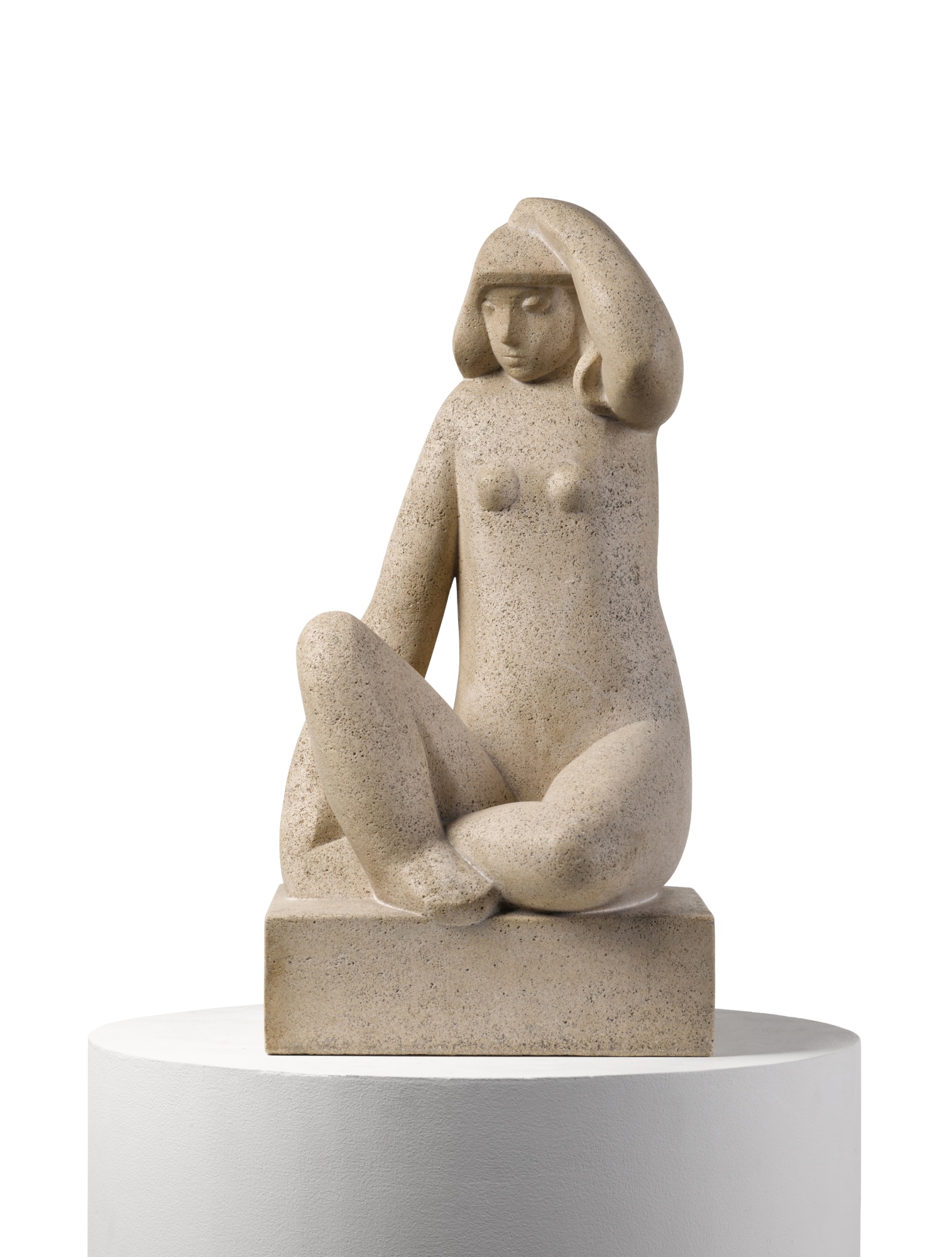
Femme assise, main sur la tête
He trained first at the Budapest School of Decorative Arts, where he developed the technical foundations that would serve him throughout his long career. In 1908, at the age of twenty, he made the decisive move to Paris, arriving in that extraordinary window of time just before the First World War when the city was a crucible of aesthetic revolution. He settled in Montparnasse, the beating heart of the avant garde, and quickly found himself immersed in conversations with artists who were dismantling centuries of pictorial convention. It was in Paris that Csaky encountered Cubism at its most vital and generative moment.
He became part of the circle gathering around Juan Gris, Fernand Léger, and the poets and critics who orbited the movement, absorbing the core Cubist proposition that form could be simultaneously analyzed and reconstructed, that a single object could be seen from multiple perspectives at once. For a sculptor, this was both a challenge and a liberation. Unlike painters, who could fragment a face or a guitar across a flat surface with relative freedom, a sculptor had to find ways to make mass itself feel multivalent, to let volume speak in several directions without losing coherence. Csaky solved this problem with extraordinary elegance.
Joseph Csaky
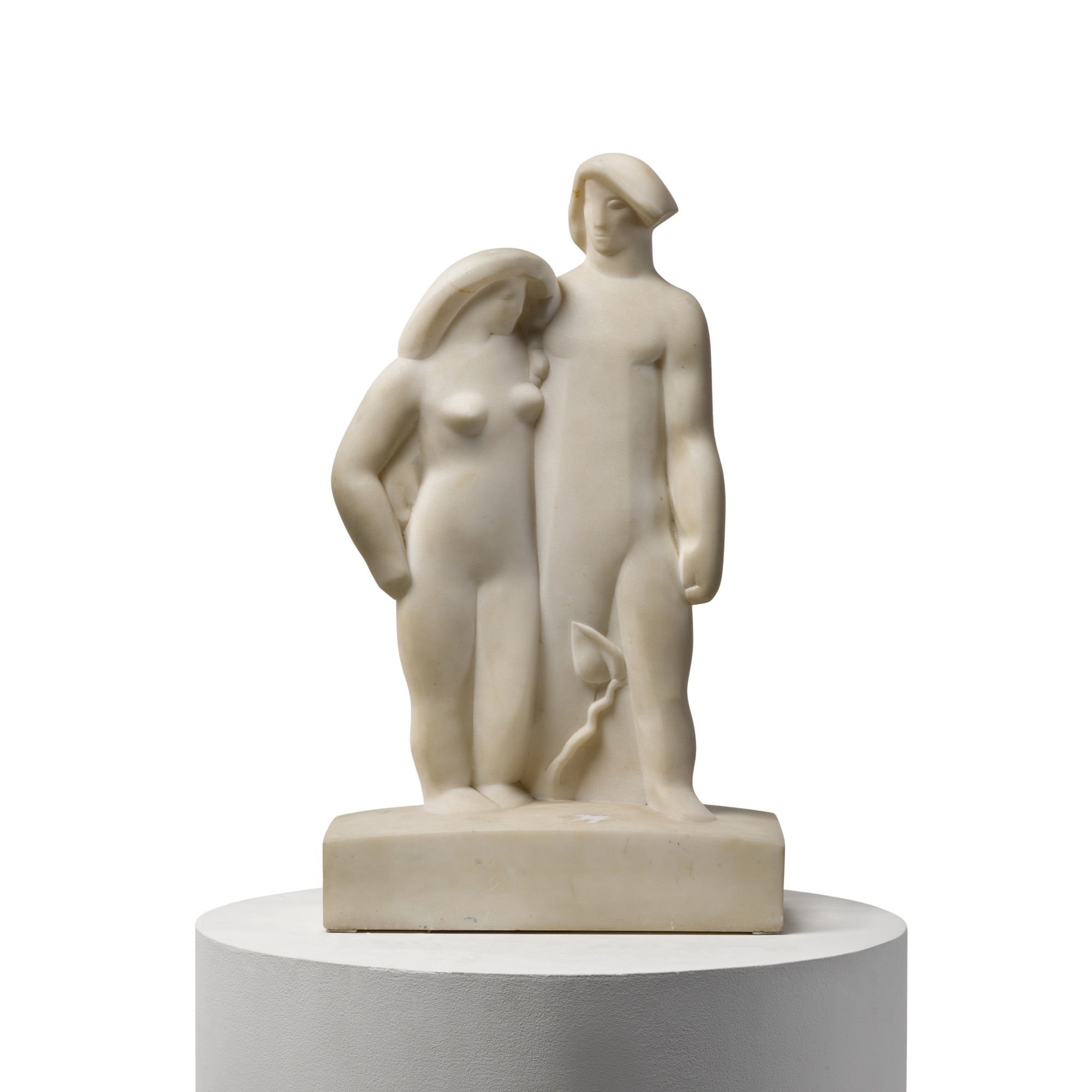
Adam et Eve
His breakthrough came in the years around 1911 to 1914, when he began exhibiting work that drew immediate critical attention. He showed at the Salon d'Automne and the Salon des Indépendants, where his geometric figures entered into dialogue with the paintings of the Section d'Or group. His early sculptures were among the first genuinely Cubist works in three dimensions, predating or paralleling the more celebrated sculptural experiments of Alexander Archipenko and Henri Laurens. What distinguished Csaky from the outset was a particular feeling for the human figure: even as he simplified and geometrized the body, he retained a deep sensitivity to posture, gesture, and psychological presence.
His figures think. They carry a kind of inward attention that purely formal abstraction tends to suppress. The works available on The Collection offer a compelling window into Csaky's range and his sustained engagement with the female figure across different materials and moods. Femme assise, main sur la tête, a seated woman with her hand raised to her head, distills a gesture of contemplation into a quietly monumental form, the planes of the body resolved into a rhythm that feels both ancient and completely of its moment.
Joseph Csaky
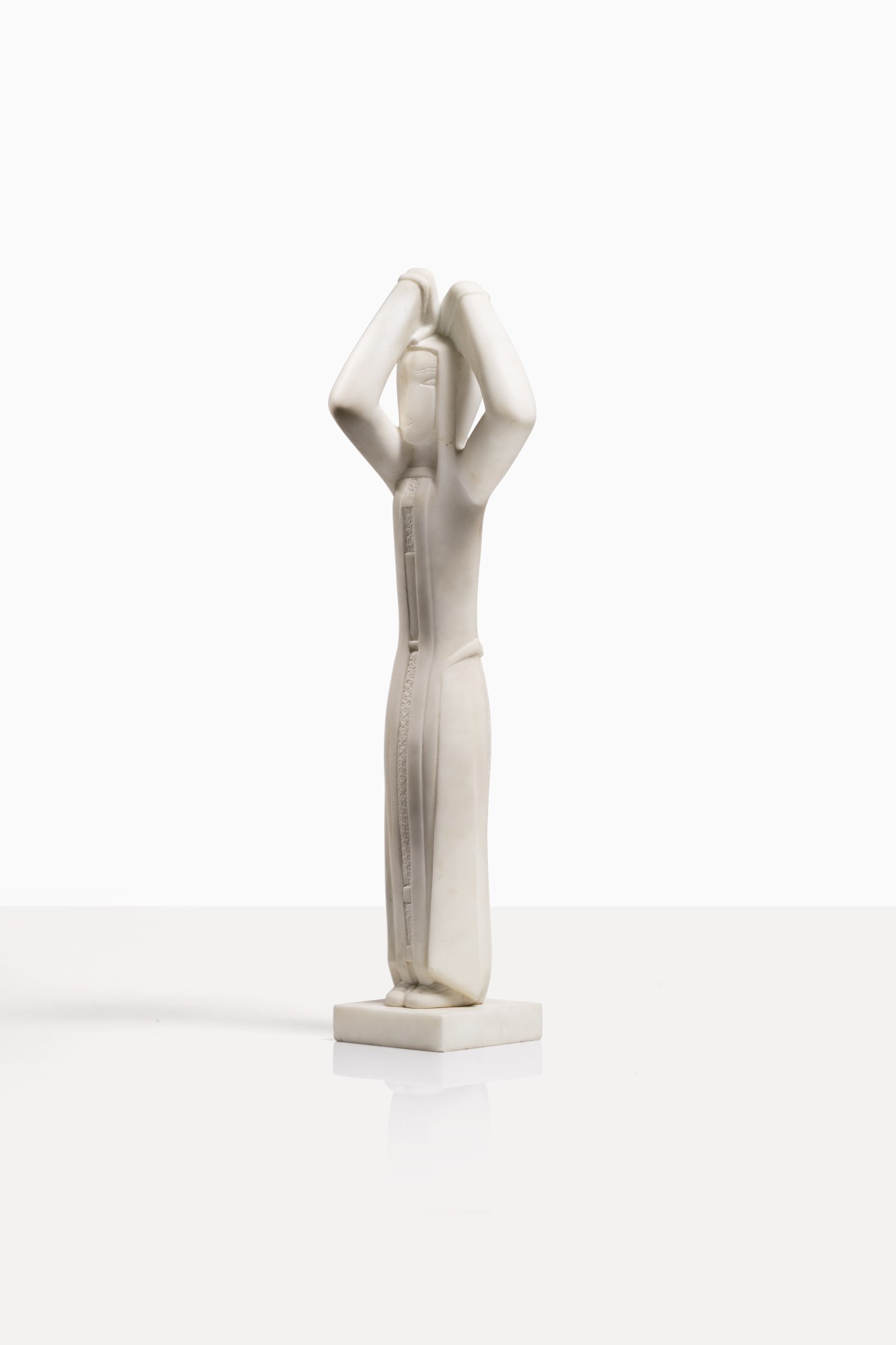
Femme aux bras levés, pièce unique
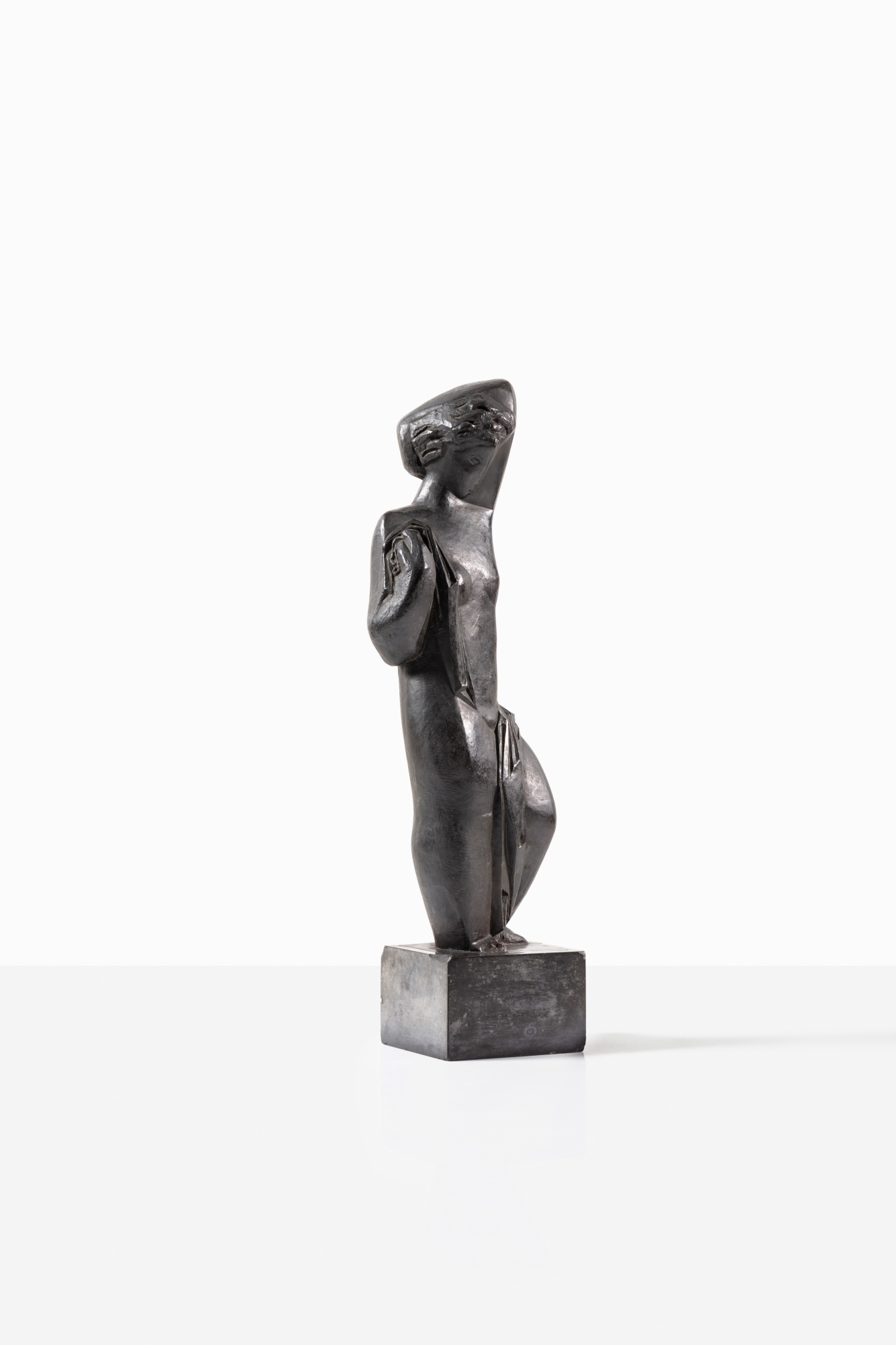
Adam et Eve in marble represents his ambition at its most classical, taking the oldest of human subjects and rethinking it through a modernist lens without sacrificing the weight and dignity that marble demands. Femme aux bras levés, a unique piece also in marble, shows the upward reach of raised arms translated into an almost architectural verticality, a form that seems to aspire toward something beyond the material. Femme Debout, in patinated bronze set on marble, demonstrates Csaky's mastery of the standing figure and his understanding of how different materials can be brought into conversation, the warm oxidized surface of the bronze playing against the cool permanence of stone beneath. For collectors, Csaky presents a genuinely compelling case.
He was active at one of the most consequential moments in the history of modern sculpture, and his best works hold their place with confidence alongside those of better known names. The market for Csaky has been historically undervalued relative to his actual art historical significance, which means that serious collectors have had the opportunity to acquire major works at prices that reflect neither their rarity nor their quality. His sculptures appear periodically at auction in Paris, London, and New York, with strong results for works that demonstrate the full integration of Cubist geometry and figurative sensitivity that defines his finest output. Collectors drawn to the broader Cubist tradition, and to the particular pleasures of early twentieth century European sculpture, will find in Csaky an artist whose work rewards sustained looking and deepens in interest over time.
Joseph Csaky
Femme Debout
To understand Csaky fully it helps to place him within a constellation of artists working through related problems in the same years. Archipenko was his near contemporary in the Montparnasse sculpture community, and the two shared an interest in the interpenetration of solid form and void. Henri Laurens brought a warmer, more sensuously curved language to Cubist sculpture, while Jacques Lipchitz moved toward a denser, more massively architectural approach. Csaky sits between these tendencies, more refined than Lipchitz at his most baroque, more geometrically rigorous than Laurens at his most lyrical.
His work also invites comparison with that of Ossip Zadkine, another artist of Central and Eastern European origin who found in Paris the conditions to develop a uniquely personal sculptural vision. The legacy of Joseph Csaky is one that continues to reward rediscovery. He lived and worked until 1971, a long life that allowed him to witness the full arc of the modernist movement he had helped to inaugurate, from its heroic beginnings in prewar Paris through the disruptions of two world wars and on into the pluralism of the postwar decades. His later work evolved toward a smoother, more classicizing resolution, but the underlying logic of his Cubist formation remained present as a kind of structural intelligence beneath the surface.
Today, as institutions and collectors alike reassess the full landscape of early twentieth century sculpture beyond the most canonical names, Csaky emerges as an artist of genuine importance, one whose commitment to the figure, to fine materials, and to the slow, patient work of formal resolution places him among the essential voices of his generation.