Josef Albers
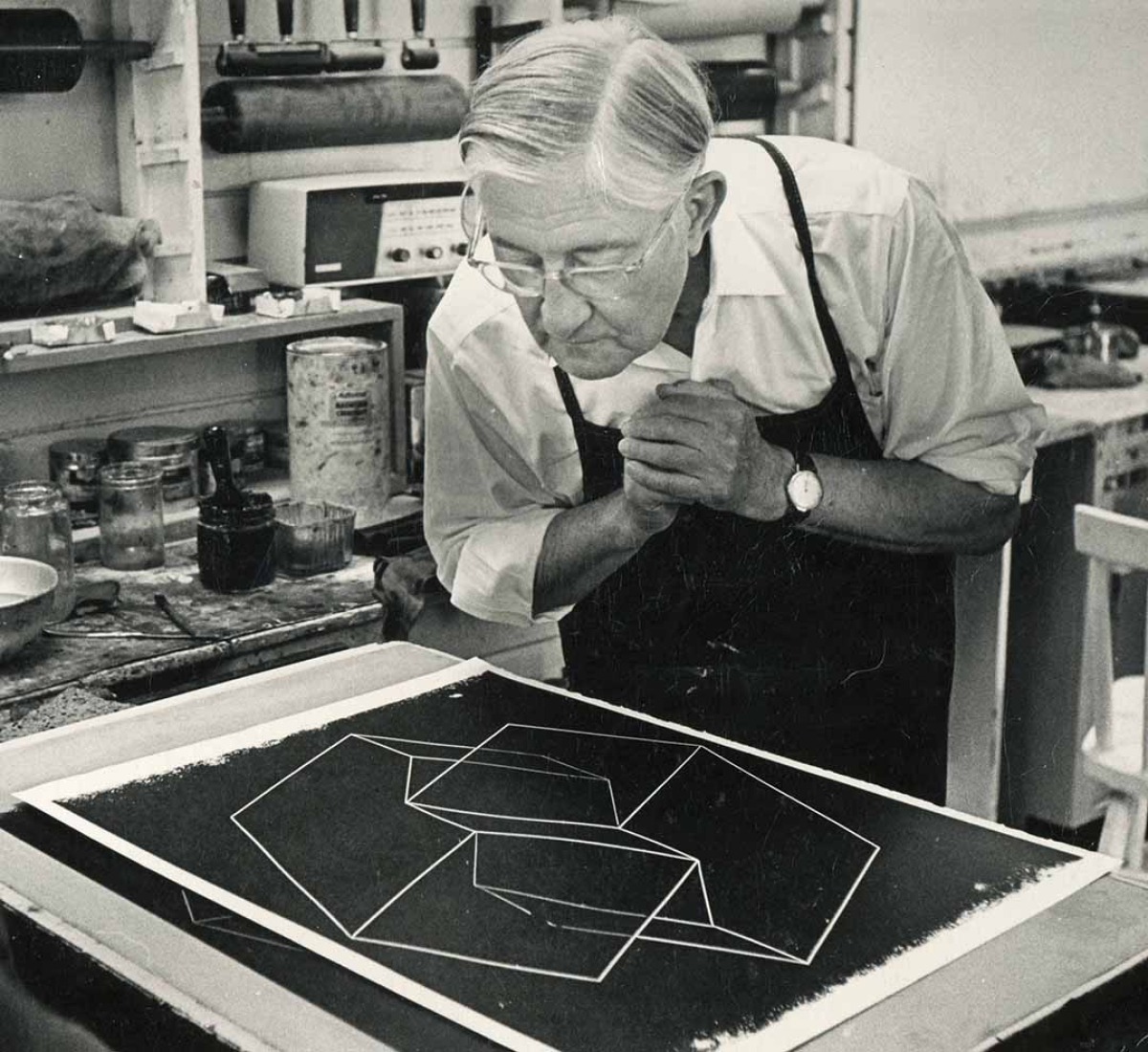
Josef Albers: The Man Who Taught Us Color
Artist Spotlight · The Collection Editorial
“In visual perception a color is almost never seen as it really is, as it physically is.”
Interaction of Color, 1963
There is a moment that visitors to the Josef Albers Museum in Bottrop, Germany, often describe in similar terms: standing before a wall of Homage to the Square paintings, something shifts. The eye begins to negotiate, to question, to feel. Squares that appear to float forward then recede. Colors that seem warm in one context and cool in another.
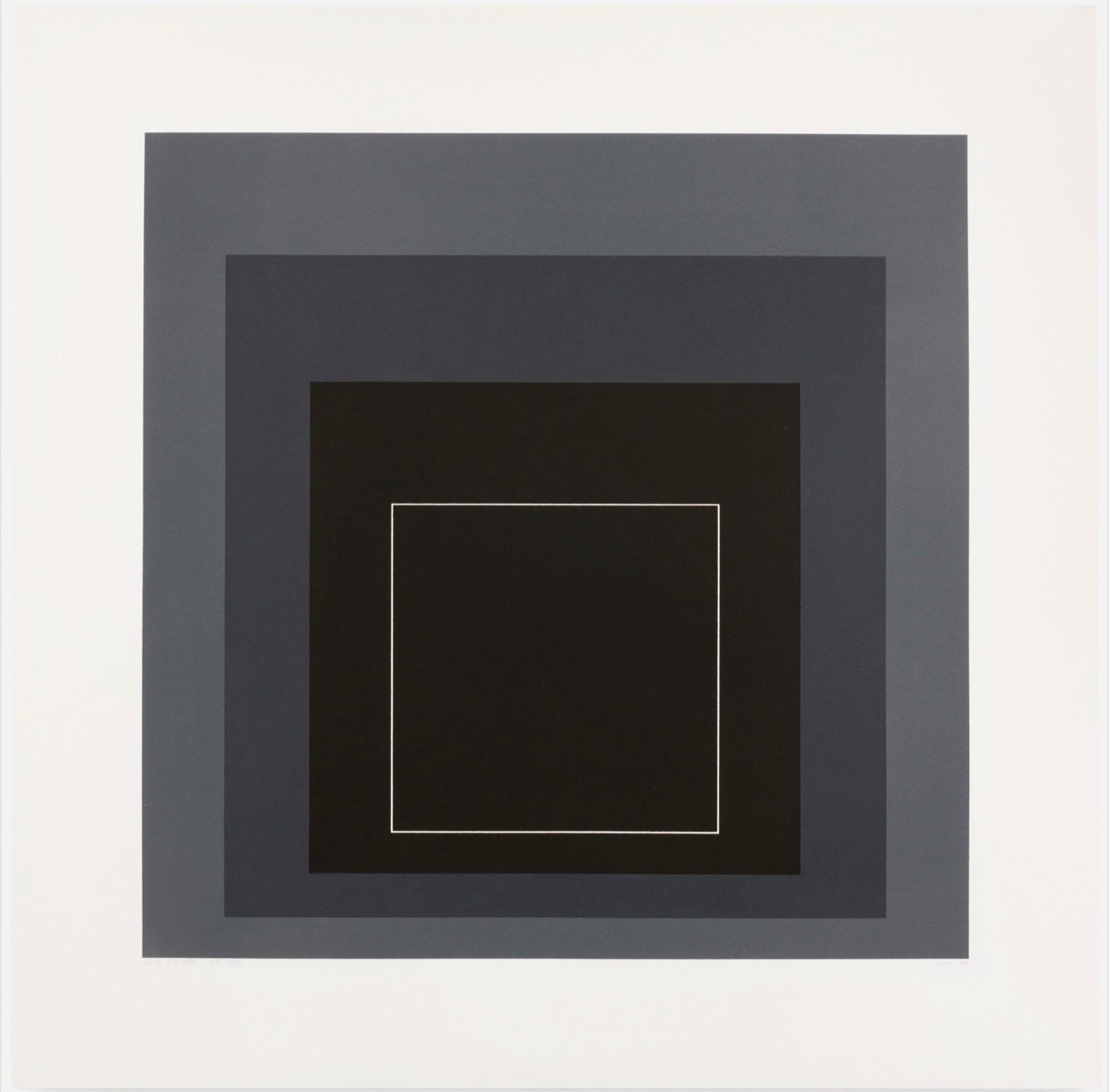
Josef Albers
Untitled, 1966
What looks like simplicity reveals itself as a lifetime of rigorous, joyful investigation. That experience, repeated across museum galleries and private collections around the world, is precisely what Albers spent more than five decades working toward. His influence on how we see, and how we teach others to see, remains as alive today as it was when he first pressed pigment onto Masonite in his New Haven studio. Josef Albers was born in 1888 in Bottrop, a modest industrial town in the Ruhr region of western Germany.
His father was a house painter and handyman, and the practical, material understanding of surfaces, tools, and craft was part of his earliest education. He trained initially as a schoolteacher and worked in that role before his hunger for something deeper led him to study art in Berlin, then Essen, then Munich. By the time he arrived at the Bauhaus in Weimar in 1920, he was already in his thirties, older than most of his fellow students and burning with a seriousness of purpose that the institution would quickly recognize and reward. The Bauhaus years were formative in ways that would define everything that followed.
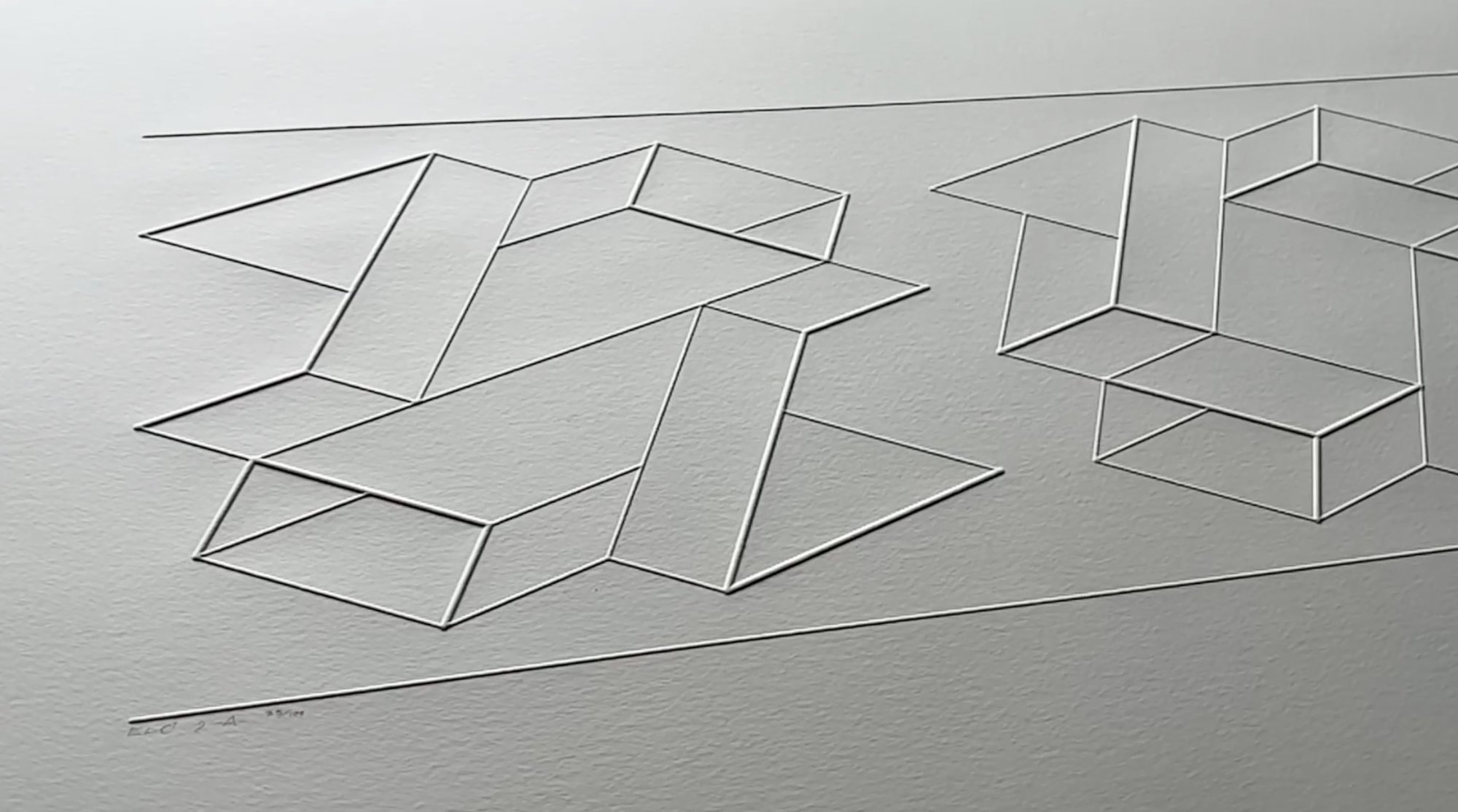
Josef Albers
Embossed Linear Constructions (ELC) 1-C, 1969
Albers began as a student but rose with remarkable speed to become a master teacher, leading the preliminary course and developing an influential approach to glasswork that drew on his interest in transparency, light, and geometric structure. When the Bauhaus relocated to Dessau in 1925, Albers moved with it, and when the school finally closed under pressure from the National Socialist government in 1933, Albers was among the first faculty members to receive an invitation to rebuild his practice abroad. Black Mountain College in North Carolina extended that offer, and Albers and his wife, the textile artist Anni Albers, emigrated to the United States that same year. The journey from Bottrop to the Blue Ridge Mountains is one of the great pivots in modern art history.
“To design is to plan and to organize, to order, to relate and to control.”
Josef Albers
At Black Mountain College, Albers taught with the same intense, Socratic curiosity he had brought to the Bauhaus. He challenged students to discover rather than merely absorb, famously beginning courses by asking them to examine a single piece of paper and describe everything they observed about it. Among those who passed through his classes were Robert Rauschenberg, Cy Twombly, and a generation of artists who would go on to reshape American visual culture. In 1950 he joined Yale University as the founding chair of its Department of Design, a post he held until 1958, and through Yale his influence spread further still, touching architects, designers, and painters in equal measure.
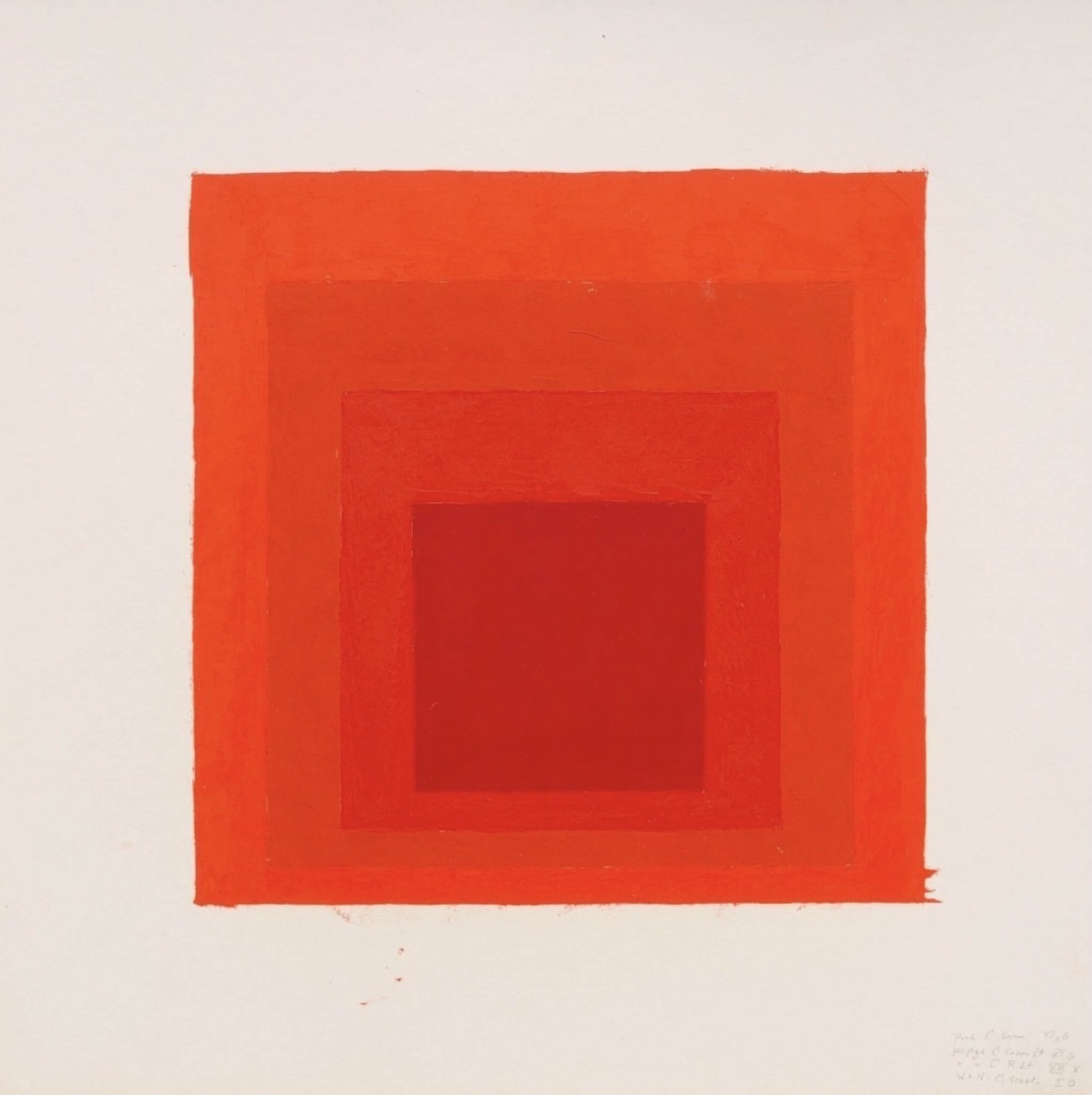
Josef Albers
Study for Homage to the Square
His 1963 publication Interaction of Color, a teaching portfolio and theoretical text that demonstrated through visual exercises how color behaves relative to its surroundings, became one of the most widely read and taught texts in art education. It remains in print and in syllabi today. The series for which Albers is best known, Homage to the Square, occupied him from 1950 until his death in 1976. Over those twenty six years he produced more than a thousand paintings and prints within the same basic format: three or four squares nested concentrically, each filled with a single color, arranged according to a precise compositional formula.
“Art problems are problems of human relationship.”
Josef Albers, lecture notes, Black Mountain College
The constraint was deliberate and liberating in equal measure. By holding the structure constant, Albers was free to direct every ounce of attention toward color interaction, studying how hues influence one another, how context transforms perception, and how much feeling can be carried by pure chromatic relationship. Works such as Orange Facade from 1959 and Homage to the Square: In Wide Light B, also from 1959, both painted in oil on Masonite, demonstrate the full range of emotional temperature he could achieve within that format, from smoldering warmth to cool, luminous expansion. Beyond the Homage series, Albers pursued a parallel body of work in his Structural Constellations, precise linear drawings and engravings that explore impossible spatial relationships, flat lines that appear to describe three dimensional forms that cannot exist in physical space.
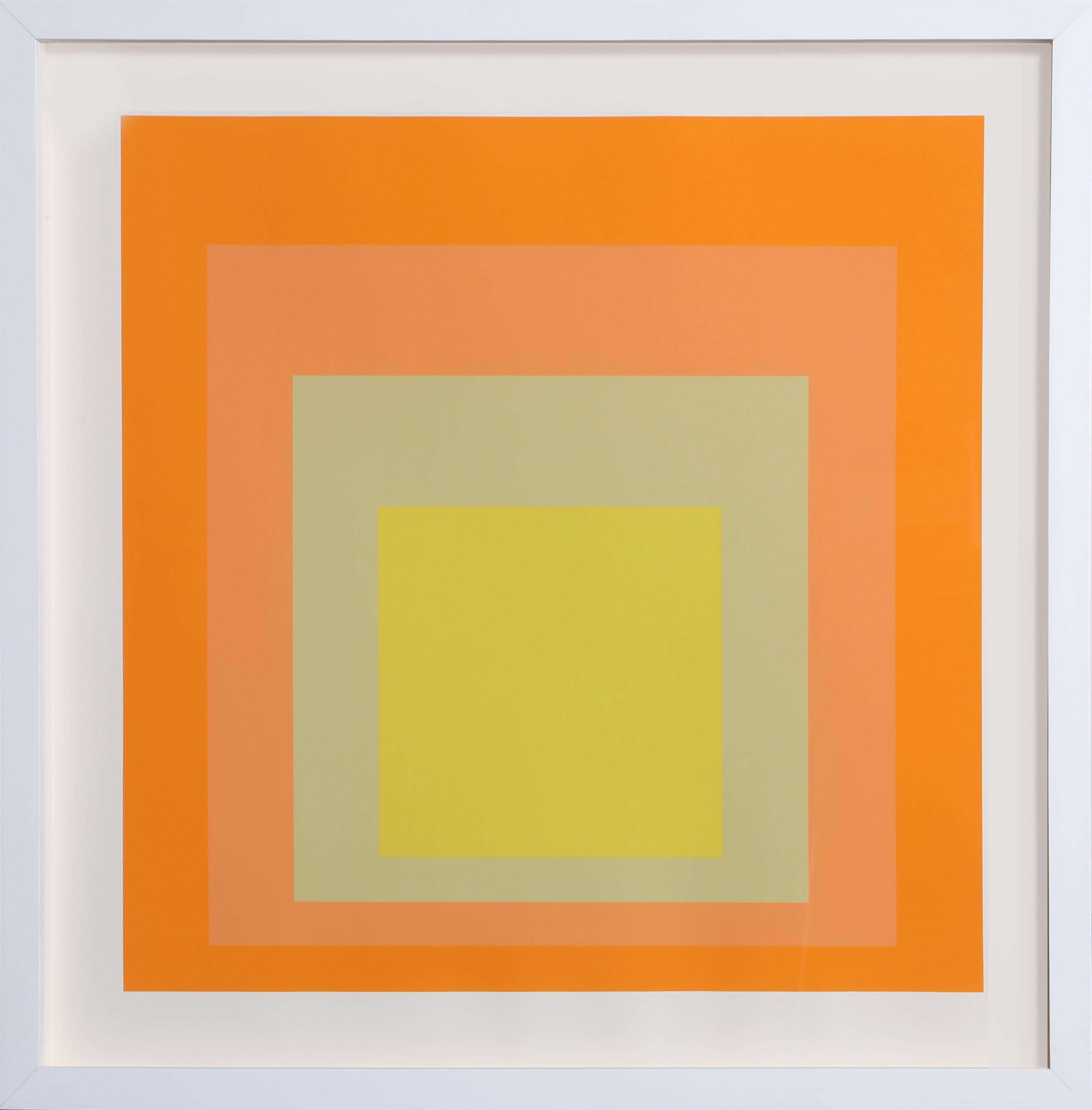
Josef Albers
Interaction of Color: Homage to the Square
Works such as Structural Constellation: Duo H sit in a different register from the color paintings, quieter and more cerebral, but equally rigorous. His printmaking practice, represented by screenprints such as SP IV from the SP series and the Embossed Linear Constructions, extended his investigations into the realm of multiples without sacrificing any of the precision that defined his studio work. Albers was an artist for whom every decision, the tooth of the paper, the sequence of colors applied, the size of a margin, carried meaning. For collectors, Albers represents one of the most coherent and intellectually rewarding bodies of work in twentieth century American art.
His market is strong and steady, supported by the institutional validation of museums including the Museum of Modern Art in New York, the Guggenheim, the Tate Modern in London, and the Kunstmuseum Basel. Study for Homage to the Square works on board and gouache on paper offer accessible points of entry for collectors building a relationship with the artist, while major oil on Masonite canvases and rare large format screenprints occupy the upper tier. What draws sophisticated collectors to Albers is not simply the beauty of individual works but the satisfaction of understanding the system, of seeing how each piece participates in a larger, lifelong inquiry. Collecting Albers rewards looking and thinking in equal measure.
Albers sits at a rich intersection in art historical terms. His Bauhaus roots connect him to Wassily Kandinsky, Paul Klee, and László Moholy Nagy. His color theory work anticipates and informs the Color Field painters, particularly Mark Rothko and Ellsworth Kelly, both of whom engaged seriously with questions of chromatic perception. His geometric precision places him in natural dialogue with Victor Vasarely and Bridget Riley in the Op Art tradition, and his influence on Minimalism, from Donald Judd to Frank Stella, is well documented.
He is not simply a precursor to these movements but a living bridge between European modernism and the American avant garde, a figure who carried the most vital intellectual energies of one tradition into the heart of another. To encounter Albers today is to encounter an artist whose questions have not aged. In a visual culture saturated with images competing for attention through noise and novelty, his work insists on slowing down, on looking again, on trusting that careful observation reveals more than first impressions suggest. He once described his purpose as demonstrating that one and one makes three or more, meaning that two colors placed together produce a third experience that neither possesses alone.
That idea, generous and empirical and endlessly generative, is as radical now as it was in 1950. Josef Albers did not merely make beautiful objects. He taught generations of eyes how to be more awake in the world.
Explore books about Josef Albers
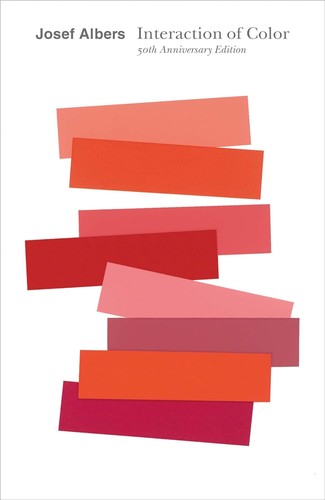
Interaction of Color
Josef Albers
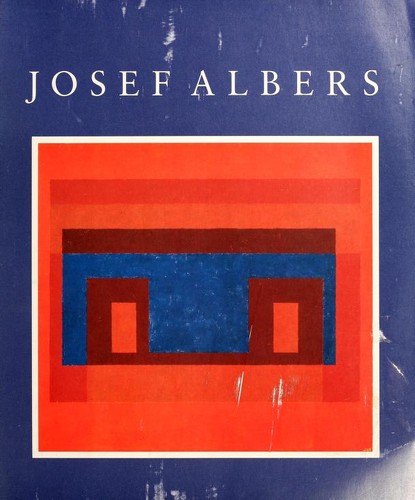
Josef Albers: A Retrospective
Nicholas Fox Weber
Josef Albers
Francois Bucher

The Albers Foundation Collection
Nicholas Fox Weber
Josef Albers: His Work as Contribution to Modern Art
Eugen Gomringer
Search Versus Re-Search
Josef Albers

Josef Albers: Paintings and Prints
Magdalena Droste