Jonathan Wateridge
Jonathan Wateridge Paints Memory Into Being
Artist Spotlight · The Collection Editorial
There is a particular kind of attention that Jonathan Wateridge's paintings demand. Standing before one of his large scale canvases, the viewer is drawn into a world that feels simultaneously familiar and deeply strange, as though a half remembered film has been paused at its most psychologically charged moment. That quality of suspended narrative has earned the British Zambian painter a devoted international following, and recent years have seen his reputation consolidate significantly, with institutional interest deepening and collectors across Europe and North America competing for works that arrive on the market with increasing rarity. His solo exhibitions at Rokeby gallery in London have been defining moments for the city's contemporary figurative painting scene, positioning Wateridge alongside the most serious painters working in Britain today.
Jonathan Wateridge
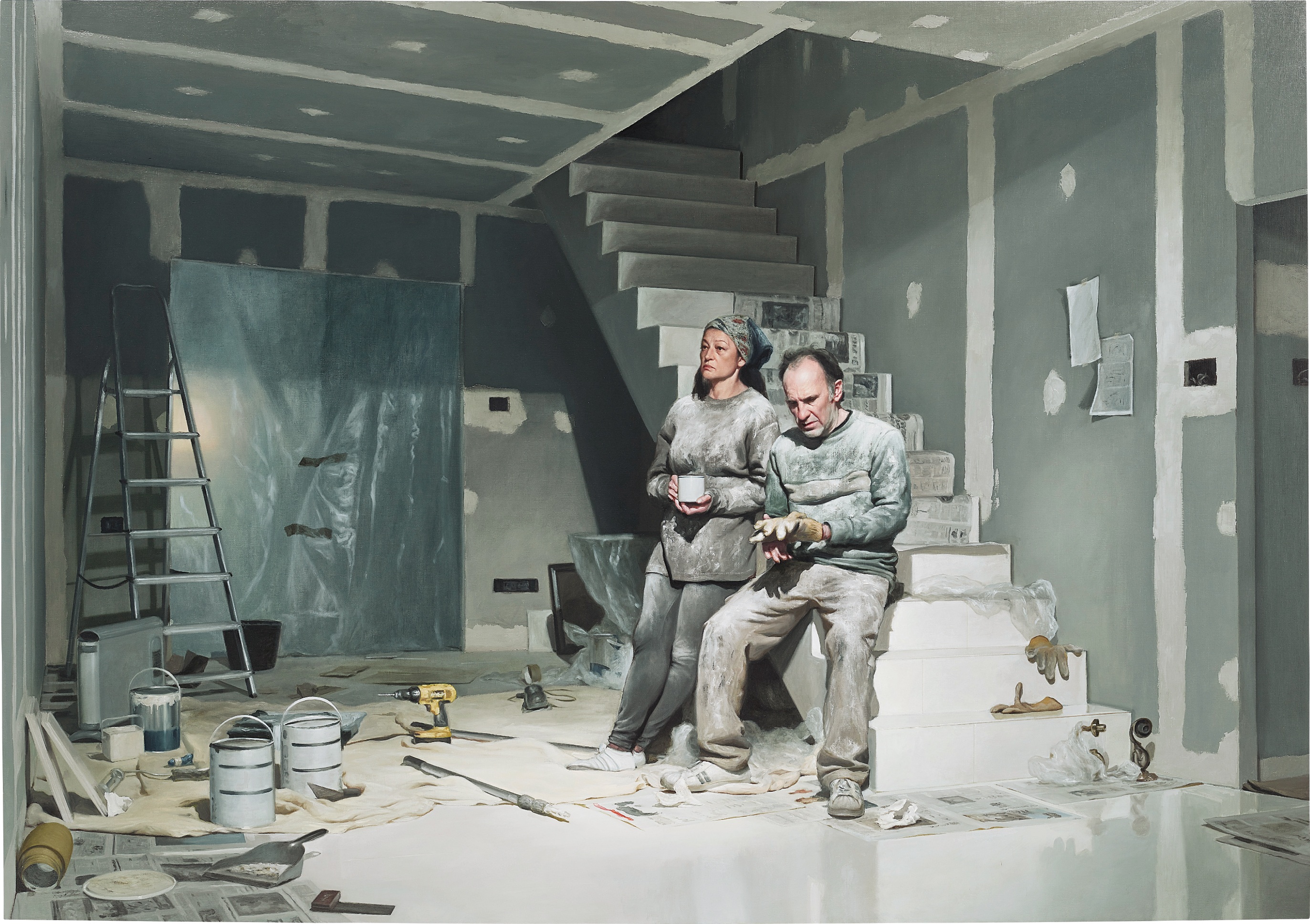
Repainting, 2011
Wateridge was born in 1972 and his early years were shaped by the experience of growing up between cultures, between the lush, charged landscapes of Zambia and the very different visual and social world of Britain. That sense of being between places, of belonging fully to neither, runs through his practice like a quiet but insistent current. It is not nostalgia exactly, though memory is always present. It is something closer to the feeling of trying to reconstruct a place or a moment from fragments, knowing the reconstruction can never be complete and that the gaps themselves carry meaning.
These formative experiences gave Wateridge an unusually rich set of visual and emotional references to draw upon. He pursued his formal training at the Ruskin School of Drawing and Fine Art at the University of Oxford, one of Britain's most distinguished art schools and an institution with a long tradition of nurturing painters who think seriously about representation and its limits. The Ruskin gave Wateridge both technical rigour and the intellectual framework to interrogate what painting can and cannot do. He emerged from his studies with an exceptional command of oil paint and a set of conceptual concerns that have only deepened over the decades since.
Jonathan Wateridge
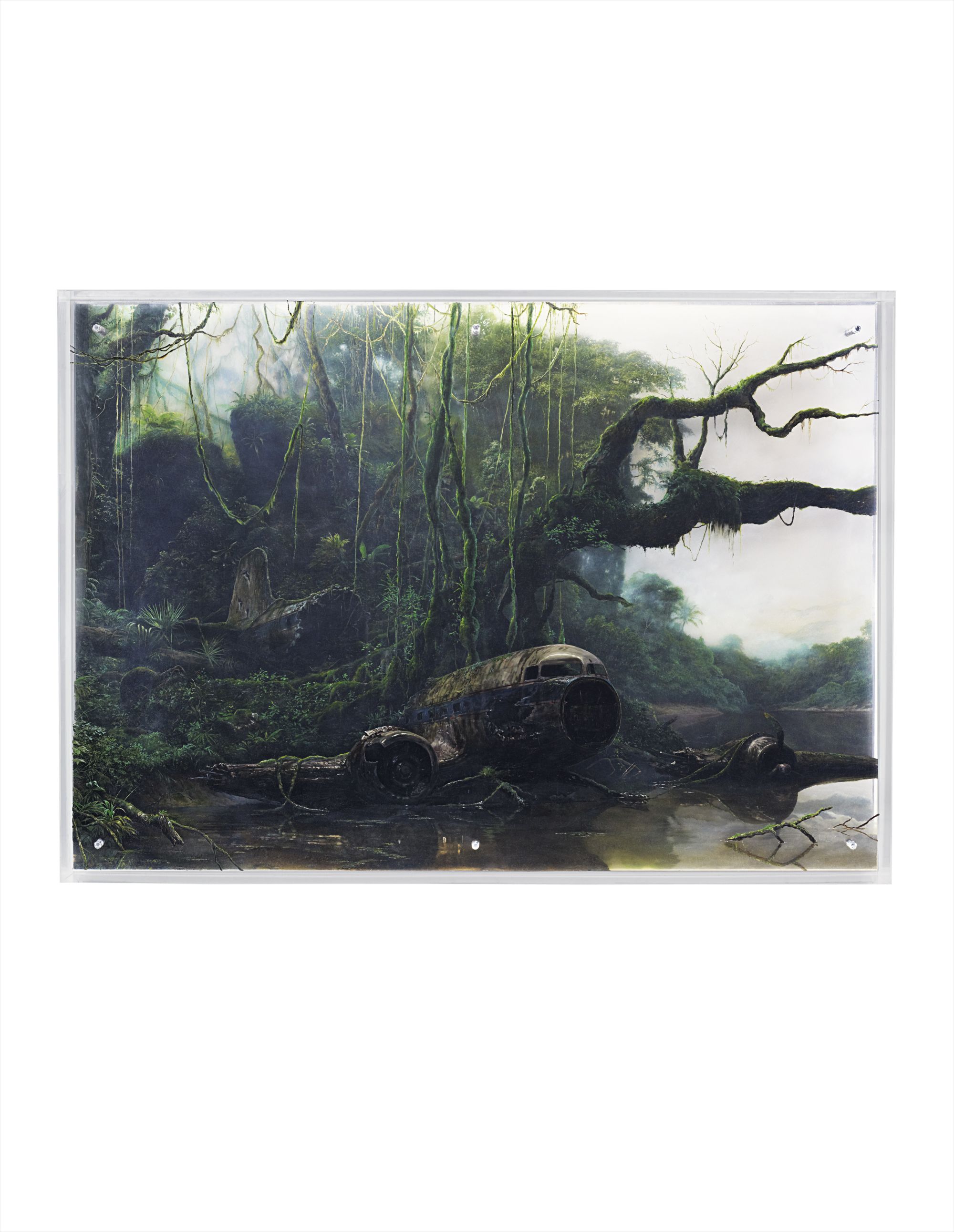
Jungle River Landscape with Plane Wreck
The combination of technical accomplishment and genuine philosophical seriousness is rare, and it is central to understanding why his work has resonated so strongly with curators and collectors alike. Wateridge's practice is built around a distinctive and carefully considered process. Rather than working from direct observation, he constructs elaborate staged photographs using professional film and photography equipment, essentially art directing scenes that are then used as source material for the paintings. This approach connects his work to a broader conversation about the mediated image, about how photographs and film have shaped the way contemporary people understand the past and reconstruct memory.
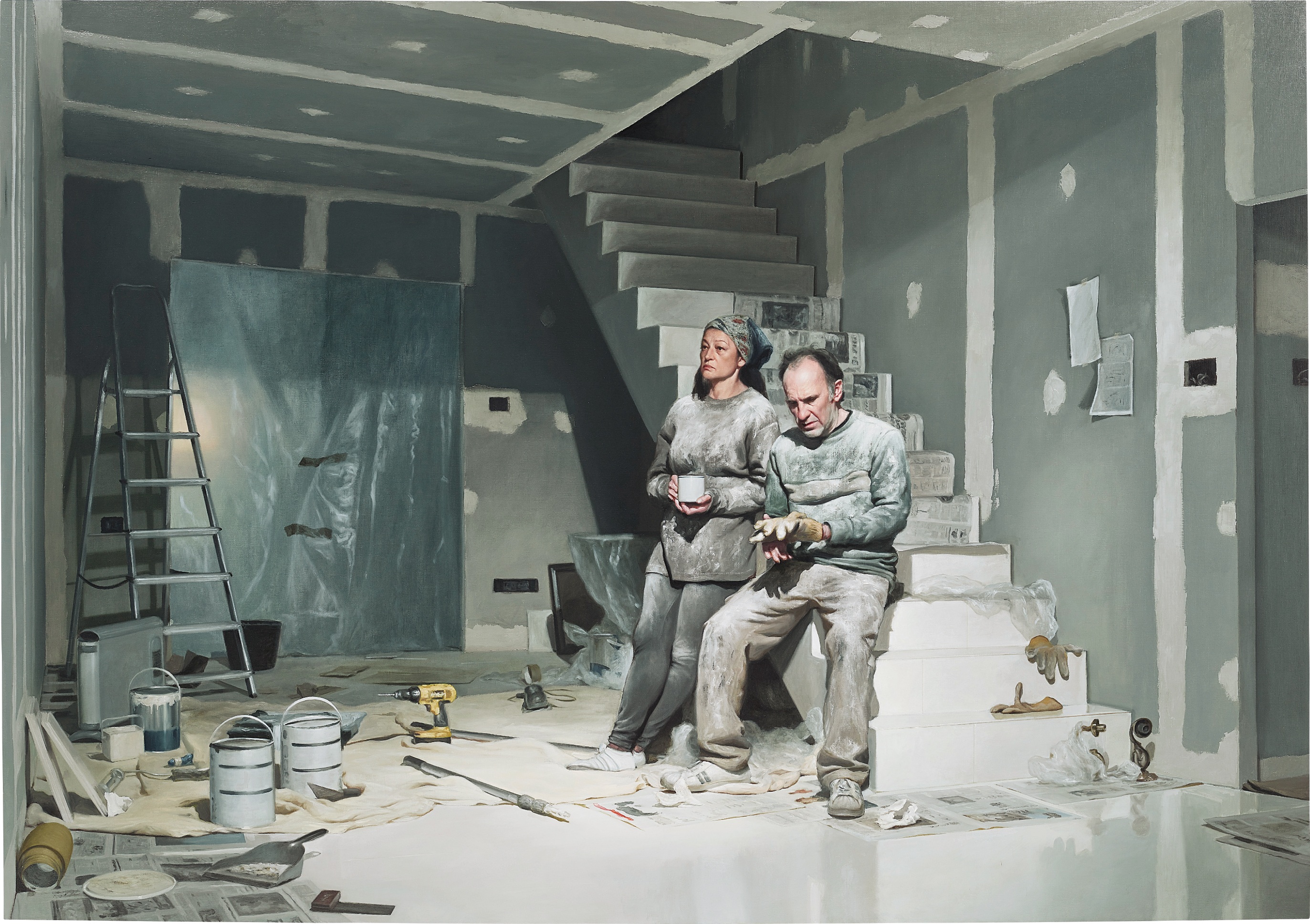
The paintings that result have a cinematic quality that is immediately legible but never merely illustrative. They feel like stills from films that do not exist, which is precisely their power. Figures appear in dense jungle settings, in ruined or ambiguous architectural spaces, in moments of action or stillness whose context is deliberately withheld. "Repainting" from 2011 is among the works that best illustrate his achievement in this period.
The oil on canvas operates with a layered self awareness, folding the act of pictorial construction into its own subject matter. The work invites the viewer to think about what it means to revisit an image, to apply new readings over old ones, and to ask whether any painted scene can be innocent of the images that preceded it. "Jungle River Landscape with Plane Wreck," executed in oil on plexiglass sheets in ten parts, is an even more ambitious statement. The use of plexiglass as a support introduces literal transparency and fragmentation into the work, so that the painted surface and the physical material of the painting are in active dialogue.
The image of a plane wreck half consumed by jungle vegetation carries unmistakable resonances of colonial history, of adventure narratives gone wrong, of the way the natural world absorbs and eventually erases human ambition. For collectors, Wateridge offers something genuinely uncommon: a painter whose work rewards sustained looking and whose prices have risen steadily without yet reaching the ceiling that his quality justifies. His works in oil on canvas are sought after for their technical finesse and their capacity to hold a wall with quiet authority, while the more experimental multi panel plexiglass works appeal to collectors with an appetite for works that challenge the conventional boundaries of painting as a medium. Because Wateridge produces relatively few works each year, scarcity is a real factor in the market.
Those who have collected early and held have seen their acquisitions appreciate meaningfully. For those coming to his work now, the advice that any serious advisor would offer is to move with intention: opportunities to acquire significant examples do not remain open for long. Wateridge belongs to a broader constellation of contemporary painters who have returned to figuration not as a retreat from conceptual ambition but as its fullest expression. His concerns overlap with those of painters like Luc Tuymans, whose cold and claustrophobic figures similarly refuse to yield their full meaning, and Neo Rauch, whose dreamlike scenes draw on memory, history, and the unconscious in ways that parallel Wateridge's own methods.
There is also a clear connection to the tradition of painters who have worked with photography and film as generative sources, from Gerhard Richter's photo paintings onward. What distinguishes Wateridge within this company is the specificity of his biographical and geographic sensibility. The postcolonial dimension of his work, the way it holds the experience of displacement and cultural complexity without reducing it to illustration, gives it a depth that places it firmly in the most important conversations happening in painting today. Wateridge's legacy is still being written, which is part of what makes collecting his work so compelling right now.
He is an artist at full command of his powers, producing work that speaks to the central anxieties and fascinations of contemporary life: the instability of memory, the seductiveness and deception of images, the weight of history on the present moment. Institutions that have not yet acquired his work will. The collectors who have recognised his importance early are already part of the story of how twenty first century British painting found its footing and its ambition. For anyone who believes that painting remains one of the most profound and inexhaustible forms of human inquiry, Jonathan Wateridge is an artist whose work deserves not just admiration but the closest possible attention.