John Sloan
John Sloan, Poet of City Life
Artist Spotlight · The Collection Editorial
“Art is the response of the living to life. It is therefore the most vital of all human activities.”
John Sloan, "Gist of Art", 1939
There is a particular kind of painting that makes you feel you have pressed your face against a warm window on a cold night and glimpsed something true about the way people actually live. John Sloan painted those windows, those streets, those rooftops, and those ordinary moments of urban existence with a tenderness and honesty that still feels startlingly fresh more than a century after the work was made. His canvases belong to the great tradition of democratic American art, a tradition that insists the life of a laundress, a barroom regular, or a woman hanging washing in the wind deserves the same attentive gaze that European academies reserved for gods and heroes. That conviction, pursued across five decades of restless, searching work, is why Sloan remains one of the most rewarding and quietly radical figures in American art history.
John Sloan
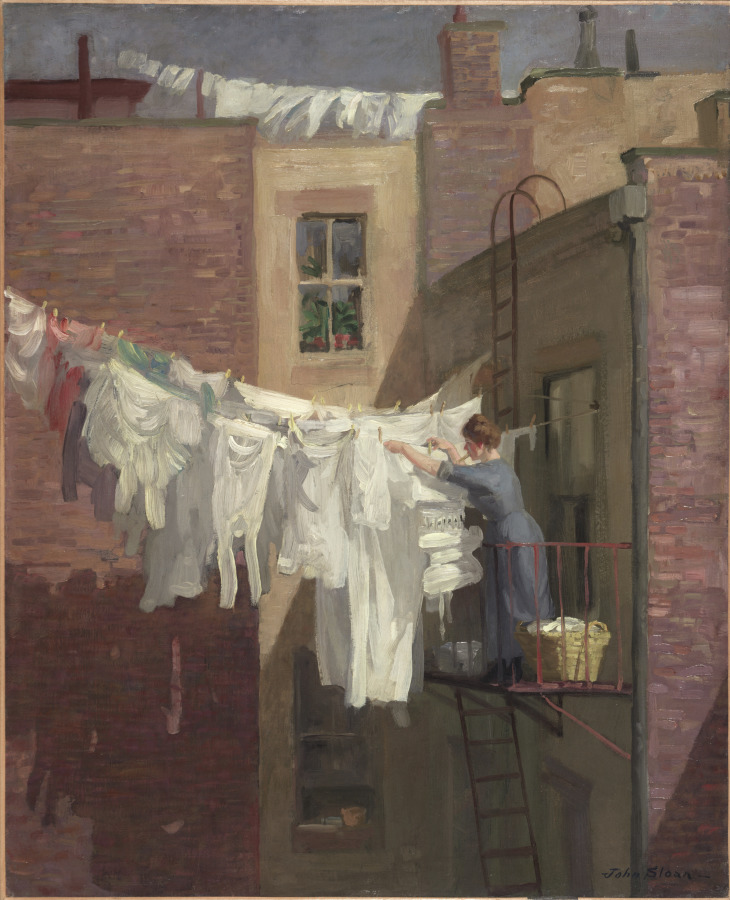
A Woman's Work, 1912
John French Sloan was born in Lock Haven, Pennsylvania, in 1871, the son of a modest family that moved to Philadelphia when he was still a child. He was largely self taught in his early years, working as a commercial illustrator and puzzle designer for newspapers and publishing houses in Philadelphia during the 1890s. That training in illustration sharpened his eye for narrative and gave him an instinct for capturing the telling detail, the gesture that says everything, the expression caught in the instant before it disappears. He fell into the orbit of the painter Robert Henri, whose passionate belief in art as a form of social engagement transformed Sloan from a skilled craftsman into a committed artist with something urgent to say.
Henri gathered around him a group of Philadelphia painters who would eventually become notorious as the Ashcan School, a name coined half in mockery that they wore with pride. Sloan, along with Henri, George Luks, William Glackens, and Everett Shinn, brought to American painting a gritty new attention to the textures of urban working life. When Sloan relocated to New York City in 1904, settling in Greenwich Village, the city became his great subject. He walked its streets obsessively, filled sketchbooks with observations, and translated what he saw into paintings of an almost journalistic immediacy that nonetheless carried genuine painterly depth.
John Sloan
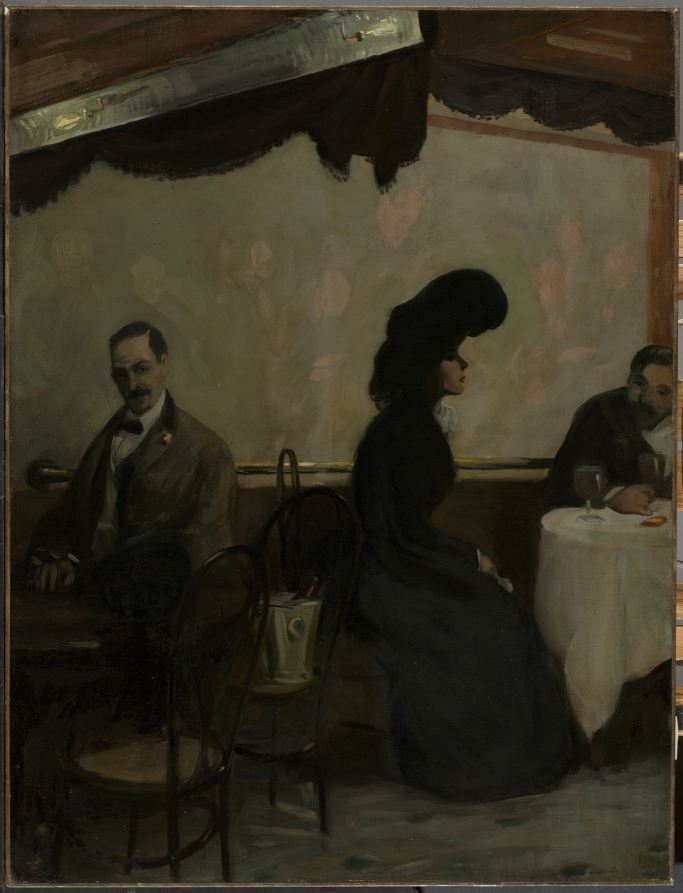
The Rathskeller, 1901
The move to New York was the defining catalyst of his mature career. The years between roughly 1905 and 1915 represent the peak of his urban realist work, a body of paintings and etchings that stand among the most vital produced on American soil during that era. "A Woman's Work," painted in 1912, captures a woman hanging laundry against the grey geometry of a city building with a dignity and warmth that transforms a mundane chore into something worth celebrating. The painting rewards close looking: the quality of light, the weight of the fabric, the unselfconscious posture of the figure all speak to Sloan's profound respect for his subjects.
“The most interesting thing in the world is a human being.”
John Sloan
"The Rathskeller," completed in 1901 and among his earlier masterworks, plunges the viewer into the amber glow of a basement restaurant, rendering the social rituals of ordinary city dwellers with the same seriousness a Dutch Golden Age painter might bring to a tavern interior. These are paintings that trust the viewer to find meaning in the everyday. His printmaking practice runs parallel to his painting and deserves equal attention from collectors and scholars alike. Sloan produced a remarkable body of etchings, many of which are considered among the finest prints made by any American artist of the twentieth century.
John Sloan
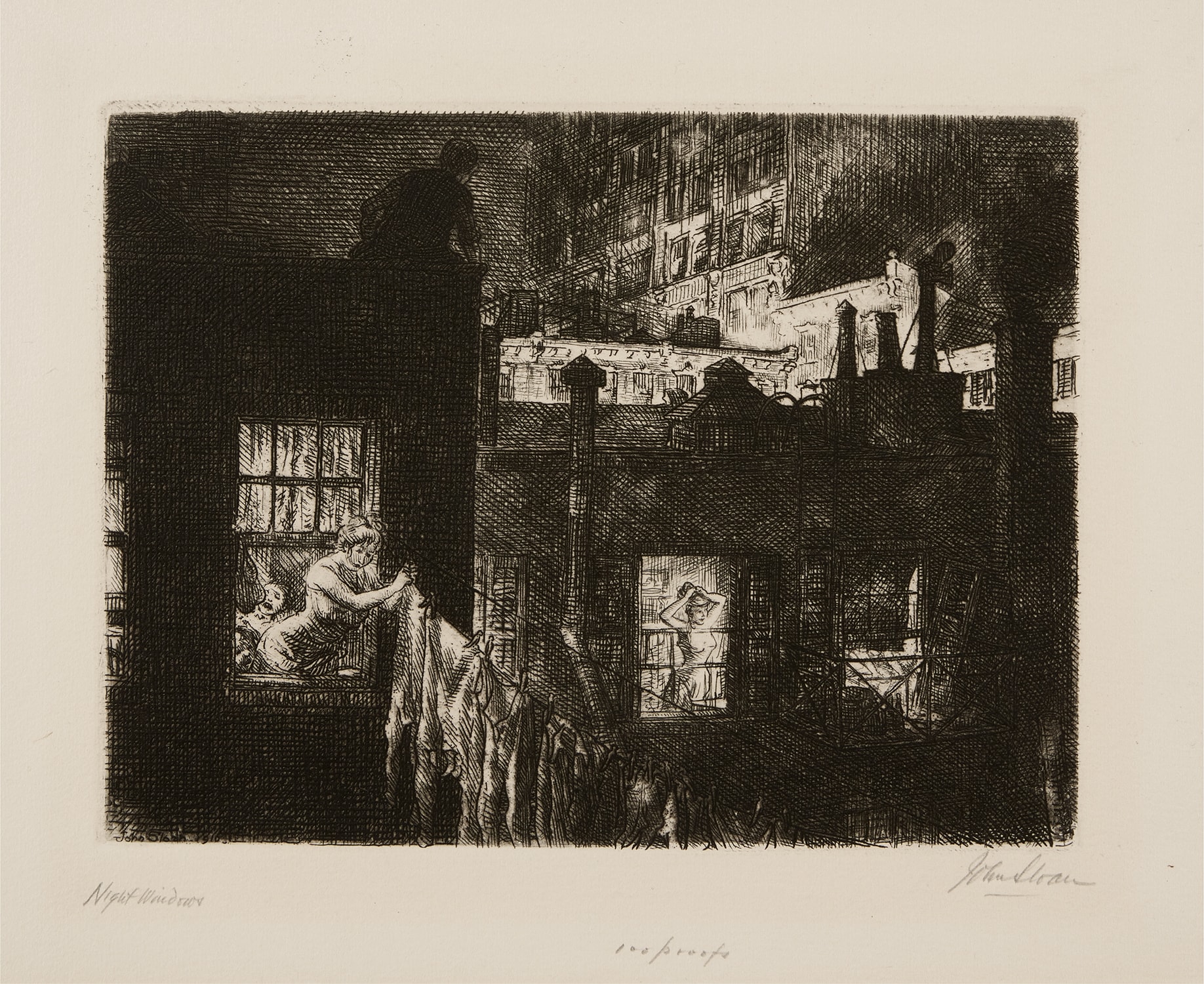
Night Windows (M. 152)
Works such as "Night Windows" demonstrate his mastery of the medium and his ability to translate the particular quality of city light, whether gaslit, electric, or simply the pale glow of a domestic interior seen from outside, into the subtle tonal language of etching. These prints circulated widely in his lifetime and introduced his vision to audiences who might never encounter the paintings, and they remain among the most accessible and collectible points of entry into his world today. On the market, Sloan occupies an enviable position as an artist whose work combines genuine art historical importance with relative accessibility compared to his peers. His oils appear regularly at the major American sale rooms, including Christie's and Sotheby's, where strong examples of his New York city scenes and his later New Mexico landscapes have commanded prices in the six figure range.
Collectors drawn to American Modernism and Social Realism consistently seek out his work, and institutions including the Delaware Art Museum, which holds a significant collection, and the Smithsonian American Art Museum have long championed his legacy. For collectors entering his work through prints, the etchings offer an extraordinary opportunity to own museum quality objects that speak directly to the heart of his artistic achievement. To understand Sloan fully, it helps to place him in conversation with the artists around him. Robert Henri shares his democratic impulse and his love of paint applied with confidence and speed.
John Sloan
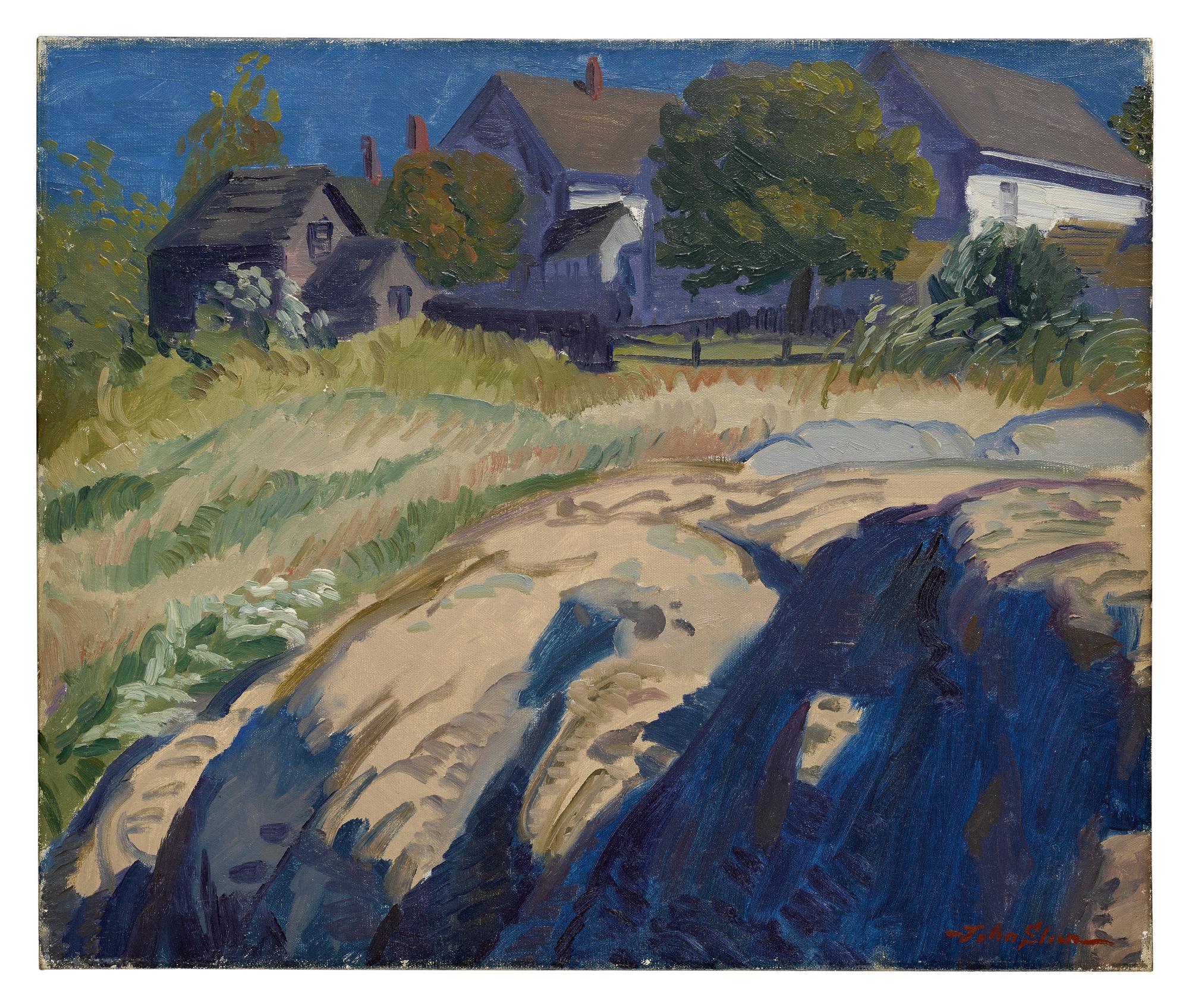
Sun And Shadow In Rocks, 1916
George Bellows, slightly younger and immensely celebrated, operates in a related register of urban American energy. Beyond the Ashcan circle, there are resonances with the earlier French Realism of Gustave Courbet and Honoré Daumier, both of whom believed that art had a responsibility to the lives of ordinary people rather than to the comfort of elites. Sloan was deeply engaged with politics throughout his life, joining the Socialist Party in 1910 and contributing illustrations to radical publications, and that political conscience infuses even his most apparently simple genre scenes with a quiet moral seriousness. Later in his life, Sloan made extended visits to Santa Fe, New Mexico, beginning in 1919, and the light and landscape of the Southwest opened a new chapter in his painting.
Works like "Sun And Shadow In Rocks" from 1916, made just before these visits became an annual pilgrimage, show him already reaching toward a more structural, almost geological engagement with landscape, one that would deepen considerably under the influence of the New Mexico terrain. This late period is sometimes underappreciated but contains some of his most searching and formally adventurous work. He also taught for many years at the Art Students League in New York, where his influence on successive generations of American artists was considerable and lasting. John Sloan died in 1951, leaving behind a body of work that refuses sentimentality while brimming with genuine feeling, a rare and precious combination that only grows more valuable with time.
Explore books about John Sloan
John Sloan: A Painter's Life
David W. Scott
John Sloan's Prints: A Catalogue Raisonné
Peter Morse
John Sloan 1871-1951
Helen Farr Sloan
The Paintings of John Sloan
Peter Morse
John Sloan and the Philadelphia Press
Rowland Elzea
John Sloan's New York Scene
Bruce St. John
Gist of Art: Principles and Practice Expounded
John Sloan