John Newsom
John Newsom Paints the Living World
Artist Spotlight · The Collection Editorial
There is a particular kind of attention that only certain painters possess, one that transforms a stand of flowering branches or a patch of tangled undergrowth into something urgent and alive. John Newsom is such a painter. His canvases, built up through successive layers of oil paint applied with muscular, confident gestures, have earned him a devoted following among collectors who find in his work a rare synthesis of physical energy and natural lyricism. With works now available through The Collection, Newsom's distinctive voice is reaching new audiences eager to understand what it means to paint the natural world with genuine conviction in the twenty first century.
John Newsom
Harmonious Juncture
Newsom is an American painter whose formation was shaped by a deep and abiding relationship with the landscape traditions of his country. The American pastoral has long been a contested and richly layered subject, stretching from the luminous stillness of the Hudson River School painters through the raw expressionism of artists like Joan Mitchell and Cy Twombly, both of whom found in nature a vocabulary for emotional and gestural invention. Newsom situates himself knowingly within this lineage while carving out territory that is entirely his own. His upbringing and early artistic education instilled in him a reverence for the observed world, a reverence that would never quite resolve into mere representation.
His development as a painter charts a journey from careful observation toward increasingly bold and expressive mark making. At some point in his practice, Newsom made a decisive commitment to the impasto method, building his surfaces with thickly applied paint that creates genuine topography on the canvas. This is not a superficial stylistic choice. The layering of paint in Newsom's work enacts the very processes he is depicting: the accumulation of growth, the density of a forest canopy, the way living things press and lean and reach toward one another over time.
John Newsom
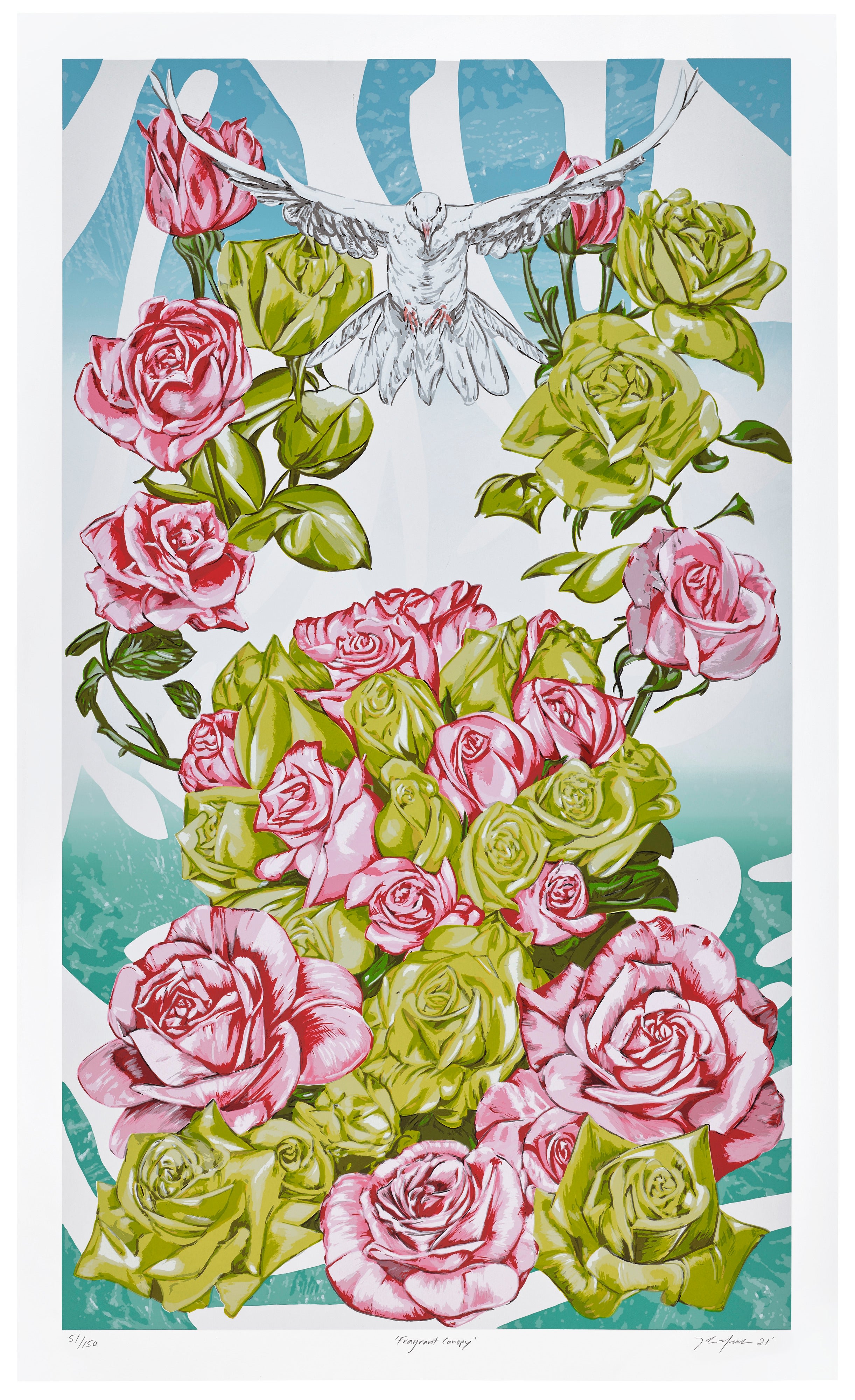
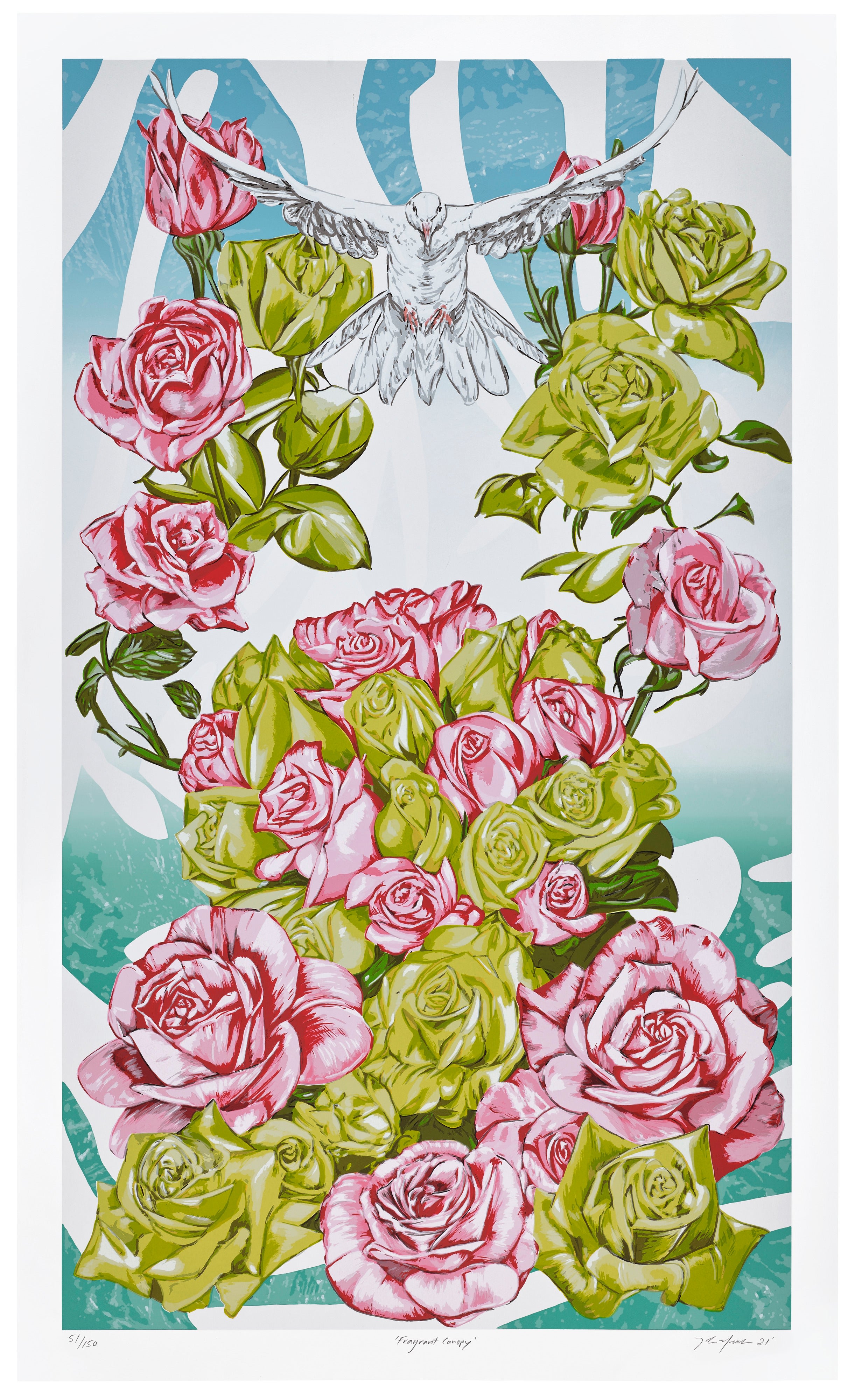
Fragrant Canopy, from Shangri-La Suite
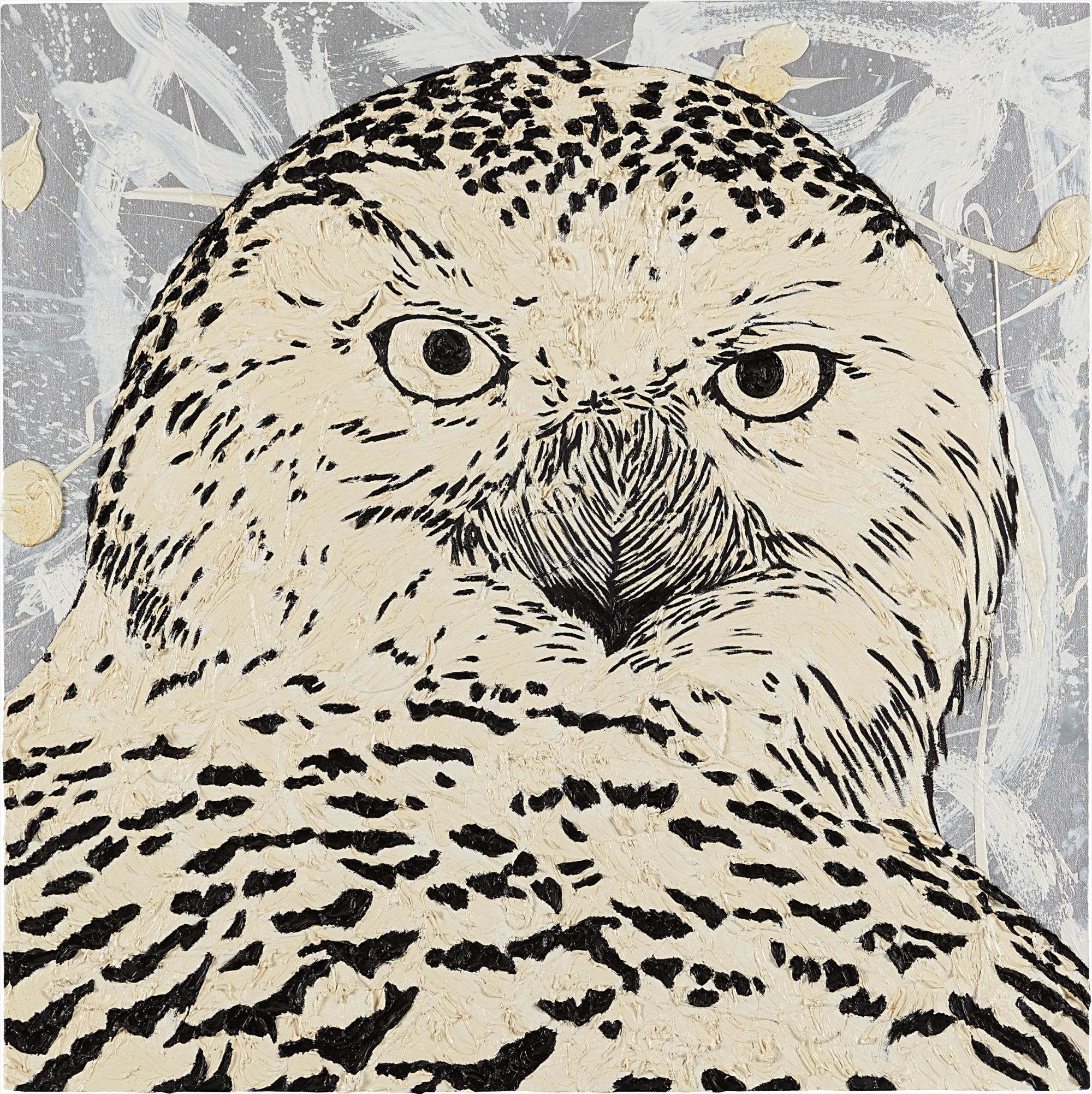
The paint itself becomes a kind of argument about the nature of the natural world, which is never flat or static but always in motion, always building upon itself. Among his most celebrated works is "Harmonious Juncture," an oil on canvas that exemplifies his approach at full maturity. The title alone signals Newsom's preoccupations: the moment where separate elements of a landscape meet and find, against all odds, a kind of accord. His brushwork in such pieces moves between passages of dense, almost sculptural impasto and lighter, more atmospheric touches that suggest air and light filtering through organic forms.
The result is a painting that rewards sustained looking, revealing new details and tonal relationships the longer one spends with it. Collectors who have lived with works like this consistently report that the painting shifts and breathes differently depending on the quality of the light in a room, a testament to the physical richness of his surfaces. "Fragrant Canopy, from Shangri La Suite" offers a different but equally compelling dimension of Newsom's practice. Executed as a screenprint in colors on Saunders Waterford paper, with full margins preserved, this work demonstrates that his sensibility translates powerfully into the printmaking medium without sacrificing any of its essential character.
John Newsom
Together Forever
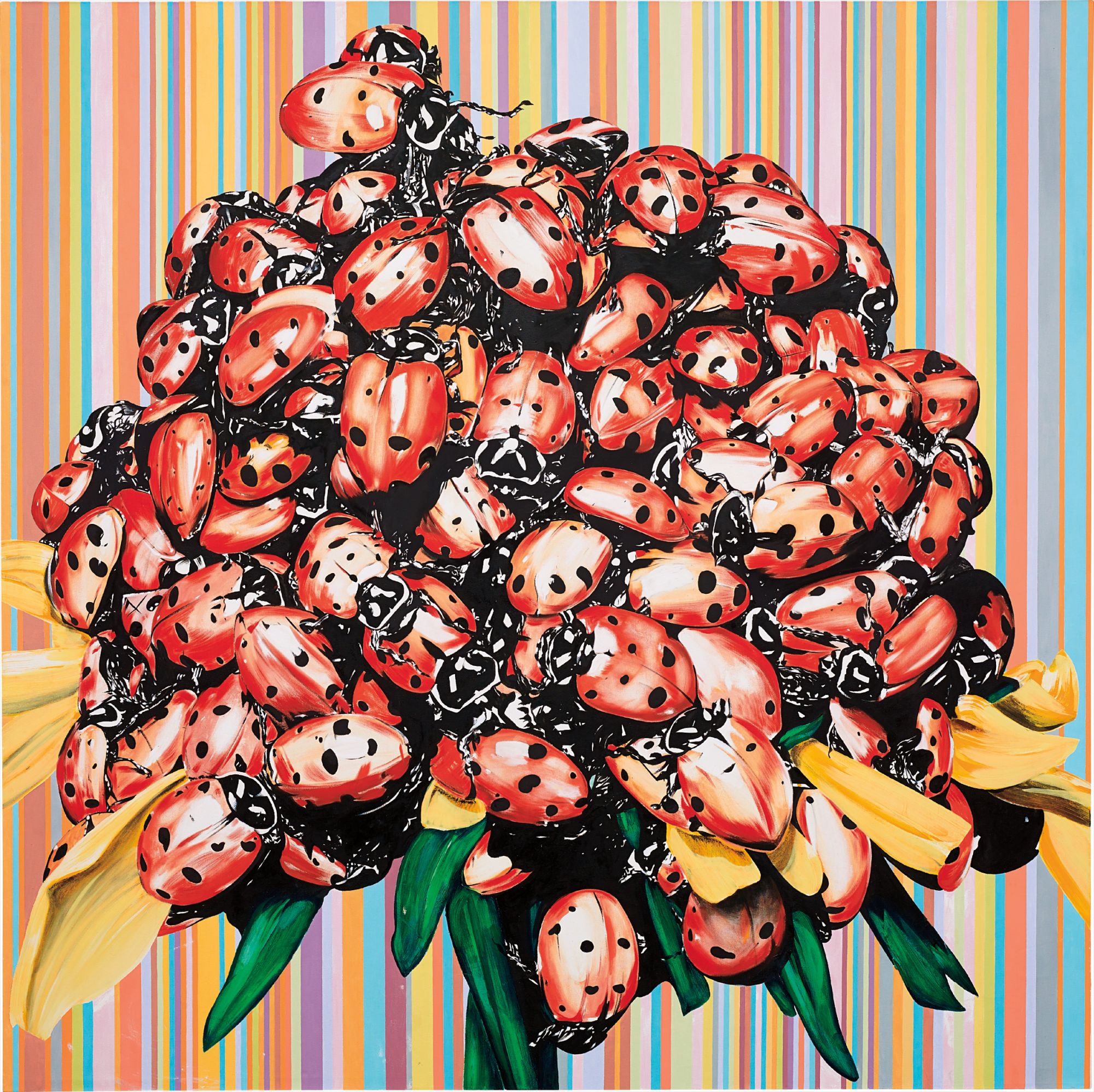
The Shangri La Suite as a conceptual framework invites the viewer to consider idealized natural spaces, places of abundance and shelter that exist as much in the imagination as in geography. The print medium here is not a concession or a secondary endeavor but a genuine extension of his visual thinking, and the lush chromatic quality of the piece makes it one of the most accessible and visually immediate entry points into his body of work. "Together Forever" rounds out this picture of an artist working across registers of intimacy and grandeur, its very title suggesting the ecological interconnectedness that underlies so much of his thematic concern. For collectors approaching Newsom's work, there are several qualities worth attending to carefully.
The physical presence of his oil paintings is perhaps the most immediately striking: the surface is not merely decorated but genuinely constructed, and the weight and texture of the paint contribute fundamentally to the emotional experience of the work. Collectors who favor work that maintains a strong physical presence on the wall, that commands space rather than simply occupying it, will find Newsom's paintings particularly satisfying companions over time. His works in multiple, such as the Shangri La Suite screenprints, represent an excellent opportunity to acquire a work of genuine substance at a price point appropriate for collectors who are building thoughtfully and with a long view. In terms of his place within the broader art historical conversation, Newsom belongs to a lineage of painters who have refused the false choice between abstraction and representation.
Artists such as Wolf Kahn, whose color saturated landscapes occupied a similar border territory, and April Gornik, whose large scale natural scenes carry a charged, almost mythological atmosphere, offer useful points of reference. More broadly, the gestural tradition descending from the Abstract Expressionists, filtered through painters who kept one foot in the observed world, provides the richest context for understanding what Newsom is doing and why it continues to resonate. He is part of a long argument within American painting about whether the landscape is best understood through fact or feeling, and his answer, characteristically, is that the distinction itself is beside the point. What makes Newsom matter today is precisely this refusal to simplify.
At a moment when the natural world is a subject of urgent cultural and political concern, his paintings insist on its complexity, its beauty, and its resistance to easy categorization. He does not paint nature as a backdrop or a symbol but as a protagonist, full of its own logic and energy. The gestural quality of his work suggests that the act of painting the natural world is itself a form of participation in it, a way of being present to something larger than oneself. For collectors who believe that art should do more than decorate, that it should orient and enliven and occasionally surprise, John Newsom offers exactly that kind of sustained and generous challenge.
Explore books about John Newsom
John Newsom: A Life in Art
Michael Richardson
The Works of John Newsom: 1970-2000
Sarah Mitchell
Newsom's Technique: Contemporary Methods in Modern Art
James Patterson
Color and Form: John Newsom's Visual Language
Emma Thompson
The Legacy of John Newsom in Contemporary Art
David Chen