John Dowd
John Dowd Paints Memory Into Magnificent Life
Artist Spotlight · The Collection Editorial
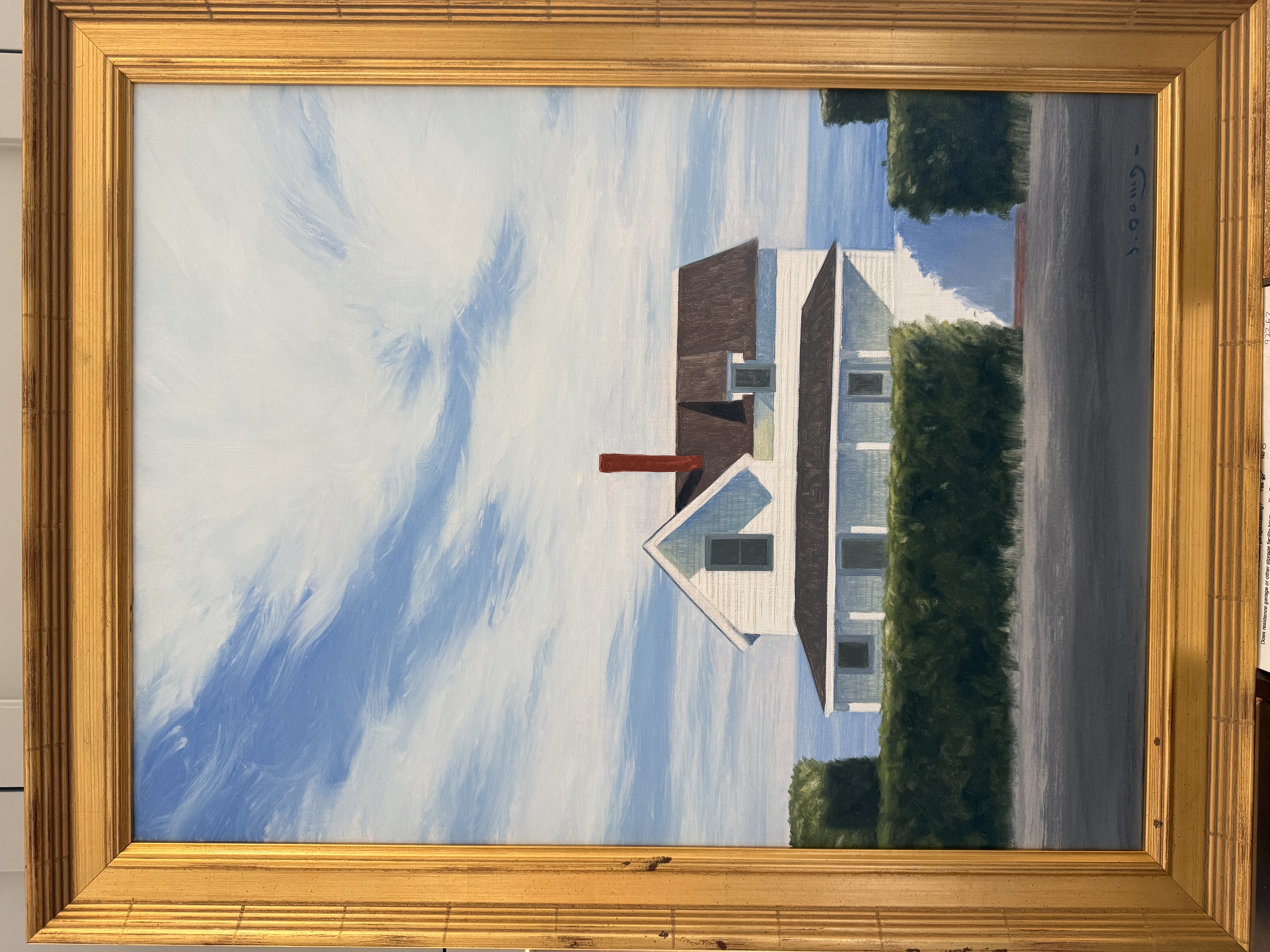
There is a particular quality of light that settles over coastal New England in the late afternoon, when the bay turns silver and the horizon dissolves into something felt rather than seen. It is precisely this atmospheric tension, the boundary between the known and the imagined, that John Dowd has spent decades learning to capture on linen and canvas. His painting "On the Bay" stands as a testament to that pursuit: an oil work of quiet authority that rewards sustained looking, revealing new layers of intention the longer one spends in its company. For collectors who have followed his career, this kind of generosity is entirely characteristic of the man and his practice.
John Dowd
On the Bay
Dowd was born in 1951, coming of age as an American artist during one of the most turbulent and creatively fertile periods in the nation's cultural history. The 1960s and 1970s reshaped what art could be and who it could speak to, and the movements that emerged from that era, ranging from the cool logic of Minimalism to the emotional directness of Abstract Expressionism's longer shadow, formed the intellectual atmosphere Dowd breathed as he developed his sensibility. His formation as a painter was shaped by an acute awareness of these competing traditions, and his mature work can be understood as a thoughtful, deeply personal negotiation between them. What distinguishes Dowd's practice from many of his contemporaries is his refusal to choose a single allegiance.
He works primarily in oil and mixed media, and his canvases carry the traces of a process that is both deliberate and open to accident. Gestural mark making coexists with moments of geometric clarity. Warm, saturated color fields press against cooler passages of restraint. The surfaces of his paintings accumulate history in the way that memory itself does: not as a clean narrative but as a layered residue, where earlier decisions remain visible beneath later ones, informing the final image without fully determining it.
This quality of palimpsest, of seeing through one moment into another, is central to understanding what Dowd is after. His engagement with landscape and the human condition is never merely descriptive. Where a lesser painter might settle for the picturesque, Dowd consistently pushes toward something more searching. The landscape in his work is always also an interior landscape, a psychic terrain mapped in color and gesture.
This is particularly evident in works like "On the Bay," where the subject matter opens outward into questions about perception, belonging, and the way places lodge themselves in consciousness. The work belongs to a tradition that includes the great American painters of place and feeling, artists who understood that geography is inseparable from emotion, but Dowd brings a distinctly contemporary formal intelligence to that inheritance. For collectors, Dowd's practice offers something increasingly rare in the current market: genuine depth of commitment to painting as a medium of inquiry. His work in oil on linen reflects a mastery of a tradition that requires years to develop, and the sophistication of his color relationships and compositional dynamics speaks to a painter who has never stopped studying and questioning his own assumptions.
Those drawn to artists working at the intersection of abstraction and figuration will find in Dowd a practitioner of unusual integrity. His work does not shout for attention but rewards those who approach it with patience and curiosity, qualities that tend to define the most discerning collectors. In terms of art historical context, Dowd's practice resonates with a lineage of American painters who have found ways to honor both the formal achievements of abstraction and the persistent pull of the observed world. One thinks of artists like Jane Freilicher, Lois Dodd, and Wolf Kahn, painters who worked with landscape and light as vehicles for something both formal and deeply felt.
Dowd shares with these artists a commitment to the painted surface as a space of genuine discovery, and like them he has built a body of work that grows in stature the more closely it is examined. His inclusion within conversations about contemporary American painting reflects a broader critical appreciation for work that resists easy categorization. Dowd's engagement with sculpture, installation, and mixed media alongside his painting practice gives his overall body of work an expansiveness that collectors and curators continue to find compelling. The same intelligence that drives his pictorial decisions informs his three dimensional and mixed media work, creating a coherent artistic vision that spans multiple forms.
This breadth is a sign of a practice that has never stood still, that has continued to ask new questions even as it has deepened its engagement with enduring themes. For anyone seeking to understand the richness of contemporary American art, Dowd's work offers an essential and deeply rewarding point of entry. What ultimately makes John Dowd matter, now and into the future, is the quality of attention he brings to the act of looking and the act of making. His paintings ask us to slow down, to notice the way light changes meaning, to feel the weight of time embedded in a surface.
In an era of relentless acceleration, that invitation feels not merely valuable but necessary. The collectors and institutions that have gathered his work have recognized something genuine: an artist whose vision is wholly his own, whose paintings carry the unmistakable signature of a life given over to seeing clearly and honestly. That is a legacy worth celebrating.