John Cage
John Cage: The Composer Who Freed Art
Artist Spotlight · The Collection Editorial
“I have nothing to say, and I am saying it, and that is poetry as I need it.”
Lecture on Nothing, 1949
There is a moment in the history of twentieth century art when silence became a statement. It arrived at the Woodstock performing arts venue in Maverick Concert Hall in the summer of 1952, when pianist David Tudor sat down at a keyboard and played nothing at all for four minutes and thirty three seconds. The audience heard wind through the trees, the shuffle of restless feet, the ambient breath of a room full of people confronting their own assumptions about what music could be. That piece, 4'33", was the work of John Cage, and it remains one of the most radical and generative gestures in the entire history of avant garde art.
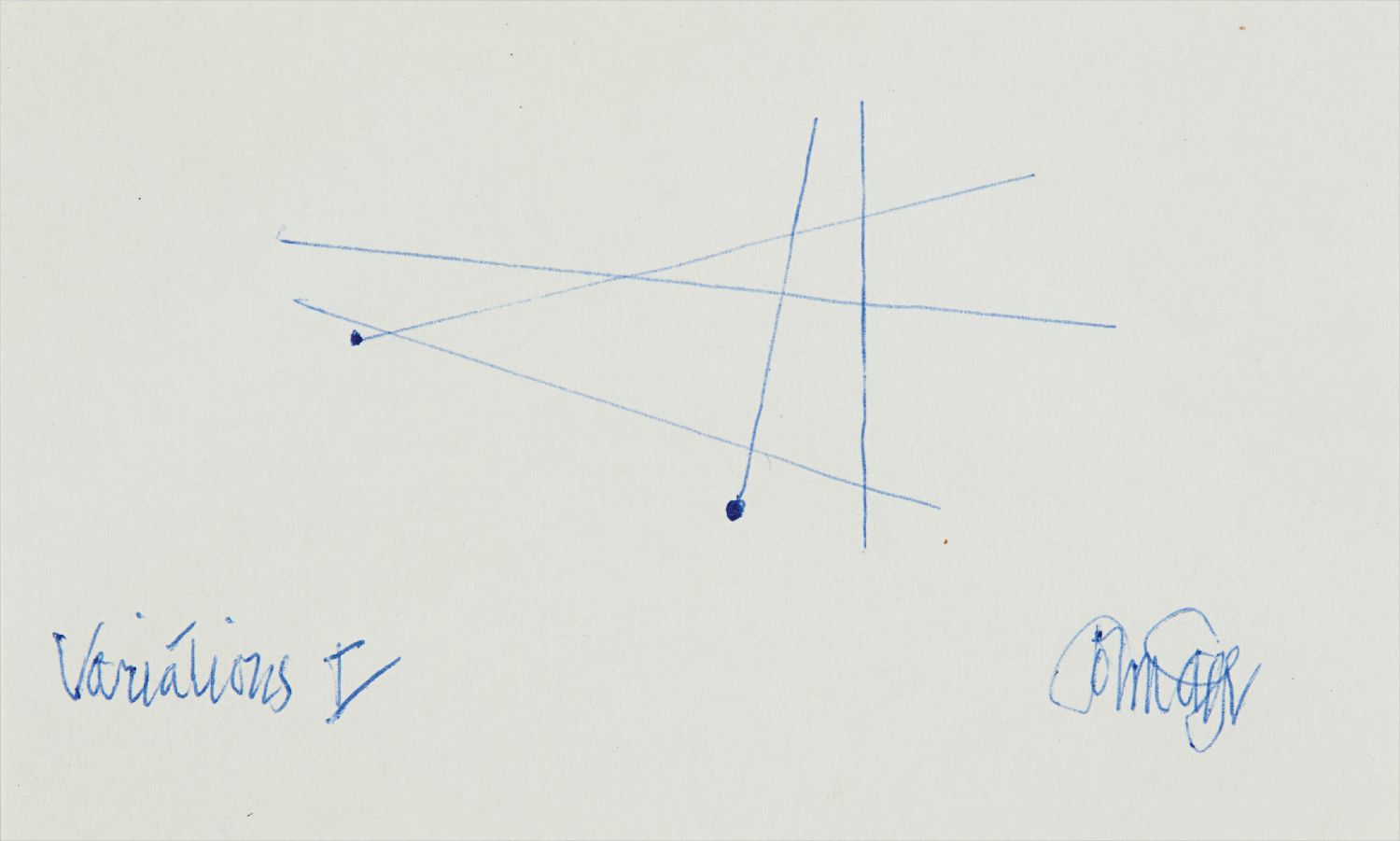
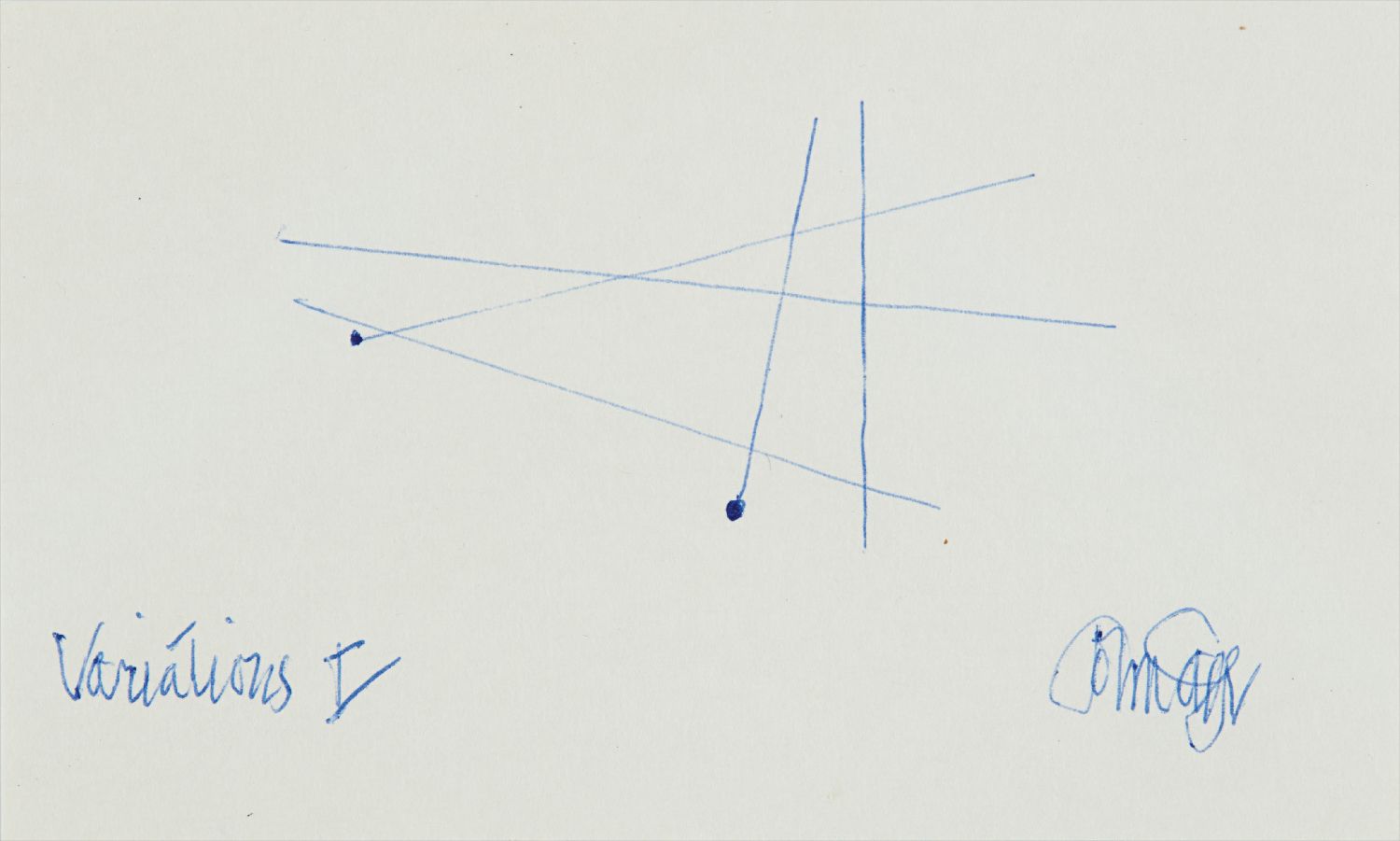
John Cage
Variations I
More than seven decades later, its reverberations are everywhere. John Milton Cage Jr. was born in Los Angeles on September 5, 1912, the son of an inventor whose restless curiosity clearly shaped the boy who would grow up to dismantle the conventions of Western music and visual art alike. Cage studied briefly with the composer Arnold Schoenberg after moving through Europe in his early twenties, absorbing everything he could about structure, harmony, and form before deciding, with characteristic thoroughness, to overturn all of it.
Schoenberg famously told Cage he had no feeling for harmony, to which Cage responded that he would devote his life to hitting his head against that wall. It was a wall he eventually dissolved entirely. His early work explored percussion and prepared piano, the latter being an instrument physically altered by placing objects between its strings to produce sounds closer to gamelan or found noise than to the concert repertoire. Cage was deeply influenced by his engagement with Zen Buddhism, particularly through his studies with Daisetz Teitaro Suzuki at Columbia University in the late 1940s.
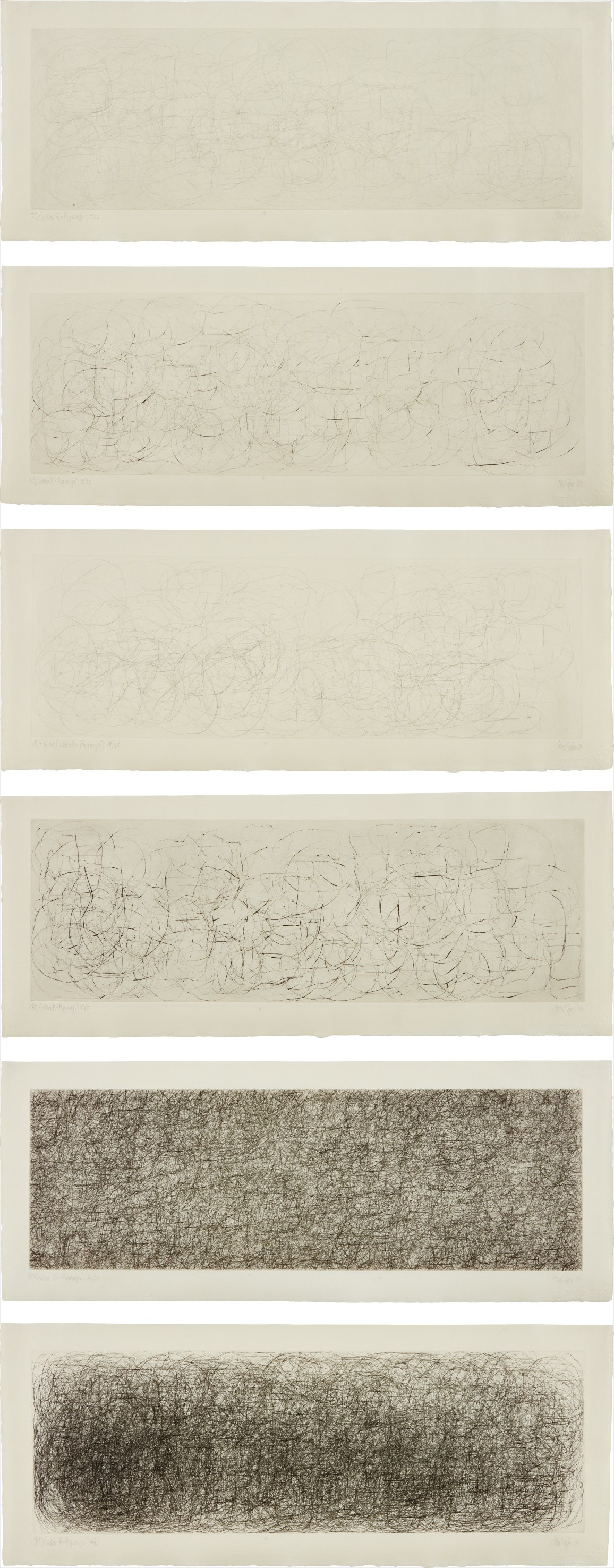
John Cage
2R + 13.14 (where R=Ryoanji); R2/2 (where R=Ryoanji); R3 (where R=Ryoanji); R2/3 (where R=Ryoanji); R2/1 (where R= Ryoanji); and (R3) (where R=Ryoanji)
This philosophical grounding gave Cage a framework for thinking about art as a practice of relinquishing control, of inviting chance and the environment itself into the creative act. From this conviction emerged his systematic use of chance operations, often drawn from the ancient Chinese divination text the I Ching, to determine compositional decisions. It was a revolution conducted with the calm of someone who had simply stopped being afraid. Cage's visual art practice, less frequently discussed than his music but equally important, grew directly from these same ideas.
“The function of art is to imitate nature in her manner of operation.”
Silence: Lectures and Writings, 1961
His graphic scores are themselves extraordinary aesthetic objects, notations that float between instruction and image, between map and poem. His collaborations with Crown Point Press in San Francisco, beginning in the 1970s and continuing until his death in 1992, produced a sustained and remarkable body of printmaking that has become central to how collectors and institutions engage with his visual legacy. Works such as the Ryoanji series, which takes its name from the celebrated Zen rock garden in Kyoto, use chance derived placements of stones as generative forms, traced in soft pencil or etched into aquatint to produce compositions of breathtaking, seemingly accidental beauty. The stones themselves were used as templates, their placement on the page determined by Cage's I Ching methods, resulting in images that feel both inevitable and utterly open.
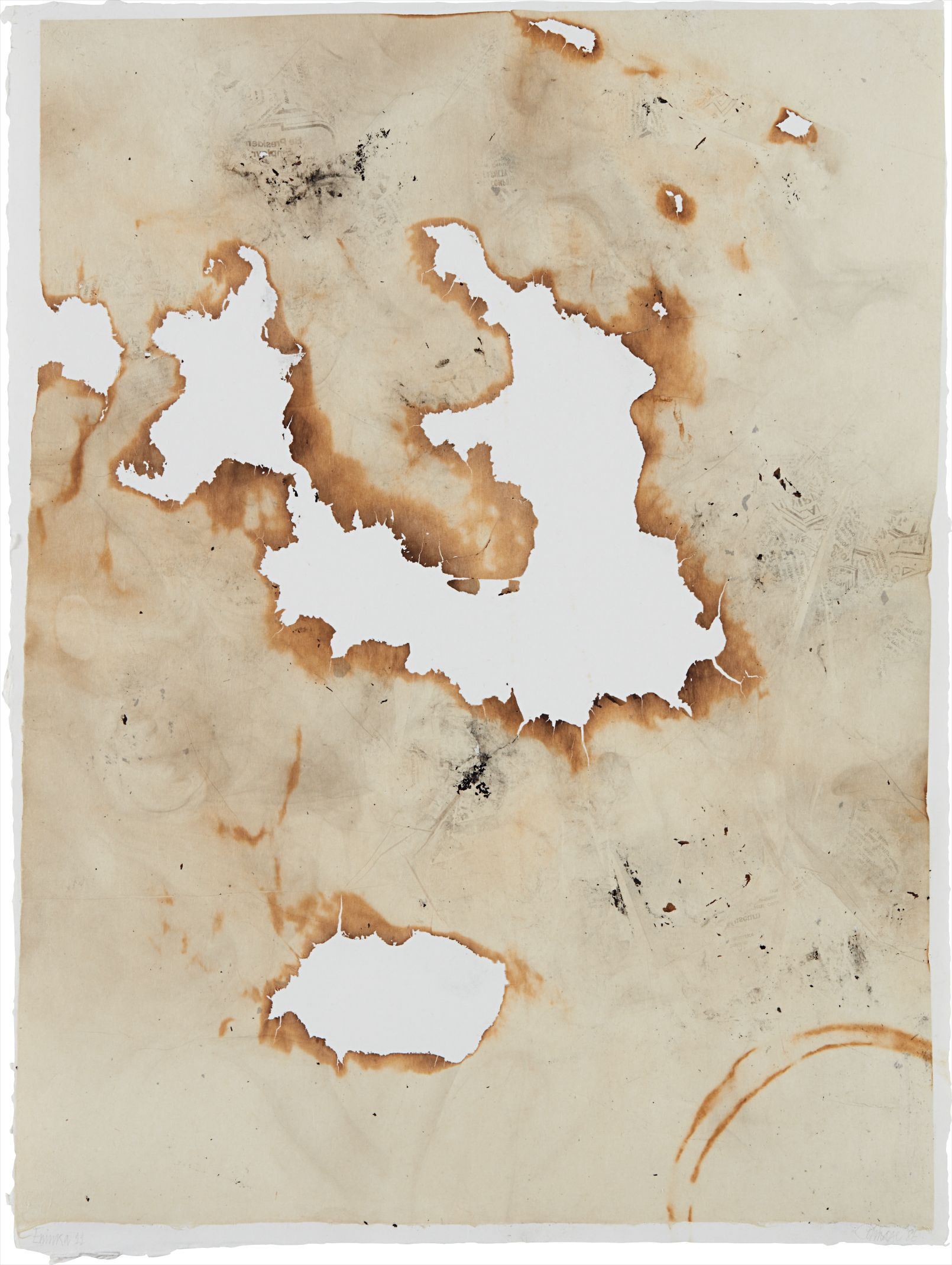
John Cage
EninKa No. 11
The Global Village series and works such as 11 Stones and Dramatic Fire demonstrate the full range of his printmaking sensibility, from the austere elegance of smoked paper aquatints to the dense, layered richness of color work on Fabriano and Whatman mould made papers. His collaborations with the artist Jasper Johns in the late 1960s produced some of the most coveted objects in Cage's visual catalogue. Not Wanting to Say Anything About Marcel, created in 1969 as a tribute to Marcel Duchamp following his death, exists as both a lithograph and a Plexigram, a screenprint on Plexiglas mounted in walnut that has the quality of a philosophical object as much as an artwork. The piece is a meditation on friendship, on the impossibility of adequate tribute, and on the nature of language itself, with fragments of text scattered across the surface like thoughts interrupted.
“I can't understand why people are frightened of new ideas. I'm frightened of the old ones.”
John Cage
Fontana Mix, another key work in the visual canon, extends the logic of his graphic scores into screenprinted form, with Mylar overlays that collectors can arrange, introducing a further layer of participation and chance into the viewing experience itself. For collectors, Cage's works on paper and prints represent one of the most intellectually rewarding areas of the secondary market. His editions from Crown Point Press are consistently well documented, with clear provenance and the press's distinctive blindstamp providing reliable authentication. Works from the Ryoanji series, particularly those with multiple components or strong numbering from small editions, have attracted sustained interest at auction, appearing at Christie's, Sotheby's, and Phillips in recent decades.
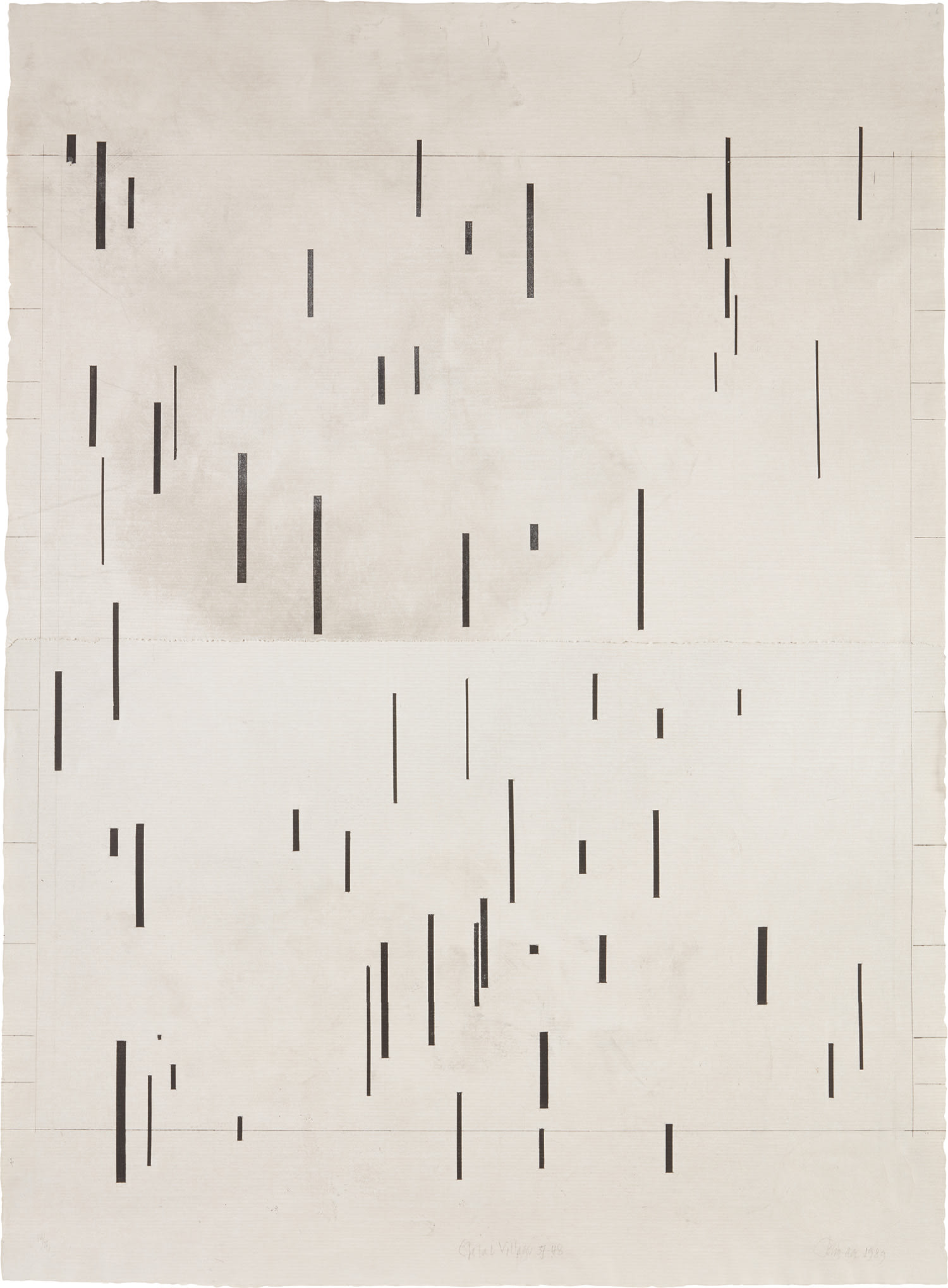
John Cage
Global Village 37-48
The smoked paper works carry a particular material drama, their surfaces evoking time and transformation in ways that resonate deeply with collectors drawn to process based and conceptual art. Cage occupies a singular position in the market: recognized as a canonical figure whose visual practice remains undervalued relative to his art historical importance, which makes this a compelling moment to engage seriously with his work. Cage belongs to a broader constellation of artists who transformed the postwar period into an era of radical questioning. His closest affinities are with Robert Rauschenberg, with whom he enjoyed a long friendship and creative exchange at Black Mountain College in North Carolina, and with Merce Cunningham, the choreographer who was his life partner and collaborator.
Duchamp is the presiding spirit over much of his thinking. In the visual arts, his influence extends to Fluxus, to conceptual art, to the entire tradition of artist books and multiples. Artists as varied as Nam June Paik, Yoko Ono, and Sol LeWitt carry traces of his thinking about instruction, chance, and the dissolution of authorship. Cage died in New York on August 12, 1992, just weeks before he would have turned eighty, leaving behind a body of work that continues to expand in significance with each passing decade.
Museums including the Museum of Modern Art in New York and the Smithsonian have held major retrospectives and exhibitions of his visual work, and scholarly attention to his printmaking practice has grown substantially since his death. To collect Cage is to collect a way of thinking, an invitation to hear the world differently and to look at marks on paper as events rather than objects. His work does not decorate a room so much as it changes the atmosphere of the room entirely, which is perhaps the highest thing that can be said of any art.
Explore books about John Cage
John Cage: A Life
David Revill
The Roaring Silence: John Cage, A Life
Paul Griffiths
John Cage and the Architecture of Silence
Peter Dickinson
Silence: Lectures and Writings by John Cage
John Cage

A Year from Monday: New Lectures and Writings
John Cage
John Cage: Music, Philosophy, and Intention
Alvin Lucier and Douglas Simon
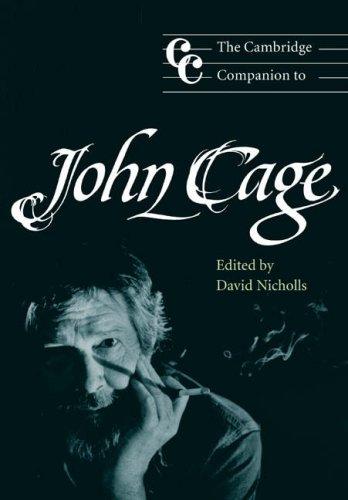
The Cambridge Companion to John Cage
David Nicholls
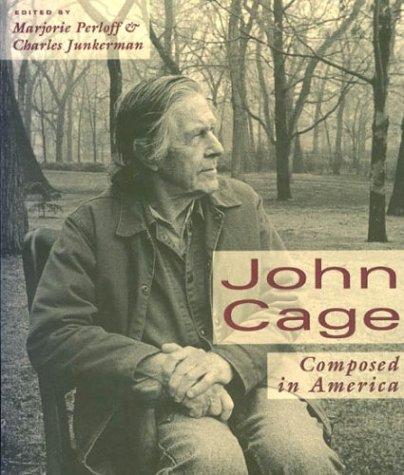
John Cage: Composed in America
Marjorie Merryman